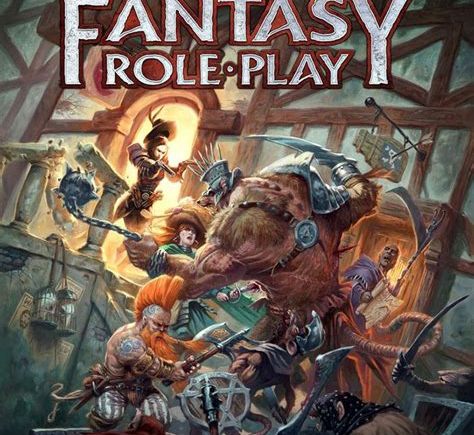
Review: Warhammer Fantasy Roleplay, Fourth Edition

Warhammer Fantasy Roleplay, First Edition, was the first fantasy roleplaying game I ever owned. It was the early nineties, and like all good Christian parents, mine denied me access to Dungeons & Dragons, fallout and carry over from the demonic-worship craze of the late eighties. As we all know, but I didn’t question as a child, there was nothing inherently demonic or evil in D&D (the opposite mostly, though one of Tom Hanks’ early films told a different story). But, not knowing better, they allowed me this gem of a game, darker, grittier, and far less wholesome than the high-fantasy cheese of AD&D.

Ownership of this vaunted tome (which I lost or gave away or sold somewhere along the way, much to my present chagrin) had a very formative effect on me. It solidified my love of roleplaying games, proved the gateway into my miniature gaming hobby, and gave me my first real taste of dark fantasy (a penchant I cannot shake even now). As someone, even in elementary school, deeply interested in medieval and early modern history and wanting some semblance of verisimilitude in my roleplay, it’s little wonder that WFRP, warts and all–no, warts especially–has a special place in my heart. Before high school, I’d also purchased several of the Rolemaster FRP books so, though I didn’t know it, 80’s “realism” in RPGs became my foundation.

I never ran or played a game of First Edition WFRP, though I did manage to collect most of the books at one point or another. When Second Edition was released (I was now in college), I scrupulously and slavishly purchased each of the books as it was released and ran a few games with those rules (though I admittedly used the Riddle of Steel rules, released close in proximity, for those Warhammer Fantasy-based games I most enjoyed). My miniature gaming had focused mostly on 40K, but something about the Tolkien pastiche smashed up with a more historically-influenced setting always called me back to WFRP in my gaming (of course, the first edition of Dark Heresy had not yet been hinted at even–though that’s a story for when I review Wrath & Glory, I suppose).

Likewise, when FFG published the third edition of WFRP, I couldn’t help but go all in on that system as well. For all of the quirks and fiddly-bits of the 3rd edition (much of which I found very innovative and fascinating from a design standpoint), I ran some of the most narratively deep scenes based on those strange custom dice. The board-game like pieces really did provide some opportunities for building unique subsystems to support the story, from chases to countdown clocks. The “stances” adapted just enough from Riddle of Steel (which remains one of my favorites for three reasons: (1) at the time of its release, I was a study group leader for the Association for Renaissance Martial Arts and deeply invested in the study of real swordplay; (2) the writer of TRoS was also a member of ARMA, one with whom I’d had the fortune to spar with; (3) there are design ideas, like spiritual attributes, that I still find amazing, even if I now find the combat system too intricate for my gaming needs and desires) to sate my desired treatment of combat at the time.

I don’t want to participate in “you-should-have-been-there”-ism too much, but I will relate one fascinating development in one of the WFRP games I ran. When the PCs stumbled across some warpstone, one of the characters decided to squirrel some away to sell later. As it tends to do, the warpstone started to have an effect on this character, and a fellow PC (a staunch and suspicious Kislevite), discovered this. While the first character slept soundly, the Kislevite snuck up on him and, pressing the barrel of a pistol to the first character, ended the foolish threat to the party. What surprised and pleased me was the response of the murdered character’s player: “Yeah, that’s what you should of done. That was not going to go well.” That’s mature roleplaying from dedicated players. Drama!

I should also note that, perhaps the result of my fumbling with Rolemaster, I’ve never been a huge fan of d100/Percentile RPG systems. I fully admit that this is a personal thing and not some objective complaint about that style of system itself (my preference, almost certainly a side-effect of my playing White Wolf games, Shadowrun and TRoS, is for dice pool systems).

When I heard that Cubicle 7 had the contract for Warhammer Fantasy Roleplay, Fourth Edition, two things excited me: first, I’ve found the One Ring to be both the most faithful RPG version of Tolkien’s world yet and mechanically innovative to boot; and, second, I’d hoped that the new ruleset would veer away from the d100 system used in the past (as Wrath & Glory has done). One of those things proved true.

Perhaps the best compliment I can give WFRP4 is that it’s a percentile system I’d actually consider running. Even with my preference for the Fate or Cortex Plus/Prime systems, this ruleset reinforces the grittiness and darkness of the setting in what I feel merits the additional crunch. Reading the rulebook has also reminded me that, second only perhaps to D&D/OSR rules, how much material there is out there that could be easily adapted for subsystems or alternative/house rules for WFRP4. I’ve found myself very interested in some of the things that the Mythras system has done with d100, and then there’s all of the Chaosium, Runequest, Zweihander (particularly appropriate) and Rolemaster stuff out there as well.

My personal confession to the versatility and playability of percentile RPGs is not the point of this post, however. Let me instead focus on the (many) things that I really enjoyed about this system, especially as an iteration of the first and second editions (which I’ll assume you’re familiar with).

First, the art is beautiful. Andy Hepworth and Jon Hodgson, who worked on The One Ring illustrations also worked on this tome, and the artwork is similar to that of TOR: watercolory, somber and evocative of the setting’s tone. As I said in my Witcher RPG review, the artwork itself is almost worth the price of admission–but I’m a very visual person.

Additionally, in the style you’ll remember from the FFG version of the game, much of the setting information is given in-character through letters and reports. The beginning of the book combines pictures with a skillful economy of words to highlight the Empire, giving just enough detail for even a newbie to the setting to run a session that a seasoned veteran would say, “Yep, that feels like Warhammer.” I just love this.

I’ve gotten ahead of myself, though. I really should have led with the thing that I love most about WFPR4–its transparency that the players and GM should make the setting their own personal version of the Warhammer Fantasy world, supplemented with reminders about this throughout the text on the subjects of both mechanics and setting, and supported by optional rules and reminders that rules that don’t fit your game should be ignored or changed.

Let’s talk about some of the changes to the previous incarnations (of course skipping the outlier that was 3rd Edition). Fourth Edition has “softened” character generation and brought it into the world of “modern” gaming. Where the early editions of the game relied entirely on random generation of player characters (yeah, everyone wants to be a Ratcatcher, but no one wants to play the poxy doxy), the latest edition has kept the random generation tables but has given rewards to sticking to them rather than making them mandatory. For instance, for your starting career, you first roll one result. If you take that result, you get a substantial XP bonus you can either hoard or spend on starting upgrades to your character. Didn’t like that result? You roll two more, and if you pick one of the three, you still get an XP bonus (though not as substantial as when you only had the one option). Don’t like any of the three results? Just choose what you want to play. No XP bonus, sure, but at least you’re playing something you find interesting. This goes for most aspects of character generation.

Above, I mentioned the Spiritual Attributes of The Riddle of Steel RPG. While WFRP4 doesn’t use those per se, it does join the forefront of modern player-driven (narrative) gaming by giving both the individual players and the group as a whole ambitions. Ambitions are short- and long-term goals that, when completed, grant XP for character improvement (in addition to the normal XP of session survival and accomplishment). Like 13th Age’s “One Unique Thing” or Milestones in Fate, they give the GM some guidance on what players are interested in dealing with in the narrative of their game.

As well, ambitions are a call-to-action for players to learn about the game world (so that they can craft good ambitions) and help define those elusive both most-important aspects of character–character itself (as in the inner life, personality, beliefs and psychology of a fictional entity beyond the mechanical numbers on the page).

My other favorite new thing in Fourth Edition? The “Between Adventures” chapter. These optional rules recall the “township events” of Warhammer Quest (God that we would get an updated version closer to the original instead of the bastard “End Times” game that was produced–oops, my rabid fanboy is showing). I spent a good deal of my youth (when I was but had not realized that I was an introvert) playing that game. In WFRP4, the Between Adventures chapter gives the players interesting complications that might arise while not in the wilderness fighting orcs or Chaos as well as endeavors that might be undertaken to gain small–but perhaps lifesaving–advantages during the next adventure. It’s a clever way to provide for some roleplaying opportunity and character development without having to devote large amounts of playtime to characterization–though if that’s what your group wants, there’s no reason you can’t do that, either!

Much of the rest of the rules will prove familiar to the player of the first or second editions–nasty critical hits, rules for corruption and disease, limited magic, careers that range from the extraordinary to the ultra-mundane (if historically accurate), Skills and Talents, etc.

Petty magic is back for those who missed it (I did). Each Career now has four tiers of advancement, so the Apprentice Apothecary and the Master Apothecary are within the same write-up instead of spread across four different careers that represent incremental steps in the same line of work and training. Character social status (as within the Bronze, Silver and Gold tiers of society) is more explicitly treated and made relevant to gameplay. Task difficulty has been more effectively balanced (Very easy tasks are now +60 to Attribute+Skill Ranks) given the relatively low attribute and skill values of starting characters. Advancement, XP and skill ranks have been streamlined in a way I find to be an improvement.

First and second edition adventure material should require little or no adaptation to be usable, and previous mechanics or careers will be relatively easy to adapt.

In short (though perhaps it’s too late for that), if you liked the first and second editions of WFRP, you’re very likely to enjoy Cubicle 7’s take. If you didn’t, I’d take a look anyway.

The main competitor for WFRP4, I think, is the indy-game Zweihander (itself an iteration of WFRP2), though Shadow of the Demon Lord may be a better fit for those who want a game closer to classic D&D but heavily influenced by modern gaming mechanics and the approach and feel of Warhammer (the creator, Robert J. Schwalb, worked on WFPR2 among other things).

The release of the book has very much tempted me to return to the Empire circa 2511. If I do, I’ll probably even use this ruleset rather than trying to adapt to a more narrative-focused system, as WFRP4 seems a decent compromise between massive crunch (which I ideologically though not practically miss) and the narrative-focused games to which I’ve become more focused.

Have you had a chance to read through the book? What did you think?

Blog Update

I completely missed posting last week and haven’t posted anything this week. This post is not going to be as substantive as usual, unfortunately (I’ll try to get a substantive post up over the weekend!), but I wanted to let my readers know what’s going on and what to expect in the near future.

NaNoWriMo is not a go.
Last November, I made very good progress on the first draft of my first novel set in Avar Narn by participating in NaNoWriMo (National Novel Writing Month). I had hoped to participate again this year to get the first draft finished. Unfortunately–at this point–I’ve made the decision not to participate this year.

K and I are still waiting on a placement of kiddos, which could happen at any moment now but (obviously) hasn’t happened yet. I’m concerned that, as November nears, I’ll need to be focusing more of my time on the kids when they arrive. As much as I’m yearning to get the first draft (and then revisions) done on this novel, it simply must take a back seat to the children and their needs.

Additionally, K and I are purchasing a house and will be closing and moving around November. K’s got a lot going on with her worklife right now and into the near future, so I intend to take on the better part of the moving efforts.

That doesn’t leave much room in my schedule to try to fit in 1667 words a day in November, so I’ve decided to give myself a little break on that front.

This does not mean I won’t be writing–just probably not as intensely as I would be if participating in NaNoWriMo. I’ve been spending time working on (and reworking) some of the setting information for Avar Narn (mythology, legends and history, religion, geography, etc.) that will be the basis for (hopefully) many short stories and novels in the future. Expect some posts related to this “background” information.

I’ve got one Avarian short story currently underway (though I’m not sure I’ll end up happy enough with it that it will get posted) and plotting in the works for at least half-a-dozen more. I have more plotting to do for the rest of the novel (and some changes in the part that’s already written, which I’ve been slowly working through) and I hope to get some writing done towards the novel in the near future.

I had said not long ago that I’d be working on some sci-fi short stories (and a few are in their infancy), but Avar Narn is my truest passion and that’s where I’ve decided to really focus.

On Publishing
I’ve been thinking a good bit about how to approach publishing some of my work. That’s a daunting set of decisions, and I’m not fully decided, but I am currently leaning toward some form of self-publishing. While I’d love to have a large readership, I’d rather follow some advice from Joss Whedon. On talking about making TV shows, he reportedly said (and I’m paraphrasing), “I’d rather make something that a few people have to watch than something that a lot of people want to watch.”

For me, the major issue (other than perseverance through mountains of rejection letters, which I could live with) is control over my projects, staying true to the story for its sake rather than caving to market demands, and taking things in the direction I want them to go. This likely means a smaller audience and less money (to the extent that there will ever be any money in my writing, which is not a guarantee) but more personal freedom. It is a quirk of my personality to prioritize my independence and doing things my way over most other advantages–for better or for worse.

This may merit a full post, and I’d love to hear the thoughts of any readers who are themselves published (I know there are a few of you out there!).

On Theology
One of the reasons I failed to get a post out last week is that I’ve recently been teaching for a Sunday school class at the church. I love to teach and its an honor to have been asked to teach by people I so deeply respect and admire. We did two weekends on the history and polity issues confronting the United Methodist Church relating to our position on homosexuality (and the LGBTQI community in general) and are now doing two weekends on the Trinity.

There are certainly some posts in the works based on this research and some other reading/studying I’ve done recently. I’ll of course have a post on the Trinity in the near future (and why it’s such an amazing aspect of orthodox Christiany faith), but I’ve also got some ideas kicking around about theories of salvation, about William of Ockham and his theology, about (modern) Gnosticism and more.

On Reviews
I’ve finished a few Great Courses on medieval history recently and I’m currently in the midst of one on Imperial China (which, as K will attest, has really gotten me geeking out a fair deal, though perhaps no more than usual). I may do some reviews on these sometime soon.

I’m also working through a few theology books which I may have some comments on.

There are a number of video games either recently out or that will be out in the next few months that I’d, one, like to play, and, two, like to share some thoughts about. The Pathfinder: Kingmaker isometric game just released; it both takes me to an RPG setting and ruleset that’s always interested me (though that I’ve found far too complex and, ultimately, flawed to play on the tabletop) and to the isometric RPGs of the 90’s that were the mother’s milk of my early (digital) gaming life. The last installment of the recent Tomb Raider trilogy is also out and I’m definitely interested in following up on the first two very-well-done games of that series.

Of course, Red Dead Redemption 2 and Call of Cthulhu will be out soon, both of which I’m excited about. I was in law school about the time the first Red Dead Redemption came out, and I distinctly remember sitting with a judge in his late-sixties or early-seventies at lunch during a summer internship as he ranted about how great the game was. He wasn’t wrong.

On Roleplaying Games
As those of you who are interested in such things may have noticed, most of my recent posts on the truest-and-highest art of gaming–the tabletop RPG–have been about the Cortex Plus/Prime system. I’ll be continuing to post about my Shadowrun conversion for those rules.

I have always dreamed of an RPG to go along with Avar Narn. I’ve run several games set in the world over the years (using rulesets as diverse as The Riddle of Steel, Cortex, Fate, and D&D), but my ultimate desire is to build a roleplaying game specifically designed for the unique nature of the world (said every RPG designer with a pet setting ever, I know). While I love “generic” roleplaying games like Fate and Cortex for a wide variety of play, I am also a believer that systems specifically designed for particular settings are usually better, because the mechanics can reinforce the setting and vice-versa.

One of the most annoying things I see in D&D is the assumption by some players that the rules of D&D are the immutable physics of any setting using that ruleset rather than the rules serving the setting (and being subordinate to both normal and narrative logic).

Both Fate and Cortex intend to be rulesets that bridge the gap between the completely generic ruleset and the one-setting ruleset by using modularity and a toolbox approach that encourages customization. But even this, I think, will not be sufficient for my purposes.

I see games like The One Ring with mechanics that really bring forward the themes and motif of the game as a whole–not to mention indy games like Dogs in the Vineyard, Houses of the Blooded and Torchbearer that really push the envelope of rules for narrative games or RPGs (however you parse those two out)–and I am inspired. We’ll see what comes of it, so expect posts as I struggle through issues of design and ask for feedback (and, hopefully, some eventual assistance with playtesting).

I had mentioned a ways back that I was working on a massive campaign set in the Warhammer 40k universe. That is on a backburner, to be sure, but still in the pipeline.

I’d like to do some review of the newer Warhammer Fantasy and 40K rulesets in the future as well.

Reader Involvement
In case it isn’t apparent, thinking critically and imaginatively and then writing about those thoughts. Maybe it’s a disease–I’m just not happy if I’m not doing it, and I find a lot of fulfilment just from writing and from posting here.

But that doesn’t mean I don’t want to know that people find some usefulness in what I write! I’d love to have more comments, requests for topics, questions to follow up on from posts and more reader involvement in general! Drop me a line, even if it’s just to tell me what you think of the blog in general–or if you think there’s something I could improve on. And invite your friends!

Conclusion
Well, that’s a long list of things I’d like to do, perhaps more than can reasonably be accomplished. But it seems worth trying to do anyway, so we’ll see what comes of it.

Going a Little Crazy

As of today, K and I have been on the active list for our second foster placement for two weeks. The suspense is killing us.

The first time we became an active foster family, we had a placement within three days of going active. That being our only experience of the process, we’re chomping at the bit for something to happen.

We could get the call at any time, so all of our plans must currently be held in “tentative” status and every decision has a “what will we do if we get a placement call” component to it.

But we’ve only had one call for a potential placement, and that was the very day we became active again. It was a potential placement that just wasn’t a good fit for us, so we did the hard thing all of our clinicians, foster trainers and the rest of our support group has recommended to us–we passed and waited for something that will be a good fit for us. I can see how that becomes more and more difficult as time goes on and the desire to have kids in the home now continues to crescendo.

It’s a feeling of constantly being on edge–a strange combination of the night before Christmas and the night before that test you really should have studied for–but didn’t. It’s not that I don’t feel well-prepared, though, it’s quite the opposite. The source of tension is that the kids I imagine being in my home soon, falling in love with, are an amorphous blur in my imagination. We have, at present, no way of knowing what the specific challenges will be, what little miracles will greet us each day, what sorts of things will start me pulling out my hair. As is most often the case, it’s the not knowing that’s tough.

All of that is to say two things, I suppose: (1) as I hinted at back in July, there’s soon to be much more to say on this part of the blog, and (2) if I’ve been less active, or more distracted lately, at least now you have some explanation if nothing else.

On the other hand, maybe I should be trying to write more to stay sane–that usually helps. If only I could get my thoughts to stand still!

Cortex Prime: Small Unit Combat Rules, Part I

Small Unit Combat for Cortex Prime

This article is a work-in-progress subsystem for Cortex Prime games. I’ve formulated these ideas while working on my Shadowrun Cortex Prime hack, but this system in particular would have usefulness in any modern or futuristic game where small force-on-force tactical engagements are a key part of the game.

These rules will be updated after playtesting. If you have suggestions, leave a comment!

System Assumptions

The below has not been tailored for the Shadowrun ruleset yet, but is formulated for an international espionage/military thriller game I’ll be running for some friends. I’m using a “simplified” (compared to the Shadowrun work) Cortex Prime that starts similar to the Leverage system in Cortex Plus with some of the Shadowrun ideas previously-described incorporated. Trait Sets are Approach, Aspects, Role (rather than Skills, which Shadowrun will use), Specializations, and Signature Assets.

Approaches are: Covert, Expedient, Dynamic, Cunning, Deliberate, Daring.
Roles are: HUMINT, SIGINT, Tradecraft, Direct Action and Analysis.
Relevant Specializations: Direct Action: CQB and Marksmanship; Analysis: Tactics 

This system is using a Physical Stress and Physical Trauma track to account for injury.

What is Small Unit Combat?

When I use the term “Small Unit Combat” in this post and for these rules, I mean localized tactical engagements at the fireteam level, where there are only a handful of combatants on either side. Specifically, these rules were designed with close-quarters battle (breaching, room-clearing and short distance engagements) in mind. Further revisions and additions will be necessary to use these rules on a larger scale or to employ them reliably outside of CQB scenarios.

In CQB situations with trained combatants (we’ll assume that the player characters at least fit that bill), individual operators work cooperatively and closely in fireteams. The fireteam executes its maneuvers, attacks and actions as a cohesive unit, with each person in the unit having pre-assigned and well-drilled responsibilities during each maneuver or action undertaken by the team. For instance, as the team navigates, it does so in a predefined formation, with each fireteam member having not only a designated spot within that formation, but also a designated “field of fire,” an angle or scope of the battlefield around the team in which that member is responsible for engaging targets.

When the team breaches a room to engage the targets within, these roles take extra significance and are determined by the tactical approach decided upon by the team leader. If the team leader determines that entry will be made through a locked door, then the team’s roles might look like this: one person is designated as the breacher—the person responsible for eliminating the door as an obstacle (this might be done by the use of a breaching shotgun to blow the door of the hinges, a breach charge to explode the door inward, or by hand tools like a sledgehammer or battering ram); a second person standing by with a flashbang or explosive weapon to surprise and soften the targets in the room; and the rest of the team who will move into the room immediately after the detonation of the device deployed by the second person (the first of whom is usually referred to as the “point man”. As each assaulting team member moves in, he must make a decision about how to turn and which angles of the room to engage. The team will have painstakingly drilled beforehand on the individual process of room clearing, the priority of target engagement and the positions within the room in which each assaulter will conclude the assault (if all goes well). But as the first assaulter enters the room, she must determine which side of the room she will engage; those who follow cue their own engagement strategies off of the person in front of them. This allows for a combination of well-drilled maneuvers and extemporizing to address the realities of actual contact with the enemy.

Numerous examples of these techniques can be found on the internet, movies and TV. An understanding of the techniques and tactics of close-quarters battle will greatly assist in the use of these rules in a way that creates exciting and fast-paced combat encounters that may be resolved in a matter of minutes.

Fireteams as Characters

These rules assume that the number of player characters involved in the game are roughly the size of a fireteam or breaching unit—typically four to five people, but we’ll assume 3-6 to be accommodating. If there are more PCs than that, they should likely be divided into two (or more) fireteams for the purposes of the combat. Enemy fireteams should be of comparable size.

Like the Fate Fractal, this system models fireteams as characters to “zoom out” from individual actors slightly, simplifying and speeding up combat without depersonalizing it for the players (hopefully). The rules for determining the Trait Sets for fireteams are given below.

Traits for Fireteams

NPC Fireteams: The core of NPC fireteam dice pools are composed of one die for each combatant in the fireteam. The die type correlates with the combat effectiveness of each combatant (later on, I’ll refer to each member’s added die as their “Quality Die”). A combatant with no training and no experience likely uses a d4, while a combatant with training but no real combat experience probably uses a d6. A combat veteran would typically add a d8 to the pool, an elite operator a d10 and a top-ten-in-the-world type combatant a d12. This however, is just a suggestion—you can adapt these rules to skew more to the “hardcore” realistic side or to the more cinematic side by the weight given to combatant skill and experience in dice selection.[1]

I’m going to suggest that NPC fireteams be given no more than six combatants—use multiple fireteams to handle additional combatants. I will likely, in the future, develop some additional systems to address other specific combat scenarios—holding out against overwhelming assault forces, for instance.

Player Fireteams: A player fireteam’s dice pool is composed of the team’s Tactics Die and its Operator Dice.

The first die in the Fireteam’s Pool is their Tactics Die. The Tactics Die is equal to the Tactics specialization die of the fireteam’s designated leader.

Operator Dice: Trained operators in a CQB fireteam communicate primarily about when to take action, not how to take action—each member of the team is expected to know his role and be able to function effectively without getting in the way of his teammates. Each teammate in the fireteam contributes his Direct Action die to the dice pool. If a character’s CQB specialization is higher than his Direct Action skill, he may use that die instead. If the character has the CQB specialization but it is lower than the Direct Action skill, the character may step up his Direct Action die by one (the usual maximum of d12 still applies) when operating in a fireteam.

Other Fireteam Factors

Injury: The highest Stress or Trauma die for any fireteam member who is injured but not out of the conflict is added to the opposing dice pool, per normal combat rules.

Technology and Equipment: If a fireteam is using vastly superior technology to its opponents, give the fireteam an Asset that represents the scale of the difference. For instance, a special ops team operating at night with thermal and/or late-gen night-vision goggles and top-tier weaponry after cutting off a building’s power and facing opponents armed with only improvised melee weapons might get a d12, whereas a fireteam with standard military technology of the most developed nations fighting against a fireteam using outdated but functional firearms and tech might enjoy a d6 bonus. No specific guidelines are given for this die so that it is adaptable to particular situations—but this means consistency in its use is paramount.

Other Assets: As with any Conflict under Cortex rules, a fireteam with time to prepare may create Assets to assist impending combat. This uses the normal rules for Asset creation and must also make narrative sense. These Assets should typically represent good planning and preparation for a maneuver (Covering Fire, Multiple Breach Points, Overwatch) or bringing special equipment to bear (Breaching Charges and Flashbangs). It may be assumed that a fireteam equipped with particular equipment will be using it per standard operating procedures even when Assets are not in play, so Assets should represent especially-effective applications of those tools and equipment.

Combat Effects

The most common goal of an engagement is to stop the enemy, whether by pacifying them, driving them off, or inflicting sufficient injury that they can no longer fight back. In general, fireteam combat operates like combat between individuals (with Effect Dice as damage), but the following changes are necessary to bring the system into greater focus.

Inflicting Harm-the Characters

When a fireteam containing one or more PCs takes damage, we need to know which operator has taken the specific hit. Doing this is relatively simple. Each member of the fireteam is assigned the numbers 1-12, for simplicity sake, you may just assign the numbers arbitrarily, making sure to assign a number to each member of the fireteam before assigning additional numbers to any other member of the fireteam. The numbers should be as evenly distributed as possible, i.e. in a fireteam of four each member should have three numbers assigned. If the numbers don’t divide evenly, or for greater realism even when they do, start with those characters taking the most exposed roles in the team (first in, rear guard, etc.) in assigning numbers.

When an Effect Die is selected, apply it to the character corresponding to the number shown on the die. Each injury die assigned to a character in the fireteam is added to enemy fireteam dice pools.

Given the lethal nature of close-quarters battle (and the benefit of not dealing with armor rules in a complex manner), injuries inflicted by successful enemy/opposition rolls will be counted as Trauma, whereas injuries applied as Complications (see below) will be counted as Stress.

Inflicting Harm—NPCs

Most NPCs in fireteams will be nameless combatants. Therefore, it is not as important to keep specific track of injuries for individual members of a fireteam. To remove an NPC from combat, an Effect Die equal to their Quality Die. For each Effect Die equal to or greater than a combatant’s Quality Die, an NPC combatant is removed from action. If the fireteam has members of mixed Quality Dice, I recommend removing the lower-quality combatants first. Note that this simplified damage system is not based necessarily on killing enemy combatants, but rather, rendering them combat ineffective. That could certainly mean that they have been killed, but it could also mean that they have fled, surrendered, been too injured to continue fighting or that some other circumstance has intervened to prevent them from fighting further—this is intentionally left to narrative freedom.

If the Effect Die assigned against an NPC fireteam is less than the lowest Quality Die in the group, apply that die as a Complication to the NPC fireteam. When a subsequent Effect Die is applied to the fireteam, if the steps of the second Effect Die added to the Complication Die would meet or exceed one of the Quality Dice in the group, remove both a Quality Die for the eliminated combatant and the Complication die. Each Effect Die assigned may injure or eliminate only one enemy combatant at a time—dice steps over the threshold to eliminate a combatant are lost.[2]

A Side Note About PC Injuries

As these rules are currently written, multiple PC injuries will quickly put a PC fireteam in extreme danger. Playtesting will be necessary to make sure that this works in practice (the alternatives I have in mind are to apply either an “average” of the current injury dice or simply the highest injury die in effect as the bonus die to the enemy fireteams). The rationale for the current system is to make combat difficult for characters and to make them focus on good preparation and execution to avoid stumbling into massacres. After playing with these rules some, I may change to one of the alternatives. If you happen to try out these rules for yourself, your input and criticisms are appreciated.

Extra Effect Dice

In some of my previous posts on the in-progress Cortex Shadowrun design, I’ve introduced the idea of applying multiple Effect Dice from a single roll (although I’m sure I’m not the first person either to think of or to implement this or something similar).

One of the goals of this system is to provide a simplified combat system for larger-scale combats (as a supplement to individual-based combat, which may be more dramatically appropriate in certain cases). As such, a limit to only taking out one enemy at a time doesn’t make a whole lot of sense—it artificially slows the pace of combat.

So, I’m going to allow the use of multiple Effect Dice on a successful roll. My current thought (before playtesting) is to allow an additional Effect Die to be applied for each three full points the successful party’s roll beats the opposition’s roll. I also intend to allow a Plot point to be paid to allow one additional Effect Die to the result. Both options assume that an Effect Die is available to be used.

Complications

When Complications are invoked against the PCs in this CQB ruleset, the easiest application is to apply the Complication as Stress to one of the characters—representing that character taking a hit stopped by body armor (but painful, scary and distracting nonetheless), being lightly injured in a hand-to-hand scuffle, or suffering an environmental injury while maneuvering.

One complicating factor here is the determination of which character should suffer the Complication. For this, I’m going to implement what I’m tentatively calling “the Hotseat.” In brief, a different player rolls the team’s dice pool each turn; the character belonging to the rolling player is “in the Hotseat” for that turn and is the one who suffers the (personal) effects of the Complication if one is taken (although, for purposes of the team’s rolls, the entire team will suffer the effects of the Complication Die as it’s added to enemy fireteams’ rolls).

Conclusion and Moving Forward

This system is, as mentioned, currently theoretical and without playtesting. I’ll post about my experiences playtesting it and make modifications to it based upon those experiences.

Additionally, it is not yet complete. Here are a few things I’m already thinking I’d like to add:

-Rules for Sniper Teams
-More guidance for objectives that are not simply combative (we’ll start, I think, with some of the classic video-gamey objectives—bomb disarmament, hostage rescue, etc.)

I’d love to hear from you guys—criticisms, alternative rules or approaches, or things you’d like to see added as well!


—————————————————————————————————————————————-

[1] It should be noted here that by “hardcore,” I do not mean incredibly mechanically detailed or overly concerned with the minutiae of combat—whether a .45-caliber submachinegun is a better weapon in a particular situation than a short-barreled assault rifle, for instance. Instead, I mean the feel of the combat and thus the game. Is this a game where every combat action carries a serious risk of death or where the player characters are expected to steamroll standard infantry like an 80’s action movie? The nuances of combat are many and, while they make excellent details for the narration of firearms combat, typically only to stall progress and make a fight boring when it should be exciting if incorporated into the mechanics of the system employed.

[2] Of course, you can change this rule and count surplus dice steps against subsequent combatants for a more cinematic game.