An Ad Hominem Homily: Luke 16:19-31

This past Sunday’s text in the Methodist lectionary was Luke 16:19-31.

It’s a difficult passage, the story of that other Lazarus. In this short parable, Jesus tells us of an unnamed rich man and (the other) Lazarus, a disease-afflicted man who lies at the doorstep of the rich man’s home hoping for scraps from the man’s table. Both die, with Lazarus being carried by angels to Abraham’s bosom and the rich man going to Hades.

The rich man calls out across a great divide to Abraham to send Lazarus to bring him water, but Abraham tells him that none can cross the chasm. The rich man then begs Abraham to let Lazarus go to the rich man’s living family to warn them about his fate. Abraham objects that his family has Moses and the prophets to guide them. The rich man retorts that they may not heed the message from the prophets, but will certainly listen to someone returned to the dead. Abraham ends the parable by explaining that those who will not believe Moses and the prophets will not even believe one who rises from the dead.

Jesus sometimes has words difficult for us to hear, and even one such as myself whose theology focuses on the love, forgiveness and benevolence of God would be a fool to ignore the warnings in such passages.

The warning hits especially close when, as with K and I’s new church home, one must walk past homeless folks to enter worship.

The Rich and the Poor

I certainly do not want to de-emphasize the message in this parable about how we should treat the poor, the afflicted, those less fortunate than us. This warning is the clearest part of the passage, and perhaps the one that resonates most with Jesus’s other sayings.

But I’m going to make my comments on that aspect of the passage quickly and move on to less-frequently-discussed ideas conveyed by the text.

I’ll point out the purple robe worn by the rich man. Purple dye–at least the best of it–was known as Tyrian purple; it was produced by the Phoenicians in Tyre (and later elsewhere along the Mediterranean), a city north of Israel in modern Lebanon and visited by Jesus according to Mark. Tyrian purple comes from the secretions of sea snails from the Muricidae family. Even before the first century C.E., writers remarked that the dye was worth its weight in silver. The expense of this purple dye caused it to be known as “royal purple” or “imperial purple.” According to Strong’s, the word that we translate rather feebly as “dressed in” (at least in the ESV) has a meaning more like “habitually dressed in.”

Everyone hearing Jesus’s message at the time would have immediately understood his meaning–this was not just a wealthy person; this was a person with the means to squander money on lavish clothing, not for special occasions, but for everyday use. I suppose it’s like saying the man drove a Ferrari or Lamborghini past Lazarus every morning.

This is poised next to the statement that “Even the dogs came and licked his sores.” There are two ways to read this statement, I think. The first is what we instinctually read–that the dogs licking his sores is a further insult and embarrassment to Lazarus. But, through both experience and reading, I know that dogs can smell disease in humans (and Lazarus’s seems to be pretty obvious besides) and will often lick wounds in an effort to comfort and promote healing–this is their instinctual reaction. So, I think that the juxtaposition here is not just about Lazarus’s lowliness; it’s also about the fact that even the beasts who survive off of scraps from the table know to treat Lazarus better than the rich man does.

Truth and Seeing

As I mentioned above, I don’t think that the real point of this passage is simply about behavior and punishment. In fact, I don’t think that we should read the afterlife scene depicted should be taken as a statement of actual reality at all.

One hint of this, I think, is Jesus’s use of the word Hades–he’s making reference to a Greco-Roman cosmology that he surely doesn’t believe in. Now, on the one hand, Jesus is speaking to a culture now firmly entrenched in the ideas of the Greco-Roman world, but he’s also speaking primarily to Pharisees here, and it would seem that, were he wanting to make a statement about what to expect in the afterlife, he might have used the Hebrew word sheol instead.

So, with that argument made, I’m not going to spend a lot of time on the ideas of afterlife justice and punishment here–I just don’t think that’s the point and I don’t think that’s where we should be spending our interpretive time and effort with the passage.

Instead, I want to focus on the substance of the exchange between Abraham and the rich man rather, with the setting allegorically informing the conversation rather than being a demonstration of reality. In transparency, this is probably a break with tradition–this parable is frequently depicted in medieval art, probably because of its treatment of the afterlife.

When the rich man is dead and in Hades, he can see that Lazarus is with Abraham–the text tells us this plainly. Based on the text, we are well within our rights, I think, to assume that the rich man is founded in the Hebrew beliefs of the time. It follows, then, that he should immediately understand the situation as it is, with Lazarus being rewarded and him being punished. And yet, he persists in the worldview he had in life, the one that caused him to ignore Lazarus in the first place–that, by virtue of his wealth and status he was necessarily better than Lazarus and deserved to be higher than him and served by him.

Let’s make that clear: in spite of seeing Lazarus being rewarded and in the presence of Abraham, and being himself in a place of torment (and assumedly punishment), the rich man still thinks its fitting to ask Abraham to tell Lazarus to serve him.

For me, this changes the way that I look at Abraham’s response when he says, “And besides all this, between us and you a great chasm has been set in place, so that those who want to go from here to you cannot, nor can anyone cross over from there to us.”

I read this not as a statement about the inability of the dead to move between punishment and grace, but as a statement that the worldly status quo, the dominance of the wealthy and powerful over others, cannot be enforced in the afterlife. Were the rich man not blind to reality, he would have seen this in his situation and would not have made the request in the first place. We see him as foolish in asking for such a thing, and I think that’s entirely the point given what follows.

If you’re like me, you find it strange that the rich man then asks Abraham to send Lazarus and not him to warn his (the rich man’s) family. This could be because the rich man still refuses to look past the disparity of social rank and privilege he enjoyed in life despite Abraham’s explanation, but it could also be that he believes Lazarus might have the privilege to speak to the living where he does not or that Abraham’s side of the chasm is connected to the land of the living and the rich man’s is not. Here, we have a break with Greco-Roman views of Hades, I think, given the number of stories in both Greek and Roman culture in which a spirit of the dead communicates with the living.

Regardless of the why, it’s the substance of the exchange that follows the request that matters most. Ultimately, Abraham says that those who do not believe Moses and the prophets will not believe even someone returned from the dead.

Abraham’s response to the rich man is an application of logic to the ad hominem fallacy engaged in by the rich man–it’s the truth of the message that matters, not the source of the message. Those who have already rejected the truth upon hearing it will not suddenly believe it because someone else–even one risen from the dead–tells the truth to them again. Those who choose to remain blind to the truth when it is staring them in the face, as the rich man does throughout this passage, will find ways to continue to do so.

Social science seems to back this up–just this week I heard on NPR about a study that seems fortuitously related to this topic. In that study, the political beliefs of participants were assessed before and after they participated in a program of interaction with people of different political beliefs and backgrounds. Our assumption, as is so often the case, is that exposure to different ideas, the building of relationships with people of differing beliefs, will naturally cause us to become more open-minded–or at least empathetic to differing views. But this particular study showed that a significant number of participants with very strongly-held views became more entrenched in their views after participating in interactions with people of differing views, choosing to use those interactions as confirmation of their pre-existing beliefs rather than evidence that it might be reasonable to believe otherwise.

The current state of American politics–particularly as Republican congresspersons and officials engage in impressive mental gymnastics to remain loyal to an embattled president with a history of willful ignorance of the ideals of American government–provides further evidence. But if I’m going to be fair (and I should be, shouldn’t I?), the problem lies on both sides of our political divide, because the biases and extreme positions of some Democrats have given an excuse to make the argument that any action taken against the President is a matter only of political bias. Just this morning on the drive to work I head a Republican congressman not just imply but state that the current Ukraine scandal might not have any merit because the whistleblower involved might be biased against Donald Trump. The ad hominem fallacy again raises its ugly head–it doesn’t matter at all whether the whistleblower was biased in blowing the whistle; it only matters whether the allegations of misconduct and abuse of power are true. But I digress.

As those of you who follow the theological posts on my site well know by now, I take an existentialist approach to my theology. I’ve argued that the process of sanctification (and therefore participation in the present Kingdom of God) is a matter of changing oneself to see reality more clearly. In many ways, that’s the argument of this parable–I’m willing to argue that, had the rich man seen reality the way God created it and communicated truth about it to us through Moses and the prophets, he would have treated Lazarus as he should have and never would have ended up in the situation in which we find him. Righteous action flows from righteous thought, which flows from righteous seeing.

Jesus’s Self-Referential Meaning

I haven’t heard or read anyone discuss the irony in Abraham’s final words in this passage. When Jesus gives this parable, he is going to die and return from the dead with messages for the Disciples and for us at large. So how do we relate this statement to Jesus’s death and resurrection (and its effect–or lack thereof–on believers)?

It’s possible that this is evidence that Jesus’s death and resurrection was never intended as a sign to create belief in God. If we take the message of Luke 16:19-31, that makes sense, right? For those whose contact with Jesus already convinced them that he was the Son of God, his resurrection was simply confirmation of their belief, not the source of new belief. Those who rejected Jesus’s divinity before his death and resurrection had ready arguments for continuing to disbelieve. Someone stole the body. Jesus only swooned on the cross and never actually died. The crucifixion never actually occurred.

This, existentially speaking, is the condition in which we, as human beings in the modern age, find ourselves. We have no way to prove the reality of the resurrection itself, much less to use it prove Jesus’s divinity. We have Moses and the prophets, and the Disciples and letter-writers; if we don’t find truth in them, where will we find it?

I need to carry this further, I think. As I argued in my last theological post (Speaking Creation), Jesus is the reality of our creation and sustenance, with the Bible’s primary value as a gateway to a personal encounter with Jesus that transcends all other human ways of knowing or seeing. Jesus is the right seeing of the universe. The incarnation and crucifixion, then, are revelations of truth, not for the purpose of forcing us to see clearly, but for giving us the possibility of seeing clearly if we are willing to see at all.

For us Methodists, it’s the prevenient grace of the Holy Spirit that allows us to be open to seeing before the truth is ever clear to us. But that is a mechanism beyond my understanding except in the most abstract of senses.

This idea, that the crucifixion and resurrection are not about causing belief, naturally requires the question: “What is it about, then?” Jesus answers that question, at least in part, elsewhere, when he tells us that “No greater love have a man than this; that he lay down his life for his friends.” As Paul writes, “But God demonstrates his own loves for us in this: While we were yet sinners, Christ died for us.”

This knowledge returns us to the chasm between Abraham and the rich man. If that chasm were ever intended to represent a real divide between the forgiven and the unforgiven, it cannot remain after the redemptive act of Jesus’s death and resurrection. Abraham speaks to the rich man in terms of impossibilities, but through Jesus, all things are possible.

Synchronicity and Application

I had the very good fortune to hear J.J. Warren speak this weekend at a Reconciling United Methodists of the Texas Annual Conference event. If you’re not sure who J.J. Warren is, search for him in Google. Start with his speech from the floor of the Called Special Session of the General Conference of the UMC earlier this year and go from there. His first book, Reclaiming Church: A Call to Action for Religious Rejects, is available for pre-order on Amazon.

He spoke/preached on the prophet Amos, whose warning to the Hebrew people was that God found the worship and supplications of the Hebrew people distasteful (to put it mildly) while they refused to engage in the pursuit of the social justice that God had called them to.

The application of this message in the warning that we, as United Methodists, ought to be very carefully scrutinizing whether we’re seeking God’s justice with our actions, not just with regard to LGTBQ+ issues but also in matters of immigration, wealth disparity, inequities of power in our nation, the lack of justice in our judicial system, and many other issues both “secular” and political, resonates deeply with the passage from Luke. After all, that’s the very warning the rich man fails to heed in his ignorance of Lazarus: are you pursuing justice or allowing injustice?

Was Amos at the forefront of Abraham’s mind when he warns the rich man that those who are heedless of the prophets will not heed even one risen from the dead? Something to think on…

Speaking Creation

A picture may be worth a thousand words in terms of raw content, but even a few words can be more precise than a picture. And when words create pictures, an emergent gestalt of the minds of writer and reader, where do we put that in the hierarchy? When our words shape, craft and regulate thoughts, how do we categorize that most fundamental structure of reality?

The idea that language, whether deterministically or only by influence, shapes cognition and perception, is formally known as the Sapir-Whorf Hypothesis. It’s a far-reaching idea, particularly for both the writer and the theologian. Here, I’ll focus on the latter.

The Book of John tells us, or at least very heavily implies, that Jesus is the Word of God, co-eternal with the Father, that “Through him all things were made; without him nothing was made that has been made.” I’ve talked about my perceived misapplication of the phrase “Word of God” to the Bible rather than to Jesus in a previous duology of posts.

Indeed, in Genesis, God speaks Creation into being. Both Tolkien and Lewis picked up on this, though they  also incorporated music into the speaking of Creation in their respective worlds. As medievalists, they would have been familiar with the idea of the music of the spheres, and perhaps that influenced their choices in worldbuilding and writing. For both, I think, as for me, the act of writing fiction, of using words to create something new, is both an act of worship and the exercise of the most Godlike of human endowments–creativity itself–in imitation of our source.

Just as God and the created thing are separate and distinct, language (as a medium of creation) and creation itself are separate and distinct. Any scholar of semiotics (or philosophy for that matter) will tell you that the description or word for a thing is not the thing itself. I’ve before referenced Magritte’s The Treachery of Images as emblematic of this idea.

Nevertheless, I think it is impossible to overstate the importance of speech in the creative act in the Book of Genesis and the linking of Jesus Christ to both act and medium of creation. But what do we do with that?

We turn to words, of course. Our fiction is full of the idea that speech is the moderator of thought and experience, at least for human beings. In Orwell’s 1984, Newspeak allows the government (to attempt, at least) to control the thoughts, perceptions and self-expressions of the citizens of Oceania. Even more fascinating (to my mind) is China Mieville’s Embassytown, where the evolution of the Language of the Ariekei “Hosts” coincides with changes in their consciousness and perceptions. In my review of Brooks Landon’s Great Course on Building Great Sentences, I spend a fair amount of time on the idea that good sentences are essentially consciousness hacking. Certainly, the Sapir-Whorf hypothesis supports such an idea.

That is what fascinates me most about the use of speech in the Biblical story of Creation. Even if, as I do, you interpret Genesis as being far more metaphorical than literal, this detail communicates something undeniably true about human existence. Like it or not, language structures experience. When was the last time you thought to yourself purely in terms of abstract images, feelings and ideas? I can’t think of time ever when my own internal monologue was not yapping away.

This is why the study of foreign languages is so mind-expanding–coded within the words and structure of a language are fundamental perceptions and assertions about the nature of existence and reality. This goes far beyond how many words for snow a language has (though that is itself a telling example of a manner of perceiving the world) or that in Latin actor and subject of action sometimes require the reader to make assumptions about how the world is, as in the sentence “Miles puella vincit” (“The soldier conquers the girl,” or, “The girl conquers the soldier” since both nouns are in the nominative declension). There are subtler effects, too subtle to describe here, involved in the availability and specificity of words in any particular language or even words within a language. This isn’t a post about the mechanics of how language shapes thought, but one about the consequences of that fact.

Before we go further, just a little more about the Sapir-Whorf Hypothesis. Linguistic research in recent decades has lent support to the “soft” school of the Hypothesis–that language may influence but is not deterministic upon cognition and perception. That matches with “common sense” philosophy and experience, I think–I’ve never encountered, personally or second-hand, a specific instance of language preventing someone from changing his mind about something, an assertion with any plausibility that all speakers of a language share the same ideas on a particular topic, or an event where a language barrier proved insurmountable to compromise between different peoples in any but the most practical of senses. So, the analogy, as all analogies must at some point (if they are actually analogies and not two instances of the exact same thing held up to one another), begins to unravel here. Nevertheless, I proceed.

The assertion that Jesus is the Word of God carries with it the claim that Jesus makes in John 14:6: “I am the way, the truth and the life. No one comes to the Father except through me.” But it does so in a way that is far more nuanced and complex than the fundamentalist idea that salvation is exclusive to those who profess Jesus as Lord with their mouths.

Instead, the idea tells us that Jesus is the way, the truth and the life, not in some categorical sense exclusive to other worldviews, but in the fundamental sense that Jesus is God’s fullest expression to man of the very nature of Creation and reality itself. This being the case, anyone who catches some glimpse of reality is in some sense glimpsing Jesus, regardless of the name they put to it. This comports with the claim in 1 John 4:8 that “Everyone who loves has been born of God and knows God. Whoever does not love does not know God, because God is love.” (The congruence of these ideas might provide some argument in support of the idea that the writer of the Gospel of John and the First Epistle of John are one and the same).

If Jesus is the truest language, that is, the truest medium and structure for accurate perception of and cognition about all created things, we must add the action of the Holy Spirit at Pentecost to what we’ve seen of Jesus Christ and the Father in Genesis.

At Pentecost, the Holy Spirit descends upon the crowds gathered around the apostles so that all clearly understand the divine message spoken by the apostles on that day–each as if hearing in his own tongue. The idea hear is clear–Jesus, as the fundamental structure for understanding all questions existential, is available to all.

This idea allows for some ecumenical respect for other faiths while preserving the primacy of Jesus as a person of the all-sovereign triune God. It allows us to respect the genuine striving for God that members of other faiths seek while asserting that the clearest, most beneficial view of God is in the person of Jesus Christ.

I don’t know a thing about Neal Stephenson’s religious beliefs, but as I’ve mentioned in several other posts, some of his works have inspired particular insights into my own theology, and I would rate him up with Joss Whedon as one of my “unintentional mentors” in that regard. This seems as good a time as any to discuss Snow Crash in brief. Spoilers in the next paragraph (didn’t see that coming in this post, didja?).

One of the plot-critical philosophical thoughts behind the plot of Snow Crash is the idea that the Asherah cult and pagan belief constitutes a sort of meme-virus in Sumerian language and that the separation of languages in the story we know as the Tower of Babel is a counter-virus intended to inoculate against the deleterious effects of the Asheran cult. It’s a brilliant fantastical use of Biblical narrative and, like the other fictional works I’ve mentioned here, more than a little in line with the Sapir-Whorf Hypothesis. It carries with it a great warning itself in the person of Reverend Wayne, who seeks to combine the Snow Crash drug with his personal charisma and authority co-opted from Christianity to distribute his own meme-virus. I don’t think I need to do much to tie this example into the ideas above.

Salvation aside, this idea, that Jesus is both the medium and the structure of Creation, should profoundly influence our idea of sanctification. It tells us that seeking the person of Jesus is coming to a clearer paradigm for understanding existence as it actually is. This is an existential understanding of sanctification, as I have elsewhere argued (see the “Brief Outline of My Theology” for a quick and dirty overview). It states that seeking Christ causes change within us–of our way of understanding our relationships to all else in existence rather than some subjugation of our unique personalities–and that this change in understanding is what allows the more abundant living and the participation in the Kingdom of God that Jesus came to offer us, through his teaching, yes, but even more profoundly through the direct experience of him. The giver becomes the gift, all one.

FFF & Frostgrave Continues

When not trying to get some writing in–on my slowly-developing novel or on the blog–or preparing my impending Shadowrun campaign, I’ve been steadily working away at more stuff for Frostgrave.

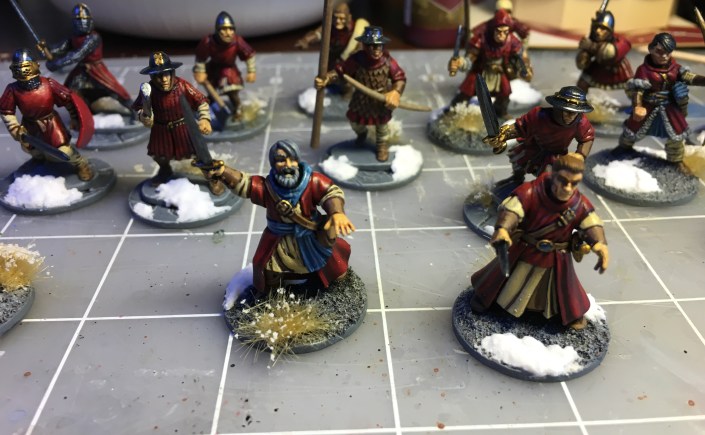
Without further ado, here’s my second warband all painted up, an elementalist and his retinue:

As you can see, this one is largely Fireforge historical miniatures, with some kitbashing from the Oathmark humans and some Frostgrave plastics. Some of the miniatures have Renedra textured bases, which I’m pretty happy with, but some were assembled and based before I had the bases (or started this warband) and so there’s a little bit of a hodgepodge. As you see, I’ve added some foliage tufts and snow paste to these bases (as well as the first warband) for extra effect.

(It’s really bugging me that I can’t figure out exactly what my snow paste is made of. It’s definitely a spackle base, with some sort of glitter and maybe a gloss medium added. If I can parse it out, I can make my own much more cheaply, which would be nice!)

This warband does not have as wide an array of specialist soldiers than the first one–I figured the elementalist would want to focus on combative soldiers bringing the pain over utilitarian ones.

I’ve gone back and forth in my head about how strongly to color-code my warbands (I’ve inadvertantly got Christmas colors going now, it seems). I often like the rag-tag look for its thematic nature (reinforcing the expendability of soldiers), but there’s a great convenience (both in the efficiency of painting and in recognizing minis on the table) to matched soldiers.

After the first color-coded warband I’d finished, I actually had started to do some rag-tag soldiers. But, after painting about ten or so, I realized that they rather handily fit into some color-coded groups: browns for my barbarians, purples and blacks for my cultists, etc. So, I think I’m sticking to color-coding for now.

One of the reasons I picked Frostgrave to get back into minis gaming (other than the setting and style of the game, which are both right up my alley) is the relative ease of having enough miniatures myself to invite friends to partake in the fun of the game without having to talk them into purchasing and painting a bunch of minis for themselves. Having over the last decade talked friends into Warmahordes, Infinity and Malifaux, I decided I’d better front the cost of the game myself and not have to persuade anyone to spend anything if I want to best maintain my relationships. Of course, I’m not stopping anyone who wants to join in with their own warband!

My Proxxon hot wire cutter came in a few weeks ago as well. I almost immediately jury-rigged some jigs (one for cutting circles and one for “ripping” styrofoam to adjust its thickness) based off of the very nice ones done by GeBoom at Shifting Lands. I’ll definitely want to invest in their jigs eventually (and there’s a lot of other cool stuff, like their window templates, I’ll want to add to my order), but I was excited to just get things going. Maybe too excited with the number of styrofoam rings that ended up on my study table. I’m still making a lot of mistakes and learning a lot with each task or operation, but so far I do have one pretty decent (and multi-leveled!) round tower for the Silent Tower scenario (as well as just generally useful terrain).

I’ve got a larger square tower in the works and a number of cut foamcore and insulation foam pieces that need texturing before I glue them to bases for more general ruined terrain.

I can’t say enough good things about the Proxxon. It’s just an amazing tool. I think I’d love it even more with the Shifting Lands add-ons, but I’m able to do a lot of stuff with the base unit and the two jigs I put together with a nail, leftover 1/8″ hardboard and some wood glue.

I’d focused on terrain for a short while before I went back to painting minis, which is where I’m feeling the current pull. It’s all got to get done eventually; I’ll post more pics as things develop.

What Writers (and Roleplayers) Need to Know about Swordplay: Part VI: Social Context

For the previous post in this series, click here.

In the first scene of Romeo and Juliet, two armed servingmen of the house of Capulet are boasting to one another, demonstrating bravado in their defiance of the Montagues (and their preponderance of sexual innuendo). According to the stage notes they are armed, as we would expect, with sword and buckler.

Sampson attempts to provoke two Montague men by biting his thumb at them. As an aside, it’s worth noting that this was not an offensive gesture in England at the time–but it was in Italy. Since our story is set in “fair Verona,” that makes sense, but it also allowed Shakespeare to avoid fears of censorship by using a gesture that wouldn’t have been offensive to the audience–or those with authority to censor.

An exchange of words is coupled with blows, as Sampson and Gregory (the Capulet men) begin to fight with Abraham and Balthasar. All are armed with sword and buckler. This combination of weapons allowed for a lot of noise and commotion without as much risk.

Remember that I said that the foyning (thrusting) fence had been outlawed in England in 1534? Dueling, disturbing the peace, assault and murder were all already illegal, so the passage of such a law indicates a social anxiety about the increased deadliness of the thrust. With sword and buckler fighting, particularly if there is no thrusting or grappling and a medium distance is engaged, there can be a lot of swinging of weapons against which there is ready defense (both sword and buckler). Indeed, the court records of Tudor England indicate that these “swashbucklers” were known to brawl without significant injury on either side on many occasions. This matches with the servingman’s dispute–he must put on a good show for the honor of his master, but he doesn’t actually want to get killed, so he fights only as aggressively as he must to avoid derision and acquit himself well, expecting his opponents to do the same.

If murder and death had been the actual intent here, the parties would not (as they often did and do in our dramatic example) face each other openly and begin with words and taunts–they would have engaged in ambuscade and trickery.

Let’s return to Shakespeare. Benvolio, a Montague noble, and Tybalt, a Capulet noble, enter just as the fight begins. Benvolio attempts to stop the fray. But Tybalt is a duelist of the newer style (to England at least)–he enters with a rapier. We know this in part because of Mercutio’s later description of him, which matches with Spanish styles of rapier fence (or at least stereotypes about them).

The English master George Silver had great derision in his fight manual for the rapier as un-English–and indeed, it was the popularity of Italian fencing masters in London teaching rapier over other forms of fighting in Elizabeth England (and therefore depriving Silver of business) that underlay much of his scorn. The sword and buckler, on the other hand, was considered the proper (and traditional) servingman’s armaments in England. But Tybalt is no servingman, he is one of the nobles represented by Gregory and Sampson.

So, Tybalt’s entry into the fight is disruptive on three levels–it interjects foreignness into what (despite the Italian setting of the play) is good ‘ole Englishness; represents a condescension of the noble into the sort of brawl whcih should, in line with social expectations, be left to the servingman; and brings a very palpable and socially-recognized increase in the lethality of the fight through the introduction of the rapier. Indeed, his first words to Benvolio are, “What, art thou drawn among these hearless hinds? [and here Tybalt is calling out the lack of true deadly intent in the servingmen fighting with sword and buckler]. Turn thee, Benvolio, look upon thy death.” These stacked transgressions would have singled Tybalt out for a villain in the first moments of his entrance, with no exposition needed. That is brilliant writing.

That kind of context is lost to the modern audience–we lose some great narrative techniques with it. It takes careful worldbuilding and weaving these expectations into a novel (or game) to bring the audience to a position where they’d recognize such a message given with so much “show don’t tell,” but it is possible to reclaim these opportunities. In some sense, the barbarian with the “twenty-pound sword” is a very clumsy way of trying to use something similar (choice of weapons to convey character), but this is too blunt, too dumb, to be a mark of skill in the craft or familiarity with the conceits of historical parallels.

I love Tybalt’s example because it hits so many social contexts about the use of weapons all at once. The classist angle is the easiest of them, as this persists through most or all historical periods when hand-to-hand fighting is the primary method of violence. Early on, the sword itself is the emblem of the higher-class warrior. By the Elizabethan period, the type of sword used serves a similar function. Likewise, the grosse messer I mentioned in the previous post was a lower-class weapon than certain alternatives. But as important in Tybalt’s example is that there is a social stratification about when and how it is appropriate (or conversely, inappropriate) for people of certain social status to fight.

Vincentio Saviolo, one of those Italian rapier masters who had come to London in 1590, included instructions in the rules of dueling in his fighting manual. This code included the point that men of high status ought not duel with men of lower status, because their lower status itself meant that they could not participate in the game of honor that lay behind the code duello. The closest thing I can think of in this context in the RPG world is the D&D conceit that cleric’s cannot use bladed weapons because they cannot “spill blood,” a popular but unverified historical belief based–as far as I can tell–on the fact that Bishop Odo bears a mace rather than a sword in the Bayeux Tapestry. Anyone who’s seen blunt trauma knows that this is a distinction without a difference on its own (blunt trauma’s plenty bloody), not to mention that it’s a pretty poor argument from history even if we’re going to give a lot of play to the potential hypocrisy of medieval clergy. We can do better as gamers and writers.

The nationalist context of the use of weapons in Romeo & Juliet, George Silver’s Paradoxes of Defense, and an adventure pamphlet purporting to tell the story of an English adventurer who participated in the post-Armada attack on Cadiz, was the focus on my master’s thesis.

Silver states in his fight manual that he can handily defeat two men armed with rapiers with the good old English quarterstaff, but declines to boast that he can defeat three. The adventurer in the Cadiz pamphlet bests three rapier-armed Spaniards with his quarterstaff in a duel arranged after his capture by the Spanish simply to set up the writer’s argument of English national superiority, it seems.

In the historical Renaissance, there’s a tension in the context of weapon use. For warfare, there will likely be a homogenization where the context of warfare is the same or similar (i.e. all of Europe moved to pike formations, cannons and increasingly lighter cavalry over the period) but choices in minor variations of arms and armor (or those weapons used outside the context of warfare) that are tied to national identity. The Italians and Spanish with their rapiers and the English with their swords and bucklers and quarterstaves are one example.

The point is, use this to develop setting and character. From a mechanical sense, perhaps, fighting is fighting is fighting. But not from a philosophical or social sense–there are rules that shape the who, what, when, where and how of fighting created by people and cultures. And, as we see with the swashbuckler servingmen, not every fight is intended to maim and kill.

I’m gonna have to dig on D&D again (sorry if you’re an enthusiast–from a gaming and narrative perspective, it’s not a bad game, even if I personally have a lot of gripes with it). Let’s look at D&D’s rapier: d6 damage instead of d8 of the “traditional” one-handed sword (still incorrectly called a “longsword”) and the ability to use Dexterity instead of Strength on attack rolls. Wrong on so many levels! All weapons should probably be using Dexterity to hit–or better yet, a system relying more on skill than attributes and levels, and the historical rapier was largely considered to be deadlier than the cut-and-thrust single-hand-sword (all other things being equal–experience shows that this match up is much more about the skill of the participants than anything else, and social perceptions certainly don’t always match with reality). So, we see the rapier in D&D as the weapon of Rogues and other “secondary” fighters rather than a measure of social status and a weapon particularly suited for self-defense, dueling and street-brawling over warfare.

Now, if you’re a GM or player of D&D, it would take a massive set of homebrew rules to replace the D&D conceits with more realistic rules (a trap I regularly fall into, never successfully, before again admitting to myself that the D&D system just isn’t a ruleset I can redeem for the types of games I like to run). But that doesn’t mean you can’t make some easy modifications to how you treat weapons in your setting (in the social context and aside from their mechanics) in a D&D campaign.

If you’re a writer, take these ideas and run–and be thankful you don’t have to tie them to mechanics!

In the last post in this series, I’ll provide some final thoughts and some reading recommendations.

What Writers (and Roleplayers) Need to Know about Swordplay, Part V: Learning the Art

For the previous post in this series, click here.

The sword masters of the early-modern period agree that one must learn the sword by doing and, indeed, this is a precept of many modern WMA groups–reading the fight manuals and seeing their illustrations is one thing, but one cannot truly understand the art and craft of the sword (or any other aspect of medieval/Renaissance hand-to-hand combat) without actually experiencing it, working through the techniques described.

With that in mind, it’s safe to assume that most training in swordplay occurred by direct instruction. The farther we go back in history, the harder it is to determine exactly what that looked like, but we can make some safe assumptions. During most of the medieval period, training in arms was a part of a young nobleman’s education, and it was expected that those who had charge over him, whether he was raised by his own family or placed in the household of another noble house, would provide for such. This likely started as an informal affair and became more formalized during a young man’s time as a squire while that system was in use.

While a few of the fighting manuals show grappling techniques, many do not, and those that do tend to show more advanced techniques of traps, breaks, locks and such. I can’t remember a manual that demonstrates how to throw a punch or how to kick someone. As is the usual assumption when the specifics of a skill are not described when the skill is mentioned in an instructional manual, the common belief is that those people writing the fight manuals took for granted that a person looking to undertake instruction armed combat understood the fundamentals of unarmed combat. We might say something along the lines of, “those young men who didn’t learn how to defend themselves with fists and feet during their childhood lack the constitution and mental preparation necessary to learn the sword.”

From the grappling techniques recorded in fighting manuals, the medievals and their Renaissance successors had a relatively comprehensive grasp of unarmed fighting, retaining some techniques that descended from Roman practice and perhaps even from Greek Pankration as well as formulating techniques specific to the weapons of their own day. As I said before, to a certain extent (and most so with unarmed fighting), the capabilities of the human body and body mechanics being what they are, and people being of generally the same amount of intelligence and insight across geographies and times, unarmed fighting is unarmed fighting, regardless of what little stylistic spins you put on it.

As we also discussed earlier, in the medieval period, both because of the cost of equipment and the nobility’s concerns about peasant revolt, formal training in the sword and those weapons preferred by the nobility were probably restricted to the nobility. But the later the period, the more widespread the availability of swords.

By the 16th century, at least, swords were available and affordable enough that those of the burgeoning middle class could afford them. As mentioned in Part II, owning a sword, and carrying it if you could get away with it, were social signifiers as much as practical, defensive goals.

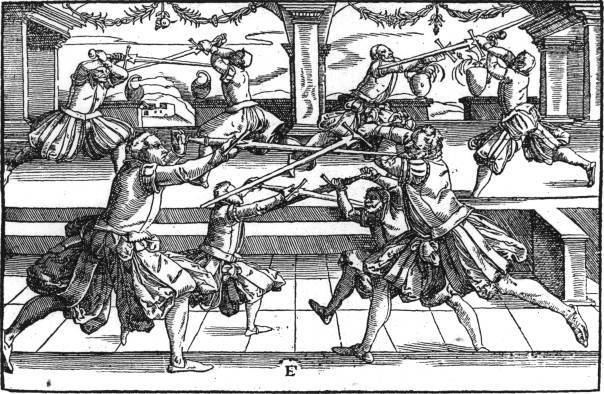
We have papers and statues affecting the London guild of masters of arms from the 1530’s, and a number of woodcuts from the same century depicting the fechtchules, where those who could pay the dues and commit to the rules of membership could study the arts of war under an acknowledged master. These woodcuts display training in the longsword and quarterstaff, in the grosse messer (the “big knife” single-handed sword; the kriegsmesser or “war knife” is the two-handed variant, of German usage), and to a lesser extent, in other weapons.

Generally, students accepted to a fight school where called “scholars.” After studying for a time and proving adeptness in  the foundational skills, they could progress to “free scholars” and then to “provosts.”

Doing so required “playing the prize,” a public demonstration of skill through sparring matches with other members of the school as well as (potentially) the school’s master and even potentially visiting masters (though this was usually reserved for someone seeking the title of master himself–according to Parisian law of the period, he would need at least three other masters to certify his skill with multiple weapons).

A raised platform for visibility was an expectation for the event, and the person playing his prize might be expected to provide beer or other drink for his schoolmates (for the afterparty, I guess), so we are again returned to the linkage of social status (or at least wealth) with attendance at these schools.

Bear in mind that, in England at least, “foyning” (thrusting) was made illegal (I’ll pick this up in the next post) in 1534. Sparring was conducted with bated (i.e. blunted) steel; some amount of injury was expected. The crowds, though, were also used to executions as a form of public entertainment (ultraviolent films had not yet been produced, after all), and it seems that there was a ready audience who wanted to see the blood flow. Remember that armed fights are usually over very quickly, and if the exhibition, as it was intended to be, consisted of controlled action emphasizing finding the opening with discipline and technique enough to pull the strike when it was clear that it would have connected, then there was room to add more blood to the show.

I don’t have the documentary evidence to back this up, but I’ve heard more than one historian say that (an as a folk etymology it makes sense) the organizers of such exhibitions arranged for pugilism to warm up the audience–unarmed fighting lasting longer and being a bit bloodier when conducted with bare or lightly-padded fists and actual intent. Over time, the pugilism aspect became more and more of the focus, hence our modern reference to boxing as “prizefighting.” Remember, the scholars, free scholars and provosts were “playing the prize.”

The 16th century also saw the burgeoning field of science applied to the sword, particularly math and geometry. Indeed, Mercutio describes Tybalt (in Romeo and Juliet) as “More than prince of cats, I can tell you. O, he is the courageous captain of compliments. He fights as you sing prick-song, keeps time, distance and proportion; rests me his minim rest, one, two, and the third in your bosom: the very butcher of a silk button, a duelist, a duelist; a gentleman of the very first house, of the first and second cause. Ah, the immortal passado! The punto reverso! The hai!” (Act 2, Scene 4). It was in particular the Spanish who made comparisons (in the rapier fight) with dancing–the importance of precision of time and distance, with careful footwork. For more information on this aspect of the science of arms, see Sydney Anglo’s book, The Martial Arts of Renaissance Europe, which includes both frontispieces showing the fencing master/author as mathematician and scientist (bearing compass and other tools of the trade) and images parodying the overuse of mathematical principles as the major focus of fencing instruction (there is one in particular of a dwarf farting, with the wind from his buttocks parsed out into geometrical diagram).

I want to emphasize, again, that despite the prevalence of the written fight manuals in this period, the bulk of real instruction took place through personal relationships, whether or not commercialized. The richest employed private instructors, while the middle class sought the public instruction available through the guilds and schools run by masters of defense. Without a practice partner and the opportunity to work through precise (and sometimes complex and counter-intuitive) maneuvers, it is difficult to do more than properly practice stances, movement between them, basic cutting technique and blocking technique when working solo.

Let’s conclude this part by bringing it to the writer’s craft and the gamer’s table. If you have a martially-skilled character, how did he learn, and how did that affect him. Was his teacher patient or demanding? Was his instruction in solitary practice between single student and instructor, or as part of a group whether in military drill (which, as we have mentioned, would have focused more on formation and movement than the techniques of individual combat) or fight school. In a group, what were the rivalries, tough lessons and embarrassments, not to mention successes, that shape how the character thinks about fighting now?

For the D&D (and other fantasy game) players, what about a fighter whose purpose in adventuring is not the righting of wrongs or the accumulation of wealth, but the gathering of practical fighting experience in multiple weapons to undergird his dream of establishing a fight school? Unfortunately, D&D’s approach to weapons is almost entirely gamist, without much in the way to distinguish when a dagger is a better weapon than a halberd, or that its the skill of the arm much more often than the weapon itself that causes the grievous injury, but I digress.

On that note, think about what the experienced swordsman actually thinks about fighting. The assumption in D&D and its many sister games is that the fighter is expected to jump into the fight, to push the party into combat encounters. But the person who knows how fragile life is in hand-to-hand combat, that even the lucky unskilled peasant can kill a well-trained knight, probably doesn’t rush to fight when there are alternatives. And almost certainly avoids doing so fairly when he has the option of seeking advantage. Yes, there will be some for whom ideology overtakes all practical concerns, but that should be far from the norm (and when it is, it’s all the more believable when it does occur).

For the next post in the series, click here.