Fatherhood Update

I haven’t written much about the kiddos in a little while, so I’m putting up a brief update on this front.

We’re just past the three months mark with them living with us. I’ve been having a little bit of an existential “crisis” around that benchmark, though it seems I’m pulling out of it now. The series of questions with which that “crisis” was concerned are the most fundamental about kids: Do I really want to be a father? Does it really make sense for me to have kids? What about the opportunity cost with the other things about which I’m passionate–like my writing (I’m getting a lot less time for that to be sure)?

To add to this, Hawkwood’s been having some behavior issues. Nothing too serious, particularly for a toddler who’s just gone through the trauma of a family separation. But it’s given me a constant low level of frustration with him that’s sometimes hard to shake, giving me the unrealistic but still daunting question–is it always going to be like this?

Of course it won’t. Hawkwood will be starting with a play therapist soon, so hopefully that will help. So will time. And me keeping it together, letting go of my frustration with him, and sticking to TBRI. Of course, that’s much easier said than done, and perhaps the reminders that I’m not always as unflappable or possessed of completed self-control as I like to think I am–and the crisis of identity that goes with that–is part of the turbulence.

Since the kids had never been in any kind of school or daycare before, we’re also going through the rounds of all of the commonest communicable diseases–we’ve had bouts of croup, hand/foot/mouth, stomach bugs, and the like. K’s still got her teacher immunities, but even she’s succumbed, at least partially, to one of the waves of pestilence that’s passed through the house. This too shall pass, but assaults on my immune system aren’t helping my calm.

The sweet moments with Hawkwood are there, to be sure, and Marshall, though he’s getting a bit more stubborn and demanding about some things (and on the very verge of walking!) has been relatively easy. It seems to me (though it may be merely a matter of perspective) that Hawkwood’s behavior is somewhat better with K. I’m sure that this in part that K has both formal education and years of experience in working with children, but she tells me that it’s also probably that Hawkwood has especially bonded with me and so feels more comfortable acting out and expressing himself around me. Don’t tell her, but I don’t know her to be often wrong.

We’ve been told that all foster parents go through the “maybe I should quit” phase at about this time, so that knowledge has been somewhat comforting to us–when you have thoughts like this, it’s easy to wonder if you’re just a terrible person or severely broken. Jury’s still out on that, I guess, but nothing good comes from ignoring the way you feel, so we’re confronting everything head on.

At this point, we still don’t know what the kids’ long-term situation will be. CPS has been reticent and we get only snippets of information without any details or explanation from those with more knowledge than us. That’s par for the course, but frustrating nonetheless. All the signs we are getting, however, are pointing to a likelihood that the kiddos will be available for adoption. Whether that’s really the case, and what any timeline on that might be, is beyond us at the moment.

It seems especially that time has been short for anything other than work and the kids lately, so I’m falling behind on my passion projects (which also stresses me out!). I’m still hoping to have my novel fully plotted by the end of the month so that I can get a good start on the first draft for NaNoWriMo. I’m running short sessions of a Shadowrun campaign over a Discord server on Sunday evenings, which so far has been quite enjoyable. On the other hand, I’ve fallen behind on my Frostgrave work and I’ve been really wanting to spend some time further refining and adding to the Avar Narn setting aside from what I need for the novel but, when I can find a few minutes for it, I’m often too tired to focus!

This whole parenting thing is still early, and I know it will continue to get easier (and I’ll therefore be able to turn more attention to writing again).


Post-Run Thoughts on Shadowrun 6th Edition

A ways back, when I did my set of posts on Shadowrun characters, I promised that I’d be doing a system review in the near future. I’m not sure that this qualifies, formally speaking, as a review, but I am going to share what I think about the system after having run a few sessions now.

As you might have gathered, I was excited about the 6th Edition system when it first appeared. I like the idea of Edge as something more like Fate points and, in theory, that it supplants the need for the endless lists of modifiers in previous editions of Shadowrun. I was much more forgiving than most about other complaints about the system–and particularly the problems with the first printing of the rulebook. A lot of that, really, is likely due to the fact that I got my copy in PDF, which had already been updated with errata by the time I read it, coupled with the fact that my familiarity with Shadowrun lead me to naturally assume things that were not originally included in the rulebook–things like how much Essence you start with.

Character creation is more or less what you remember being from 3rd, 4th or 5th editions with the Priority System and some amount of Karma to round things out (IIRC, more Karma than was standard in previous editions. I have developed some gripes with character creation and advancement, though.

First, I’ve noticed what I think are some balance issues in the Priority Table. Because spells cheap in Karma cost and the Adjustment Points granted by the Metatype selection on the Priority can be used to increase your Magic reason, there’s actually very little reason to choose the higher-tier selections for Magic use compared to selecting a lower tier, using your adjustment points to increase Magic, your Karma to buy some extra spells, and having more Skill and Attribute Points.

Second, I personally think that there’s too much of a gap between the tiers for Skills and Attributes–I’m not sure that you can really create a viable character if you chose Priority E for skills or Attributes.

With the amount of Karma available at chargen, it also strikes me that Physical Adepts may be more powerful than characters augged for a similar role. As an Adept, you can take three levels of Initiation, take extra Power Points at each level, and start with nine Power Points.

These balance issues would likely be resolved by using an entirely Karma-based character creation system with some limits on how much Karma can be spent where and how.

But that leads to another issue–Attributes and Skills cost the same amount of Karma to increase, and the value of some Attributes over others doesn’t necessarily give parity. Agility, for instance, applies to a lot more skills than most of the other Attributes. And, given that raising an Attribute–any Attribute, I think–increases your effective rating in more than one skill, this is problematic.

Character generation is one thing, and the more I look at it, the more the shiny new facade falls away, revealing cracks in the plaster underneath. The more damning issue, though, is that while the new use of Edge is a great idea in theory, it doesn’t really simplify things in play very well.

Now, instead of tracking lots of little modifiers, I have to track different pools of Edge, make sure I’m distributing Edge (as appropriate, without sufficient guidance from the rulebook), make sure my players are tracking and spending Edge, and keep in mind all of the different basic Edge spends and special Edge actions available. The worst part though, is how unnatural the system feels in play. With Fate or Cortex Plus/Prime, the economy and use of points is relatively straightforward and intuitive after a short time playing. Here, though, I’m supposed to hand out Edge points when using a dice pool modifier feels more appropriate and then use those Edge points at a later time–when it may not really feel appropriate or connected. Worse, I’m not sure it really simplifies much. Sure, I don’t need to track how many rounds were fired in the last turn to calculate a recoil modifier for this turn, but a simplification of the amount and types of modifiers or the use of an advantage/disadvantage system would do much more with less.

There are other places where the attempt at a more narrative approach to Shadowrun feels less than fully-realized. Spells are a huge example here. SR6 attempts to simplify spells somewhat by adding some variables that can be applied to spells rather than required the choice of a Force Level (such as expanding AoE or adding additional damage). But that system could be used to require so many fewer spells and give sorcerers so much more flexibility and the opportunity is lost. A few examples: (1) allow the caster to modify the base spell to touch or area of effect and eliminate the need for different spells with the same general effect but different minor parameters; (2) allow the caster to modify Illusion spells to affect technology rather than having two separate spells; (3) Allow the caster to add on the additional Heal spell effects rather than making her use spell selections for six different minor variations.

This is the second time recently I’ve come across a system that I think I like on reading but don’t in practice–the previous being the new edition of 7th Sea, where I find the core mechanic more limiting and cumbersome than freeing. I guess that that means that designers are taking more risks to push mechanics in new directions than has perhaps been the case in the past, but with mixed results for major titles. I see some influence from Dogs in the Vineyard in 7th Sea, the former being a game I love from a design perspective but would probably never run. But, as a smaller title, the price of admission easily covers exposure to the innovative mechanic, whereas the greatly heightened production value of 7th Sea means a much higher buy-in. That’s a discussion for a different time.

In running the past few sessions of Shadowrun, I’ve admittedly been ignoring much of the RAW, using dice pool modifiers when it seems more appropriate, simplifying hacking rolls, etc. I don’t think that, as a GM and within the art of running a game, that there’s anything wrong with that so long as what’s being done is consistent and allows the character stats to have comparable effect on results as they would using RAW. But that’s not a good sign in terms of game design, and I’m finding myself sorely tempted to go back to Fate or Cortex to run the game. Alas, I can foresee the groans from my players at the lost time in learning and going through SR6 chargen only to change to a simpler system a few games in, so I’m not sure I’ll try to make that sale.

Without getting overly technical or formal in reviewing the system, what I’m finding is (for me personally, your style of running games may achieve a completely different result) that the system is encumbering my running of the game more than facilitating it, giving me too many mechanics when I want fewer, and not enough when I could use a little more. As much as I’d like to continue liking the SR6 system, at the end of the day, I’m not sure that there’s a worse conclusion I can come to.

As I’ve hinted at in other posts, I’m really not a fan of D&D, because it doesn’t lend itself to the types and styles of games I like to play. But it’s well-loved because, despite its relative complexity (and I think it’s fair to say it’s really middle of the road as far as that goes), it supports a certain type of gameplay and approach. I’d argue that the OSR has so much support for exactly the same reason, though that approach is somewhat different from D&D 5e and at least partially stoked by nostalgia.

Shadowrun remains one of my favorite RPG settings, so I’ll probably continue to buy the books to keep up with setting material, but that doesn’t mean I’ll feel great about doing so.

Can I make SR6 work for a long campaign? Yes; yes I can. Will I feel like I’m fighting with the system all the way through? Probably.


Capturing the Medieval in Fiction

(N.B.: In this post, I’m using the terms “medieval,” “Renaissance” and “Early Modern” more or less interchangeably for stylistic purposes and ease of writing. Scholars do not agree on the applicability of these terms, with some scholars favoring a “long Middle Ages” lasting into the 18th century, others starting to use the term “Early Modern” with the Italian Quattrocento, and others having more discrete epochs to which they ascribe the terms. I’m not messing with any of that, and I don’t think it will prevent you from getting my point.)

On the heels of my series about “What Writers (and Roleplayers) Should Know About Swordplay,” I thought I might write a little bit more generally about verisimilitude in fiction and RPGs set in a pseudo-medieval or -Renaissance milieu.

When it comes down to it, there are two ways you can write and run games in this sort of a setting, and I think we’ll see that, in gaming at least, the two camps are relatively simple to parse.

The first is the Renaissance Faire approach. It’s not how things were; it’s how we wish they were. This is a fantastic pastiche of history, a facade of the early modern propped up by set pieces that, if we look behind them, we realize are two-dimensional suggestions and not faithful recreations.

Don’t get me wrong, Renaissance Faires are fun. I try to go to the Texas Renaissance Festival every year; when I was in grad school, I’d skip out on a Friday to set up camp for the weekend and play board games with friends until the park opened Saturday morning.

But there’s also something deeply unsatisfying about the Renaissance Festival to me in a way I try to push down deep every time I go. It’s very much pretend-time, and while it has its own charms, it completely lacks the nuance and depth that fascinates me about the time period, that caused me, for a time, to study it professionally.

I’ll defer to Neil Gaiman for a quip that has always made me laugh, from The Sandman #73, when Hob Gadling (who was alive to see the Renaissance) says while visiting a Renaissance Festival: “Well, the first thing that’s wrong is there’s no shit. I mean, that’s the thing about the past that people forget. All the shit. Animal shit. People shit. Cow shit. Horse shit. You waded through the stuff…you should spray them all with shit when they come through the gates. No lice. No nits. No rotting face cancers. When was the last time you saw someone with a bloody great tumor hanging off their face?”

Why do I find the lack of those things so disappointing? It’s not that I’m a masochist (I don’t think). It’s that we’ve sanitized the human experience out of this period so that it seems patently false and superficial. No, I do not want to be sprayed with feces, I don’t want to pick up a colony of lice just for authenticity’s sake when I next attend the Faire (which starts in just over a week, I believe).

But when I want to imagine a world with close ties to the historical period, I want some authenticity to inform the setting, to play a part in the conflicts that develop, the small trials and tribulations. I want a setting that feels immersively real.

In the Renaissance, it was rude to show the underside of your hat to someone while you bowed; typically you would hold it close to your body to prevent anyone from seeing such a private place. Because the underside of your hat was probably nasty. Even if you didn’t have lice, sweat, body oils, and accumulated detritus made the interior of your headpiece rather unpleasant to consider.

These details remind us how different the human experience was for people back then. When air conditioning was no thing, long-term food storage precarious, famine only a bad harvest or a weather disaster away, people had different concerns than we might now. Human nature was the same, of course, and the same motivations (greed, fear, desire for comfort and safety, identity, conscience, piety, to name a few) drove people to behave as they did. But the world in which those motivations acted, and the results they produced under the circumstances, were often different in ways difficult for the modern mind to recapture.

Think about the offense you might take if someone living five-hundred years from now looked back on us and thought about the way we live as “quaint” or as some pastoral fantasy of a “less complicated” life.

Clearly D&D fits into this first camp. The narrative focuses on the fantastic over the mundane, which it is happy to gloss over. There’s not necessarily anything wrong with that–I can imagine that most players would much rather focus on that aspect of their game than mundane minutiae.

The second camp hits closer to the feel I’d expect, but not through verisimilitude, necessarily. Games like Warhammer Fantasy Roleplay, its modern cohort Zweihander, and those games that tend to fit into the position of “weird” fantasy; in the fiction world, think China Mieville’s New Crobuzon.

These settings are grittier, and WFRP in particular makes a greater point about the weirdness of the common folk of the Empire, the constant threat of disease, the unavoidable presence of untreated mental illness, superstition mixed with genuine piety, and a fear of the occult that a medieval or Renaissance person might well relate to. But these are generally treated as originating, at least to a great degree, from the fantastic elements of the setting–the actual existence of magic, the prevalence of monsters, the actions of very real beings whose provenance is disease and madness. In some sense, this is just putting flesh on the bones of beliefs and superstitions underlying medieval culture (to the extent that it is monolithic, which is to say not at all).

If the end “feel” of the setting is all that you’re after, then WFRP and its brethren and sistren come “close enough,” to capturing the early-modern vibe, I suppose.

For me, personally, though, the interaction between the mundane and the fantastic is a fertile ground for narrative and worldbuilding depth, one that most fantasy fiction and roleplaying games gloss over or make generic.

Let’s take the Thieves’ Guild for instance, a classic in fantasy settings and D&D in particular. The idea came about, in part at least, because of the historical existence of the “thieves’ cant” and “canting crews” (see 1698’s “New Dictionary of the Terms Ancient and Modern of the Canting Crew”). The cant was not a language, really, but a large body of slang used by those involved in illicit occupations to code their discussions from the body public and to identify who was “in” and who “out.” But this was not indicative of any large, institutionalized criminal enterprise; it was a grassroots and organically-developed aspect of criminal life by loose affiliation. This allows for a lot more nuance (although perhaps a lot more work for a GM as well) than a single or a few competing “Thieves’ Guilds.” Sure there were organized criminal operations as well, but none of these seem to have exercised exclusive dominion on the criminal underworld of a place.

I am fascinated by the minor but constant pains of the adventuring life. Having been a somewhat avid camper and backpacker, I have experience in the frustrations that can accompany short-term wilderness treks made more comfortable by modern materials and technology. Remove those pleasantries and extend the voyage and things become more difficult. Adventuring quickly seems to be much more like military life in war (or at least what I understand it to be like with no personal experience): boredom, drudgery and myriad minor obstacles to frustrate punctuated by bouts of extreme excitement, danger and fear. Have you ever considered that the days- weeks-long hike to that dungeon might be just as dissuasive (or deadly) to would-be adventurers than the monsters that live within it? How about the possibility that a noble desperate to find some relief from the gout might be just as likely to hire adventurers to search for a miracle cure as some old wizard seeking ancient artifacts?

That’s where the beauty of it comes together–when we get characters and situations that combine and blend mundane human concerns with the fantastic, we get settings and narratives that are far more complex, far more interesting, and far more believable than those that neglect such details.

And think about how much such concerns add to your worldbuilding? Where is the average wizard going to find the most lucrative (and consistent) employment–in throwing fireballs around and calling down comets or in helping to make sure the crop yield is good, healing common disease, and dispelling some of the more vexing aspects of daily life? Is a “remove lice” spell or a “bathe” spell more valuable than a magic missile in an economic sense? How about that “unseen servant” when it’s time to make camp after ten hours of walking or riding?

On a related note, how would disparate access to magical services reinforce class distinctions and divisions?

Don’t be fooled by the fact that games tending towards “80’s realism” more often incorporate these considerations (or at least facsimiles of them)–mechanics are not necessary to bring this depth to your game. It comes out in the descriptions of places and things, the motivations and behaviors of characters, and the narrative details. You can incorporate these ideas into mechanics if you’re so inclined–Torchbearer at least incorporates fatigue and hunger (among other items) into constant and legitimate concerns for adventurers (in a relatively simple way as well), and even judicious application of fatigue levels in D&D can do the trick without further rules changes.

There are plenty of books on societal structures and the operations of certain medieval institutions (especially the manor house in feudalism) written especially for roleplayers (but equally helpful to writers of fiction if you ignore the offered mechanics and focus on the information provided). Expeditious Retreat Press’s Magical Medieval Europe has long been a staple on this front, as are Lisa Steele’s Fief and Town and, more recently Philip McGregor’s Orbis Mundi 2 (probably my favorite of these).

But there aren’t as many (any?) books I’ve found specifically for roleplaying gamers and writers about medieval/Renaissance culture and habit. Yes, you can read Machiavelli’s The Prince for one (embittered) man’s political theory, Castiglione’s Book of the Courtier for idealized elite behavior, and mine Shakespeare’s (and Marlowe and Jonson, etc.) works for glimpses of behavior–though you’ll likely need to read a bunch of scholarly resources to decode these as well! These are all worthwhile things to do.

I’ve found a couple of books and resources that I believe are excellent primers on aspects of early-modern culture that can be very advantageous to the writer or GM. Note that they range from the scholarly to the popular (and perhaps over simplified). They are:

  • Ruth Goodman’s How to Behave Badly in Elizabethan England
  • Most Great Courses on the Medieval and Renaissance periods
  • Edward Muir’s Mad Blood Stirring: Violence and Vendetta in Friuli During the Renaissance
  • Ian Mortimer’s Time Traveler’s Guides
  • The London Medieval Murder Map
  • Frances and Joseph Gies’s Life in a Medieval… Series
  • Gamini Salgado’s Elizabethan Underworld

And for the truly weird:

  • Darren Oldridge’s Strange Histories
  • Carlo Ginzberg’s The Cheese and the Worms
  • John Waller’s The Dancing Plague
  • Norman Cohn’s Europe’s Inner Demons
  • Brian Levack’s The Witch-Hunt in Early Modern Europe
  • Keith Thomas’s Religion and the Decline of Magic (one of my very favorites)

Bonus Round – Quick Facts

Sugar
Despite the Greco-Romans being aware of sugar, it wasn’t much of a thing in the early middle ages in Europe. The Crusades and contact with the near east reintroduced sugar in small quantities to the continent, but its use was long limited to medicinal purposes over gustatory ones (see sugar packing of wounds, known to the ancients, for an example, but also usage for stomachache, etc.). It wasn’t until the 15th Century “settlement” (read: colonization) of the Madeira and Canary islands that sugar began to enter European culture in a big way–and this was further accelerated by the “discovery” of the “New World.”

Cotton
Linen and wool were the dominant textiles for universal use, with rarer things (velvet, ermine, silk, etc.) available to the nobility. Some cotton was occasionally used in medieval Europe, but it was rare enough that John Mandeville describes it as deriving from a “wool-growing tree” and some artwork depicts vegetative lamb-plant hybrids (something Hob Gadling also refers to in Sandman #73).

Cotton is native to Egypt and Africa, but like sugar, it didn’t enter broad circulation in European culture until the cultivation of cotton in the “New World.”

Fruits and Vegetables
Depending on how historical(ly based) your setting is, you might want to check on what kinds of fruits and vegetables (or animals, for that matter) were unknown before the “discovery” of the “New World”–tomatoes, blueberries, strawberries, avocadoes, maize and a good deal more.

Conclusion
As I’ve said before, all of this information is a guide–not a set of constraints (unless you’re writing historical fiction).

Think of all of these details as a complex web of joined points; if you pull one point, it’s going to have ripple effects on other points in the web. That doesn’t mean don’t do it, but it does mean you should exercise some caution and forethought in how you pull, lest you pull so hard that the lines between snap. That’s your verisimilitude you just destroyed.

At the same time, though, these sorts of details are opportunities, opportunities to efficiently convey ideas about the nature and feel of the world in which you’re writing or gaming. Don’t lose out on those opportunities!

What Writers (and Roleplayers) Need to Know about Swordplay, Part VI: Reading Recommendations and Conclusions

Reading Recommendations:
The Martial Arts of Renaissance Europe, Sydney Anglo
Records of the Medieval Sword, Ewart Oakeshott
The Art of Sword Combat: A 1568 German Treatise on Swordsmanship, Translation                      of Jaochim Meyer by Jeffrey Forgeng
The Medieval Art of Swordsmanship: Royal Armouries MS I.33, another Jeffrey                              Forgeng translation
Sigmund Ringeck’s Knightly Art of the Longword, David Lindholm and Peter Svard
Master of Defense: The Works of George Silver, by Paul Wagner
How to Behave Badly in Elizabethan England: A Guide for Knaves, Fools, Harlots,                   Cuckolds, Drunkards, Liars, Thieves and Braggarts, by Ruth Goodman (the chapter               on violence has some great social context about swashbuckling, the rest of the                     book is also great fun)

Film: Believe it or not, Star Wars, Episode III, has some of the best swordplay in film (the move where Anakin cuts off Dooku’s hands looks like it could have come straight out of a fight manual), though it should be noted that the Germanic longsword style is probably not the best way to employ a weapon that only needs to touch its target to cause serious wounds–a more subtle system would probably be warranted.

The film, The Duellists, with Harvey Keitel and David Carradine, has some pretty good moments as well. Although well outside our period, the TV show Black Flag has some decent swordplay in it, and a generally excellent depiction of the tactics and combat techniques of early 18th-century pirates. Unfortunately, I can think of more cringeworthy examples of swordplay in film than good ones.

RPGs: If you want an RPG that realistically treats medieval/Renaissance combat in all its glory and detail, then you need to look at The Riddle of Steel by Jake Norwood and Driftwood Studios (now out-of-print and the publishing company defunct, I believe). Norwood in addition so other applicable background experience, was (may still be) a (very talented) member of The Association for Renaissance Martial Arts. I got to spar with him once, more than a decade-and-a-half ago at this point, and found him to be both a fierce fencer and a gracious person.

The Riddle of Steel has a very cool system for combat that focuses on character skill but also accounts for various advantages and disadvantages in weapon selection. It’s been more influential on my own thoughts on game design for other reasons (its Spiritual Attributes are a really cool idea), but as a younger gamer, I loved the combat system, running games set in Avar Narn and the Warhammer Fantasy setting (the latter of which was a particularly good marriage of rules and setting). Now, I prefer more streamlined rules, with my knowledge of fighting techniques influencing narration more than mechanics.

There are two sucessor systems to TROS that I’m aware of: Blade of the Iron Throne, which ports the rules into a more sword & sorcery system, and Song of Swords, which I believe just published after the wait following its successful kickstarter. I haven’t checked it out yet.

Another gamer and member of the historical martial arts community built a large rules mod for the 3.5 Edition of D&D called Codex Martialis, that brings a lot of the ideas from TROS into approximated usage with the d20 system. I haven’t gone back to look at how much work it would take to port this over to the Fifth Edition (likely a rewrite of the Fighter class at a minimum), but it might be worth investigating if you or your players don’t want to leave D&D but want to find some ways to put the ideas in this series into mechanics. I personally think that d100 systems like Mythras probably provide the best middleground, but I’m personally not a huge fan of d100 systems either (picky me!). though Mythras may be my favorite of them.

Some Thoughts About Swordplay in RPGs
Following on my recommendation of The Riddle of Steel and its successors, I want to share some personal thoughts on using knowledge about swordplay in RPGs. Given my preference for simple and quick-moving RPG systems (at present I’m even thinking of laying the complexity of my in-progress Avar Narn RPG system aside for a customization of Fate to the setting), I actually don’t think that much needs to be done mechanically in an RPG to capture realistic swordplay.

That is not to say that nothing should be done. The bare minimum, as GM or player, is to get a grasp of swordplay (and hand-to-hand combat in general) so that you can describe your combats well–make them exciting and interesting with realistic detail and flow that helps to hold the attention of the players.

If you want to do more than that, then you’re talking about making some assumptions about theme and setting. A realistic treatment of swordplay means genuinely dangerous combats that don’t typically last very long. Not every fight will end in death and large-scale dismemberment, though. Here’s a thought to drive that home: it takes about 8 pounds of force to pull an ear off. How many people really want to keep fighting when someone just ripped their ear off? Probably not the majority.

Permanent/lingering wounds and a real possibility of character death will achieve this, but give rise to additional necessary considerations. You need to do one (or more) of three things: (1) give players access to improved healing (and perhaps resurrection) through the setting, (2) ensure that there are mechanical “meta” mechanics for preventing character death (hero points, Edge, whatever you’d like to call it and/or (3) get their buy-in about character death and setting lethality before play begins.

There are, I believe, some important mechanical considerations to a game with realistic combat. I really believe that a bell curve system of task resolution is best, because predictability of outcome will be a huge benefit to players and characters when they must choose whether or not to fight. A bell curve maintains the possibility that an inexperienced person will get lucky and kill a skilled combatant, but it also means that a skilled combatant fighting an untrained person will usually result in a beatdown. This, I think is realistic. I believe that a dice pool system is potentially serviceable, as you get diminishing returns as difficulty decreases (the more important part of the bell curve), but the mechanic with a Gaussian distribution will be better in the end.

If you want to take things further, damage inflicted in combat derives more from the skill of the attacker than the weapon used–in the right hands and the right situation, a dagger may be deadlier than a sword or polearm. Weapons, then, should likely give some advantage on attack tests when they would reasonably offer the combatant advantage over his foe rather than setting the range of damage he does.

Shields should be treated as weapons, not armor, because that’s what they are. Yes, they are weapons better suited to deflecting enemy blows, but they may still be used to push, bash and strike with both the shield face and the edges of the shield. A buckler, in essence, is an armored fist.

Combined with all of the above, fighting ability should probably be skill-based and not level-based. That’s debatable, of course, since levels arguably represent the experience and veterancy of a character, but surviving fights long enough is not the sole determiner of whether a character will “git gud.”

As you can see, all of this militates against D&D for the system to use if you want to run games with realistic combats–or much realism at all, I’d argue. A game where a character can survive a direct hit from a fireball or lightning strike just doesn’t lend itself to verisimilitude. I’d reiterate that that does not make D&D bad/wrong; it’s just a very different approach to RPGs than a gritty and realistic system and the availability of a variety of approaches to our games is a wonderful thing.

I will warn, from my own experience, however, that attempting to modify the D&D system into something that effectively captures some verisimilitude in its combat requires such sweeping changes to both mechanics and assumptions of the system as to be an exercise in futility. That way lies madness.

I’d also say that gritty and deadly doesn’t necessarily mean the “low fantasy” genre, though I see in both literature and games a strong correlation between the two. I would not describe my own setting, Avar Narn, as low magic, but I would certainly argue that it’s gritty.

Conclusion
My argument here is not for the primacy of historically-based realism in fiction and fantasy roleplaying–these media are far too broad to allow such an oversimplification and there are many competing goals in our fictional pursuits over verisimilitude. I do intend to argue, though, that an understanding of the historical basis is a benefit to anyone who devotes the time to it, because that understanding gives you power to manipulate the feel, genre and themes of your setting intentionally rather than wondering in blind.

The less realistic the combat, the more legendary (in the literary sense) and mythopoeic a story or game will feel, and that’s an opportunity to exploit just as the opposite is.

I hope that this series has given you something to mull over, some new opportunities to explore and consider as you create settings and mechanics for your own fiction or games. The rest, as they say, is up to you.

An Ad Hominem Homily: Luke 16:19-31

This past Sunday’s text in the Methodist lectionary was Luke 16:19-31.

It’s a difficult passage, the story of that other Lazarus. In this short parable, Jesus tells us of an unnamed rich man and (the other) Lazarus, a disease-afflicted man who lies at the doorstep of the rich man’s home hoping for scraps from the man’s table. Both die, with Lazarus being carried by angels to Abraham’s bosom and the rich man going to Hades.

The rich man calls out across a great divide to Abraham to send Lazarus to bring him water, but Abraham tells him that none can cross the chasm. The rich man then begs Abraham to let Lazarus go to the rich man’s living family to warn them about his fate. Abraham objects that his family has Moses and the prophets to guide them. The rich man retorts that they may not heed the message from the prophets, but will certainly listen to someone returned to the dead. Abraham ends the parable by explaining that those who will not believe Moses and the prophets will not even believe one who rises from the dead.

Jesus sometimes has words difficult for us to hear, and even one such as myself whose theology focuses on the love, forgiveness and benevolence of God would be a fool to ignore the warnings in such passages.

The warning hits especially close when, as with K and I’s new church home, one must walk past homeless folks to enter worship.

The Rich and the Poor

I certainly do not want to de-emphasize the message in this parable about how we should treat the poor, the afflicted, those less fortunate than us. This warning is the clearest part of the passage, and perhaps the one that resonates most with Jesus’s other sayings.

But I’m going to make my comments on that aspect of the passage quickly and move on to less-frequently-discussed ideas conveyed by the text.

I’ll point out the purple robe worn by the rich man. Purple dye–at least the best of it–was known as Tyrian purple; it was produced by the Phoenicians in Tyre (and later elsewhere along the Mediterranean), a city north of Israel in modern Lebanon and visited by Jesus according to Mark. Tyrian purple comes from the secretions of sea snails from the Muricidae family. Even before the first century C.E., writers remarked that the dye was worth its weight in silver. The expense of this purple dye caused it to be known as “royal purple” or “imperial purple.” According to Strong’s, the word that we translate rather feebly as “dressed in” (at least in the ESV) has a meaning more like “habitually dressed in.”

Everyone hearing Jesus’s message at the time would have immediately understood his meaning–this was not just a wealthy person; this was a person with the means to squander money on lavish clothing, not for special occasions, but for everyday use. I suppose it’s like saying the man drove a Ferrari or Lamborghini past Lazarus every morning.

This is poised next to the statement that “Even the dogs came and licked his sores.” There are two ways to read this statement, I think. The first is what we instinctually read–that the dogs licking his sores is a further insult and embarrassment to Lazarus. But, through both experience and reading, I know that dogs can smell disease in humans (and Lazarus’s seems to be pretty obvious besides) and will often lick wounds in an effort to comfort and promote healing–this is their instinctual reaction. So, I think that the juxtaposition here is not just about Lazarus’s lowliness; it’s also about the fact that even the beasts who survive off of scraps from the table know to treat Lazarus better than the rich man does.

Truth and Seeing

As I mentioned above, I don’t think that the real point of this passage is simply about behavior and punishment. In fact, I don’t think that we should read the afterlife scene depicted should be taken as a statement of actual reality at all.

One hint of this, I think, is Jesus’s use of the word Hades–he’s making reference to a Greco-Roman cosmology that he surely doesn’t believe in. Now, on the one hand, Jesus is speaking to a culture now firmly entrenched in the ideas of the Greco-Roman world, but he’s also speaking primarily to Pharisees here, and it would seem that, were he wanting to make a statement about what to expect in the afterlife, he might have used the Hebrew word sheol instead.

So, with that argument made, I’m not going to spend a lot of time on the ideas of afterlife justice and punishment here–I just don’t think that’s the point and I don’t think that’s where we should be spending our interpretive time and effort with the passage.

Instead, I want to focus on the substance of the exchange between Abraham and the rich man rather, with the setting allegorically informing the conversation rather than being a demonstration of reality. In transparency, this is probably a break with tradition–this parable is frequently depicted in medieval art, probably because of its treatment of the afterlife.

When the rich man is dead and in Hades, he can see that Lazarus is with Abraham–the text tells us this plainly. Based on the text, we are well within our rights, I think, to assume that the rich man is founded in the Hebrew beliefs of the time. It follows, then, that he should immediately understand the situation as it is, with Lazarus being rewarded and him being punished. And yet, he persists in the worldview he had in life, the one that caused him to ignore Lazarus in the first place–that, by virtue of his wealth and status he was necessarily better than Lazarus and deserved to be higher than him and served by him.

Let’s make that clear: in spite of seeing Lazarus being rewarded and in the presence of Abraham, and being himself in a place of torment (and assumedly punishment), the rich man still thinks its fitting to ask Abraham to tell Lazarus to serve him.

For me, this changes the way that I look at Abraham’s response when he says, “And besides all this, between us and you a great chasm has been set in place, so that those who want to go from here to you cannot, nor can anyone cross over from there to us.”

I read this not as a statement about the inability of the dead to move between punishment and grace, but as a statement that the worldly status quo, the dominance of the wealthy and powerful over others, cannot be enforced in the afterlife. Were the rich man not blind to reality, he would have seen this in his situation and would not have made the request in the first place. We see him as foolish in asking for such a thing, and I think that’s entirely the point given what follows.

If you’re like me, you find it strange that the rich man then asks Abraham to send Lazarus and not him to warn his (the rich man’s) family. This could be because the rich man still refuses to look past the disparity of social rank and privilege he enjoyed in life despite Abraham’s explanation, but it could also be that he believes Lazarus might have the privilege to speak to the living where he does not or that Abraham’s side of the chasm is connected to the land of the living and the rich man’s is not. Here, we have a break with Greco-Roman views of Hades, I think, given the number of stories in both Greek and Roman culture in which a spirit of the dead communicates with the living.

Regardless of the why, it’s the substance of the exchange that follows the request that matters most. Ultimately, Abraham says that those who do not believe Moses and the prophets will not believe even someone returned from the dead.

Abraham’s response to the rich man is an application of logic to the ad hominem fallacy engaged in by the rich man–it’s the truth of the message that matters, not the source of the message. Those who have already rejected the truth upon hearing it will not suddenly believe it because someone else–even one risen from the dead–tells the truth to them again. Those who choose to remain blind to the truth when it is staring them in the face, as the rich man does throughout this passage, will find ways to continue to do so.

Social science seems to back this up–just this week I heard on NPR about a study that seems fortuitously related to this topic. In that study, the political beliefs of participants were assessed before and after they participated in a program of interaction with people of different political beliefs and backgrounds. Our assumption, as is so often the case, is that exposure to different ideas, the building of relationships with people of differing beliefs, will naturally cause us to become more open-minded–or at least empathetic to differing views. But this particular study showed that a significant number of participants with very strongly-held views became more entrenched in their views after participating in interactions with people of differing views, choosing to use those interactions as confirmation of their pre-existing beliefs rather than evidence that it might be reasonable to believe otherwise.

The current state of American politics–particularly as Republican congresspersons and officials engage in impressive mental gymnastics to remain loyal to an embattled president with a history of willful ignorance of the ideals of American government–provides further evidence. But if I’m going to be fair (and I should be, shouldn’t I?), the problem lies on both sides of our political divide, because the biases and extreme positions of some Democrats have given an excuse to make the argument that any action taken against the President is a matter only of political bias. Just this morning on the drive to work I head a Republican congressman not just imply but state that the current Ukraine scandal might not have any merit because the whistleblower involved might be biased against Donald Trump. The ad hominem fallacy again raises its ugly head–it doesn’t matter at all whether the whistleblower was biased in blowing the whistle; it only matters whether the allegations of misconduct and abuse of power are true. But I digress.

As those of you who follow the theological posts on my site well know by now, I take an existentialist approach to my theology. I’ve argued that the process of sanctification (and therefore participation in the present Kingdom of God) is a matter of changing oneself to see reality more clearly. In many ways, that’s the argument of this parable–I’m willing to argue that, had the rich man seen reality the way God created it and communicated truth about it to us through Moses and the prophets, he would have treated Lazarus as he should have and never would have ended up in the situation in which we find him. Righteous action flows from righteous thought, which flows from righteous seeing.

Jesus’s Self-Referential Meaning

I haven’t heard or read anyone discuss the irony in Abraham’s final words in this passage. When Jesus gives this parable, he is going to die and return from the dead with messages for the Disciples and for us at large. So how do we relate this statement to Jesus’s death and resurrection (and its effect–or lack thereof–on believers)?

It’s possible that this is evidence that Jesus’s death and resurrection was never intended as a sign to create belief in God. If we take the message of Luke 16:19-31, that makes sense, right? For those whose contact with Jesus already convinced them that he was the Son of God, his resurrection was simply confirmation of their belief, not the source of new belief. Those who rejected Jesus’s divinity before his death and resurrection had ready arguments for continuing to disbelieve. Someone stole the body. Jesus only swooned on the cross and never actually died. The crucifixion never actually occurred.

This, existentially speaking, is the condition in which we, as human beings in the modern age, find ourselves. We have no way to prove the reality of the resurrection itself, much less to use it prove Jesus’s divinity. We have Moses and the prophets, and the Disciples and letter-writers; if we don’t find truth in them, where will we find it?

I need to carry this further, I think. As I argued in my last theological post (Speaking Creation), Jesus is the reality of our creation and sustenance, with the Bible’s primary value as a gateway to a personal encounter with Jesus that transcends all other human ways of knowing or seeing. Jesus is the right seeing of the universe. The incarnation and crucifixion, then, are revelations of truth, not for the purpose of forcing us to see clearly, but for giving us the possibility of seeing clearly if we are willing to see at all.

For us Methodists, it’s the prevenient grace of the Holy Spirit that allows us to be open to seeing before the truth is ever clear to us. But that is a mechanism beyond my understanding except in the most abstract of senses.

This idea, that the crucifixion and resurrection are not about causing belief, naturally requires the question: “What is it about, then?” Jesus answers that question, at least in part, elsewhere, when he tells us that “No greater love have a man than this; that he lay down his life for his friends.” As Paul writes, “But God demonstrates his own loves for us in this: While we were yet sinners, Christ died for us.”

This knowledge returns us to the chasm between Abraham and the rich man. If that chasm were ever intended to represent a real divide between the forgiven and the unforgiven, it cannot remain after the redemptive act of Jesus’s death and resurrection. Abraham speaks to the rich man in terms of impossibilities, but through Jesus, all things are possible.

Synchronicity and Application

I had the very good fortune to hear J.J. Warren speak this weekend at a Reconciling United Methodists of the Texas Annual Conference event. If you’re not sure who J.J. Warren is, search for him in Google. Start with his speech from the floor of the Called Special Session of the General Conference of the UMC earlier this year and go from there. His first book, Reclaiming Church: A Call to Action for Religious Rejects, is available for pre-order on Amazon.

He spoke/preached on the prophet Amos, whose warning to the Hebrew people was that God found the worship and supplications of the Hebrew people distasteful (to put it mildly) while they refused to engage in the pursuit of the social justice that God had called them to.

The application of this message in the warning that we, as United Methodists, ought to be very carefully scrutinizing whether we’re seeking God’s justice with our actions, not just with regard to LGTBQ+ issues but also in matters of immigration, wealth disparity, inequities of power in our nation, the lack of justice in our judicial system, and many other issues both “secular” and political, resonates deeply with the passage from Luke. After all, that’s the very warning the rich man fails to heed in his ignorance of Lazarus: are you pursuing justice or allowing injustice?

Was Amos at the forefront of Abraham’s mind when he warns the rich man that those who are heedless of the prophets will not heed even one risen from the dead? Something to think on…

Speaking Creation

A picture may be worth a thousand words in terms of raw content, but even a few words can be more precise than a picture. And when words create pictures, an emergent gestalt of the minds of writer and reader, where do we put that in the hierarchy? When our words shape, craft and regulate thoughts, how do we categorize that most fundamental structure of reality?

The idea that language, whether deterministically or only by influence, shapes cognition and perception, is formally known as the Sapir-Whorf Hypothesis. It’s a far-reaching idea, particularly for both the writer and the theologian. Here, I’ll focus on the latter.

The Book of John tells us, or at least very heavily implies, that Jesus is the Word of God, co-eternal with the Father, that “Through him all things were made; without him nothing was made that has been made.” I’ve talked about my perceived misapplication of the phrase “Word of God” to the Bible rather than to Jesus in a previous duology of posts.

Indeed, in Genesis, God speaks Creation into being. Both Tolkien and Lewis picked up on this, though they  also incorporated music into the speaking of Creation in their respective worlds. As medievalists, they would have been familiar with the idea of the music of the spheres, and perhaps that influenced their choices in worldbuilding and writing. For both, I think, as for me, the act of writing fiction, of using words to create something new, is both an act of worship and the exercise of the most Godlike of human endowments–creativity itself–in imitation of our source.

Just as God and the created thing are separate and distinct, language (as a medium of creation) and creation itself are separate and distinct. Any scholar of semiotics (or philosophy for that matter) will tell you that the description or word for a thing is not the thing itself. I’ve before referenced Magritte’s The Treachery of Images as emblematic of this idea.

Nevertheless, I think it is impossible to overstate the importance of speech in the creative act in the Book of Genesis and the linking of Jesus Christ to both act and medium of creation. But what do we do with that?

We turn to words, of course. Our fiction is full of the idea that speech is the moderator of thought and experience, at least for human beings. In Orwell’s 1984, Newspeak allows the government (to attempt, at least) to control the thoughts, perceptions and self-expressions of the citizens of Oceania. Even more fascinating (to my mind) is China Mieville’s Embassytown, where the evolution of the Language of the Ariekei “Hosts” coincides with changes in their consciousness and perceptions. In my review of Brooks Landon’s Great Course on Building Great Sentences, I spend a fair amount of time on the idea that good sentences are essentially consciousness hacking. Certainly, the Sapir-Whorf hypothesis supports such an idea.

That is what fascinates me most about the use of speech in the Biblical story of Creation. Even if, as I do, you interpret Genesis as being far more metaphorical than literal, this detail communicates something undeniably true about human existence. Like it or not, language structures experience. When was the last time you thought to yourself purely in terms of abstract images, feelings and ideas? I can’t think of time ever when my own internal monologue was not yapping away.

This is why the study of foreign languages is so mind-expanding–coded within the words and structure of a language are fundamental perceptions and assertions about the nature of existence and reality. This goes far beyond how many words for snow a language has (though that is itself a telling example of a manner of perceiving the world) or that in Latin actor and subject of action sometimes require the reader to make assumptions about how the world is, as in the sentence “Miles puella vincit” (“The soldier conquers the girl,” or, “The girl conquers the soldier” since both nouns are in the nominative declension). There are subtler effects, too subtle to describe here, involved in the availability and specificity of words in any particular language or even words within a language. This isn’t a post about the mechanics of how language shapes thought, but one about the consequences of that fact.

Before we go further, just a little more about the Sapir-Whorf Hypothesis. Linguistic research in recent decades has lent support to the “soft” school of the Hypothesis–that language may influence but is not deterministic upon cognition and perception. That matches with “common sense” philosophy and experience, I think–I’ve never encountered, personally or second-hand, a specific instance of language preventing someone from changing his mind about something, an assertion with any plausibility that all speakers of a language share the same ideas on a particular topic, or an event where a language barrier proved insurmountable to compromise between different peoples in any but the most practical of senses. So, the analogy, as all analogies must at some point (if they are actually analogies and not two instances of the exact same thing held up to one another), begins to unravel here. Nevertheless, I proceed.

The assertion that Jesus is the Word of God carries with it the claim that Jesus makes in John 14:6: “I am the way, the truth and the life. No one comes to the Father except through me.” But it does so in a way that is far more nuanced and complex than the fundamentalist idea that salvation is exclusive to those who profess Jesus as Lord with their mouths.

Instead, the idea tells us that Jesus is the way, the truth and the life, not in some categorical sense exclusive to other worldviews, but in the fundamental sense that Jesus is God’s fullest expression to man of the very nature of Creation and reality itself. This being the case, anyone who catches some glimpse of reality is in some sense glimpsing Jesus, regardless of the name they put to it. This comports with the claim in 1 John 4:8 that “Everyone who loves has been born of God and knows God. Whoever does not love does not know God, because God is love.” (The congruence of these ideas might provide some argument in support of the idea that the writer of the Gospel of John and the First Epistle of John are one and the same).

If Jesus is the truest language, that is, the truest medium and structure for accurate perception of and cognition about all created things, we must add the action of the Holy Spirit at Pentecost to what we’ve seen of Jesus Christ and the Father in Genesis.

At Pentecost, the Holy Spirit descends upon the crowds gathered around the apostles so that all clearly understand the divine message spoken by the apostles on that day–each as if hearing in his own tongue. The idea hear is clear–Jesus, as the fundamental structure for understanding all questions existential, is available to all.

This idea allows for some ecumenical respect for other faiths while preserving the primacy of Jesus as a person of the all-sovereign triune God. It allows us to respect the genuine striving for God that members of other faiths seek while asserting that the clearest, most beneficial view of God is in the person of Jesus Christ.

I don’t know a thing about Neal Stephenson’s religious beliefs, but as I’ve mentioned in several other posts, some of his works have inspired particular insights into my own theology, and I would rate him up with Joss Whedon as one of my “unintentional mentors” in that regard. This seems as good a time as any to discuss Snow Crash in brief. Spoilers in the next paragraph (didn’t see that coming in this post, didja?).

One of the plot-critical philosophical thoughts behind the plot of Snow Crash is the idea that the Asherah cult and pagan belief constitutes a sort of meme-virus in Sumerian language and that the separation of languages in the story we know as the Tower of Babel is a counter-virus intended to inoculate against the deleterious effects of the Asheran cult. It’s a brilliant fantastical use of Biblical narrative and, like the other fictional works I’ve mentioned here, more than a little in line with the Sapir-Whorf Hypothesis. It carries with it a great warning itself in the person of Reverend Wayne, who seeks to combine the Snow Crash drug with his personal charisma and authority co-opted from Christianity to distribute his own meme-virus. I don’t think I need to do much to tie this example into the ideas above.

Salvation aside, this idea, that Jesus is both the medium and the structure of Creation, should profoundly influence our idea of sanctification. It tells us that seeking the person of Jesus is coming to a clearer paradigm for understanding existence as it actually is. This is an existential understanding of sanctification, as I have elsewhere argued (see the “Brief Outline of My Theology” for a quick and dirty overview). It states that seeking Christ causes change within us–of our way of understanding our relationships to all else in existence rather than some subjugation of our unique personalities–and that this change in understanding is what allows the more abundant living and the participation in the Kingdom of God that Jesus came to offer us, through his teaching, yes, but even more profoundly through the direct experience of him. The giver becomes the gift, all one.

FFF & Frostgrave Continues

When not trying to get some writing in–on my slowly-developing novel or on the blog–or preparing my impending Shadowrun campaign, I’ve been steadily working away at more stuff for Frostgrave.

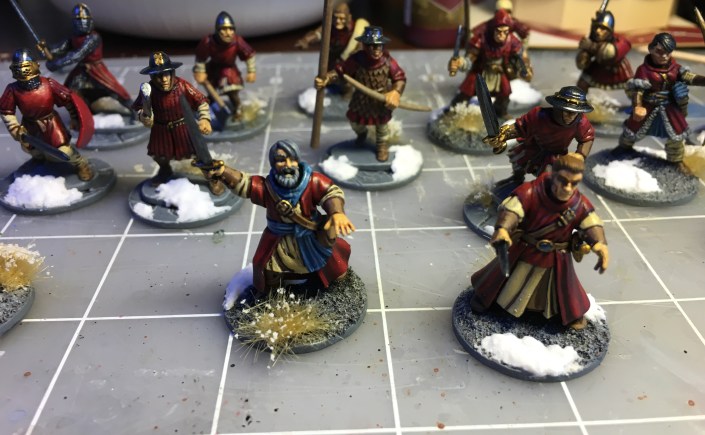
Without further ado, here’s my second warband all painted up, an elementalist and his retinue:

As you can see, this one is largely Fireforge historical miniatures, with some kitbashing from the Oathmark humans and some Frostgrave plastics. Some of the miniatures have Renedra textured bases, which I’m pretty happy with, but some were assembled and based before I had the bases (or started this warband) and so there’s a little bit of a hodgepodge. As you see, I’ve added some foliage tufts and snow paste to these bases (as well as the first warband) for extra effect.

(It’s really bugging me that I can’t figure out exactly what my snow paste is made of. It’s definitely a spackle base, with some sort of glitter and maybe a gloss medium added. If I can parse it out, I can make my own much more cheaply, which would be nice!)

This warband does not have as wide an array of specialist soldiers than the first one–I figured the elementalist would want to focus on combative soldiers bringing the pain over utilitarian ones.

I’ve gone back and forth in my head about how strongly to color-code my warbands (I’ve inadvertantly got Christmas colors going now, it seems). I often like the rag-tag look for its thematic nature (reinforcing the expendability of soldiers), but there’s a great convenience (both in the efficiency of painting and in recognizing minis on the table) to matched soldiers.

After the first color-coded warband I’d finished, I actually had started to do some rag-tag soldiers. But, after painting about ten or so, I realized that they rather handily fit into some color-coded groups: browns for my barbarians, purples and blacks for my cultists, etc. So, I think I’m sticking to color-coding for now.

One of the reasons I picked Frostgrave to get back into minis gaming (other than the setting and style of the game, which are both right up my alley) is the relative ease of having enough miniatures myself to invite friends to partake in the fun of the game without having to talk them into purchasing and painting a bunch of minis for themselves. Having over the last decade talked friends into Warmahordes, Infinity and Malifaux, I decided I’d better front the cost of the game myself and not have to persuade anyone to spend anything if I want to best maintain my relationships. Of course, I’m not stopping anyone who wants to join in with their own warband!

My Proxxon hot wire cutter came in a few weeks ago as well. I almost immediately jury-rigged some jigs (one for cutting circles and one for “ripping” styrofoam to adjust its thickness) based off of the very nice ones done by GeBoom at Shifting Lands. I’ll definitely want to invest in their jigs eventually (and there’s a lot of other cool stuff, like their window templates, I’ll want to add to my order), but I was excited to just get things going. Maybe too excited with the number of styrofoam rings that ended up on my study table. I’m still making a lot of mistakes and learning a lot with each task or operation, but so far I do have one pretty decent (and multi-leveled!) round tower for the Silent Tower scenario (as well as just generally useful terrain).

I’ve got a larger square tower in the works and a number of cut foamcore and insulation foam pieces that need texturing before I glue them to bases for more general ruined terrain.

I can’t say enough good things about the Proxxon. It’s just an amazing tool. I think I’d love it even more with the Shifting Lands add-ons, but I’m able to do a lot of stuff with the base unit and the two jigs I put together with a nail, leftover 1/8″ hardboard and some wood glue.

I’d focused on terrain for a short while before I went back to painting minis, which is where I’m feeling the current pull. It’s all got to get done eventually; I’ll post more pics as things develop.

What Writers (and Roleplayers) Need to Know about Swordplay: Part VI: Social Context

For the previous post in this series, click here.

In the first scene of Romeo and Juliet, two armed servingmen of the house of Capulet are boasting to one another, demonstrating bravado in their defiance of the Montagues (and their preponderance of sexual innuendo). According to the stage notes they are armed, as we would expect, with sword and buckler.

Sampson attempts to provoke two Montague men by biting his thumb at them. As an aside, it’s worth noting that this was not an offensive gesture in England at the time–but it was in Italy. Since our story is set in “fair Verona,” that makes sense, but it also allowed Shakespeare to avoid fears of censorship by using a gesture that wouldn’t have been offensive to the audience–or those with authority to censor.

An exchange of words is coupled with blows, as Sampson and Gregory (the Capulet men) begin to fight with Abraham and Balthasar. All are armed with sword and buckler. This combination of weapons allowed for a lot of noise and commotion without as much risk.

Remember that I said that the foyning (thrusting) fence had been outlawed in England in 1534? Dueling, disturbing the peace, assault and murder were all already illegal, so the passage of such a law indicates a social anxiety about the increased deadliness of the thrust. With sword and buckler fighting, particularly if there is no thrusting or grappling and a medium distance is engaged, there can be a lot of swinging of weapons against which there is ready defense (both sword and buckler). Indeed, the court records of Tudor England indicate that these “swashbucklers” were known to brawl without significant injury on either side on many occasions. This matches with the servingman’s dispute–he must put on a good show for the honor of his master, but he doesn’t actually want to get killed, so he fights only as aggressively as he must to avoid derision and acquit himself well, expecting his opponents to do the same.

If murder and death had been the actual intent here, the parties would not (as they often did and do in our dramatic example) face each other openly and begin with words and taunts–they would have engaged in ambuscade and trickery.

Let’s return to Shakespeare. Benvolio, a Montague noble, and Tybalt, a Capulet noble, enter just as the fight begins. Benvolio attempts to stop the fray. But Tybalt is a duelist of the newer style (to England at least)–he enters with a rapier. We know this in part because of Mercutio’s later description of him, which matches with Spanish styles of rapier fence (or at least stereotypes about them).

The English master George Silver had great derision in his fight manual for the rapier as un-English–and indeed, it was the popularity of Italian fencing masters in London teaching rapier over other forms of fighting in Elizabeth England (and therefore depriving Silver of business) that underlay much of his scorn. The sword and buckler, on the other hand, was considered the proper (and traditional) servingman’s armaments in England. But Tybalt is no servingman, he is one of the nobles represented by Gregory and Sampson.

So, Tybalt’s entry into the fight is disruptive on three levels–it interjects foreignness into what (despite the Italian setting of the play) is good ‘ole Englishness; represents a condescension of the noble into the sort of brawl whcih should, in line with social expectations, be left to the servingman; and brings a very palpable and socially-recognized increase in the lethality of the fight through the introduction of the rapier. Indeed, his first words to Benvolio are, “What, art thou drawn among these hearless hinds? [and here Tybalt is calling out the lack of true deadly intent in the servingmen fighting with sword and buckler]. Turn thee, Benvolio, look upon thy death.” These stacked transgressions would have singled Tybalt out for a villain in the first moments of his entrance, with no exposition needed. That is brilliant writing.

That kind of context is lost to the modern audience–we lose some great narrative techniques with it. It takes careful worldbuilding and weaving these expectations into a novel (or game) to bring the audience to a position where they’d recognize such a message given with so much “show don’t tell,” but it is possible to reclaim these opportunities. In some sense, the barbarian with the “twenty-pound sword” is a very clumsy way of trying to use something similar (choice of weapons to convey character), but this is too blunt, too dumb, to be a mark of skill in the craft or familiarity with the conceits of historical parallels.

I love Tybalt’s example because it hits so many social contexts about the use of weapons all at once. The classist angle is the easiest of them, as this persists through most or all historical periods when hand-to-hand fighting is the primary method of violence. Early on, the sword itself is the emblem of the higher-class warrior. By the Elizabethan period, the type of sword used serves a similar function. Likewise, the grosse messer I mentioned in the previous post was a lower-class weapon than certain alternatives. But as important in Tybalt’s example is that there is a social stratification about when and how it is appropriate (or conversely, inappropriate) for people of certain social status to fight.

Vincentio Saviolo, one of those Italian rapier masters who had come to London in 1590, included instructions in the rules of dueling in his fighting manual. This code included the point that men of high status ought not duel with men of lower status, because their lower status itself meant that they could not participate in the game of honor that lay behind the code duello. The closest thing I can think of in this context in the RPG world is the D&D conceit that cleric’s cannot use bladed weapons because they cannot “spill blood,” a popular but unverified historical belief based–as far as I can tell–on the fact that Bishop Odo bears a mace rather than a sword in the Bayeux Tapestry. Anyone who’s seen blunt trauma knows that this is a distinction without a difference on its own (blunt trauma’s plenty bloody), not to mention that it’s a pretty poor argument from history even if we’re going to give a lot of play to the potential hypocrisy of medieval clergy. We can do better as gamers and writers.

The nationalist context of the use of weapons in Romeo & Juliet, George Silver’s Paradoxes of Defense, and an adventure pamphlet purporting to tell the story of an English adventurer who participated in the post-Armada attack on Cadiz, was the focus on my master’s thesis.

Silver states in his fight manual that he can handily defeat two men armed with rapiers with the good old English quarterstaff, but declines to boast that he can defeat three. The adventurer in the Cadiz pamphlet bests three rapier-armed Spaniards with his quarterstaff in a duel arranged after his capture by the Spanish simply to set up the writer’s argument of English national superiority, it seems.

In the historical Renaissance, there’s a tension in the context of weapon use. For warfare, there will likely be a homogenization where the context of warfare is the same or similar (i.e. all of Europe moved to pike formations, cannons and increasingly lighter cavalry over the period) but choices in minor variations of arms and armor (or those weapons used outside the context of warfare) that are tied to national identity. The Italians and Spanish with their rapiers and the English with their swords and bucklers and quarterstaves are one example.

The point is, use this to develop setting and character. From a mechanical sense, perhaps, fighting is fighting is fighting. But not from a philosophical or social sense–there are rules that shape the who, what, when, where and how of fighting created by people and cultures. And, as we see with the swashbuckler servingmen, not every fight is intended to maim and kill.

I’m gonna have to dig on D&D again (sorry if you’re an enthusiast–from a gaming and narrative perspective, it’s not a bad game, even if I personally have a lot of gripes with it). Let’s look at D&D’s rapier: d6 damage instead of d8 of the “traditional” one-handed sword (still incorrectly called a “longsword”) and the ability to use Dexterity instead of Strength on attack rolls. Wrong on so many levels! All weapons should probably be using Dexterity to hit–or better yet, a system relying more on skill than attributes and levels, and the historical rapier was largely considered to be deadlier than the cut-and-thrust single-hand-sword (all other things being equal–experience shows that this match up is much more about the skill of the participants than anything else, and social perceptions certainly don’t always match with reality). So, we see the rapier in D&D as the weapon of Rogues and other “secondary” fighters rather than a measure of social status and a weapon particularly suited for self-defense, dueling and street-brawling over warfare.

Now, if you’re a GM or player of D&D, it would take a massive set of homebrew rules to replace the D&D conceits with more realistic rules (a trap I regularly fall into, never successfully, before again admitting to myself that the D&D system just isn’t a ruleset I can redeem for the types of games I like to run). But that doesn’t mean you can’t make some easy modifications to how you treat weapons in your setting (in the social context and aside from their mechanics) in a D&D campaign.

If you’re a writer, take these ideas and run–and be thankful you don’t have to tie them to mechanics!

In the last post in this series, I’ll provide some final thoughts and some reading recommendations.

What Writers (and Roleplayers) Need to Know about Swordplay, Part V: Learning the Art

For the previous post in this series, click here.

The sword masters of the early-modern period agree that one must learn the sword by doing and, indeed, this is a precept of many modern WMA groups–reading the fight manuals and seeing their illustrations is one thing, but one cannot truly understand the art and craft of the sword (or any other aspect of medieval/Renaissance hand-to-hand combat) without actually experiencing it, working through the techniques described.

With that in mind, it’s safe to assume that most training in swordplay occurred by direct instruction. The farther we go back in history, the harder it is to determine exactly what that looked like, but we can make some safe assumptions. During most of the medieval period, training in arms was a part of a young nobleman’s education, and it was expected that those who had charge over him, whether he was raised by his own family or placed in the household of another noble house, would provide for such. This likely started as an informal affair and became more formalized during a young man’s time as a squire while that system was in use.

While a few of the fighting manuals show grappling techniques, many do not, and those that do tend to show more advanced techniques of traps, breaks, locks and such. I can’t remember a manual that demonstrates how to throw a punch or how to kick someone. As is the usual assumption when the specifics of a skill are not described when the skill is mentioned in an instructional manual, the common belief is that those people writing the fight manuals took for granted that a person looking to undertake instruction armed combat understood the fundamentals of unarmed combat. We might say something along the lines of, “those young men who didn’t learn how to defend themselves with fists and feet during their childhood lack the constitution and mental preparation necessary to learn the sword.”

From the grappling techniques recorded in fighting manuals, the medievals and their Renaissance successors had a relatively comprehensive grasp of unarmed fighting, retaining some techniques that descended from Roman practice and perhaps even from Greek Pankration as well as formulating techniques specific to the weapons of their own day. As I said before, to a certain extent (and most so with unarmed fighting), the capabilities of the human body and body mechanics being what they are, and people being of generally the same amount of intelligence and insight across geographies and times, unarmed fighting is unarmed fighting, regardless of what little stylistic spins you put on it.

As we also discussed earlier, in the medieval period, both because of the cost of equipment and the nobility’s concerns about peasant revolt, formal training in the sword and those weapons preferred by the nobility were probably restricted to the nobility. But the later the period, the more widespread the availability of swords.

By the 16th century, at least, swords were available and affordable enough that those of the burgeoning middle class could afford them. As mentioned in Part II, owning a sword, and carrying it if you could get away with it, were social signifiers as much as practical, defensive goals.

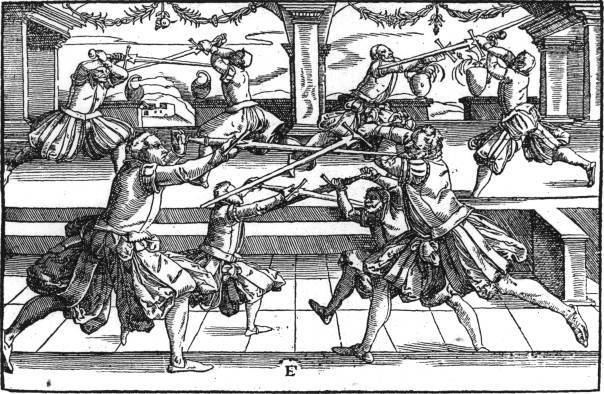
We have papers and statues affecting the London guild of masters of arms from the 1530’s, and a number of woodcuts from the same century depicting the fechtchules, where those who could pay the dues and commit to the rules of membership could study the arts of war under an acknowledged master. These woodcuts display training in the longsword and quarterstaff, in the grosse messer (the “big knife” single-handed sword; the kriegsmesser or “war knife” is the two-handed variant, of German usage), and to a lesser extent, in other weapons.

Generally, students accepted to a fight school where called “scholars.” After studying for a time and proving adeptness in  the foundational skills, they could progress to “free scholars” and then to “provosts.”

Doing so required “playing the prize,” a public demonstration of skill through sparring matches with other members of the school as well as (potentially) the school’s master and even potentially visiting masters (though this was usually reserved for someone seeking the title of master himself–according to Parisian law of the period, he would need at least three other masters to certify his skill with multiple weapons).

A raised platform for visibility was an expectation for the event, and the person playing his prize might be expected to provide beer or other drink for his schoolmates (for the afterparty, I guess), so we are again returned to the linkage of social status (or at least wealth) with attendance at these schools.

Bear in mind that, in England at least, “foyning” (thrusting) was made illegal (I’ll pick this up in the next post) in 1534. Sparring was conducted with bated (i.e. blunted) steel; some amount of injury was expected. The crowds, though, were also used to executions as a form of public entertainment (ultraviolent films had not yet been produced, after all), and it seems that there was a ready audience who wanted to see the blood flow. Remember that armed fights are usually over very quickly, and if the exhibition, as it was intended to be, consisted of controlled action emphasizing finding the opening with discipline and technique enough to pull the strike when it was clear that it would have connected, then there was room to add more blood to the show.

I don’t have the documentary evidence to back this up, but I’ve heard more than one historian say that (an as a folk etymology it makes sense) the organizers of such exhibitions arranged for pugilism to warm up the audience–unarmed fighting lasting longer and being a bit bloodier when conducted with bare or lightly-padded fists and actual intent. Over time, the pugilism aspect became more and more of the focus, hence our modern reference to boxing as “prizefighting.” Remember, the scholars, free scholars and provosts were “playing the prize.”

The 16th century also saw the burgeoning field of science applied to the sword, particularly math and geometry. Indeed, Mercutio describes Tybalt (in Romeo and Juliet) as “More than prince of cats, I can tell you. O, he is the courageous captain of compliments. He fights as you sing prick-song, keeps time, distance and proportion; rests me his minim rest, one, two, and the third in your bosom: the very butcher of a silk button, a duelist, a duelist; a gentleman of the very first house, of the first and second cause. Ah, the immortal passado! The punto reverso! The hai!” (Act 2, Scene 4). It was in particular the Spanish who made comparisons (in the rapier fight) with dancing–the importance of precision of time and distance, with careful footwork. For more information on this aspect of the science of arms, see Sydney Anglo’s book, The Martial Arts of Renaissance Europe, which includes both frontispieces showing the fencing master/author as mathematician and scientist (bearing compass and other tools of the trade) and images parodying the overuse of mathematical principles as the major focus of fencing instruction (there is one in particular of a dwarf farting, with the wind from his buttocks parsed out into geometrical diagram).

I want to emphasize, again, that despite the prevalence of the written fight manuals in this period, the bulk of real instruction took place through personal relationships, whether or not commercialized. The richest employed private instructors, while the middle class sought the public instruction available through the guilds and schools run by masters of defense. Without a practice partner and the opportunity to work through precise (and sometimes complex and counter-intuitive) maneuvers, it is difficult to do more than properly practice stances, movement between them, basic cutting technique and blocking technique when working solo.

Let’s conclude this part by bringing it to the writer’s craft and the gamer’s table. If you have a martially-skilled character, how did he learn, and how did that affect him. Was his teacher patient or demanding? Was his instruction in solitary practice between single student and instructor, or as part of a group whether in military drill (which, as we have mentioned, would have focused more on formation and movement than the techniques of individual combat) or fight school. In a group, what were the rivalries, tough lessons and embarrassments, not to mention successes, that shape how the character thinks about fighting now?

For the D&D (and other fantasy game) players, what about a fighter whose purpose in adventuring is not the righting of wrongs or the accumulation of wealth, but the gathering of practical fighting experience in multiple weapons to undergird his dream of establishing a fight school? Unfortunately, D&D’s approach to weapons is almost entirely gamist, without much in the way to distinguish when a dagger is a better weapon than a halberd, or that its the skill of the arm much more often than the weapon itself that causes the grievous injury, but I digress.

On that note, think about what the experienced swordsman actually thinks about fighting. The assumption in D&D and its many sister games is that the fighter is expected to jump into the fight, to push the party into combat encounters. But the person who knows how fragile life is in hand-to-hand combat, that even the lucky unskilled peasant can kill a well-trained knight, probably doesn’t rush to fight when there are alternatives. And almost certainly avoids doing so fairly when he has the option of seeking advantage. Yes, there will be some for whom ideology overtakes all practical concerns, but that should be far from the norm (and when it is, it’s all the more believable when it does occur).

For the next post in the series, click here.


FFF’s Guide to 6th Edition Shadowrun Characters, Part V: Make Your GM Happy

For the previous post in this series, click here.

I’ve ferociously tapped out a lot of words on the subject of making characters in the sixth edition of Shadowrun, and I truly hope you’ve found them to be valuable. But so far, I’ve only tip-toed around what makes Shadowrun so great–the setting and the characters that inhabit it. In this last post in the series, I’ll talk a bit about the non-stat details of building characters.

It is very easy for the mish-mash of genres that Shadowrun is (not to mention some of the things that inhabit it) to give the impression that this is a gonzo or pulp-style setting. Certainly, you can treat it that way, and I’m not going to tell you your wrong if that’s your preference. But for me (which you’ve probably seen coming if you’ve read more than a handful of my posts), the excitement of Shadowrun (in addition to having some of my favorite things: magic and cyberpunk, in one setting) is the sheer what if? fun that can be had when the setting is approached with verisimilitude in mind.

There are a number of (uncomfortable) parallels that can be drawn between the real world in 2019 and the Shadowrun setting: governments that seem to care less and less about certain types of people, private companies and concerns with far too much power and far too little oversight, racism and divisiveness prevailing over unity and compassion, and an ever-increasing and deepening divide between the ultra-wealthy and everyone else. There’s plenty here to latch onto anchor the believability of a Shadowrun game.

That trolls and orks are the focus of racism rather than members of specific ethnicities or religions is an easy translation (and perhaps a safer space for exploring some of those problems than a strictly real-world equivalent, which can, of course, still be found in the Shadowrun world).

The technology of Shadowrun seems to be a relatively realistic progression of our current technologies, provided that full-immersion VR and DNIs are possible.

Magic and all that goes with it is perhaps the hardest point of verisimilitude, but given our culture’s fascination with “real world plus magic” stories (Harry PotterThe MagiciansThe Umbrella Academy, just to name a few), there’s no reason to suspect this constitutes a special hurdle.

So, creating characters who live and breathe in this world, for whom this is everyday reality, should not be so difficult. And that’s why I’ve titled this post as I have–developed, nuanced and believable characters are a GM’s dream.

It is more narratively interesting, for all involved, I think, for characters to be threatened in ways that are not simply based in the stats of the enemies they must physically confront, or the difficulties of the obstacles in the way of their success. The more interesting challenges are those that force moral questions, require the characters to choose between the lesser of two evils or between self-interest and altruism. The more interesting threats are those that challenge a character’s worldview or that act against those (non-material) things the character holds dear.

While the shadowrun may be at the core of the game, and it can certainly be played such that the overarching world plots and the revelation thereof are the campaign’s focus (this is the way the game line has been developed in many ways), the best drama for me comes from plots in how the characters relate to each other and those around them while living the life of a shadowrunner. When the players take the position that they do runs for money but have character goals (whether or not internal or external) that they have their characters regularly and doggedly pursue, then they have three-dimensional characters who really live into the conceit of the shadowrunner lifestyle.

This height of roleplaying intensity and drama requires both a dedicated GM who can respond and improvise on the spot to player-character driven plot developments and then look forward to incorporate those developments into the overall plot of a campaign and players who are willing to put in the time to develop their characters enough to drive the action of the plot with the psychological needs and global desires their characters have. Since this is a series on building characters (and a not-so-subtle opportunity for me to explain to my own players what I’d like to see from them), it’s that latter part we’re focused on.

To begin, the SR6 rulebook devotes some space (perhaps not as much as I’d really like, but some) to developing a character history and idea before starting with the Priority Table. Previous editions have jumped straight into the mechanics, so this is a step in the right direction and, again in line with the edition’s move in a more narrative direction while not abandoning fully the detail and grit of its (historical) system.

Additionally, the rulebook asks the player to think about how their character feels about (and, by extension to what extent they’re comfortable handling) the darker and seedier sides of the Shadowrun setting. For a setting where prostitution and human trafficking has progressed to forcing sex workers to use personality chips to override their natural personas with personas designed to fulfill the sexual fantasies of their clients (see Bunraku Parlors), this is an absolutely necessary conversation if you’re going to play into both verisimilitude and the grit (and existential horror) of a cyberpunk setting.

I’m sure that there will be comments about “special snowflakes who need trigger warnings” and “catering to social justice warriors,” but people who make those comments are not people I want at my table. As a game, everybody needs to be able to have fun. As an art or literary form, everyone at the table needs to be comfortable enough with the subject matter to engage in it, and forcing discomfort on participants is not a way in which this medium can be successful (though I acknowledge that forcing the observer into a state of reflective discomfort may be a worthy goal of art in general).

GMs should not leave the book to do the heavy lifting on having these conversations–this is a Session 0 concern of importance.

But back to characters. What can the player do to create both a character that is more interesting to play (because s/he/they are more than the sum of their numbers) and that gives the GM more to work with in developing the campaign?

Let’s start with the basics. Your character needs a name, and if you tell me is Dr. Murderhobo McStuffins, you’re dead out of the gate in my game–and in the most embarrassing and ignoble way I can devise. But bring me a believable name–even a strange or exotic one–and you’re on the right path. Give me a street name with a story behind it, even a simple one, and you’re starting to find some favor.

On of the best examples of a really interesting street name comes not from Shadowrun but from Joe Abercrombie’s First Law series. We meet the Named Man called “Shivers” as a hardcase who has it out for Logen Ninefingers, and we find out just what a hardcase he is in his “adventures” with Monza Murcatto in Styria. We assume that his name has an equally hard origin until he reveals that he’s called Shivers because he went to take a piss in a river before his first raid, fell in, was dragged a good ways and came out without his clothes and shivering. That’s how you get a street name!

A good backstory can give your GM great hooks to involve you in stories that go beyond, “you meet Mr. Johnson in a trendy club.” And knowing the life-changing events in your character’s past can give your GM the ability to pull at your character’s (and your) heartstrings, adding drama and interest to the campaign. It can also help your GM to give your character chances to shine in both action and drama.

It’s tempting to think that this requires a long written backstory, and then that you need to give it stylistic treatment. I can assure you that bullet-points that get the gist across will suffice, and that’s something you might realistically spend the time doing (this isn’t a judgment, just a statement of reality; everyone is busy).

Your character’s background can help to reinforce the genre (high tech, low life; systematic oppression and inequality of power and resources; the mysteries of the Awakened world; the constant shadow games and betrayals of the megacorporations; the commoditization of all aspects of life; the descent of the planet’s ecologies as it they are indiscriminately stripped of resources for short-term gain). If your GM has some campaign themes in mind, your character’s background can reinforce these as well.

Ideologies are important, too. Does your character have a faith? Does your character go to mass every Sunday, but spend his time there playing AR or VR games? Bear in mind that you don’t have to be religious yourself to play a religious character; Joss Whedon (who I like to call my favorite atheist theologian) has written or said a lot about his fascination with the narrative of characters of faith, particularly when they’re struggling with that faith. Roleplaying a character of faith doesn’t require an admission of truth in what the character believes, and we could probably all stand a little more empathy with people of faiths that don’t match our own.

Of course, ideology and faith are not necessarily the same thing, though they’ll certainly influence one another. Is your character an anarchist? A collectivist anarchist or and individualist anarchist? Even the punk philosophy has its points of contention; no ideology can be roleplayed with integrity without some nuance to it. And that makes for interest in-game situations–what if your anarchist character is approached to do a run for an anarchist collective, but you don’t agree about end goal or means? That’s interesting.

Everyone alive has goals for their future–the ability to set a future goal and plan for it is an important distinction made between animal and (meta)human intelligence. Even if your character doesn’t think often about what her goals are, she has them. The more important they are and the more conscious she is of them, the more they can be used to drive the plot. Sure, your character is a runner right now, but does she want to save up enough nuyen to eventually open a bar for other runners to hang out and share intel in? Is she looking for that one big score that will allow her to spend the rest of her life on some beach in the Caribbean League? Does she want to kill the Mafia don who she sees as responsible for her sister’s death? Does she want to be known as the best decker in her city? All of these goals might influence both character and plot.

Contacts are a great way to flesh out your character and give the GM hooks as well. How do you know your contacts? Do you like them? Do they like you? Loyalty and liking each other aren’t the same thing.

All those fake SINs I recommended your character have? They all have (fake) personal details attached. You should come up with at least the very basics for each one. Think of driver’s license information: what’s the name on it? how old does it say you are? what does it say your profession is? where does it say you live (general area should suffice)? what does any associated picture look like (clean shaven, long hair, different colored hair)?

The more details you have about who your character is, the more opportunities the GM has to tailor events, situations and plots to involve your character in more than the mere “this is the mission we’re currently playing through.” I want to reiterate here that the focus on character development should not be coming up with a well-written, in character semi-memoir to date or a short story representative of the character. Yes, you can do those things if you have time and will, and they might be helpful. But if you start them and don’t finish, that’s not going to help you and your GM very much. Start with easy stuff: bullet-point descriptions, a small collection of pictures that exemplify aspects of your character, and other small stuff provides plenty to begin with–you can work on your own (and, as necessary, with your GM, to build and add-on details as you go).

One of five-point Edge expenditures allows you to intrude somewhat on the GMs prerogatives and to add a detail to the story–this is a great way to insert something into the plot when you have an idea related to your character details.

Even if you don’t often (or ever) resort to that assertive method, the more you give your GM to work with, the more interesting and custom-tailored he can make your campaign, whether he’s creating it from scratch or using premade adventures.

Don’t skimp on this aspect of character creation, but be efficient, too!