Pilgrimage, Day 6: All Jesus All the Time

For the previous entry, click here.

We spent the majority of the day today in Capernaum and on Mt. Arbel. I’m not able to express my feelings about these experiences in words just yet, so I’ll share some of my thoughts instead.

Capernaum was Jesus’s “home base” during his ministry. The town sits on the northwest side of the Sea of Galilee (a glorified lake, really), firmly within Jewish territory but not too far from Gentile settlements. It makes great practical sense–Capernaum lies near the international trade routes and near many of the other major settlements of Galilee. Even more, archeology indicates that Capernaum was a manufacturing center for grain and olive oil–meaning that people from all the smaller villages nearby likely came to the town with their raw materials, allowing Jesus’s ministry to reach farther more efficiently.

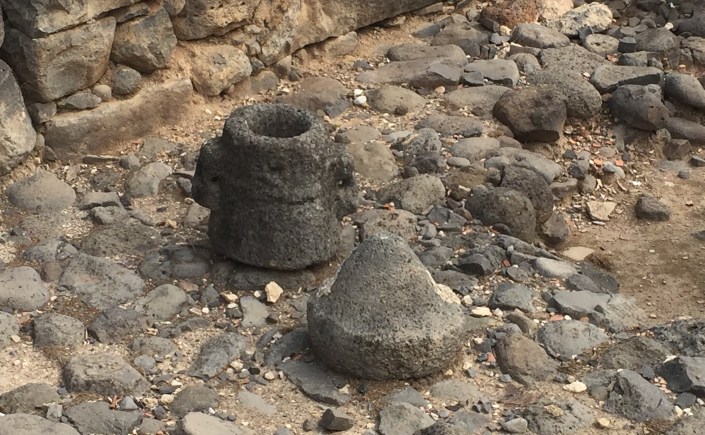
There were other realizations today. Prime among them, which has been building since we got here, is just how poor my mental imagery of Biblical scenes had been–the imaginative equivalent of a painted-craft-paper background in an elementary school play. This land is diverse in form and terrain, beautiful and full of life (both plant and animal). More than this, I’m starting to realize just how visual Jesus’s mode of speaking and teaching is. It’s axiomatic to say that Jesus spoke in parables that would make sense to the disciples, but it’s another thing altogether to say that Jesus had the objects he used in his analogies before him at the time he spoke the parables. This makes good pedagogic sense as he’s attempting to use the mundane to explain the complex and supernal. When you see a donkey mill–the kind of mill often used for milling grain in 1st Century Israel–and know that the device was so common that there was almost certainly one in front the disciples when Jesus says that it would be better to tie a millstone to your neck and throw yourself into the ocean (the Sea of Galilee, too, is likely in view at the time, a wholly different and more complete understanding comes into focus.

As Dr. Beck argues in his books and on this trip–very rightly so, I think–Jesus made great use of geography and the things that could be seen at the locations where he gave particular lessons and made particular statements.

This takes us to Mt. Arbel, the likeliest location for the Sermon on the Mount and the Great Commission. Rather than rehashing, I’ll refer you again to Dr. Beck’s books for the full laying-out of the argument. But, sitting on the mountain, going through the Sermon on the Mount, listening to Jack’s explanation, I could not help but be moved. Until today, I had not had the visceral emotional response to being were Jesus walked and taught that I had hoped to have. Today, though, things became real at a very fundamental level. There’s something about putting Jesus’s words into geographical and visual context that makes them feel more embodied (and therefore more “real” and relatable) and at the same time more spiritually profound.

I’m also realizing just how perfect the place and time of the Incarnation was. As I mentioned in previous posts, the Roman Empire makes a perfect example for the kind of craving for wealth, power and dominance that Jesus argues against. That Israel represents the great international route between the Middle East and Egypt by land and is linked to Europe and the rest of Africa by sea, means the message has a way to reach the world. The place itself and its history provides the context for a revelation that directly addresses the people of the place and yet remains universal in applicability.

For me, especially, with my heavy philosophical bent, this journey is really convicting me of the embodied, present and concrete nature of Jesus’s life teachings, and Passion. When we arrived, we were told that, like Abram, God has called us to Israel, that there is something for God to reveal to each of us here. This confrontation with the Incarnation as something no longer abstract and far away in time and place may be just the thing God brought me here to show me. It’s certainly something I needed, even if I didn’t know that I needed it.

For the next entry, click here.

Pilgrimage, Day 5: The Modern and the Ancient

For the previous entry, click here.

I’m trying to get a jump on posting for the day instead of, as I’ve done the past few days, waiting until the last moment. It’s about 4:00 p.m. local and, having finished our touring day (since the winter hours for Israeli national sites has them close at four), we are on the bus back to the Sea of Galilee.

As I mentioned yesterday, we spent today in the Golan Heights. We heard sporadic artillery fire, all of which came from an Israeli tank proving ground close to our first visited site. Burnt-out tank hulks left from the six-day war occasionally cropped up in the otherwise beautiful scenery. We spent about 10 minutes driving behind an IDF humvee with a remote-controlled turret boasting a 50-cal machinegun and a TOW missile launcher. Overhead were the vapor trails of fighter jets penetrating just into Syrian airspace just before hitting their afterburners back to sovereign skies. At least once, we passed a barbed wire fence warning of unexploded mines on the other side. Still, there was never a concern for safety, just an ever-present reminder of the frailty of human nature and the conflict that results from such weakness.

The closest we came to the actual border was on the (dormant) cinder cone of the volcano, Mt. Bental, where we surveyed the land while standing next to two U.N. observers tasked with keeping watch over the “no man’s land” that starts a scant few miles from the base of the mountain and its nearby twin. Just across the border, about due east, lay the ruins of Quneitra, destroyed in the Yom Kippur War. Just north of that, the town of New Quneitra, where the inhabits rebuilt after being unable to salvage the ruins. Damascus lay just outside of view, thirty-seven miles to the Northeast. It was a strange feeling to be so close to such tragedy and unable to do a damn thing about it.

Mount Bental was our second stop today. Our first was Gamla or Gamala (the “Camel”), a humpbacked hill set deep in a canyon to the northeast of the Sea of Galilee that had been heavily fortified by the Sicarii (sometimes called “Zealots”) who probably had many commonalities of thought with the Nazarenes. The whole thing quickly reminded me of the Rebel Alliances’s base on Hoth, a fortification from which to strike out at the (Roman) Empire during the 66 C.E. revolt. In 67, Agrippa II failed for seven months to take the fortress and kill its inhabitants. Vespasian then arrived with three legions and built ballistae to fire 1300 stone balls and 1600 arrows into the fortress. This caused a breach, but the Romans suffered heavy casualties in the close quarters combat that ensued, with the defenders going so far as to topple interior walls onto the invaders, forcing a general retreat. A second assault was successful, with tradition holding that the core survivors fled to the citadel at the top of the hill to cast off their wives and daughters before jumping off themselves. A northern Masada.

Josephus says that the Romans killed 10,000 at Gamla. I find that highly suspect, based on the size of the settlement (at least as is currently visible) and the poor likelihood that a defending force of that size (1) would have been able to withstand siege for seven months without running out of supplies and (2) would have chosen to turtle up in their fortress and allow the Romans to seize the initiative when they had superior numbers and knowledge of the terrain.

Our interest was in the first-century synagogue in Gamla, the lower architecture of which is relatively well-preserved. It is highly probable that Jesus taught their during his Galilean ministry. The trek down the ravine to the fortress (and back up!) was exhausting but worth it.

After Bental, we first visited Caesarea Philippi and then Dan. At Caesarea Philippi, the Romans built a temple to Pan inside an artificial cave in which sprang one part of the headwaters of the Jordan river–a cave that was often thought of as a gateway to hell. A temple to the genius of Augustus Ceasar was also erected. At Dan, the King of Israel Jeroboam had an altar built and a golden calf idol placed so that his people would not have to travel south to the Temple in Jerusalem in the Kingdom of Judah to worship (and be tempted to defect).

It was between these two places that Jesus brought the disciples when he asked them “Who is it that people say that I am?” Behind him, Mt. Hermon, the only “real” mountain in Israel and thus the likeliest spot meant by Matthew when he describes Satan taking Jesus to the mountain to show him the splendor of nations and to offer them to him. Mt. Herom overshadows the ancient international highway, where the caravans of goods from the various nations would have represented their splendor without any miraculous or “magical| move on Satan’s part. When (soon after answering that Jesus is the “the Anointed One, Son of the Living God”) Peter tells Jesus that he cannot go to Jerusalem to die, Jesus responds “Get behind me, Satan!” just as he had previously told (actual) Satan.

Additionally, Caesarea Philippi represented the waywardness of Roman paganism while Dan represented the errancy of the Kingdom of Israel in falling away from worship of Yahweh (and the Canaanite paganism with its idols as well). It was a perfect–if unexpected–placed to pose the question of identity and capability to the disciples. Satan, death, Hell, the Empire, paganism–all were present to view the declaration.

The ideas above came either from our wonderful guide, Jack Beck (I suggest reading his books and watching his documentaries) , or from some of the Methodist pastors with whom I’m traveling.

To conclude, I’ll give you an idea of my own. You have likely heard the comparison and juxtaposition of the Caesars as divine figures with Jesus as the Son of God. Let’s nuance that a little more: the Romans didn’t actually worship the Emperor; they worshipped the genius of the Emperor. This is a little hard to explain, and a scholar of Imperial Rome would do it far better than I, but let’s give it a shot, shall we?

The Romans believed in numen, something akin to the Hawai’ian idea of “mana.” Spiritual power infused things to different degrees, from the small gods of the household and the spirits of ancestors to the greater gods of the state pantheon. The genius of the Emperor, then, was the numinous or divine power behind and within the Emperor. This may have become one in essence with the personality of the Emperor upon death, but during life the Emperor himself and the Emperor’s genius were related–closely–but distinct. The Roman Emperor has a divine force within him but is not divine in essence.

Contrast that with the orthodox Christian doctrine of the nature of Jesus Christ–both fully human and fully divine, with those aspects inseparable from one another, the perfect union of humanity and divinity in the same (consubstantial) essence. While I’m not sure that this comparison addresses anything not already spoken to by the volumes of theology already written, it does provide a sort of bridge into discussion of the nature of Christ by way of comparison. Clearly, I’m still very much focused on the sharp contrast between the Roman as a representation of the faulty ideas the culture of the world gives us and the spiritual truth that Jesus speaks, and does, and is.

For the next entry, click here.

Pilgrimage, Day 4: First Revelations

For the previous entry, click here.

Today started at 5:30 a.m., as we scrambled to get our bags packed, eat breakfast and portage said bags out of the Jaffa Gate and down to the bus to leave before 7. Uncharacteristically for me, it’s about 11:00 p.m. local as I write this. Something about the combination of this place and the fellowship of those journeying with me has given me more energy than I typically have.

Our day started with a whirlwind trip through Ceasarea Maritima and its aqueduct, then to Muhraqa Carmelite Monastery (for its position on Mt. Carmel near where Elijah confronted the priests of Baal), to Tel Megiddo, to Nazareth (particularly Mt. Precipice, where the photo above was taken. Er–the photo that would be above if the internet would allow me to upload it) to our hotel on the eastern (formerly Gentile) side of the Sea of Galilee.

In case it wasn’t apparent, the day was packed, with over six miles walked and at least five hours in the bus.

I have much to say about the day’s experiences, but I’ll focus on one idea in particular and leave the rest to germinate further.

Consider on the one hand Caesarea Maritima, a piece of Rome in the Middle East created at the command of Herod the Great, lover of all things Roman as well as power and luxury. And perhaps genius builder. Herod wanted to have a palace (complete with swimming pool) that appeared to float on the sea. He also wanted to create an artificial harbor (reportedly larger than the Athens harbor) on the dangerously shallow coast line where Strato’s Tower had stood.

This required an unprecedented use of hydraulic cement–that is, cement that will set even underwater. The Romans had invented the stuff and used it to build bases for piers and other small-scale projects, but Herod used it both to lay the foundation of his palace and breakwaters for the harbor. The site had no potable water, so Herod built a Roman-style aqueduct to bring water in from thirteen miles away.

Not to be without the finer elements of Roman culture, Ceasarea Maritima boasts a large ampitheatre and a chariot stadium that could have fit 20,000 people. Unwilling to have the same beige limestone look as Jerusalem, marble and granite were imported by sea to create columns, statutes and sheathing for those facades that were not plastered and covered with frescos. Intricate mosaic tilework covered the floors of many buildings and homes, which had indoor heating through the innovative Roman technology for underfloor steamworks and used the tides to sweep latrine waste out to sea twice a day. The remnants of clay pipes providing running water remain evident.

The city must have passed the test, because Pontius Pilate lived in Herod’s Palace there as much as he could (when business did not call him to Jerusalem), as did later provincial overlords. Caesarea Maritima boasted trade (at least for the import of luxury items), the latest in first century CE technologies, and art and architecture worthy of the Empire.

On the other hand, consider Nazareth. If, as I was before today, you’re not familiar with the geography, here’s what you need to know: Though an urban sprawl today, Nazareth was a tiny village in the first century, perhaps a dozen homes and just enough land cleared for subsistence farming. Those homes–they were mostly caves, perhaps expanded for a little extra comfort, but caves nonetheless. These dozen or so cave-homes occupied an elevated bowl shape surrounded on all sides by rugged mountain terrain. Until the Israelis literally (I assure you that the word is being used correctly) cut through the mountainside to build a road, there was no easy way to get to Nazareth. Pick the spot you think will be easiest to climb, and set aside several hours to do it.

This is probably exactly how the people of Nazareth liked it. Given their proximity to the ultra-fertile Jezreel Valley below and the numerous nearby settlements (Nain and Shunem, to name two) where they could have lived, this village’s isolation must have been highly intentional. A handful of Jewish families willing to scratch out an independent living to practice the faith of their forefathers and to avoid contamination by the Greco-Roman culture seducing their many peers. The kind of place our dear President would likely call a “shithole.”

When Jesus uses Rome as an example of the often-corrupting influences of wealth, status and power, he can point to Caesarea Maritima (named for Augustus Caesar) on the coast as a very concrete example of his meaning. At the same time, the King of Kings himself hailed from the unlikeliest and humblest of origins–a dirt-poor and poorly-regarded settlement of religiously-fanatic survivalists. The juxtaposition of these two real, geographically significant places brings sharply into focus the tension between those seductive but ultimately unfulfilling vanities with the extent to which God proved willing to condescend to be present with us in the world. Two very different ideologies (and here I mean God’s in choosing to use Nazareth, not the Nazarene peoples’s own ideas) placed in such close proximity in the same land.

Let it sink in.

Tomorrow, we’ll spend much of the day in the Golan Heights, visiting a first-century synagogue where Jesus almost undoubtedly preached, the village of Dan in the far north of the country near the borders with Lebanon and Syria (if the weather is clear enough, it might be possible to see Damascus from there) and Caesarea Philippi. It’s hard to think that on this pilgrimage we’ll be so close to the continuing devastation and heartache of the Syrian civil war.

For the next entry, click here.

Pilgrimage, Day 3

For the previous entry, click here.

Today has been a long day. We started the day at the Jerusalem University College campus for a briefing on Dr. Jack Beck’s approach to geography in the Bible.

If it’s not clear that I’m a nerd, this may have been my favorite part of the day. By my understanding, Dr. Beck’s approach is essentially existential–the geography of the land formed a crucial and central part of the worldview and cosmic understanding of the Biblical authors. Understanding the geography of the Holy Land helps us to understand the way that they thought and felt about the subjects about which they wrote.

This existential–and unfortunately, mostly intellectual–understanding informed my day today more than I had anticipated.

After our morning classroom session, we proceeded through Jerusalem’s Jewish Quarter to the Western Wall, the part of the late retaining wall built for the Second Temple that is closest to where the Holy of Holies once stood. Many of those traveling with our group felt the tangible presence and power of the Lord in approaching the wall. I, unfortunately, did not. I saw a pile of old stones. Historically and religiously significant, of course, but no more directly relevant to my spiritual understanding than any rock formation built from Creation. In some ways, I envy those whose experiences were more profound than my own, and I take some solace in the fact that that’s the majority of our group.

But my own experience also directly relates to some points that Dr. Beck has made as well as more expansive conversations I’ve had with fellow pilgrims. Both Judaism and Islam have significant attachment to physical location Christianity, focused ultimately on the person of Jesus Christ (and, perhaps, on orthodoxy rather than orthopraxy), does not have as strong a (institutional or faith-wide) focus on geographically significant places.

Considering the journey I’m on, with its particular focus on geography, that statement requires some unpacking. For Jews, the physical presence of the Lord within the Temple constitutes a central locus for the religion. For Islam, the Holy City of Mecca represents a physical place strongly tied to the faith it represents and embodies. For Christianity, however, the focus of embodiment is a focus on God adopting human flesh, not upon a geographic locale. And the God who dwells among us is simultaneously more universal and more ephemeral than geography–that is the way of all flesh. In some sense, that perhaps undermines the (temporal) power of Christianity. Ultimately, though, it makes the theology of Christianity far more applicable and far more enduring than those of the other “faiths of the book.”

If that is the case, then the geography of the Holy Land holds power to better help us understand the person and words of Jesus Christ without itself verging on idolatry as the physical bearer of what the Hawai’ians might call “mana.” But the land itself is not a source of salvation as it might be considered to be in Judaism and Islam. This analysis, I hope, is what influenced my lack of strong emotional response to the Western Wall. I found myself more moved by the significance of the devotion of worshippers at the site than the site itself.

After the wall, we traveled to the City of David, that hill to the south of the Temple Mount that likely represents Jerusalem after David seized it from the Jebusites (and, indeed, the city had been called Jebus before the Israelites conquered it). I found the geography here fascinating for its claustrophobic space–an entire settlement containing only 10 acres. Solomon would follow his father by building the First Temple of the Lord, expanding the are of Jerusalem to something closer to 32 acres. The archeology, which has been ongoing for over 20 years at the site, made it clear that the location matched both the Bible in description and the material culture for the period of David.

We had intended to travel through the “wet” tunnel built by King Hezekiah to bring water from the Gihon Spring in the Kidron valley to the Central Valley on the other side of Mount Zion (the ancient mount Zion on which the City of David was built, not the more modern “Mount Zion” partially contained within the Old City walls, on the outside of which the JUC campus sits) but were hindered by scheduling difficulties. We were only able to pass through the earlier Canaanite “dry” tunnel that allowed passage to the pool tower to which water from the spring flowed from behind the fortification walls. This was quite enough.

After that, we walked down Mount Zion to the Pool of Siloam (and then back up) and back to through the Old City to the hotel. My Fitbit marked over 15,000 steps before the end of the day.

After dinner, I went to find some baklava near the Jaffa Gate to debrief on our experiences. The camaraderie certainly vied for the best part of the day, though I have to say that, ultimately, it’s sharing these experiences with K that ultimately does that.

Tomorrow, very early, we leave to head to Caesarea Maritima, Nazareth, and the Sea of Galilee.

For the next entry, click here.

Pilgrimage, Day 2: Arrival

For the previous entry, click here.

This evening, at least by Israeli time, I write to you from the Gloria Hotel just inside the Old Jerusalem city walls near the Jaffa gate.

We arrived at about 4:20 p.m. local time after a mostly sleepless night on the plane. An hour-and-a-half or so to get through passport control and baggage claim, an hour from Tel Aviv to Jerusalem by bus, a fifteen minute walk up to the Jaffa Gate and the hotel, fifteen minutes to get room keys and take baggage up to the hotel room, and finally dinner at 7:30. After dinner, an intrepid companion and I decided on an evening stroll through the Old City.

It was breathtaking in a number of ways. The beauty of the old stone (the city wall dates from the 16th Century and is a fascinating combination of medieval design approaches. The Old City itself is a tangled ball of streets, sidestreets, alleys, closes and stone stairs, the historical equivalent of the steel canyons of a modern downtown, with stone buildings overhanging on both sides of each street.

My intent was simply to wander and wonder, to soak in all they I could of the environment without being to focused about it, to let it wash over me. This the city did without holding back. We wandered into the Muslim Quarter, where shopkeeps and their children were closing up for the evening. From the instant we encountered the Damascus Gate (we had exited the Old City through the New Gate and followed the outer wall to the Damascus Gate to re-enter), it was clear that things were different there. Four IDF soldiers with M4s stood watch over the entrance, cordoned off by steel traffic barriers like they occupied a make-believe guard tower.

Further into the Quarter, we encountered a squad of eight IDF soldiers in full tactical gear patting down a single young Palestinian man in soccer shorts and a jersey. He cooperated (who wouldn’t with that many assault rifles around) and the whole thing seemed rather low-key, quotidian. Perhaps that’s what bothered me most about the seen, the faces on both sides that resignedly said, “This is just the way things are.”

In an instant, that experience shook me from the reverie of this trip. I came for history. I came for spiritual reflection and introspection. I came for friends and theology. And I forgot that there’s a very real and ongoing struggle here, one with victims and perpetrators and perpetuators on both sides–and dozens of those who have become used to this way of life for each one who wants to do something about it.

To be clear, I have no solution for the Israeli-Palestinian conflict. I have too little real or meaningful experience from either perspective to do anything but naively say, “Why can’t we all just find a way to peacefully and respectfully co-exist?” I have sympathy for both Israelis and Palestinians and a belief that both sides have fault to claim and both sides will have to learn to forgive for their to be any hope.

And while the particulars of Israeli-Palestinian relations trouble me (to the meager extent that I understand them), what I really took away from the scenes I witnessed in the Muslim culture is a reminder. We cannot separate the past from the present just as we cannot separate the present from the past; they are inextricably bound together for eternity. The study of this trip has little meaning if it does not relate the present needs of the world. And I, of course, firmly believe that the message and redemptive work of the Incarnation, the Passion and the Resurrection are every bit as important now as they’ve ever been. As we start our serious work tomorrow, I’ll be going in with eyes open to the need to find something with modern applicability in every past location, person and event we discover.

For the next entry, click here.

This Year in Jerusalem

In less than two months, I’m going to Israel. This will be my favorite kind of trip–a study trip with accompanying professors, homework beforehand, and the goal of coming to understand the cultures, history and geography of Israel and its surrounds to better understand scripture.

I am fortunate enough to have this opportunity because of K’s ministry; this is a trip for young clergy and their spouses. Some of my favorite people are going and we could be going to spend two weeks on the Jersey Shore (place or TV show) and I wouldn’t mind. But we’re going to Israel.

We’ve been given books to read and maps to study and mark up before we go. For me, it is a fascinating and tedious process–I see mentions of peoples or places or cultures from the ancient past and go on hours-long rabbit trails that conclude with me writing prodigious notes to myself on the backs of maps that have little to do with the main point of study. Did you know that there’s a good chance that the near-mythical “Hanging Gardens of Bablyon” were actually constructed by Sennacharib in Ninevah? The same Sennacharib mentioned in the Book of Kings as carrying off people from the Kingdom of Israel and nearly destroying the Kingdom of Judah?

None of that time is wasted, though I imagine it’s going to annoy the hell out of K as I offer (unsolicited) trivia throughout our trip. This course of study has made me feel like I’m in grad school again and–being the perpetual student–I’m loving it. Even moreso, it’s directed my thoughts in some ways that I believe will profoundly effect both my theological work and my fiction writing. Many of the things below will likely see their own posts and soon, but here’s some of what I’ve been brought to ponder lately:

Studying maps and geography has been eye-opening in terms of Biblical (and historical understanding). There are so many things that become clearer about both the broader historical context and the context of passages in the Bible when you understand (however abstractly at the current juncture) the “lay of the land.” The locations and movements of the Babylonians, the Assyrians, the Egyptians, the Arameans, the Edomites and the Moabites and all the other ancient cultures of the Levant sheds light the context of the Israelite people as they journey from polytheism to henotheism to monotheism (and back-and-forth quite a bit). The strategic importance of the Levant on the world stage and the many times it has changed hands over the millennia is just fascinating. There is much to be said about all this (much of it already written by experts in books, so who am I to spend lots of words on it?), but suffice to say that I have studied history extensively and am only now starting to see lots of things come into clarity now that I am locating events and peoples on the map relative to one another. Even some idea of motives become clear when you put things together. All in all, I’m actually a little disappointed that, in all of my historical studies, none of my classes spent a whole lot of time (if any at all) using the geography of the time and place to place events in context.

Of course, all of this study of geography makes me think of Avar Narn. This, coupled with the fact that I’ve recently spent some time looking through Tolkien’s old maps and drawings and their evolution has me going back to the layout and maps of my own fantasy world. I have posted some previous maps of parts of Avar Narn on this site, but I am afraid to say (but not really) that they will soon be obsolete and superseded as I replace them with a more thorough effort at consistently mapping the world (or at least the continent where most of my stories will be set) in line with its history, cultures, and languages. I am beginning to very much envy Martin’s choice to name everything in Westeros in English. In breaks from the map work for my impending journey, I’ve re-sketched the continent, placed it longitudinally and latitudinally, worked out air and sea currents (as best I know how) and, correspondingly, the various climate zones of the space.

Because of some changes in the history of Avar Narn which have occurred both in direct rewriting of that history and from ideas better explored (or created) in the first Avar Narn novel (still very much in progress, of course), there will be further changes to the locations of some of the nations and peoples as shown on the previous maps. Alongside that, I’ll be doing some renaming of locations to tie them in better with the linguistic work I’ve done for the setting. There will definitely be more posts about all of this in the future.

Back to the theology side, where I’ve also been thinking a lot about historicity in theology. This has been something of a journey and a struggle for me. Intellectually–as I’ve communicated through the blog before–I don’t believe that concern with historicity is the most fruitful or meaningful of concerns in understanding our faith. I believe that the text of scripture is divinely inspired–but also filled with human agency and not to be taken literally–but that it’s just not that important to know whether the Exodus actually happened as written (there’s no corroborating evidence that it did). What is important is what the story of the Exodus tells us about our God and the evolving Israelite understanding of God as a macrocosm of the way in which the individual gradually struggles with an understanding of the divine.

At the same time, I cannot deny that the historical context of the Biblical writings is illuminating in its interpretation. And in addition, I find that archeological and historical research can help us understand the human motives in the Bible and perhaps filter some of that from the divinely inspired aspects. For instance, there’s very little evidence to support that the conquering of Canaan as told in Joshua occurred; the gradual occupation of the land by the Israelites as told in Judges seems far more likely.

I’m fine with this; it doesn’t bother me that the Bible may not be historically accurate on all fronts–it’s not meant to be a history (well, maybe Joshua and Judges are somewhat) and has a different purpose for us that should not be confused with absolute historicity. In the same way, Genesis is not intended to be a science manual for the creation of all things.

What I’m struggling with is how emotionally bound to questions of historicity I find myself (in spite of myself). There’s a pang of upset in my stomach when I find that an event as told in the Bible is probably not actually how something happened.

I believe in the historicity of Jesus, but I’d be a Christian even if I didn’t–I believe that the story of Jesus tells us Truth about the nature of our Creator, Sustainer and Savior that is unfettered by our existential reference points. So why do I find myself caring so much about the answers to historicity? Especially when it’s clear that–in broad strokes at least–the Old Testament narrative about the Jews’ evolving relationship with God is borne out by the historical record. I think that this is a matter of wanting things to simple, clear and absolute. And this from someone who finds great wonder in the complexity, ambiguity and mystery of existence! Perhaps that’s what it comes down to–a minor crisis of identity. And that makes me wonder whether all obsessions with the historicity of Biblical events spawns from that very human concern.

In general, I think that the Christian testimony–as an unfairly broad generalization–would be perceived as more reasonable (which I believe it inherently is) if we were able to communicate our faith in a way that incorporates questions of historicity without being dominated by them. Many a man has gone in search of Noah’s Ark (with many claims to have found it), but even an indisputable confirmation of its existence would not tell us much about who God is that the Bible doesn’t tell us already.

I’m sure you’ll hear more about that as I post (to the extent that I’m able) from Israel, where the question will, in some part, be a constant concern of mine (if not all of us traveling together). Stay tuned for more on all fronts.

See my journal of the trip here.

Hell, Part I

K is currently taking a class on theodicy in seminary (I think it’s called Evil and Suffering or something like that). It’s a subject that fascinates me, so I’ve been very interested to lean over her shoulder and see what she’s reading and discussing in class.

As part of an assignment, she had to watch a documentary called Hellbound?, so we watched it together last night. It inspired me to share some of my own thoughts here.

To be clear, I don’t know the answers to questions about hell and judgment. Unless you are privy to some direct revelation on the subject from God, neither do you. So, let’s get that out of the way: you should feel free to disagree with my thoughts here without the word “heresy” being applicable to either of us. What I present here are, in my belief, the most reasonable interpretive arguments about the subject.

Scriptures are contradictory on the subject of hell. There are certainly passages that can be readily interpreted as positing an eternal hell-like condition for those condemned to such a fate, but there is also much ready support for alternative positions. A quick chart for the “big three” of the traditional schools of thought on hell can be found in this article: http://www.patheos.com/blogs/johnshore/2014/11/proof-that-believing-in-hell-is-not-scriptural/.

The chart pictured is also used in the Hellbound? documentary. Please note that, while I probably agree with the surrounding article, I didn’t read it and just pulled the link for reference to the chart. I’ll leave you to delve into the particulars of scriptural confusion about the existence and nature of hell on your own; it’s an interesting investigation.

A quick summary of those popular schools of thought regarding hell above. The most traditional school argues for the existence of a hell made for eternal conscious suffering—fire and brimstone and all that. The second approach, annihilationism, takes the position that those who are not granted salvation simply cease to exist. No conscious suffering, but not being is a pretty terrifying concept as well. The epistles seem to indicate that this was Paul’s position on the subject. Lastly (according to the chart), is universalism—the belief that all people/souls will be saved and restored in the broad sweep of eternity.

Along with scriptural disagreement, we have to be very careful about superimposing popular cultural ideas of hell upon the scriptures. I would argue that most of what people “know” about hell isn’t Biblical at all—it comes from Dante’s Divine Comedy and Milton’s Paradise Lost.

On a more scholarly tack, beliefs that came into Jewish culture during the Intertestemental Period also contributed deeply to popular beliefs about the nature of demons, hell and the struggle of good and evil. These beliefs probably came to Judaism (and then Christianity) from Zoroastrianism. Zoroastrianism is a dualistic religion with a “good god” (Ahura Mazda) and an “evil god” (Ahriman) locked in eternal battle for the souls of mankind. Sound familiar?

Indeed, much of the references to “places” in the hereafter in both the Old and New Testament rely upon the mythologies and frameworks of other cultures as well. The Old Testament sheol looks very similar to other Mesopotamian afterlife descriptions and the New Testament use of the words hades and tartarus draw upon Greek mytho-religious beliefs. They are neither strictly nor directly Christian. Gehenna was a literal place outside Jerusalem; we must at least consider that Jesus’s mentions of gehenna are warnings about impending consequences in the here-and-now rather than proclamations about the hereafter.

When we view all of these factors together, we see that we must make interpretive choices to take a theological position on the existence, nature and purpose of hell. There is a temptation for me to stop here and let the point of this post be simply to ask readers to realize that these interpretive necessities make room for reasonable disagreement on the subject without a need to call those with other views “heretics” or “non-Christians.” However, I’m going to go further and make my own arguments.

To that end, I’ll use several different approaches to support my conclusions and I’ll point you to some of my previous posts for an expanded look at some of these subtopics. For one argument I’d like to share, I point you to the post “The Beautiful Truth about Evangelism.” In that post, I argue that it is poetically and theologically profound that coercion (like the fear of hell) cannot create true followers of Christ. When we talk about the existence and nature of hell, we have to address the preachers who use the fear of hell as their main strategy to (futilely) attempt to win converts to Christ. There, mentioned and discussed in length elsewhere; let’s move on.

Let’s look at justice. One of the main arguments for the existence of an eternal hell is attempt to raise up and accentuate God’s justice (as we’ll find, most of the arguments about the existence and nature of hell are really about the nature of God).

I’d like to offer some challenges to making our sense of justice prime in our understanding of hell. As a lawyer, I think about justice quite a bit, both in the abstract and in the very particular. I am convinced of this: humans are not capable of true justice. True justice, as both American law and common sense would have it, would be the reversal of the injury, a full restoration of all that was lost because of the injury. Because we cannot fix feelings about what has occurred, bring back the dead, or restore lost intangibles, we substitute, approximating justice by the use of some alternative restitution. In criminal law this typically means punishment of the offender. In civil law it means that the offender must pay money to the offended. Neither of these solutions really do all that much in terms of restoration. Only God could heal in a way that undoes the injustice and restores justice. Even when we deal with God undoing the injustice—as in Job—we remain with questions about suffering and justice that are difficult to understand and impossible to answer.

Job led Calvin to posit a “double justice,” arguing that there are aspects of God’s justice which may be understood in human terms and aspects which are unknowable—but nevertheless just. I certainly agree with the latter; I remain ambivalent about the former.

Our inability to fully understand God’s justice should give us pause at assuming the nature of God’s justice and then using that as an argument on which to build theological positions.

Even under human interpretations of justice, we have issues getting to the idea of an eternal hell as just. In American criminal jurisprudence, we have a long-established belief that punishment for a crime ought to be proportionate to the seriousness of the crime and that we ought to avoid “cruel and unusual” punishments. Can we really say that an infinite punishment for finite offense is proportionate and thus “just?” I highly doubt this.

In Hellbound?, the creative writing instructor Robert McKee argues that hell is necessary in Christian theology because, without the possibility of eternal damnation, there is no meaning to our actions and moral choices. Shame on him; someone so well-versed in the craft of creative writing ought to know better. Nothing in a fictional story actually matters—there are no real consequences. Stories matter because we give them meaning aside from the consequences. That’s what stories at their essence are: attempts to create meaning in world that is ambiguous and difficult to interpret. As I think I’ve quoted on this blog before, I’ll point you to the talented writer Joss Whedon and his opposing view. He was once quoted as saying “If nothing we do in the universe matters, the only thing that matters is what we do.”

Christian morality is meaningless if it is based on a quid pro quo or a fear of damnation; it becomes coerced and not a free choice. A virtue is only a virtue when exercised for its own sake and not for reward or avoidance of punishment. Thus, it would be more meaningful for a Christian to commit to follow Jesus and keep his commandments simply because it is right than out of heavenly aspirations or hellish fears. The truth is exactly the opposite of what Mr. McKee says of meaning and hell. In fact, McKee seems to think that there is only his position and the antinomian heresy—that the natural and logical result of redemption in Christ for all would be the doing of constant evil because “it doesn’t matter.” I’m not sure that you could find a single theologian who would say that sin suddenly doesn’t matter if we remove hell from our analysis—we simply don’t need hell to argue that sin is wrong.

I must admit a ready argument to the above, frequently (and often crudely) retorted by fundamentalist faithful—“God can do whatever God wants and that is necessarily just and good because God gets to define justice and goodness.” I can’t argue with that because I can’t argue with God. It is axiomatic that, in a certain sense, whatever God does is correct because God’s the one who has set the rules for judgment.

But that fact is insufficient on its own—because it is so axiomatic it’s also relatively meaningless. It doesn’t actually tell us anything about God and so it doesn’t actually support the fundamentalist’s view about the way that God is.

Let’s peel that back further. What do we say about a god who establishes a certain justice and then creates us to have a gut feeling that the way that god acts is in fact unjust? Nothing good. We would either have to say that that god is omnipotent but less than fully good or that that god is neither good nor omnipotent because some force external to the god’s self establishes a meaning for justice.

Fortunately, that is not the image of the Christian God. By all available measures our God plays by the rules of justice God has established. That is an important message of Christ and the cross—that God will suffer beside us in anything we are made to suffer. That is omnipotence and goodness combined.

What does that mean for hell? For me, it means quite simply that the image of a God who allows eternal suffering (or annihilation, for that matter) does not comport with what I understand about God through the person and divinity of Jesus Christ. I must admit here that in the Gospels Jesus has many difficult statements that might touch upon an eternally-existing hell for the damned. He doesn’t mention such directly, but he does tells about the “broad” and “narrow” ways, and at least one parable mentions casting people in the “abyss” or “outer darkness.” In all intellectual honesty, I must admit that I resolve this conflict by prioritizing my understanding of Jesus drawn from all of the scriptures as a key to understanding any particular scripture. Given the many problems of interpretation in scripture, this seems to me the only reasonable approach (a stance that, as I’ve mentioned in other posts, I share with Barth).

This is not all there is to say about justice and hell. As I alluded to above, I cannot find just proportionality for eternal punishment for finite sins—no matter how extensive. Poetically, isn’t it more just that Hitler dies to find that his efforts at domination, self-worship and annihilation of the Jews have all failed to God’s power and goodness than that he burns in a lake of fire? The former doesn’t just have a sense of justice to it; it also allows for the redemption of even Hitler. As I’ve repeated in many posts, “mercy triumphs over judgment.”

This is the choking point for many traditionalist views about hell. Hitler, Pol Pot, killers, rapists and thieves in general. The problem is that the person arguing from the traditional view of hell here falls prey to some idea about subjective “fairness” rather than objective justice. In other words, “how would it be fair for Hitler to go to heaven when I’ve been so much better than him in my own life?” I don’t know the answer to that question, except that the Bible is full of scriptures reminding us that that’s not a question we’re qualified even to ask, much less answer. We ought to be worrying about ourselves in the context of what is objectively good and right, not what other people do.

If Jesus is not clear about hell, he is very clear about forgiveness. To follow Christ, forgiveness is not an option—it is a strict command. When discussing this subject, I sometimes mention the serial killer Jeffrey Dahmer. Before he was killed in prison, Dahmer claimed to have found Jesus, become a Christian and to have repented of his sins. His sincerity is not the point for us to discuss—only God knows the man’s heart. But does our faith have room to believe that even he could be forgiven and saved (let’s avoid for now the discussion of what exactly is required for salvation and assume that he meets the minimum requirements)?

If we cannot fathom forgiveness for the worst in humanity, we cannot say that Christ has conquered sin. We must ignore the command to forgive others their trespasses against us. We must ignore prohibitions on humans attempting to render cosmic judgment on others. In other words, we must rewrite God and Jesus. We become the Pharisees, saying “Thank God I am not a mass murderer; surely I will get into heaven.” There is no place for the “to outrun the bear I just have to outrun someone else” mentality in Christianity.

There is still much to discuss in the debate about hell, so I’ll continue this discussion in one or more subsequent posts. For the time being, let me leave you with this: I think Rob Bell has the most honest approach to this subject. I agree with his hopes and beliefs regarding hell as described in his book Love Wins, but it’s not the nature of his arguments or his conclusions that I mean here. It’s his opening gambit, his disclaimer, his caveat. He says, in (very) loose paraphrase, that we just don’t know the truth about hell, and by all accounts it seems that we can’t know for sure. Let’s be willing to live in that mystery, talking about our thoughts, our interpretations and our hopes tentatively rather insisting that those who do not take our position are evil, demonic, heretical or un-Christian. Then, let’s focus on loving one another as Christ is clear that we must do.

More to follow.

The Word of God for the People of God, Part II

For the previous post in this series, click here.

The Constitution of the United States of America is often referred to as a “living document.” We use this term because, by some miracle of foresight, careful drafting or the simple adaptability of the generic, the Constitution remains responsive to changing societal conditions. The same document has governed this nation from a time of agrarian society where industrial power was provided by the sweat of draft animals to the digital age.

When Supreme Court justices interpret the Constitution, they often speak in terms of “discovering” new doctrines of law rather than creating or adopting them (the doing of which might be a violation of the Constitution). While we’ve amended the document on many occasions, the principles of the core of the Constitution remain the foundation of American government and jurisprudence. It seems that the Constitutional well never runs dry when faced with new and difficult questions—questions that would never have been considered by the nation’s founders.

If the Constitution is a living document, the Bible is even more so. Given its length and breadth, there’s a lot of material to draw from, but even the same passage read repeatedly on different occasions will reveal different things to the same reader. This layering of meaning in the text of the Bible is one of its most defining features, I think.

Partially, this is a matter of the rich metaphors used by the Biblical authors and by the style of the writing itself. However, I believe that the multiplicity of meanings in and the always-something-new attribute of the Bible runs deeper than the skill of its writers—this is where I would say that the Bible is God-breathed, that it has a mystical way to speak to us afresh and to address our own situation no matter what that situation may be.

The Bible is more alive than the Constitution. The Constitution is alive because we return to its principles as we expand the law to deal with new social, legal and technological issues. In that sense, the Constitution is also dead—without the necromantic power of the person reading and interpreting the document, it is simply words on a page. Interpretation is uncertain, perhaps dangerous even, and best combined with a healthy bit of skepticism and careful evaluation.

The Bible, though, is alive in a different way. The true power of the Bible is that, in reading it, studying it, and living with it, one might have an encounter with the Living God, a personal encounter that transcends words on a page in meaning and power to change a person and a life. That was my experience.

For all of my intellectual theologizing, I did not understand Christianity (to the extent that I do at all) until I personally encountered Christ while reading the Bible—and that occurred only a few years ago. For all my talk of mysticism, that was only one of a very small handful of experiences in which I can say I had a direct encounter with the divine in my life. And yet, it changed me in ways that can never be undone, and neither would I want them to be.

Without the intervention of the divine upon the reader, the Bible does not possess the full power that it might. It would be a collection of wisdom, of valuable words, of a truth not fully containable within words, but it would be dead. The Bible is alive because our God is alive.

As Barth might put it, the Word of God (Christ) often comes to us through the medium of the word of God (the Bible), but the two are not the same and do not always coincide. Priority must be given to the Christ.

That is a difficult thing. How do we discern what an encounter with the divine really means? How do we interpret the messages we believe we’ve received from God, particularly when God has such a mastery of the subtle? We can argue fairly about the meaning of a passage of scripture; it becomes much harder to argue with someone about the Truth with which they feel they’ve been convicted.

If that feels dangerous, it’s because it is. For a historical example of the worst potential from those who claim to hear the voice of God but who act in ways clearly against God’s desires, go listen to Dan Carlin’s Hardcore History Series called “Prophets of Doom.” (While you’re there, stay a while with Mr. Carlin; his podcasts are terrific).

On the other hand, much has been done with the Bible itself that is counter to God’s desires, without a need for God’s involvement at all. See Gary Oldman’s character, Carnegie, in The Book of Eli for a (fictional) example of that.

While we must deal with the problem of interpretation of the divine message, that problem exists whether received in text or direct experience of the divine. The existence of such problems really does not change the way we prioritize the person of Jesus Christ and the scriptures.

As I’ve argued in other posts, the human mind is limited in its ability to understand the divine. Nevertheless, Christianity is a religion (despite its many fractious denominations) deeply focused on orthodoxy, that is, proper belief. But perhaps we ought to focus more (as Christianity also attempts to do) on the substance of the relationship with the divine, which is transformational even without being understood.

To that end, perhaps we ought to talk about the Bible as a kind of entheogen.

The Word of God for the People of God, Part I

It is a phrase we Methodists hear every Sunday after the scripture lesson: “The word of God for the people of God.” This phrasing is not used just by Protestants; its origin is probably in the Institutio Generalis Missalis Romani, the Catholic Church’s liturgical document governing the celebration of mass, where the reader of scripture ends by saying, “Verbum Domini,” and the congregants respond, “Deo gratias.”[1]

The phrase troubles me somewhat, not in and of itself, but in the implications it seems to intimate, particularly for American evangelicals predisposed to literalist and infallibilist positions regarding the Bible.

The Bible itself makes no claim to be “the word of God.” In fact, the Gospel of John opens by identifying Jesus Christ as the Word. Now, Paul does tell us that all scripture is God-breathed and useful for teaching, rebuking, correcting and training in righteousness. 2 Timothy 3:16. I do not mean to call that statement a falsehood (I don’t think it is one), but let’s pull at the strings a little.

The apostle Paul was likely most active from 30 A.D. to 50 A.D., with his death likely sometime around 67 A.D. Scholars do not have a hard understanding of the time of writing and sequence of the Gospels, but they do have enough circumstantial evidence to build strong theories about the same. The Gospel of Mark was probably the first of the canonical Gospels to be written, appearing sometime between 65 A.D. and 70 A.D.[2]

Looking at those dates, we see that Paul had no access to the canonical Gospels during the time he wrote his epistles (which, since he was writing them, were also not part of any recognizable canon). The oral traditions upon which the written Gospels were probably based were undoubtedly in circulation, being preached by Paul himself, others whose names we have in the Book of Acts and certainly many unnamed missionaries as well, but when Paul wrote the words of 2 Timothy, there were no New Testament scriptures to be included in that statement. Really, what Paul is getting at here is that the Jewish scriptures—the Torah, the chronicles and the stories of the prophets—remain relevant to the Christian and should not be abandoned because of the Incarnation.

Let’s also think about the meaning of “useful for teaching, rebuking, correcting and training in righteousness.” Human cultures have always (at least as long as they’ve recorded their thoughts) used both positive and negative examples to model behavior for others. We tell stories of heroes persevering and triumphing over adversity to demonstrate those qualities we think best in a human being. Conversely, we tell stories about people meeting unfortunate ends to warn away listeners from behavior we have deemed harmful or anti-social.

Several genres are strongly based in using negative examples to persuade the audience to avoid or adhere to certain behaviors. The Greek tragedies, based as they are upon the hubris of their victim-protagonists, provide one sample. As a more modern (and specific) example, consider Friday the 13th, where teenagers at Camp Crystal Lake are murdered, typically after some carnal encounter with their fellows. The obvious moral: premarital sex will get you killed; don’t do it.

You can find plenty of additional positive and negative examples for instructing in behavior in your favorite literary medium. Without putting too fine a point on it, I mean to say that not all examples useful for instruction are ones we’re meant to follow. Paul isn’t saying, “do exactly what the scriptures say without question;” he’s saying, “when properly considered, all scripture has something worth learning.” I think that we can all agree with that, but it is not an argument for a literal interpretation as it is often used.

The New Testament did not become an official canon until centuries after Christ. Marcion of Sinope (declared a heretic for his dualistic belief that the God of the New Testament could not be the same as the God of the Old Testament—ironically based on a somewhat literal reading of texts that failed to make any attempt at reconciliation or synthesis) gave us the first list of “authoritative” (according to him) scriptures around 140 A.D. More lists, closer to the eventual official canon, existed by the beginning of the 3rd century and became relatively close in selection by the middle of the century. Still, the first appearance of the exact list that would become the canonized New Testament (and described as canonized) did not appear until a letter of Athanasius of Alexandria in 367 A.D.

In contrast, the first ecumenical council, the First Council of Nicaea, occurred in 325 A.D. Prior to that many smaller councils had occurred as early as 50 A.D. (the “Council of Jerusalem” described in Acts; the next known council was the Council of Rome in 155 A.D.) to 314 A.D. Each of these councils answered doctrinal and theological questions, though the pre-ecumenical councils were not dispositive as they led to different regions ascribing to different theologies, something the Council of Nicaea sought to rectify.

The First Council of Nicaea brought us the Nicene Creed (though it was amended in 381 at the First Council of Constantinople into the Niceno-Constantinopolitan Creed). These creeds, perhaps with minor differences in translation or stylistic variances, are still used in worship today. Admittedly, certain of the doctrines codified in these creeds—particularly Trinitarian doctrine and homoousios—came from disciplined close readings of available scriptural documents, but it is nevertheless important to note that the doctrines were adopted before the official canon, and that it is thus likely (based on human nature) that the official canon selected those books that supported already-adopted doctrine over those that provided arguments against such doctrines.

Did God have a hand in these debates, councils and thinkers who gave us both the doctrine and the canonized New Testament? I have no doubt. Did God fully ordain and control the development of doctrine and the canon? God could have, but that doesn’t match my own experience of how God moves in the world. Of course, I’ve been wrong before…

The point of all of this information is not to discredit the value of scripture in the Christian walk, nor to attempt to answer the ultimate questions of interpretation or theological position of the Bible. Nor do I suggest that we should stop using the “word of God for the people of God” phraseology in our liturgy. God does speak to us through scriptures, although this phenomenon I think is more complex than the reading of the words themselves. It should also be noted that the lack of capitalization of the word “word” in the liturgical phrase “word of God” is purposeful; careful Methodist theology is not trying to conflate the Bible with Jesus Christ. This, however, gets lost somewhat in the hearing of the liturgy.

My goal in this post has been to provide some complicating factors based on history and logic surrounding the creation of scripture to nuance our understanding of the meaning of the words “the word of God” when referencing the Bible as compared to “the Word of God” when speaking of Christ.

This discussion cannot end here, because it does not fully answer questions about the Word of God and the use of scriptures. While I will continue to examine this topic, I’m going to hopefully avoid some pedantry and redundancy by referring you to my early post, “Ambiguity in Scripture, Part IV” for a discussion of the Barthian approach to the Word of God as Jesus Christ, a point I’ll pick up on in the post that follows.

For the next post in this series, click here.


[1] An interesting footnote to this historical point, particularly in the context of this post, is that “Verbum Domini” used to be rendered in English as “This is the Word of the Lord” from 1969 until 1991, when the translation became “The word of the Lord.”

[2] It is possible that the theorized Q source predates Mark and was already in some circulation at the time the Mark was written, but this remains debatable.

The End of Violence, Part IV: An Argument

For the previous post in this series, click here.

As promised, I’m going to humbly offer here my own views as to the appropriate relationship between the Christian and violence. The best way to begin, I think, is to start with a few statements based upon the previous posts in this series (or from scripture not discussed) and which all readers could (I hope) agree upon. Following these statements are some questions raised by the previous analysis that represent issues that must be resolved.

First: When it has a chance of success, a non-violent approach is morally superior to a violent approach.

Second: Jesus never explicitly commands his followers not to do violence.

Third: Jesus wants us to love even our enemies.

Q: If some violence is acceptable, when and how much?

 Q: Does loving our enemies (or our friends, for that matter) necessarily mean punishing those who commit injustice?

Q: How do we resolve the tension that results when we are called to love both those who would do harm and those they target as victims?

The three statements and three questions give us a good foundation to build upon before we delve into the gray area. Here’s how we begin:

Precept 1: The Christian should, to the extent possible, avoid using violence.

Violence solves problems, yes, but it typically creates more problems than it solves. Thus, Matthew 26:52, “They who take the sword will perish by the sword.”

As a student of Renaissance history, I often think of the Wars of the Roses or the vendettas fought amongst the Italian nobility during the Quattrocento. One act of violence creates a need to “get justice” or “get even” or “punish wrongdoers.” We are left with a century of bloody conflicts, each subsequent engagement arising out of those fought before it. I’m not sure that any other century is different.

Machiavelli, writing about that time, offers the pragmatic advice in The Prince that, when one moves against one’s enemies, one ought to destroy every remnant, every vestige of the enemy and his friends and relations so that none is left to seek reprisal. In the struggle for power, as was the status quo in Machiavelli’s Italy, this is sound advice. But it also reflects the extremity to which violence must be used to prevent further violence.

We ought to realize that violence, even if used for just purposes, is a result of the fallenness of humanity. Were everyone to love his neighbor as himself, there would be no need for violence. Thus, while an individual act of violence may not be a particular sin, the use of violence is always the participation in the corporate sin of humanity. Because of this, it must be used only as a last resort and should be employed only with a since of sorrow that a better outcome could not be achieved.

Precept 2: Violence should only be used to prevent or stop violent injustice against a person, not after the fact. The need for violence must be immediate.

If there’s time to think of alternative solutions, there’s time to seek a non-violent resolution to a problem. On the other hand, if immediate action is required, however, the time for seeking de-escalation of the conflict has been lost. This precept helps us to comply with Precept 1.

Let’s also think of the collateral consequences here. One of the questions posed above was how we can balance loving victims and wrongdoers. When immediate action is not necessary, we can attempt to work on loving solutions for both parties. Yes, this may be punishment for a wrongdoer, but I leave that an open question for another series of posts. When immediate action is necessary to preserve life and limb, it seems just to intervene against the wrongdoer to protect the innocent. Not our first choice given the requirement to love even our enemies, but the choice to do something non-violent has been taken from us when immediate responsive violence becomes necessary.

This also means that we do not use violence to punish wrongdoers when there is no immediate threat. Violent punishment has largely been shown to be ineffective at deterring future offense (look at 18th Century England, where the death penalty was handed out like it was about to be outlawed). More important, punishment is more about the punisher and not the punishee. When we seek violent retribution for wrongs done to us or others, we are willingly participating in the fallenness that perpetuates violence in the world. “Vengeance is mine…sayeth the Lord” (Deuteronomy 32:35, Romans 12:19). Violence inflicted as punishment cannot restore to wholeness the party injured by a crime. Because only God is truly just, we ought to leave the meting out of retributive punishment to God. I’m not saying we should never punish wrongdoers; however, violently punishing them is nothing but retribution.

This also means that violence should not be employed to protect property—only people. I’d like to avoid (for now) debates about Jesus’ views on personal property and ownership. Without going into that, I think that we can agree that Jesus’ teachings and life made clear that he valued human life over any property rights he believes in (whatever those may be).

In Texas, where I live, the law explicitly allows justified use of force for the protection of property in specific circumstances. But the law and morality should not be confused—they are separate entities with separate goals and concerns, only sometimes aligned.

Precept 3: Only the necessary amount of violence ought to be used.

To the extent that we can avoid doing more harm than necessary, we should. This is an aspect of loving our enemies. Deadly force ought not to be used if less-than-deadly force could reasonably suffice. The amount of violence we use ought to be scaled to the injustice or violence we seek to prevent. This, perhaps, is what we should take away from Jesus’ statement about turning the other cheek—violence is not the answer to offense, even if violent, that does not really threaten life or limb.

I need to hedge and be absolutely clear that, while a solid precept from a philosophical/theological standpoint, strict adherence to this precept is extremely difficult in practice. When we apply force—especially deadly force—against another person, we have little surety in the ultimate results of the force. There’s plenty of second-guessing to be done in the aftermath of a violent engagement (Would fewer shots fired have been sufficient? Could I have done something differently to stop the attacker and injure him less?), but split-second decisions must be made in a fight and survival is on the line, so the objectively best choices may not be made in the moment.

I recently heard someone say, “if the bad guy is worth shooting once, he’s worth shooting five times.” This is tactically correct—while the human body is a frail thing and a single wound from a firearm may kill a person in a relatively short amount of time, the body is also highly resistant over the short term and a single shot from a weapon the likes of which a civilian would be wielding is unlikely to immediately physically stop the attacker (though it might psychologically). Since the goal of morally-applied violence is to stop the attacker as soon as possible, a high amount of force quickly applied may be necessary, making it less likely that the attacker will survive.

As another complicating factor, applying a lesser degree of force is often accompanied by a greater degree of risk of injury to ourselves. Having studied techniques of unarmed combat, I know (technically) how to defend and disarm someone with a knife. But the same training has made clear that, when fighting a person with a knife, you will get cut, and even expert fighters (which I do not claim to be) can be killed in a knife-fight because of bad luck. If knives come out and I have reasonable tactical distance from the threat, I’d rather be behind a gun. I’m not a big guy by any means, and there are plenty of people in this world with whom I’d prefer not to go toe-to-toe unless forced and, if I’ve decided that violence is morally justified, I’m going to fight to win. A disparity in force with my opponent means the stakes of the violence may be raised higher than I would have voluntarily raised them and I must respond in kind.

Where we can, though, we ought to mitigate the results of our violence to the extent possible. After the threat is over, we ought to provide all the medical attention we can to the injured parties—including and perhaps especially any wounded attacker(s). Again, this is a matter of loving our neighbors.

Precept 4: A Christian who is prepared to do violence must make efforts in the world to prevent the necessity of violence.

If, as I do, you stand willing to do violence to other human beings to protect the innocent, you must recognize some responsibility for participation in culture and human nature that permits violence. Recognizing that, you ought to make efforts to proactively prevent the causes of violence where possible.

By this, I mean actively trying to make the world a better place. Of course, the Christian is called to this anyhow; we are called to show mercy and love justice, so we ought to (non-violently) pursue justice for the oppressed where we can, and we ought to focus on giving wrongdoers the chance to atone and reintegrate into society rather than focusing on punishing them.

This means showing kindness and respect to others—especially those with who you disagree, helping the poor to escape poverty, helping to improve unjust systems and institutions, and showing the love of Christ to our neighbors.

The person willing to do violence ought not to be quick of temper and ought to be ready to forgive offenses—otherwise our readiness to do violence turns to definitely destructive and sinful ends. We ought to hope that we never have to do violence to another person, even if we devote time, talent and money to preparing for the possibility. We must recognize that the proper response to violence is not always more violence.

If we are prepared to do violence, we Christians must be more prepared to refrain from doing violence.

Conclusion

I’d like to summarize my argument thus: We ought to view violence itself as an evil, but one that may be occasionally be used to prevent greater evil. While Christ does not explicitly command us not to do violence, it is clear that love ought to prevail wherever it can. Violence should be employed only reluctantly and with sorrow for the alternative resolutions that have been lost, even if they have been lost through the will of someone other than ourselves. Most of all, we ought to do everything that we can to prevent violence, both in our immediate situation and in the world at large.

I think I probably have one more post on this topic to do, to clean up a few loose ends and address a few things that I realize I’ve left out (what about the Ten Commandments!). More to come.