Cortex Prime Shadowrun, Part VI: Magic, Foci and Alchemy

Yes, it’s been a while since I’ve worked on this series. Yes, my writing work is unpredictable and jumps from topic to topic. The curse of the creative “free spirit” with too many interests, I guess (though I’m usually quick to say that “be interested in everything” was the best advice I ever got). All of that aside, I’m getting back to working on some Cortex hacks of various types to flex my RPG mechanics muscles again. I hope you find the work useful.

Foci
Foci are a big deal in Shadowrun, in many ways the magician’s equivalent of the street samurai packing the Panther Assault Cannon. Modeling them in Cortex is, on the one hand, relatively simple–each Focus is a Signature Asset. On the other hand, Shadowrun uses multiple types of foci and there are some specific attributes of foci in the world of Shadowrun that ought to be mechanically addressed as well.

The creation of foci is best handled in the same way as the acquisition of any Signature Asset: the player pays the requisite cost and a narrative explanation of how the Asset was acquired is given. There’s no need to go through complex creation rules.

Attributes of All Foci:

Limit: A focus may only be used by a character with the magical ability and the ability to take the specific types of actions to which the focus applies.

Limit: Binding: Until a character pays the cost to add a focus as a Signature Asset (whether at character creation or through advancement), a Focus is not bound to the character and cannot be used.

Limit: Active/Inactive: Foci must be powered by magic to be useful. When not powered, foci are inactive and can essentially be ignored altogether. When active, the following rules are in effect. Activation and the rules described below should be considered Limits on a Focus asset..

Astral Beacon: an active focus gives off a lot of astral energy, allowing others with the astral perception/astral projection abilities a benefit in finding, analyzing and targeting a magician with an active focus. When using astral perception to find or to gather information about a target with an active focus, add the focus to the actor’s dice pool as an advantage. A magician using Psychometry or other spells and abilities to analyze the astral signature of a place after the fact may, if the GM determines that the rating of the focus, its past use and the time elapsed since the use is reasonable under the circumstances, be added to the acting magician’s dice pool as an advantage.

Link: Because a focus must be bound to its user, it provides both a material link to the owner regardless of activity and a method for targeting its owner astrally when active. A magician in physical possession of another magician’s focus, or astrally viewing an active focus, may add that die to a dice pool to create an advantage for the purposes of targeting the focus’ owner with magic.

Specific Foci:

Alchemical Foci:
 Alchemical foci add their Rating to Alchemy tests.

Disenchanting Foci: These add to tests to disenchant artifacts, foci and other magical objects.

Spell Foci:
A spell focus adds its rating to Sorcery actions that match the category of spell and type of action to which the focus is attuned.
Limit: Category: A spell focus must describe one of the five categories of spells (Combat, Detection, Illusion, Healing and Manipulation) and may only be applied to Sorcery tests involving the category to which it is attuned.
Limit: Task: A spell focus must also describe one of the following magical tasks: Counterspelling, Ritual Spellcasting, Spellcasting. The focus may only be applied to Sorcery tests involving that task.

Sustaining Foci:
A sustaining focus allows a Magician to sustain a spell effect equal to or below its Rating without the Magician actively maintaining the spell. The spell may be cast at any time and “saved” into the focus to be used whenever the focus is activated.
Limit: Power: To add the stored spell effect to a dice pool, the focus must be activated and the Magician must pay an Edge point to use the effect for that Scene.
Limit: Counterspelling: Counterspelling may be used to reduce or obviate the spell effect maintained by the sustaining focus. To restore the functionality of a effect that has been partially or fully dispelled, the magician must cast the spell to be maintained anew.

Spirit Foci:
A spirit focus adds its rating to Conjuration tests of the task and category of spirit to which the focus is attuned.
Limit: Category: The focus must have a specific type of spirit (fire elemental, spirit of man, etc.) to which it is attuned. It may only be used for interactions with that type of spirit.
Limit: Task: The focus must be attuned to one of the following tasks: Summoning, Banishing, or Binding and may only be used for that type of task.

Weapon Focus:
A weapon focus adds its Rating to close combat tests in the physical or astral planes and allows its user to damage creatures and spirits normally immune to physical damage.

Alchemy:
Alchemy allows a character to store a spell for a one-time use later. This is simply handled: The character makes a test to cast the spell, but using Alchemy instead of Sorcery. The character resolves the test, including Drain, and pays one Edge to store the effect for later (the player should describe the form the alchemical device takes for narrative purposes).

Activation of the alchemical spell may require a test. If the alchemical device stores an attack effect, its rating should be added to an appropriate attack pool for close combat or a thrown weapon.

A spell that causes damage has an instant use. A spell that creates some other effect lasts for a Scene or until dispelled.

EDIT: You might be wondering why some of the classic foci (the Power Focus, for one) has no description here. Those foci that I haven’t listed are temporarily left out until I find a way to include them that satisfies me. As it stands, the Power Focus is just too powerful to add in–without the insane detail of creation cost inherent to the actual Shadowrun rules, I need to find some mechanisms within Cortex Prime that would allow some modicum of balance compared to the other, far more limited, foci.

Rethinking Tolkien

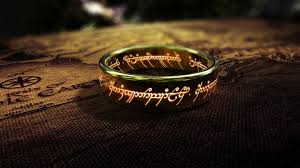
One of the things that’s been keeping me from posting on the blog lately is that I’ve been teaching a Sunday school class on Christianity in Tolkien for the past several weeks and my research and writing time has been in part devoted to preparing worthwhile material for that (I’ve also been slowly working on an Avar Narn short story or novella which you’ll see in the future, but that’s for another time).

I wanted to share some of my thoughts and realizations in preparing for teaching the class here. The late revelation of some of these ideas is a bit shameful to me–I’ve long had all of the evidence needed to come to these conclusions and yet somehow failed to do so until recently. I’m trying to keep that thought humbling and not humiliating; we’ll see how it goes.

In particular, I had long held Tolkien to be an exemplum of that easy trope of “epic” fantasy–evil and good painted in black and white without gray. My more recent (and mature) study of his works has revealed his writings to be anything but. Instead, they are indicative of the nuance of good and temptation within man’s soul, with many permutations of the characters falling momentarily to evil ways only to recover themselves (Boromir, for instance) and with lasting temptation that claws at even the sturdiest of souls (Frodo and Sam). The variegated grays in his works have dashed my thought of my love for gritty fantasy as somehow an evolution from or response to Tolkien. Stylistically, perhaps, but not in philosophical approach or theme.

The first four lessons I’ve taught centered on the following topics: the Silmarillion’s creation story and idea of “Fall” (and–a topic very dear to me as aspiring theologian/fantasy author–“subcreation”), Tom Bombadil as unfallen Adam and the One Ring as Sin, Gandalf’s resurrection narrative, and Tolkien’s Christianization of the Anglo-Saxon mindset. Much (much) ink has been spilled on the first two topics and I cannot claim much thought there as my own, so I’ll focus on the latter two. If you’re interested in reading more about the first two ideas, I’d recommend Ralph Wood’s The Gospel According to Tolkien. As a second admission, I think the class had intended for me to follow that book a little more closely in my teaching, but I’ve taken them down the rabbit-holes of my own interests instead. Such a rebel, I am.

Gandalf’s Resurrection as Odin Christianized

It is tempting and popular to view Gandalf’s resurrection after his fight with the Balrog (told when he re-encounters Legolas, Gimli and Aragorn in Fangorn Forest) as a thinly-guised Christian story of death and resurrection. But Tolkien was adamant about disliking easy allegory when incorporating Christian Truth into his stories (it might be fair to say that he does this despite his own protestations, but his letters indicate a conscious attempt not to). The preface of the Silmarillion (actually a letter of Tolkien’s) says as much.

And we know that mythical Odin provided great inspiration for the character of Gandalf, both in his nature as wise instigator and magician and in his very appearance with the worn grey clothes of the wanderer and the pointy hat now inseparable from the idea of a wizard. To look for some other relationship back to Odin in Tolkien’s resurrection story seems a ready move to make.

Let me summarize the myth I want to refer to in particular: Odin’s discovery of the runes. For excerpts from the original texts describing this legend, click here, and spend some time on the Word and Silence Blog while you’re at it. And now my summary:

In his quest for knowledge, Odin decided that a sacrifice was necessary, so he pierced himself with a spear and hung himself from the branches of Yggdrasil overlooking the fathomless watery depths below. For nine days he hung suspended there, without food or drink or comfort, waiting for revelation to come. Finally, on the ninth day, he began to discern shapes in the water beneath him, the runes. These runes are both indicative of the power of written word (perhaps that must fundamental and far-reaching of technologies) and the representations of a powerful system of magic for which Odin would be remembered and revered.

We know in Norse culture that human sacrifices were made to Odin (known as blót, though this term is more expansive than the particular instance here). These humans were sacrificed by being pierced by a spear or hung from a tree, or both–almost certainly related to this legend of Odin. In some way, this makes Odin’s time on the tree a sacrifice to himself in the search for knowledge and transcendence, a self-driven (perhaps selfish) ascension.

It is this, I think, to which Tolkien obliquely refers in Gandalf’s narrative. Gandalf returns full of new knowledge and insight (he spends several pages detailing the plans and failings of the Fellowship’s major adversaries) but having forgotten much about himself (such as that he “used to be called” Gandalf). That he has become Gandalf the White (as he says, “Saruman as he should have been”) is about as plain an indication of ascension as possible.

But it’s important to note the differences between Gandalf and Odin. Gandalf’s fight is an external one, very in line with the “northern heroic spirit” we’ll discuss shortly. Despite this, Gandalf sacrifices himself for the Fellowship, not for his own ascension and aggrandizement. That ascension is the unexpected reward–and responsibility–given by Eru Iluvatar, the supreme God of Arda (the cosmos of Middle-Earth). It is in the nature of his sacrifice that we see Christianity creep into the Odin story–“Greater love has no one than this: to lay down one’s life for one’s friends.”

Yet, while Gandalf has ascended in some way, we cannot forget the fact that he has been resurrected with purpose–because his task “is not yet finished.” His ascension carries with it responsibility, not entitlement to reverence and worship.

This goodness and Christian virtue gives Gandalf the White the right to supplant Saruman as the head of the Istari, for Saruman has chosen the pursuit of power over the role of protector and counselor to which he was intended. After his return from the Abyss, Gandalf tells us as much, that Saruman’s pursuit of power has made him foolish, that his hope of seizing the ring and gaining advantage over Sauron has been lost (though he does not yet know it), and that his massed armies, though still formidable to Men and Elves, have revealed him as an enemy of Sauron rather than an ally.

In comparing Gandalf to Saruman, we are led to ponder Matthew 16: 25-26: “For whoever wants to save their life will lose it, but whoever loses their life for me will find it. What good will it be for someone to gain the whole world, yet forfeit their soul?” Two lines, Gandalf in the first, Saruman in the second.

So, by focusing Gandalf’s actions (and the “reward” that follows) outside of himself, takes the mythic construct of sacrifice that results in ascension exemplified by Odin on the tree and “purifies” it, taking those things that are good an virtuous even in the Norse story and, through the addition of love of others, refining the unvirtuous parts into something Christian and Good.

We see this general strategy throughout The Lord of the Rings (and Tolkien’s other works) in his general fusion of Anglo-Saxon virtue with Christian virtue.

The “Heroic Northern Spirit”

We don’t know as much about the Anglo-Saxon religion as we’d like. We know it has strong connections with the Old Norse religion, but we have a paucity of evidence about were the variations and boundaries lie. Much of the Anglo-Saxon literature available to us was written by Christians, so it’s difficult to know the extent to which the “heathenry” of those texts as Christianized in the retelling. This is something medievalists and Anglo-Saxon scholars–Tolkien included–have long debated.

We do have more evidence of the Anglo-Saxon mindset, generally speaking. I’m going to point to a few examples with that we know Tolkien was intimately familiar with.

The first is an Anglo-Saxon poem called “The Battle of Maldon,” based on an historical event. In that poem, the Anglo-Saxon leader Byrhtnoth is tasked with fending of a warband of invading Danes (a common occurrence at the time). Byrhtnoth encounters the Danes camped on a sort of island connected by a narrow causeway to the mainland. By positioning his force at the mouth of the causeway onto proper land, he can force the Danes to fight only a few at a time against a much greater number and score an easy victory.

But Byrhtnoth will have none of that. There is no glory, no honor, in a slaughter. So, despite the risk–or rather, because of the risk–Byrthnoth pulls his troops back, giving the Vikings space to cross the causeway and deploy a full shieldwall formation in a pitched battle–one the Anglo-Saxons lose badly. Byrthnoth was killed.

Tolkien viewed the poem, which he believed to be written by a Christian scholar, to be a commentary and criticism of Byrhtnoth’s pride rather than a tale about the Anglo-Saxon’s courage. He penned a work of historical fiction of his own in response, “The Homecoming of Beorhtnoth, Beorthhelm’s Son.” Scholar Mary R. Bowman interprets this as Tolkien’s attempt to refine the “impure alloy” of the “northern heroic spirit” by refocusing the courage (read: “reckless pursuit of glory”) reflected in that ideology into a bravery expressed for the good of others (like Gandalf’s tale).

And then there’s the granddaddy of Anglo-Saxon literature: Beowulf. If you’re not familiar, you should read it as soon as possible. At least get the Cliff’s Notes or look up the summary on Wikipedia.

If you didn’t know, Tolkien (as scholar) wrote what is arguably still the most influential piece of criticism about Beowulf, his lecture and essay entitled, “Beowulf: The Monsters and the Critics.” In that text, Tolkien argues (among other things), that the monsters are indispensable from the story and that they should not be disregarded to try to read the text as one of mythologically-enhanced history. It should be read as literature. He goes on to argue that the author was likely a Christian familiar with the older story who had penned the text to Christianize it. In that way, we see a morality story develop between the “northern heroic spirit” of the young Beowulf, who ventures to save Hrothgar’s people to build up his own glory, and the old King Beowulf, who lays down his life to protect his subjects when a thief rouses the anger of a sleeping dragon by stealing a cup from his hoard (anyone see a resemblance there?).

For Tolkien, that “northern heroic spirit” (at its best) is about defiance to the forces of chaos, even in the face of inevitable defeat. There are numerous places in The Lord of the Rings where we see a similar function–the Christianization of the virtue of the “northern heroic spirit.” I’ll point out only a few.

The most obvious to come to mind is Boromir. His speech before attempting to take the Ring from Frodo drips with the “northern heroic spirit” as he proposes overthrowing Sauron by force. While Tolkien’s work accepts that sometimes violence is necessary, its just use is always a stalling or defensive tactic to make space for sacrifice to occur, and Tolkien is clear that the threat of Sauron and the Ring can never be defeated by the exercise of power and violence. Even were Sauron defeated in such a way, he would only be replaced as a Dark Lord by the usurper.

And, of course, Boromir’s imagining of the overthrow of Sauron puts himself at the head of the army, where he may win glory and renown for himself. Contrast him with Faramir, who has a much more reasoned (and humble) approach to the resistance of Sauron.

After the “northern heroic spirit” momentarily possesses Boromir and drives him to his immorality, he recovers, immediately repents, and redeems himself from his infractions in the most poetic way possible–through the redeemed “northern heroic spirit” itself. He fights and dies to protect the Hobbits as they are attacked; we are told he slays at least twenty orcs in the fight. He wins the renown and glory he so desired, but only by laying down his life for others.

The Battle of Helm’s Deep provides a set of related examples. The whole action by the remnants of the Fellowship at Helm’s Deep (the Hornburg, really), courses with defiance in the face of overwhelming odds as the Uruk-Hai (and, if memory serves, their Dunlending companions) prepare to destroy all resistance. But we also have three very specific instances as well.

First, the competition between Gimli and Legolas as they taunt one another with their killcount. They spur one another to greater acts of heroism in the face of the enemy (heroism because they are fighting to protect the innocent). It is especially interesting to me that when Legolas inquires after Gimli when they are separated, he says it’s so that he can tell the dwarf he’s no up to thirty kills. His very affection for the dwarf is masked under the expression of the northern heroic spirit. We might digress here onto the topic of toxic masculinity in the northern heroic spirit, but I’ll save that ball for someone else to unravel.

Second, Aragorn’s defiance of the Uruk-hai from the walls of the Hornburg as he goes to see the dawn of the third day. That exchange is well worth the short read. Perhaps as code for modern society’s version of the “northern heroic spirit,” “the balls on that one, let me tell ya’.”

Third, Theoden’s speech to inspire the men to ride out against their attackers rather than to wait and hide, even though sallying forth means almost certain death. He says that he will die fighting, not of old age. The Norse/Germanic spirit is strong in those words.

That final act of defiance, riding out on horse from the Hornburg, brings us to a third important point.

Eucatastrophe

In his “Letter 89”, Tolkien says, “I coined the word ‘eucatastrophe’: the sudden happy turn in a story which pierces you with a joy that brings tears (which I argued it is the highest function of fairy-stories to produce). And I was there led to the view that it produces its peculiar effect because it is a sudden glimpse of Truth, your whole nature chained in material cause and effect, the chain of death, feels a sudden relief as if a major limb out of joint had suddenly snapped back.”

He further elaborates on “eucatastrophe” in On Fairy Stories:

“The consolation of fairy-stories, the joy of the happy ending: or more correctly of the good catastrophe, the sudden joyous “turn” (for there is no true end to any fairy-tale): this joy, which is one of the things which fairy-stories can produce supremely well, is not essentially ‘escapist’, nor ‘fugitive’. In its fairy-tale—or otherworld—setting, it is a sudden and miraculous grace: never to be counted on to recur. It does not deny the existence of dyscatastrophe, of sorrow and failure: the possibility of these is necessary to the joy of deliverance; it denies (in the face of much evidence, if you will) universal final defeat and in so far is evangelium, giving a fleeting glimpse of Joy, Joy beyond the walls of the world, poignant as grief.”

The idea of eucatastrophe in Tolkien is a fascinating subject, one that Wood’s book spends time on and that is elsewhere much discussed. It is, in some sense, deus ex machina in both micro- and macrocosm.

But what truly fascinates me is the interplay between the northern heroic spirit and eucatastrophe.

The eucatastrophe that concludes the Battle of Helm’s Deep is Gandalf’s arrival with the Ents of Fangorn Forest. Given Gandalf’s nature as one of the Istari, his recent resurrection and ascension, this, I think, equates directly to medieval stories of a military force’s unlikely salvation coming when a host of angels descends upon the battlefield against their enemies. It is this divine intervention that saves the day for the Rohirrim and for Aragorn.

But pull the camera or the Eye of Sauron back just a little bit to the bigger picture. Yes, the final salvation comes from the divine and is completely out of the hands of the mortals (and Elves) fighting in the battle. But without their grim determination and defiance, their northern heroic spirits, would there have been space for the eucatastrophe at all?

And this, I think, is an existential masterstroke in Tolkien’s Christianization of the “northern heroic spirit.” The willingness to resist, to fight despite the odds, for the good of others creates the setting for divine intervention. Though God (in this existence or in God’s guise as Eru Iluvatar in Middle-Earth) does not need to rely on created beings to intervene and save the day, God finds usefulness and purpose in drawing mortal beings into participation in the grand narrative of the resistance to and defiance of Evil. To borrow Tolkien’s term, we have an example of “subcreation.”

We then have a combination of free will and divine determination in the argument, the same existential outlook I’ve argued for in my own theological writing.

Perhaps this is the best answer to that perennial question: Why don’t the Great Eagles just carry someone to Mt. Doom to drop the Ring in? Because, as much as Tolkien resists the idea, the story is allegorical, and God doesn’t seem to work that way. God has created in such a way that we must be tried and tested, that we must learn the value of sacrifice firsthand. This is our experience in the “real world,” and it’s similar to the experience of the Fellowship–enough so that Frodo and Gandalf briefly talk theodicy at the very beginning of the trilogy!


Introduction to Dark Inheritance (A Warhammer 40k Wrath & Glory Campaign)

(This is the 4th of seventeen posts remaining in my 200 for 200 goal. If you enjoy what I do on this blog, please share and get your friends to follow!)

I have obliquely referenced that I am working on a large-scale campaign for the new Warhammer 40k Roleplaying Game, Wrath & Glory, that I have titled Dark Inheritance. The depth and breadth of this campaign have made it the focus of my writing time lately and, while it’s still far from finished, I’m ready to share at least a summary of the campaign (safe for both GMs and players) with you. Here it is:

Campaign Summary

“The year is 12.M42. In the time since the Great Rift, the Rogue Trader captain Eckhardt Gerard Sigismund Immelshelder has operated his ship, the Righteous Obstinance, in a multitude of schemes to generate wealth and power. He is quite secretive, but often whispered about in gossip throughout the Gilead System. Rumors abound that he and his crew have been able to navigate the Warp despite the lack of the Astronomicon’s light, even successfully penetrating the Cicatrix Maleficarum and returning safely. Of course, there is no proof of any of this.

What is known is that Immelshelder has developed significant interests, business and otherwise, throughout the Gilead system. To what end is again the subject of many whispers but little substance. He is the distant relative of a noble family on Gilead Prime and the last of his own family.

One of the players will play the eldest child of the noble family on Gilead related to Immelshelder. The other players’ characters will represent other members of the noble household, retainers, or allies and confidants of the aforementioned noble character. When the campaign begins, the characters are gathered celebrating a reunion–members of the Astra Militarum are home on leave, those friends who have ventured to other planets in the Gilead system have returned to visit Gilead Prime, and the noble household has gathered its closest allies and its honored retainers.

But this party is interrupted by the sudden appearance of Inquisitor Amarkine Dolorosa, who bears strange tidings. Immelshelder and his closest companions have been assassinated. As a friend of Immelshelder and a person of power and stature within the Gilead System, Dolorosa has taken it upon herself to settle the Rogue Trader’s affairs. Therefore, she comes with both gifts and commands. Immelshelder’s will grants the Righteous Obstinance, his Warrant of Trade, and all of his other assets to the eldest child of the noble family. This character had met Immelshelder a handful of times but did not know him well. Dolorosa promises she’ll provide what assistance she can to see the noble scion settles into the life of a Rogue Trader as easily as possible.

In confidence, she explains that she also expects the newly-minted Rogue Trader’s help in finding and bringing Immelshelder’s killers to justice. Even with allies like the other player characters, can the young noble survive being thrown into the shark pool of Gilead politics and the web of allies and enemies that lead to Immelshelder’s demise? If they survive, will they bring Immelshelder’s killers to justice? How many ‘favors’ will Amarkine Dolorosa expect as fair exchange for her assistance?”

Additional Info for the Campaign

Dark Inheritance has been structured into three acts, with each part composed of numerous adventures playable in nearly any order (as the characters pursue various leads and clues to the final revelations and conclusions of each Act and, ultimately, the campaign). At present, I anticipate that each act will require ten or more gaming sessions (of 2 to 3 hours each) to complete.

Also included are subplots that can play out over the course of all three Acts as the GM sees fit (and as make sense given the actions of the characters in various places). It is my intention that the Campaign provide months, if not a year, of Wrath & Glory gaming.

Some Notes on Writing the Campaign (and Microsoft OneNote)

I’m using OneNote (for the first time), to write and organize the campaign. In the past, I’ve used Lone Wolf Development’s Realm Works to organize campaign materials, but I’m finding OneNote to be more intuitive and much more efficient. Yes, Realm Works has additional features and functionality over OneNote specific to the needs of the RPG campaign-writer, but–in all honesty–I’m not going to spend the time to learn all of the details of that functionality. For me, OneNote’s ability to allow me to focus on the writing, with just enough tools for organization and hypertextuality to order everything for maximum efficiency, provides exactly what I need.

I tend to write fiction with what I’m going to call the “accretion approach.” What I mean by this is that I begin with the barest ideas for a story: Dark Inheritance started as a combination of a Rogue Trader-type game with an idea for using a Warhammer voidship to tell haunted-house, sins-of-father type story influenced by games like The Room Series, the old Alone in the Dark games, Darkest Dungeon and numerous other tales (Lovecraft and the gothic horror of Clark Ashton Smith among others) and films (The Skeleton Key comes to mind). From that basis, I begin to add on more ideas and details–some that flow directly from the premise and others that at first seem discordant. After the basics of each new idea are added, I must go through and modify other concepts of the story (characters, plot devices and points, etc.) to account for the new material. Often, ripple effects from these changes beget the next set of ideas that get incorporated, until the basic story begins to take full narrative shape and the details come more and more into focus. OneNote has proved a godsend in as a tool for this approach.

For some fiction writing (particularly the novel I’m working on), I very much like Literature & Latte’s Scrivener program. In some ways, though, OneNote is a stripped down version of this (without functionality such as auto-compiling scenes and chapters, etc.) and I wonder if, for me, a more minimalistic approach might actually be better.

For Dark Inheritance, OneNote allows you to export the “binder” as just that–a PDF of linked pages in a binder sort of format. Unless I find something more efficient than that, Dark Inheritance will eventually appear for the public’s use in such a format.

I am preparing in the new year (as at least Act I becomes fully playable) to playtest the campaign with at least two different groups. If you’d like to help me with playtesting, please send me a message–I could certainly use the help and feedback!


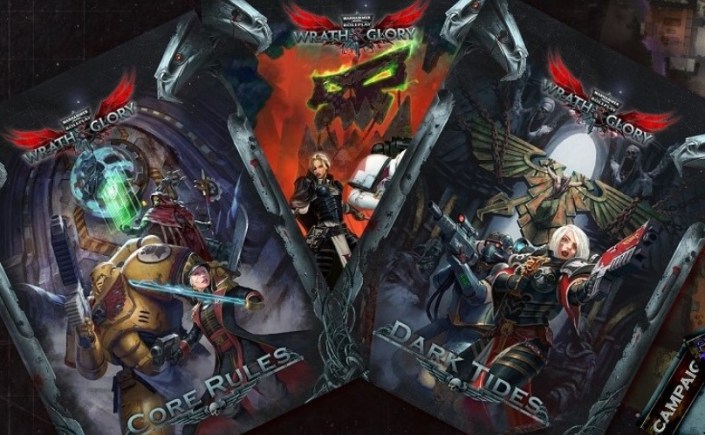
Big Review: Wrath & Glory (Warhammer 40k RPG)

(This is the 2nd of 17 posts leading up to my 200th blog post for my “200 for 200” goal. It’s a long post instead of several short ones to conserve the number and buy myself some time for the goal!)

This review is going to be different from my previous reviews in several key ways: First, I happened to order the “All-In” Pre-Order package for the Wrath & Glory RPG from Ulysses Spiel, so I’ll be reviewing physical products alongside my review of substance. Second, I’ll be sharing some general, probably stream-of-consciousness thoughts about gaming in the 40K universe–some of which will be purely opinion and editorial with little to do with the review proper. Let’s dig in:

Roleplaying in 40k (Come for the War, Stay for the Stuff)

I grew up playing the Warhammer 40k miniatures game. Though I don’t currently play any minis games (having over the past few years played Warhmachine, Infinity and Malifaux) and I don’t really have the patience for 40k’s massive set-up time, I do constantly think about collecting the miniatures again for the joy of kitbashing and painting and finding some minis-rules sets that I liked better to run some narrative skirmish-level games with friends. Of course, there’s now new Necromunda (which I also played and loved in its first incarnation), Kill Team and Warhammer Quest: Blackstone (I spent many hours with the original, fantasy version of Warhammer Quest).

But, over the past ten-to-twelve years, my experience with 40k has been in reading some of the novels and running RPGs. I was so excited for a 40k RPG when Dark Heresy was announced, I immediately pre-ordered the deluxe, leather-bound version of the first edition rules.

This is all predicate to a discussion of my love/hate relationship with 40k. Perhaps there’s some deep-seated resentment of the cost of 40k gaming, but that is not where my angst really lies.

The long-used motto of the 40k universe is (say it with me, kids): “In the dark future of the 41st millenium, there is only war.” Let’s sidestep the fact that the source material has now carried the universe into the 42nd millenium.

My response to that motto has long been, “Come for the war, stay for the stuff.” A dark future of only war makes sense for a wargame, but not so much for a deep roleplaying setting. Without further, this constant, unquestioning conflict doesn’t have the depth I prefer for a roleplaying setting. Fortunately, even before the Dark Heresy RPG, there were some sources of that depth I sought.

I have read only a fraction of the available Warhammer 40k novels. I’ve mostly restricted myself to Sandy Mitchell (Caiphas Cain) and Dan Abnett (having read the Eisenhorn Trilogy, much of Gaunt’s Ghosts and the more recent Magos–which I’ll likely be finishing up today). Both Mitchell and Abnett do an excellent job of writing stories that stand strong on their own accord, even if they’d been written in a different setting, that also bring down some of the over-the-top “grimdark” of the 40k universe into a more relatable and–frankly–far less silly version of itself. They add the “stuff” to the 40k universe necessary to the setting to develop interesting stories for roleplaying.

I’ve started but not finished a number of other 40k books. Most of them, in my humble opinion, belong on the same shelf as Fifty Shades of Grey and Twilight; that is, the “do not read, ever!” shelf. They’re not well-written, have ridiculous plots, and mostly just string together action sequences with little in between to make me care. Abnett (whose non-40k fiction is also worth a read) and Mitchell seem to be the exceptions to the rule.

Since the release of Dark Heresy and its related 40k RPGs (though I never had much use for Only WarBlack Crusade or Deathwatch), much additional setting information conducive to running a satisfying RPG campaign has been produced, thankfully.

Even so, it strikes me that the 40k setting, as typically advertised and as displayed in the majority of the fiction written about it, can’t sustain a roleplaying setting as is. The setting is too over-the-top, too nihilistic for nihilism’s sake, too grimdark. Now, if you’ve read my blog posts or my fiction, you know that I have a preference for the gritty. Too far, though, and the gritty becomes like chewing sand–painful and to no purpose.

To run a successful roleplaying game, the tone of a 40k RPG needs to come down a few pegs. We need to see that the Imperium of Man is not simple a fascist totalitarian regime if you’re going to play characters who feel duty and loyalty to it (in my opinion, at least). You need to see that there is some happiness and good in the universe worth fighting for, or what’s the point? Roleplaying games, like the best fiction, are about creating meaning. If your game universe runs circles around you, skipping about and proclaiming that, “nothing matters, everything is the worst, and you’re all going to go insane and/or die in the next five minutes!” there’s going to be an issue.

Perhaps the upside, though, is that the 40k universe, in needing to be tweaked to work in the roleplaying milieu, invites us to do what we should be doing with all published settings we’re using to run a game: make it our own. Like Mitchell and Abnett, we need to inject some logic, some flickers of goodness and hope, and some depth of character into the setting. That invitation, perhaps buried under piles of lore (being a worldbuilder and writer, I hate the term “fluff”), has the potential to grant us great freedom in using the setting. The flipside of this, of course, is canon-mongers who will exclaim at the gaming table, “that’s not the way it is; on page 47 of Fulgrim it says…” Those players are heretics; I hereby denounce them to the Inquisition.

I’m not likely to run a Call of Cthulhu campaign, as the types of stories that setting tells are generally very limited in scope. But, at least once warp-twisted to our own designs, 40k has the potential to tell stories with the same themes as CoC when desired, while making way for many other types of stories as well.

Scaled back a few pegs from full-bore nihilism, the setting allows us to play games that are tough on characters (without being unfair to them) in line with the setting and theme. I’m a big fan of John Wick’s Play Dirty books; the Warhammer universes (both fantasy and 40k) have provided me with my best experiences in implementing those ideas (in my own way, of course). The rate of character deaths in my Warhammer games is exponentially higher than in other RPGs I run, and a proponderance of those deaths are inflicted on one player character by another. Fortunately–and this is partially because of the themes of the setting–those character deaths have always seemed to be aspects of good writing: meaningful and somehow simultaneously surprising and seemingly inevitable in retrospect. Because of that, the players have not had hard feelings about these events, instead having a sense of profound collective storytelling. For a GM, there’s not much better than players getting that feeling, however achieved.

In short–though it’s certainly too late for that, isn’t it?–the 40k universe provides a very problematic roleplaying setting if used as labeled on the box, but if that difficulty is instead viewed as an invitation to make the setting your own (and the RPG material and the Mitchell/Abnett fiction are the best guides for that), there’s a lot of fun that can be had in 40k.

[Aside: While originally intending to put the linked material in this post, I thought it would be kinder to those not interested to separate out a digression on Christianity and 40k into a separate post. I invite you to read if that’s something that piques your curiousity.]

Updates to Setting (Immediate and Meta)

Wrath & Glory debuts after Games Workshop has implemented some radical changes to the 40k universe. With the (re-)appearance of Roboute Guilliman, the partially successful summoning of the Aeldari god Ynnead (and the changing, undoubtedly for copyright purposes of “Eldar” to “Aeldari,” just as “Imperial Guard” was changed to “Astra Militarum), the breakout of the great Cicatrix Maleficarum dividing the Imperial of Man into the Imperium Sanctus (still within the sight of the Astronomicon) and the Imperium Nihilus (on the other side of the massive warpstorms composing the Cicatrix Maleficarum and thus outside the light of the Astronomicon), the 40k universe is now a drastically different place, with many systems partially or wholly cut off from the rest of the Imperium.

Wrath & Glory does a good job of using this new situation for fullest effect, referring to it as a reason a disparate group of heroes with vastly different backgrounds might be working together. This gives easy permission to roleplaying bands that include an Aeldari corsair and a Primaris Space Marine next to the human characters who may be commissars, Rogue Traders, Inquisitors and the like. In short, it allows a justification for a smorgasbord of characters that would have been difficult to rationalize in earlier incarnations of 40k roleplaying (especially segmented into different game lines: Rogue Trader, Dark Heresy, Only War, etc., etc.).

The “default” setting for Wrath & Glory is the Gilead System, a collection of planets technically within the Imperium Sanctus but cut-off by surrounding warpstorms navigable only along a near-mythical path called the “Straits of Andraste” (now where have I heard that name before?). The Gilead System is designed to have a collection of the Imperial Planet types (Forgeworlds, Agri-Worlds, Shrine Worlds, Hive Words, Forbidden Worlds, etc.) so that each planet type is available without the characters needing access to a Warp-capable starship. Other than this, the Gilead System only has the barebones information given–a few names and factions that might serve as patrons or antagonists to the characters and some high-level story hooks.

This is both a boon and a bane, as it gives a GM great leeway in filling in details–but requires the GM to fill in details. If that’s not something you want to spend your time on, there’s nothing stopping you from setting your campaign before the Cicatrix Maleficarum and using the voluminous materials for the Scintilla area of the galaxy (or other published locations) from previous editions. For that matter, you could simply take that material and update it to the present in-universe time.

The Rules

I very much appreciate the new rules. If you’ve read some of my other writing about RPGs, you’ll know that I’m not so found of percentile systems and quite fond of dice pool systems. Wrath & Glory has moved 40k roleplying from the former to the latter, so from my initial approach I expected a positive reaction to the system. Not so much so that it was guaranteed, but I’ve found that the system is well-written. I’ll hit some of the high points.

Core Mechanics

The dice pool system uses attribute + skill, familiar to most roleplayers and six-sided dice, available everywhere. Certain things, like items, may add bonus dice, but most negative circumstances will adjust the difficulty level rather than the dice pool, allowing for faster logistics in making tests, as GM and player can calculate their respective parts simultaneously. A test must generate a number of icons equal to the difficulty level for the action to succeed. A result on a die of 4 or 5 generates a single icon, while a roll of 6 on a die generates 2 icons. In certain situations, icons in excess of the difficulty level can be “shifted” to achieve additional effects.

As a side note, the rules use the word “dice” for both the singular and the plural. This annoys me greatly. Other than this infelicity of language, the rules are clearly written and easy to understand.

Giving dice the potential to generate 2 icons allows for a much greater range and granularity of difficulty levels than might ordinarily be expected with a dice pool system. While I lack both the coding and mathematical skills to easily run statistics on this arrangement (my favored roll percentage calculator does not have the bandwith to make calculations this complex, apparently), the benefit should be relatively obvious.

Wrath & Glory (& Ruin & Campaign Cards)

Each test uses a single Wrath die (in the case of psyker powers, described below, multiple Wrath dice may be employed). A six on the Wrath die generates a point of Glory for the rolling character (which can be spent on bonus dice, damage and critical hit severity in combat, and seizing the initiative in combat). A roll of “1” on the Wrath die generates a complication to the scene at hand. These effects are independent of the success or failure of the test itself.

Characters also have Wrath points (hence, one supposes, “Wrath & Glory“). Wrath points are gained through good roleplaying, accomplishing objectives and through campaign cards. Wrath is used to re-roll failed dice, restore shock (non-fatal damage), improve Defiance tests (not dying when severely injured) and to make narrative declarations (I very much like this choice, both from a roleplaying design perspective and because it appropriately softens some of the grimdark of the 40k universe).

The GM also has a points pool called “Ruin,” allowing for similar boosts to NPCs.

As an additional side, the Wrath & Glory rules contain a full-page sidebar on failing forward. This, I think, reveals the modern gaming influences on the system design, but also indicates a conscious move away from the pure grimdark of the setting (and perhaps the earlier rulesets) just as the player ability to make “narrative declarations” does.

You may have noticed that I mentioned “campaign cards” a little ways back. A deck of the cards is available for purchase seperately from the rulebook. Each player is supposed to receive one campaign card at the beginnign of each session, which is lost if not used, but use is not required. When played, its effects are immediately resolved. Admittedly, I have not yet spent a lot of time with the campaign cards, but my sense is they are designed to give players a little more agency. Could you play without them? Absolutely, but I’m honestly not sure how much that would change the feel and play of the game. It may not be an extreme change.

Tracking Wrath, Glory, Ruin and Campaign cards (and other available cards) may seem to be a lot of fiddly-bits during play. On the other hand, if you’re comfortable with games like Fate, Cortex Plus/Prime or FFG’s Star Wars/WFRP3 games, you won’t have issues.

Combat

You’ll find many of the combat rules to be familiar territory if you’re a veteran roleplayer. I’m going to just pick out a few highlights.

First, the book explicitly states that there is no set time unit for a combat round, instead specifying that the narrative should inform the length of each round. This is relatively minor, but I think it provides some good insight into the design approach, and I like that.

Second, Initiative is handled quickly and efficiently. Under most circumstances, at the top of the combat round, the players decide which one of their characters will act first. After that character’s turn, a GM character acts, followed by another player character and back and forth until all actions are resolved. Ruin and Glory can be spent by a character to break the normal procedure and act next in a combat. Some circumstances (ambush) may also change this routine. Randomized initiative is offered as an option.

The rules include provisions for “mobs” to handle groups of less-talented foes. In my mind, this is an essential aspect of modern and effective game design.

There are rules to accommodate miniatures but they are not necessary. While I like minis games, I don’t like the drag on play efficiency that minis create in most RPGs.

Like many dice pool combat systems, the active character rolls against a static Defense number to determine whether an attack is successful.

Reloads are abstracted so that bullet-counting is unnecessary. That said, bonuses for “spending” reloads are available, giving players a reason to risk the dramatic position where they are out of ammo. Best of both worlds, in my mind.

Combat has enough variance in choices of actions for tactical complexity, has gritty critical hits, and all your favorite 40k weapons and armor.

Overall, combat appears to be a good compromise between narrative efficiency, gamist tactics, and “realistic” detail.

Psykers

I’m not going to spend much time on Psykers, but I want to point out one or two things. If you’ve played past 40k RPGs, you’ll be familiar with the psychic “disciplines”–biomancy, telepathy, telekinesis, pyrokineses, divination, etc. “Minor” psychic powers available to any Psyker are also available, though some (like “Psyniscience”) seem like they should be innate abilities rather than require a player to choose them as specific powers–the number of which a character may have are relatively limited.

A character using a psyker power must choose the mode of its use, from most conservative to most reckless: Bound, Unbound, Transcendant. The more reckless forms of employment grant extra Wrath dice but also increase the chance of Perils of the Warp–this is exactly what psyker powers should do in my opinion. Further, once you move up the scale, you can’t move back down in the same scene. The genie doesn’t go back in the bottle. Again, this matches the fiction and the feel of the setting.

“Magic” of any type in a roleplaying game is difficult from a design perspective. For a game to feel “balanced” you ideally want your “magical” characters to be somewhat limited in the types of effects that they can use and to have a very real cost to achieving those effects. Fortunately, the setting in 40k matches with this approach; in many fantastic settings the lore is difficult to fairly “balance” mechanically. The implementation here is about the best I’ve seen.

Character Creation

From the GM perspective, the core rulebook offers “Campaign Frameworks.” These are basically campaign hooks with recommendations for tier level, character types, theme and expected content.

Character creation itself is done by point-buy, though “standard arrays” are given for each Tier level to speed the process for those new to the setting or wanting to create a character quickly.

The Tier represents the campaign’s overall power level, both by determining the number of build points players have for their characters and which archetypes are available to them (Psykers require Tier 2, Inquisitors Tier 4, etc.).

Build points are used to purchase an Archetype, attributes, skills, special abilities, wargear, etc. The system is not so complex as Shadowrun, per se, but it does have enough depth to it that I would say you should expect an hour or two for character generation, perhaps more fore those unfamiliar with this or other RPGs.

On the other hand, the point-buy system allows for great flexibility in character creation, which I appreciate. Additionally, unlike previous 40k RPG incarnations, rules for playing Aeldari, Orks and Space Marines (regular and Primaris) are right there from the beginning.

Other Rules

Basic rules for vehicles and voidships are included in the Core Rulebook.

Overall

I’ll have to update this once I’ve been able to run a few sessions (be on the lookout for posts about the Dark Inheritence campaign I’m currently writing and hoping to run soon), but my readthrough leaves me impressed. Modern game design and a more narrative approach that lightens the grimdark just enough meets with a setting I’ve loved for a long time.

Physical Products

IMG_1832.jpg

I pre-ordered the “All-In” package when Ulysses Spiel US announced the opening of pre-orders. The above is the scope of what I received: the core rulebook, battle maps, pre-genned character booklets, the Dark Tides adventure book, the Blessings Unheralded adventure book, the soundtrack CD, acrylic tokens for characters and enemies, dice, a GM screen, themed poker chips for tracking points and six sets of cards (Campaign, Wargear, Psyker Powers, Perils of the Warp, Combat Complications Deck and Wrath Deck). The cards are of the quality I associate with CCGs, like Magic or Doomtown.

The books are bound as is typical for RPG books, with beautiful art and color. One difference enthusiasts will notice right away is that the art is distinctly lacking in “Blanchitsu.” I’m not sure that that’s necessarily a bad thing, especially given that the game design dials back the grimdark a few clicks. But, the art does border on the cartoony.

Everything came in a large box of heavy cardstock:

IMG_1833.jpg

Overall, I’m very pleased with the construction quality of the materials. I’m actually tempted, despite my usual preference for digital books, to spend a good deal of time with the printed materials. That’s a pretty high praise for me.

Conclusion

If you like the 40k universe and want to game in it, I highly recommend the Wrath & Glory game. Again, I’ll update when I’ve had a chance to run and/or play it, but by all accounts I expect a satisfying experience.



Review: Fallout 76: A Good Start

It seems that I’ve started most of my recent reviews this way, but the Fallout universe has a special place in my heart. I came of age in the late 90’s, and isometric RPGs were my video game of choice (surprised?).

I spent countless hours playing and replaying Fallout, Fallout 2, and Fallout: Tactics (I even played Fallout: Brotherhood of Steel, despite its many flaws). I lamented when the “Van Buren” project was cancelled and rejoiced when Bethesda announced Fallout 3. The nostalgia factor and fanboyness runs high with this title, so be warned.

And here we are now with a new offering in the Fallout universe, one that divurges greatly from that to which we’ve become accustomed. Multiplayer. Is it the Holy Grail of Fallout gaming, a despicable money-grab by Bethesda in recycling the core of Fallout 4, or something about which we should feel a little bit less extreme and a little more ambivalent?

Multiplayer is a strange thing for me. As an introvert, I’m far more inclined to adventure by my sullen self than to link up with some randos who do or say things that do not recommend themselves to further association. The anonymity of the internet, and multiplayer games, draws out the worst in people. I just don’t have time for that in my life.

On the other hand, playing video games with people I know and have built relationships with away from the glow of the LEDs is something I very much enjoy. In this hectic world, online gaming is sometimes how I best keep up with certain friends–we play and we converse while we play. Maybe it’s the modern equivalent of those long telephone calls I used to have in high school, before texting made such obsolete for high-schoolers.

I love open world video games and the hours of exploration that come with them–truth be told, that’s probably my favorite aspect of video games altogether, though at any other moment in time I might say that it’s strong and meaningful narrative, a well-crafted story.

I’ve had the pleasure of spending hours walking through the West Virginia wasteland as a lone wanderer and as part of a team with my friends–even a complete four-person team. None of us have had the time to hit the “end-game” activities yet, and I’m not fully certain what they are at this point. Did I mention I lived in West Virginia? Only for about two years when I was in kindergarten and first grade, so my memories of that part of my life are fragmented and vague, but this perhaps adds another touchpoint for me.

Okay, background to review complete. Now on to what you really came here for:

The Good

Fallout 76 is like getting a whole ‘nother Fallout 4 worth of locations to explore. That alone piques my interest.

There are new enemies (Mole Miners, Radtoads, Gulpers, the Scorched, and more), new weapons (my favorite for its weirdness is the “death tambo,” a tamborine with the cymbals replaced with blades) and a greatly-expanded crafting system.

The use of SPECIAL and hot-swappable Perks is a lot of fun and allows for a lot of different character builds–both within one character and those that necessitate running multiple characters for different SPECIAL arrays. The theorycrafting of character builds fascinates me in Fallout 76, much moreso than any other MMO-style game I’ve played.

Fallout 76 is, by default, like “Survival Mode” in previous Fallout titles. Not only must you manage your health and radiation levels, but you must manage hunger and thirst, disease and mutations! Your gear deteriorates relatively quickly, so keeping things maintained and finding plans to build new equipment or CAMP (the mobile equivalent of a settlement) items gives the player a lot to do without even interfacing with the quests. These needs create emergent narrative, the kinds of stories that begin, “So no shit, there I was, knee-deep in spent brass and hand -grenade pins, having drunk my last purified water and then a Deathclaw shows up.” I love that, even if no one else wants to hear my stories–especially my wife.

The consequences of dying are scaled well–you lose the junk you’ve been carrying but not all of the other precious items you’ve spent so much time finding or building. If you’re fast enough (or there are no other players around), you can return to the site of your death (if you dare) and retrieve these parts. There’s a cost, sometimes fairly steep, but not one that makes you want to ragequit anytime you die. Good job on this balance, Bethesda, that’s not an easy thing.

Another well-thought out idea is that you can change the sex and appearance of your character at any time. A minor thing for some, but a great convenience for those who may want to change up their character’s visuals every so often.

The Bad

If you’re reading reviews of Fallout 76, you’ve likely come across the complaint that it “feels empty.” I think that that’s a misleading statement (there’s another Location to scavange over every crag and just a short ways down every road), but it’s true that Bethesda’s choice not to include human NPCs in the game is a massive let-down. The self-conscious weirdness of characters in Fallout is one of the main draws, and finding the corpses of these characters and listening to holotapes to give you their background just doesn’t match encountering and dealing with the characters in life.

Yes, this simplifies a number of things for the designers: there’s no need to craft dialogue trees, to manage faction reputation, to deal with conflicting narratives and closing off certain quests to certain players, etc. But it misses one of the best parts of Fallout.

At least Bethesda had the good sense to write the narrative around this concept–there is a reason everyone in West Virginia is dead. But the idea that this approach accentuates player importance by making every living human you encounter a PC just doesn’t work. Quite the opposite, in fact, as it deprives players of a sense of agency. There’s no one to really save, no cause or ideal to support, no settlement or character to get attached to (as much as is psychologically healthy for a fictional character, I suppose). There’s no choice between the Minutemen or the Brotherhood of Steel or the Enclave or the Institute. There’s no choice of dialogue options. There are choices in branching quest lines. There are no choices.

As with any online game, you also have to deal with the jerk gamers on occasion–and they are legion. I’ve gotten into several PVP situations and had about half of them also involve the other player sending me insulting messages over Xbox live and other assorted jackassery. That is, I suppose, unavoidable.

The Ugly

Bethesda stubbornly resists logical physics in a number of ways. No, I don’t mean the super-sciency stuff, I can suspend disbelief for that. But despite many games in this series, Bethesda still thinks the average rifle weighs about 20 pounds (unless the weight units are not pounds–I’m honestly not sure). This is somewhat mitigated by the starting carry weight without penalty being 150 lbs (and Perks that allow certain items to be reduced in weight by up to 90%), but the numbers in weights across the board still bother me. I’m trying to remember back to Skyrim about whether this applies to their concept of medieval weapons as well (a real two-handed sword should weigh between about 3 and 4 pounds–though the massive zweihander could weigh 8 or 9, that’s a very specialized weapon for a very particular purpose and was used in the fashion of a spear as much as a sword).

There are a number of bugs in the game, some leading to program crashes, others causing questlines not to advance, items to suddenly disappear or other minor but infuriating issues. I have not found a glitch that restarting the program (or just logging out and back in) hasn’t fixed.

Hope for the Future

Bethesda has indicated that they intend to support Fallout 76 for the long haul. What exactly that means is unclear, but I assume that it means something like Destiny 2–at least a few years of support with new DLC quarterly or so.

If that’s truly the case, Fallout 76 could have legs–provided that Bethesda has realized that it needs to add human NPCs and everything that comes with that (factions, etc.). If not, it’ll be fun while it lasts; maybe it will tide me over until Fallout 5.

Types of Evil (or at Least Antagonists)

This post could just about as easily be a theological one, but since I’ve come to these ideas in working on Avar Narn, I figured they’re better suited to being addressed to the writers out there–anyone who wants to extrapolate into the realms of spirituality and morality is welcome of course.

As an opening, let me first say that it is difficult to write an “evil” character, whether major antagonist or supporting character. It’s difficult because few things in the world are black and white, so a character that isn’t nuanced in his/her morality isn’t believable in stories that intend to maintain verisimilitude. On an obviously allegorical, mythological or moralistic tale, there’s a lot more leeway for capital “E” evil characters. But that has its own bag of tropes and expectations tht I’m not going to address here.

Instead, I’m going to try to put together a few general categories of character types we might describe as “evil.” I think we (myself included) are quick to use terms like “bad guys” when we mean “antagonist” in the more literary criticism sense of the term. That’s probably something we should all be careful of. That said, on to some gross oversimplification that I hope will nevertheless prove useful:

(1) Capital “E” Evil
This is the character who just wants to watch the world burn, who enjoys inflicting suffering for suffering’s sake, who exists to malign and misuse everything around him for the sake of just that.

As such, this should also be the rarest kind of evil in fiction, becuase it’s the hardest kind to get right. I think that there are two subtypes to be thought of here.

The first is cosmic evil–that kind of supernatural evil that is unknowable in its reasoning or motivation. Think Lovecraftian horror. We sidestep the major problem here by positing that we just can’t understand this evil. It just is. Particularly in fantasy, we can often get away with this, but it requires special suspension of disbelief or extra worldbuilding to swing. Even then, we’ve created a de facto villain that is really only interesting in an existential sense.

The second type is the corrupted individual. What we need, I think, to make this work is a believable backstory. Nobody begins that way, so we need an explanation as to what suffering the person has gone through to mold him into this type character.

This runs two ancillary risks, however. The first is that in describing said backstory, we humanize the character to the point that he no longer really fits into the Capital “E” Evil category. The second is that we turn our story into an analysis of the nature of evil. That can be an enthralling type of tale, particularly if the “evil” character is the protaganist of the story.

(2) Mistaken Beliefs
This subgroup belongs to those characters who honestly believe that they are doing the right thing while they commit atrocities the rest of us would find blatantly evil.

There are plenty of real-life examples to draw upon here to make the argument concisely. Take the Islamic State for example. Adherents to this would-be theocracy believe that they are practicing true Islam while murdering the innocent. This is an extreme case that can be attributed to any radical/fundamentalist religious group–Christians who kill doctors who perform abortions, for example. If you truly believe that God (or gods) demanded it and that makes it right, it’s easy to justify your actions.

Next, think of the person gripped by psychosis such that they are driven by an irrational belief that they cannot bring themselves to disavow. This is a particularly moving type of antagonist because they are driven by an affliction and not by their own agency–we can’t actually morally blame those who aren’t in control of themselves. This gives us a good opportunity to explore our “hero’s” approach to evil–is she only interested in ending threats or is she interested in redemption? What does she do when that redemption isn’t something she can achieve.

There are plenty of “lower magnitude” mistaken beliefs that make interesting villains. Les Miserables’ Javier is an excellent example–a man so overcommitted to his idea of “justice” that he cannot allow himself any mercy. This type of extremism in belief is all around us–just listen to how some people think we should fight the “War on Terror” or what we should do to criminals.

We can also extend this to what in the law we would consider a “mistake of fact.” When the antagonist believes that the protaganist is a villain who must be stopped, for instance. Yes, the antagonist’s belief is untrue, but if it were true would we think of the antagonist as a “good guy?”

A brief aside here: what if the protaganist is acting immorally? Watching a character spiral out of control is heck of a dramatic ride, and testing a character’s willingness to act as he says he believes is a classic conflict to explore.

Mistaken identity (along with the particular of being falsely accused) is one of the great archetypal plots, one which fits directly into the mistake of fact.

(3) The End Justifies the Means
This is a commonly-used type of antagonist, perhaps because it’s so relatable. The constant moral choice that faces all of us in life is whether we’ll sacrifice our values to get what we’re after. The only difference here is one of scale. For the sake of drama, the means to achieve the end must be dire–the determination of life and death, or the fates of many. For what profiteth it for a man to gain the world but lose his soul?

One of my favorite examples of this type of evil is the Operative from Serenity. The Operative is a man who accepts that he does evil things, but he is sincere in the belief that it will bring about a better galaxy (which perhaps makes him fall under (2) as well). In fact, he views his sins as a form of sacrifice–he does the unspeakable so that others don’t have to. There is a sort of nobility to his principles, even if they are ultimately wrong. And, for those of you who prefer your characters to wear capes rather than swords, Batman isn’t far off here, either. In fact, I’d say that Batman and the Operative have far more in common than we should be comfortable with if we’re going to call one “hero” and the other “villain.”

Speaking of Batman, most vigilantes fit into this category. Because we love it when the bad guys get theirs, even when they get it in a way that requires a sacrifice of our values, this can be a popular protagonist as well–think of the Punisher.

I would wager that most of our favorite anti-heroes fall into this category as well–it’s their beliefs and the willingness to risk for those beliefs that make them heroes, but the way they go about pursuing the fulfillment of those beliefs that adds the “anti-.”

(4) Honor and Identity
This is perhaps a subcategory of “Mistaken Beliefs,” but it’s a significant-enough subtype that it deserves its own treatment.

People do evil things in the name of maintaining honor all the time. As a student of history–and particularly the medieval and Renaissance periods, the first examples that pop into my mind are the duel and the vendetta. I’ve recently read a book called Mad Blood Stirring: Vendetta and Factions in Friuli in the Renaissance, which reinforces the connection for me. But Renaissance Italy is not the only honor culture known for the tit-for-tat systemic murder that defines vendetta–the Hatfields and McCoys come to mind in slightly more recent history.

And, of course, we could discuss “honor killings” in certain Middle Eastern or South Asian cultures (though, to be fair, the Napoleonic Code also permitted a husband to kill an unfaithful wife and her lover, and even in American law a murder is often considered manslaughter when a husband kills his spouse after finding her “in flagrante delicto.”)

Honor cultures and actions taken under the justification of defending one’s honor are typically about maintaining a sense of identity–either one of purity or of strength (or perhaps both). The ideology of the honor culture says that if one does not maintain honor, one will be viewed as weak and will be taken advantage of by the rest of the culture.

And defending one’s sense of identity is a strong motivator, one that can create fascinating internal conflict, because it can be the conflict between internal belief and external pressures of society. For instance, “I believe that I should show mercy, but my culture tells me that I am not a man if I do not take vengeance.” Powerful stuff.

Honor, of course, is not the only identity-related factor that can lead a character to become “evil” or antagonistic. The need to belong to something greater than oneself is a fundamental human motivation, on that can lead to similar conflict between the will of the individual and the will of the group. Is there a story about gangs that doesn’t include this plotline? What about cults and religions (which takes us back to (2))?

(5) Cross-Purposes and Limited Resources
I don’t have to explain that characters don’t have to possess malicious intent to be antagonists. The world has a habit of pitting humans against each other by its very nature–or at least tempting us to work against instead of with one another.

The core of successful narrative is conflict, and all it takes is characters who want things that are opposed (or even better, mutually-exclusive) to create such.

This suits certain types of stories especially well–the noir and anything else that might be considered “gritty” immediately come to mind. The story doesn’t need to be one of moralistic pedantry, though one must be careful not to let ambivelence about morality become relativism (at least I’m going to moralize on that point).

The Game of Thrones novels come to mind, as does Abercrombie’s First Law books. The political intrigue inherent to both puts POV characters at odds with one another, certainly giving us occasional “villains,” but not as a central theme of the stories.

But this type of conflict does not just suit the morally-ambiguous; it plays well to analysis of morality. I’m going to turn here to my favorite atheist philosopher (and one of my favorite storytellers), Joss Whedon. He’s been quoted as saying, “If nothing we do matters, the only thing that matters is what we do.” As an existentialist theologian, this freedom to create meaning when meaning is not thrust upon us is a core concept to me (but not one we’ll discuss here). Likewise, when the there’s no clear “good and evil,” we must judge the morality of the characters by the choices that they make. This can, of course, be easily combined with all but (1) above.

The conflict within a character of wanting to do the right thing, but perhaps being unwilling to pay the cost to do so, is a conflict we can all relate to. I’m inclined to argue that there is nothing in the craft of fiction so real as this. If you want your writing to have that air of verisimilitude, readers will suspend disbelief for a lot of things when the characters seem lifelike and complex to them. That’s not an excuse to write fiction that is sloppy except for the characters.

That, I think, is why I’m personally drawn to “gritty” stories. They’re rich with meaning.

(6) Inanimate Evil

I include this mostly as a footnote becuase it needs little explanation. This is the classic “(wo)man versus nature” story, where an uncaring and unresponsive natural force (i.e. the elements) forces a struggle for the protagonist to survive.

Conclusion

This list is, of course, not exhaustive. Each category has subcategories and nuances to be explored (and isn’t that one of the great joys of writing?). More general categories could be appended to this. When I think of them, I’ll post an update. I’m also inclined to write more about creating the types of characters that fit into (5), or at least stories of ambivalent morality–that is, dispassion on the part of the narration about moral judgment, leaving such a task to the reader. For now, this seems sufficient.

RPG Design Journal #2: ANRPG’s Core Mechanic

For the first post in this series, click here.

Previously, I pontificated on my prefered particulars for an RPG ruleset for Avar Narn. If it’s been a short while since that first post, that’s not because I haven’t been working on the system–it’s because (as intimated in that first post) I spent a good deal of time working on a 3d6 core mechanic. Before returning to a dice pool mechanic.

What I’ve chosen is a d10 dice pool system, not unlike (in several ways, at least) the Storyteller system. Here are the particulars:

(1) A pool will typically be between 1 and 10 dice, with both Attributes and Skills rated between 1 and 5.
(2) The size of the dice pool may be modified up or down, but only by factors inherent to the acting character, such as injury. Dice pools may only exceed 10 when supernatural effects are in play.
(3) The “standard” target number for each die is 8, but this may be modified to 9 for disadvantageous circumstances or to 7 for advantageous ones. Each die meeting or exceeding the target number will count as a “hit.”
(4) Any die that rolls a 10 will count as two “hits.”
(5) The amount of “hits” needed to succeed at a task is called (for now, at least), the Threshold. Threshold is always between 1 and 8, with 1 being easy and 8 being near (but not) impossible. Anything that would be “very easy” isn’t worth rolling for and anything that would be “impossible” shouldn’t be rolled either–as common sense would dictate.

I’ve selected the above rules for the core mechanic in part because I like how the statistics work out. There’s enough granularity for a step up or down in dice to be a palpable change, for advantage/disadvantage to be important but not overwhelming, and steps within Threshold seem to have the right about of change to percentage success as well. It took the addition of rule (4) above to make the statistics work like I wanted to (I think–see previous comments on the importance of the feel of the statistics over the actual statistics). I must credit that idea to the fact that I’ve been reading the Wrath & Glory RPG recently (review on that in the near future).

We need to add a few additional interpretive aspects to the core mechanic to round out its effectiveness.

Particularly, an approach to “failing forward” and “success at cost” as well as a “margin of success” or “failure” in general.

Before any playtesting or development of subsytems, I’m thinking the following: If the roll generates a number of hits that is three or lower than the threshold, the roll is either outright failure or success at a major cost (depending upon consequences and narrative necessities). If the number of hits generated is only one or two lower than the Threshold, this should probably be a success at a minor cost. Remember this must be subject to what makes sense in the narrative. Sometimes it’s good to fail outright. Note also that this means that rolls with a Threshold between one and three are not going to fall into the “success at major cost” under these guidelines. I like to think of this as the “aim small, miss small” principle from The Patriot.

This can be flipped around for degrees of success as well. Reaching the Threshold exactly is success without any additional effect and extra hits can be viewed “success and a side benefit.”

Of course, some subsystems (like combat) will use the hard number of hits generated to determine degree of success or failure.

I’d like to come up with a good way to have the dice give some additional information aside from success or failure–like the “boons” and “banes” of the FFG Warhammer 3rd Edition dice. Using 1’s for negative effects seems a no-brainer, but with 10’s already counting as two hits, I’m not yet sure what I would do to balance for positive happenstance.

One thought I’m toying with is to have some of the dice differently colored (one in the first color, two in the second color and the rest in the “standard” color). This could allow the use of those three dice to be interpreted for particular other information in the roll if appropriate. The set up also allows us always to roll those three dice–if your dice pool is only one or two, you just look to the dice of the appropriate color for counting hits. Not sure if this extra complexity will be worth it, but it’s somethign I’m thinking on.

I’m also heavily leaning toward the idea of “dice bidding.” This mechanic allows the player to sacrifice dice from her pool to be counted as extra degrees of success if she meets the Threshold. It’s a classic risk versus reward mechanic, which I think fits thematically in the grit of Avar Narn.

I’ll be adding a resource to allow characters to purchase successes on rolls when they really need it, more on this to come.

With this core development in place, the next thing I’ll be doing is running an analysis on what kind of developed subsystems I think are necessary to give the game the right focus and feel.

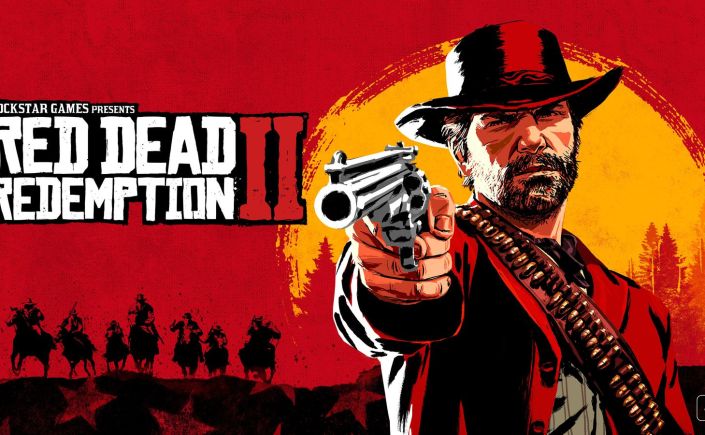
Red Dead Redemption 2 Review: Your Own Private WestWorld

I ride up to the crest of a hill, my trusty mare stamping at the earth as we come to a stop. Across the valley (modeled after Colorado, it seems), a stagecoach pulls into view, rolling down the deep ruts of a well-traveled road, unaware of the danger that awaits it.

I check my pocket watch. It’s right on time, like my informant at the train station promised. Through binoculars, I can see two men riding atop the wagon, one driver, one riding shotgun. A few riders flank the vehicle, rifles in hand.

Nothing too serious. With the right tool, I’ll make quick work of the guards and the driver. If my lock-breaker won’t do the trick, a well-placed stick of dynamite will open the strongbox that holds my reward. I just need my lever-action rifle to kick things off, the one I’ve customized with dark wood covered in dark leather, black metal accented with gold engraving.

Unfortunately, I have to open up a menu and scroll through more than a dozen longarms to get what I’m looking for. It’s a game, so maybe I could live with that, but I’m tacitly asked by to ignore the massive hammerspace my horse must have in the invisible quantum field that surrounds my saddle. Having to choose what to take with me when I leave camp would have been far more interesting.

That’s been my experience of the game in the (frankly embarrassing) amount of time I’ve spent on it. Things seem great until the game’s systems ruin the immersion with rigid, often-nonsensical responses.

On an HD TV and and Xbox One X, the game is stunningly beautiful–except for the people. Their expressions are just a bit much, their faces waxen and on the wrong side of the uncanny valley. Not too beautiful, but still inhuman.

The physics of the game veers from the believable to the frustratingly sudden. I’ve lost a number of horses (typically after reaching the max level of bonding–and thus unlocks–with them) to having them suddenly run headlong into trains or wagons (after I’ve jumped onto said train or wagon). Likewise, in the midst of thrilling chases, I’ve been launched ragdoll-like, my horse crumpling beneath me on some unseen sharp edge of the terrain.

But it’s not the physics of the game that really destroys the immersive potential. It’s the asininity of subsystems of the game that infuriate. For a game about the last outlaws of the Old West, it makes little sense to include an “Honor” system that rewards not doing many of the game’s draws–robbery, theft, gunfights and bucking the law. What’s worse, the Honor system has nothing to do with getting caught by others. Even without witnesses, you lose Honor for looting a body or taking something that’s not yours. That’s not fun.

This is exacerbated by the fact that “restoring” or improving your Honor to a high level (where there are in-game perks) is tedious and uninteresting. Help people in radiant events while traveling, kindly greet all the people you come across, perform repetitive and dull chores (“move this from here to there” in camp). There’s nothing interesting about being a white-hat in the game except for mechanical benefits. Being a roleplayer first and foremost, I see that as exceptionally bad form in design.

The “law enforcement” system also makes little sense. There is one fun/interesting aspect: witnesses to crimes will try to run away and contact the sheriff or other members of “the Law.” You can chase them down and threaten them to keep them from tattling. Unfortunately, everything’s downhill from there. The witnesses don’t actually have to run to a specific point to summon the Law–once they make it far enough, they simply disappear to be replaced by lawdogs.

The excitement of this is further diminished by a number of other flaws: rob a store and an alert automatically goes up to the law when the robbery begins (unless you’re robbing a business’s secret side business). Wearing a mask only slightly delays identification of you as the perpetrator, even in a place where no one should know your name. Of course, if you can evade fast enough, you can leave the scene of the crime, hide out for a few minutes, and come back like nothing ever happened. Without changing your appearance.

Be identified while committing crimes and a bounty will be placed on your head–this bounty increases for each infraction, but killing an officer of the law only raises it by $20. According to the internet, the 2016 value of that amount is about $2,891.65.

If your bounty gets high enough, bounty hunters will start to seek you out–though they appear randomly and without cause for being able to track you down in the wilderness. Of course, you can avoid this by going to any Post Office and paying off your accumulated bounty. Apparently the Old West works off of the ancient Germanic weregild system rather than 19th century American justice.

This is complicated by the fact that many of the “iconic” outlaw activities of the Old West net very little income compared to bounty you’re likely to generate during the activity. For instance, robbing a train got me about $100 in goods and cash while generating a bounty of $380 for defending myself from the near-instantaneous onslaught of lawmen from their hiding places in the wilderness where they must have been waiting for just such an offense to occur.

Playing the game, I can’t help but compare it to WestWorld. The game seems more like an Old West themepark than any verisimilitudinous experience. Scripted actions, often clearly weighted toward “game balance” rather than any sense of authenticity serves as a constant reminder that the whole thing is a conceit, a game. NPCs are robotic and caught in activity loops, wooden and predictable. Actions have only short-term consequences before everything is reset to its “natural state.”

The story missions are mostly good and the characters within Dutch van der Linde’s gang have at least a modicum of depth–though most of the dialogue is canned and you have very little opportunity to control Arthur Morgan’s treatment of his companions (which, again, makes the Honor system seem arbitrary and ridiculous).

Red Dead Redemption 2 is being hailed as a massive success in open-world gaming, but I just can’t agree. The game doesn’t do anything that Witcher 3 didn’t do better–and more believably. And when a fantasy setting feels more real than a pseudohistorical one, its hard not to think that the creators have strayed pretty far from the goal.

Is the game fun? Yes, yes it is, but only as a game. Does it feel like the systems of Grand Theft Auto have been conveniently ported to the Old West without much scrutiny. Yep. If you’re looking for immersion that gives you an easy time imagining yourself in Arthur Morgan’s shoes, you’ll find ocassionally satisfying bits (particularly while hunting, where animal behaviors are linked to some real-world expectations–at least in terms of diurnal/nocturnal cycles) but you’re ultimately going to be disappointed. I don’t regret picking up the game (even in limited edition at full price) and I have enjoyed the time I’ve spent on it, but I just can’t help but feel that the game could have been much more.

I’ll probably keep playing it for the time being to kill time, but not without the feeling that I could be employing my time to higher and better purpose. If I manage to finish it before Fallout 76 drops, then I’ll finish it. If not, I doubt I ever will. Certainly not in the near future given the games set to release before the end of the year or in 2019.

RPG Design Journal #1: Choosing a Core Mechanic for Avar Narn RPG

Reader beware: this post is as much me working through design ideas as it is describing design choices. If that’s not interesting to you, but RPGs are, just wait until I’ve posted something more concrete about the Avar Narn RPG’s systems.

I can’t tell you how many times I’ve started work on an RPG ruleset for Avar Narn and then stopped.

Here’s a list of rulesets I’ve used to run games in the Avar Narn setting over the years (as the setting has developed and grown): The Riddle of Steel, D&D, Fate, Cortex Plus, various custom systems.

And here’s a list of systems I find (to varying degrees) influential on my own design approaches: Shadowrun, World of Darkness (particularly nWoD Mage: The Awakening), Dogs in the Vineyard, Fate, Cortex Plus/Prime, TRoS, Warhammer Fantasy, Apocalypse World, Barbarians of Lemuria, Artesia: Adventures in the Known World, Shadows of Esteren, The One Ring, Stoltze’s One-Roll Engine (and particularly Reign), John Wick (especially Houses of the Blooded), Blades in the Dark, Fantasy Dice, GUMSHOE, FFGs system for Star Wars and WFRP3e, Burning Wheel and Torchbearer. Yes, that’s a lot of varied designs with some ideas that are incompatible with others.

Having mostly cut my teeth on dice pool systems, that’s my typical starting place. I’ve read a fair bit on game design and, this time I’ve decided to start at the very beginning, without preference for a core mechanic. Here are some links to give you some background on things I’ve been thinking about as I do this:

“How Do I Choose My Dice Mechanic”
“All RPGs Are FUDGE” (while I see a little more significance to the variation between systems than this author, the point that statistical variations in the most-frequently-employed core mechanics are not as significant as we might think seems pretty sound)
“Design Patterns of Successful Roleplaying Games”
The Kobold Series on Game Design
Robin Law’s Hamlet’s Hit Points and John Wick’s Play Dirty (although these are more about running games than designing them)

I’ve spent a lot of time trying to analyze the statistical differences between core mechanics (though math is not my strong suit, and particularly when it comes to complex probability equations) only to come down with a bad case of analysis paralysis.

Here’s what my recent reading (and experience) has led me to conclude:

(1) When the rules serve their purpose well, it’s the story that gets remembered, not the results of dice throws.
(2) The actual statistics of a core mechanic are less important than the way we perceive them–the way (our view of) the dice mechanic reinforces (or undercuts) the feel of the game and setting is what matters.
(3) The most interesting thing about a core mechanic is how it can be manipulated with interesting rules that are intuitive and yet reinforce setting ideas. Thus, a core mechanic should be selected more with an eye to what it can do for subsystems and design goals than its own merit.

Here are some of my analytical conclusions so far:

(1) Efficiency is paramount. The more you can resolve with a single die roll the better. Dice pools are often faster in use than roll and add/subtract systems because counting successes is easier than addition. Is it easier enough to force a design change? No.

(2) Inspired by the FFG custom-dice game: if a single roll can give you both the main pass/fail and degree of success information and give you cues for scene complications or opportunities, so much the better. The One-Roll Engine is also good at this. Additionally, checking the dice for multiple conditions should be simplified as much as possible so that this feature does not carry with it too hard a hit on efficiency.

(3) For a gritty setting like Avar Narn, a bell-curve or Gaussian distribution makes sense for three reasons: (a) extreme results are made more rare for a more “realistic” feel, (b) character stats are more significant in a bell-curve distribution than a linear distribution, and (c) along with (a), these distributions give more predictability to players as to results, which is important in a game where consequences of actions (including but not limited to lethality) are severe. The binomial distribution of dice-pool systems aren’t so far off as to be ruled out by this, but do not fit as well as a multiple-dice roll-and-add system.

(4) Along with a bell-curve or similar statistical distribution, the “bounded accuracy” of the latest iteration of D&D helps create expectations reliable enough for players to reasonably predict the results of courses of action.

(5) Combat requires a delicate balance–it must be fast, but it must also grant enough tactical depth to be interesting for its own sake. Additionally, it must be intuitive enough that advanced lessons in martial arts are not necessary to use the system to its fullest. One of the ways to make combat quick is to make it deadly, but combat that is too deadly is not fun for players. This is exacerbated if (1) the game intends deep and serious character development, (2) the “adventuring pace” means that injured characters must take a back seat for an extended period, or (3) character creation is time-consuming and/or complex. I’ve got a number of ideas for streamlining combat, but that’s for another time.

(6) Rules principles that can be applied to many different scenarios are far better than complex rulesets. Fate and Cortex are the best at this, in my opinion.

So what does all of this mean for Avar Narn RPG? Despite my love for dice-pool systems, I’ve currently leaning toward a 3d6 system, or perhaps even the use of Fudge/Fate dice. The 3d6 is more accessible for newbies into RPGs, but it’s probably more realistic to expect this to be a niche game. And, to be honest, I’d rather have a dedicated group that loves the system and setting than having to try to cater to a large base with very diverse expectations–especially for a first “published” (read: publicly available) system.

My apologies if you were expecting a solid answer on the core mechanic in this post! Right now, my action items in making a final decision are as follows: (1) determine the subsystems the game will need/benefit from, (2) play around with manipulation rules for various core mechanics, (3) find the core mechanic that checks off the most boxes.

Thoughts from those of you who have tried your hand at RPG design?

Review: Warhammer Fantasy Roleplay, Fourth Edition

Warhammer Fantasy Roleplay, First Edition, was the first fantasy roleplaying game I ever owned. It was the early nineties, and like all good Christian parents, mine denied me access to Dungeons & Dragons, fallout and carry over from the demonic-worship craze of the late eighties. As we all know, but I didn’t question as a child, there was nothing inherently demonic or evil in D&D (the opposite mostly, though one of Tom Hanks’ early films told a different story). But, not knowing better, they allowed me this gem of a game, darker, grittier, and far less wholesome than the high-fantasy cheese of AD&D.

Ownership of this vaunted tome (which I lost or gave away or sold somewhere along the way, much to my present chagrin) had a very formative effect on me. It solidified my love of roleplaying games, proved the gateway into my miniature gaming hobby, and gave me my first real taste of dark fantasy (a penchant I cannot shake even now). As someone, even in elementary school, deeply interested in medieval and early modern history and wanting some semblance of verisimilitude in my roleplay, it’s little wonder that WFRP, warts and all–no, warts especially–has a special place in my heart. Before high school, I’d also purchased several of the Rolemaster FRP books so, though I didn’t know it, 80’s “realism” in RPGs became my foundation.

I never ran or played a game of First Edition WFRP, though I did manage to collect most of the books at one point or another. When Second Edition was released (I was now in college), I scrupulously and slavishly purchased each of the books as it was released and ran a few games with those rules (though I admittedly used the Riddle of Steel rules, released close in proximity, for those Warhammer Fantasy-based games I most enjoyed). My miniature gaming had focused mostly on 40K, but something about the Tolkien pastiche smashed up with a more historically-influenced setting always called me back to WFRP in my gaming (of course, the first edition of Dark Heresy had not yet been hinted at even–though that’s a story for when I review Wrath & Glory, I suppose).

Likewise, when FFG published the third edition of WFRP, I couldn’t help but go all in on that system as well. For all of the quirks and fiddly-bits of the 3rd edition (much of which I found very innovative and fascinating from a design standpoint), I ran some of the most narratively deep scenes based on those strange custom dice. The board-game like pieces really did provide some opportunities for building unique subsystems to support the story, from chases to countdown clocks. The “stances” adapted just enough from Riddle of Steel (which remains one of my favorites for three reasons: (1) at the time of its release, I was a study group leader for the Association for Renaissance Martial Arts and deeply invested in the study of real swordplay; (2) the writer of TRoS was also a member of ARMA, one with whom I’d had the fortune to spar with; (3) there are design ideas, like spiritual attributes, that I still find amazing, even if I now find the combat system too intricate for my gaming needs and desires) to sate my desired treatment of combat at the time.

I don’t want to participate in “you-should-have-been-there”-ism too much, but I will relate one fascinating development in one of the WFRP games I ran. When the PCs stumbled across some warpstone, one of the characters decided to squirrel some away to sell later. As it tends to do, the warpstone started to have an effect on this character, and a fellow PC (a staunch and suspicious Kislevite), discovered this. While the first character slept soundly, the Kislevite snuck up on him and, pressing the barrel of a pistol to the first character, ended the foolish threat to the party. What surprised and pleased me was the response of the murdered character’s player: “Yeah, that’s what you should of done. That was not going to go well.” That’s mature roleplaying from dedicated players. Drama!

I should also note that, perhaps the result of my fumbling with Rolemaster, I’ve never been a huge fan of d100/Percentile RPG systems. I fully admit that this is a personal thing and not some objective complaint about that style of system itself (my preference, almost certainly a side-effect of my playing White Wolf games, Shadowrun and TRoS, is for dice pool systems).

When I heard that Cubicle 7 had the contract for Warhammer Fantasy Roleplay, Fourth Edition, two things excited me: first, I’ve found the One Ring to be both the most faithful RPG version of Tolkien’s world yet and mechanically innovative to boot; and, second, I’d hoped that the new ruleset would veer away from the d100 system used in the past (as Wrath & Glory has done). One of those things proved true.

Perhaps the best compliment I can give WFRP4 is that it’s a percentile system I’d actually consider running. Even with my preference for the Fate or Cortex Plus/Prime systems, this ruleset reinforces the grittiness and darkness of the setting in what I feel merits the additional crunch. Reading the rulebook has also reminded me that, second only perhaps to D&D/OSR rules, how much material there is out there that could be easily adapted for subsystems or alternative/house rules for WFRP4. I’ve found myself very interested in some of the things that the Mythras system has done with d100, and then there’s all of the Chaosium, Runequest, Zweihander (particularly appropriate) and Rolemaster stuff out there as well.

My personal confession to the versatility and playability of percentile RPGs is not the point of this post, however. Let me instead focus on the (many) things that I really enjoyed about this system, especially as an iteration of the first and second editions (which I’ll assume you’re familiar with).

First, the art is beautiful. Andy Hepworth and Jon Hodgson, who worked on The One Ring illustrations also worked on this tome, and the artwork is similar to that of TOR: watercolory, somber and evocative of the setting’s tone. As I said in my Witcher RPG review, the artwork itself is almost worth the price of admission–but I’m a very visual person.

Additionally, in the style you’ll remember from the FFG version of the game, much of the setting information is given in-character through letters and reports. The beginning of the book combines pictures with a skillful economy of words to highlight the Empire, giving just enough detail for even a newbie to the setting to run a session that a seasoned veteran would say, “Yep, that feels like Warhammer.” I just love this.

I’ve gotten ahead of myself, though. I really should have led with the thing that I love most about WFPR4–its transparency that the players and GM should make the setting their own personal version of the Warhammer Fantasy world, supplemented with reminders about this throughout the text on the subjects of both mechanics and setting, and supported by optional rules and reminders that rules that don’t fit your game should be ignored or changed.

Let’s talk about some of the changes to the previous incarnations (of course skipping the outlier that was 3rd Edition). Fourth Edition has “softened” character generation and brought it into the world of “modern” gaming. Where the early editions of the game relied entirely on random generation of player characters (yeah, everyone wants to be a Ratcatcher, but no one wants to play the poxy doxy), the latest edition has kept the random generation tables but has given rewards to sticking to them rather than making them mandatory. For instance, for your starting career, you first roll one result. If you take that result, you get a substantial XP bonus you can either hoard or spend on starting upgrades to your character. Didn’t like that result? You roll two more, and if you pick one of the three, you still get an XP bonus (though not as substantial as when you only had the one option). Don’t like any of the three results? Just choose what you want to play. No XP bonus, sure, but at least you’re playing something you find interesting. This goes for most aspects of character generation.

Above, I mentioned the Spiritual Attributes of The Riddle of Steel RPG. While WFRP4 doesn’t use those per se, it does join the forefront of modern player-driven (narrative) gaming by giving both the individual players and the group as a whole ambitions. Ambitions are short- and long-term goals that, when completed, grant XP for character improvement (in addition to the normal XP of session survival and accomplishment). Like 13th Age’s “One Unique Thing” or Milestones in Fate, they give the GM some guidance on what players are interested in dealing with in the narrative of their game.

As well, ambitions are a call-to-action for players to learn about the game world (so that they can craft good ambitions) and help define those elusive both most-important aspects of character–character itself (as in the inner life, personality, beliefs and psychology of a fictional entity beyond the mechanical numbers on the page).

My other favorite new thing in Fourth Edition? The “Between Adventures” chapter. These optional rules recall the “township events” of Warhammer Quest (God that we would get an updated version closer to the original instead of the bastard “End Times” game that was produced–oops, my rabid fanboy is showing). I spent a good deal of my youth (when I was but had not realized that I was an introvert) playing that game. In WFRP4, the Between Adventures chapter gives the players interesting complications that might arise while not in the wilderness fighting orcs or Chaos as well as endeavors that might be undertaken to gain small–but perhaps lifesaving–advantages during the next adventure. It’s a clever way to provide for some roleplaying opportunity and character development without having to devote large amounts of playtime to characterization–though if that’s what your group wants, there’s no reason you can’t do that, either!

Much of the rest of the rules will prove familiar to the player of the first or second editions–nasty critical hits, rules for corruption and disease, limited magic, careers that range from the extraordinary to the ultra-mundane (if historically accurate), Skills and Talents, etc.

Petty magic is back for those who missed it (I did). Each Career now has four tiers of advancement, so the Apprentice Apothecary and the Master Apothecary are within the same write-up instead of spread across four different careers that represent incremental steps in the same line of work and training. Character social status (as within the Bronze, Silver and Gold tiers of society) is more explicitly treated and made relevant to gameplay. Task difficulty has been more effectively balanced (Very easy tasks are now +60 to Attribute+Skill Ranks) given the relatively low attribute and skill values of starting characters. Advancement, XP and skill ranks have been streamlined in a way I find to be an improvement.

First and second edition adventure material should require little or no adaptation to be usable, and previous mechanics or careers will be relatively easy to adapt.

In short (though perhaps it’s too late for that), if you liked the first and second editions of WFRP, you’re very likely to enjoy Cubicle 7’s take. If you didn’t, I’d take a look anyway.

The main competitor for WFRP4, I think, is the indy-game Zweihander (itself an iteration of WFRP2), though Shadow of the Demon Lord may be a better fit for those who want a game closer to classic D&D but heavily influenced by modern gaming mechanics and the approach and feel of Warhammer (the creator, Robert J. Schwalb, worked on WFPR2 among other things).

The release of the book has very much tempted me to return to the Empire circa 2511. If I do, I’ll probably even use this ruleset rather than trying to adapt to a more narrative-focused system, as WFRP4 seems a decent compromise between massive crunch (which I ideologically though not practically miss) and the narrative-focused games to which I’ve become more focused.

Have you had a chance to read through the book? What did you think?