Christianity and Fallout (Part 2: Redemption Stories)

Let’s start with a warning: if you haven’t played Fallout 4, or watched the TV show, this discussion may not make a lot of sense. I chose characters from 4 and the TV show in the expectation that the greatest amount of people were likely to have played that game, if any of them, or to have become interested because of the television program. Also, of course, spoilers for both the game and the show, so if you’re not caught up, you might want to avoid this post until you are.

The Fallout world is full of redemptions, both minor and major, amongst characters you encounter and those you only hear about. I think it would be difficult to avoid these kinds of stories–a post-apocalyptic world certainly carries the atmosphere of a fall from grace, and the struggle to survive in light of scarce resources and centralized civilization or authority begs the question of what people are and are not willing to do to others–and for what purposes.

I’m interested in examining some of those stories here, but not in some allegorical way. I don’t think you find any analogue of a sacrificial Christ in the games or the TV show (maybe there’s an argument based on your choices at the end of Fallout 3), but that’s just fine. In fiction, I’m more interested in investigations into the human experiences and struggles relative to morality and redemption than in having a symbolic retelling of the truth I already believe in (sorry, C.S. Lewis).

Hancock (Fallout 4) – The Redeemed Rogue

As one might expect for Fallout, this example’s a little ragged around the edges, as Hancock remains a somewhat questionable character given his prediliction for violence resolutions and, if you are persuaded that drug use is inherently immoral, add that to the mix. Maybe that’s why I’m starting with him: to show that, as is often the case in real life, redemptions are not black and white, and no human (or ghoul, as the case may be) becomes perfect. We do well to remember that all of our mortal heros have their moral failings.

Nevertheless, I think there’s a credible redemption story for Hancock. If you’re not familiar with Hancock’s back story, or need a refresher, here it is. Hancock was the younger brother of Mayor McDonough in Diamond City; he left Diamond City when he failed to stop his brother from expelling all of the ghouls. He became a drifter and a heavy chem user, eventually landing in Goodneighbor, a town ruled by a mobster. Hancock tried to get some of the displaced ghouls from Diamond City to take refuge in Goodneighbor, but this didn’t work out as well. The mobster in charge of Goodneighbor, Vic, ruled as a tyrant, allowing his goons to torment civilians for fun. Hancock witnessed these goons murder a fellow drifter and failed to intervene, further driving him into despair. It was this despair that drove him to take a unique chem that gave him the best high of his life and turned him into a ghoul. In conversation, he’ll tell you he’s happy he’s a ghoul now because he didn’t want to see his old face in the mirror ever again.

When Hancock came to from his bender, he was in The Old State House in Boston next to some of the clothes from the historic John Hancock–this is when he took on the name by which he is known. Returning to Goodneighbor, he organized a massacre of Vic and his goons before taking over the government of the settlement himself, where he seeks to protect those who need protecting under the maxim, “Of the people, for the people!”

In a certain sense, Hancock’s redemption has already occurred by the time you meet him. One of the reasons he chooses to accompany you in the wasteland is to avoid letting the power of his mayorship corrupt him into becoming the tyrants he finally found the strength to fight against. If you peek behind the scenes to the in-game actions that award you affinity with Hancock, it’s almost entirely about protecting the innocent or weak (with a smattering of delivering wasteland justice to those who would prey on them). His journey is not about discovering right from wrong–he knew this from the beginning. His redemption is about believing in his own agency to do something about the injustices of the world.

Hancock’s redemption is, tangentially, about the turning away from sloth. Although this category of cardinal sin formulated by the early church varied in its specific meaning from one theologian to the next, I think it’s safe to settle on two parts to the idea–particularly if we go back to the original word used, acedia. The term means either an apathy toward God and God’s desires for us or a knowledge of what is just and right but a reluctance to work for those things. As usual, I have some caveats. First, we must be careful in using this category, because there are places of significant overlap with mental health struggles, particularly depression. Second, when, as in Hancock’s case, the issue is a lack of courage or self-confidence rather than a desire to do what is just, I think we need to keep some charity in mind for the frailties of the human condition. This latter point, is exactly what I think Hancock’s “redemption” tells us.

In a game in which you play the redoubtable hero, expected to overcome any violent encounter, trap, puzzle, or ambush, the primary question is not about what you can accomplish (at least not in the long-run) but the choices that you make. Hancock stands as a reminder that that’s not the case for everyone. It’s not the case for the vast majority of us, especially when acting alone.

In the present time in the U.S., I think we can sympathize with both fear of standing up for justice and a lack of confidence in one’s ability to actually make a difference against the tide of hate, selfishness, greed, corruption and anti-democracy that has taken hold in this country. When ICE seems to be able to kill peaceful protestors with impunity, when trumped up charges are brought against political enemies and dissidents, when due process has been ignored and the rights of the people trampled upon, the danger of standing up for justice has become palpable in a way that I have never before seen in my lifetime. The dangers faced by the heros and advocates of the Civil Rights movement are the closest I can think of.

Had you asked me a decade ago, I would have foolishly thought that we (at least most of us) had moved beyond such discrimination, hatred, and exclusion as those faced by Black Americans, indigenous persons, people of color, members of the LGBTQIA+ community and all others who have been discriminated against because of race, ethnicity, nationality, skin color, gender, sexuality, self-expression or religion. But even now, Governor Greg Abbot and his cronies raise the old canard about “Sharia law coming to the U.S.” and the pathetic assumption that any organization related to Islam must be linked to terrorism so that they may use governmental power to deprive real people of real rights that they are guaranteed under our Constitution.

Both the costs of and the need for action in the pursuit of justice are very real in this country–and undoubtedly elsewhere abroad. Hancock’s redemption is about willingness to take the risks to make change, however, small, because it is the right thing to do, despite it not being the easy or safe thing to do.

To be clear–as is hopefully obvious to those who have read much of this blog, or even the first post in this series–the analogy and example ends where Hancock uses violence to achieve his ends. Morally, I do not believe that violence and evil can be truly defeated with more violence and evil. Pragmatically, violent protest in the U.S. would feed into the narrative that those in power want us to believe about those who are standing up to the totalitarian tactics of ICE and protesting the other outrageous actions of the current government and escalate conflict in an unproductive way. I think we’ve seen that non-violent protests where the protesters accept their vulnerability (despite it not being just that they should need to do so) and that have used creative tactics rather than aggressive ones (I think of the inflatable costume protests in Portland calling to attention the utter surreality and nonsense of the beliefs and actions of anti-immigration apparatus) have been most effective.

For me, my return to this blog is in part my attempt to do something, however small, to push back for justice. It is my hope that I can help lay out a Christian theology that wholeheartedly rejects the actions of those who are doing evil in our country without rejecting the people themselves–a hard line to walk, I fully admit. But, let’s onward to continue the point of this post in particular.

Cait (Fallout 4) –

Fallout 4’s Cait is a redemption story that follows all of the usual tropes–but it’s also the one that potentially hits closest to home. Here’s the recap:

Cait was born into an abusive family that tormented her until she was 18, and then sold her into slavery. That the designers made her Irish seems a low blow and a lazy stereotype given her story. As a slave, Cait was used for the “entertainment” of the slavers, only adding to the already significant emotional trauma she must’ve experienced as a child. She eventually bought her way out of slavery, tracked down her parents, and murdered them. She then became a cage fighter and a drug addict in attempts to stave off her pain, developing the tough outer shell to protect a fragile interior that makes her believable as a character despite the stereotypes. She is also the most sexualized character, or at least the one who makes the largest number of comments with innuendo (sometimes not so subtle); for someone who has come to view relationships as transactional, this rings true.

On its surface, Cait’s companion quest is about getting clean; you’re tasked with taking her to Vault 95, which possesses a machine that can remove even her deep-set addiction. But it’s not really about that, or at least not only about that. Your assistance of her in a time of need gives her, at least in theory, someone who cares for her without expecting something in return. It’s the first non-transactional relationship she’s experienced, and it shows her something about the world that she had stopped believing was true or possible. That, experiencing love (I mean this more in the sense of philia or agape than eros, despite her being a romanceable character), is her redemption.

I admitted that Hancock’s redemption, as I argued it, wasn’t really a sort of salvific redemption. Is Cait’s? I’d argue that it is, or at least the start of one. Let’s start with what I call the “transitive property of love.” That is, if God is love, and one knows love, then one knows God. Usually, I use that as an argument that people who practice love have a share in God’s redemption whether or not they speak particular words about what they believe theologically. Here, though, let’s flip this. If a person has never known love, real love rather than affection doled out as a means to an end, have they ever known anything of God? If there is no belief in the possibility of love, can there be a possibility of belief in God? Imagine the profundity of such despair if you have not experienced it directly; there are undoubtedly those who have suffered such a fate. Now imagine that someone breaks through the armor you’ve donned to protect you from such despondence and plants the seeds in your imagination of a world full of love instead of dark. Such an experience must necessarily be transformational. A theologian or biblical scholar would call this transformation metanoia.

Cooper Howard/The Ghoul (Fallout TV)

Now we get to what I think is the most interesting example. This could be a matter of my esteem for Walton Goggins as an actor, or it could be because the more traditional narrative format makes this arc easier to see. Maybe its that we’re getting to watch it unfold in realtime. Maybe, and this is what I’ll stick with, it’s because Cooper Howard’s story–provided the writers stick the landing–has a poetry to it that sings a harmony that suits me on some level.

Before the Great War, Cooper Howard is an idealist. He’s a war hero, an American patriot, an example of the American dream, and a man of principles. We watch as his naivite sloughs off and those principles are challenged. His wife, Barb, is instrumental in his fall. First, she convinces him to star in commercials for Vault-Tec. This is already a compromise of his values, as he’s never worked in advertisements before–and admits that he’s only doing it for Vault-Tec because his wife asked him to. As Charlie Whiteknife introduces him to Moldaver, the facade of the American ideal begins to crumble. At the same time, as he learns about Barb’s role in Vault-Tec, and Vault-Tec’s own plans, any hope of returning to the good ol’ American cowboy retreats from sight.

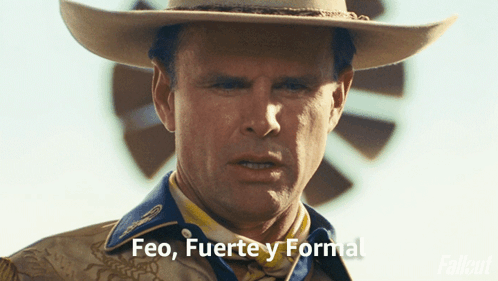
Two examples of the “poetry” (or at least good writing) in the story here. First, when Cooper is filming the movie scene in which he reluctantly shoots the bad guy instead of arresting him, pay attention to the short speech he gives: “Feo, fuerte y formal…it means he was ugly, strong, and had dignity.” (This phrase comes from what John Wayne wanted inscribed on his tombstone, which itself creates some interesting connections we won’t explore here). This is exactly what Cooper becomes when he transitions into The Ghoul. Dignified, yes, but also morally questionable (if not deplorable, which seems to be Lucy’s point of view), having lost all of the ideals he held as a human.

Second, the conversation between Barb and Cooper in the hotel after Cooper’s meeting with Robert House. He questions whether Barb was always a monster or became one working for Vault-Tec. When he incredulously asks whether she’d kill millions, billions, of people to save her daughter, she responds by asking, accusatively, “Wouldn’t you?” He may not be operating on Barb’s scale (Eddie Izzard might comment that she must get up very early in the morning), but as The Ghoul he certainly succumbs to her logic.

Here is the arc as we have it for Howard–weltschmerz has rendered him nihilistic, amoral. Can his view of the world, and thus himself, be redeemed and returned to the man of ideals and principles he began as? It’s a classic story of “the Fall” writ large in the blood of countless raiders and wastelanders.

With the latest episode (S2, E6), Howard says his real name as The Ghoul for the first time. We’ve learned more of his history with Hank MacLean, and he’s rejected an alliance with the super mutants for the war that is coming. In the latter act, he’s shown us that he has not fully succumbed to his nihilism, and I expect that his betrayal of Lucy, subsequent defenestration, and need to be rescued will function as the low point from which he begins his redemptive climb. I’m excited to see!

In the last post in this series we’ll look at the Fallout universe’s satire and criticism of late-stage capitalism, particularly in comparison to the Gospel according to Luke.
Christianity and Fallout (Part I: Violence)

One of my most popular posts (maybe the most popular) was a post about Christianity and the Warhammer 40k universe. I thought I might write on a similar subject with another beloved setting.

I cut my video-gaming teeth on Fallout, playing both 1 and 2 when they came out, and pining for Van Buren until it was finally cancelled. I’ve played through Fallout: Tactics, 3, New Vegas, and 4 multiple times, the non-canonical Brotherhood of Steel games (set in my home of Texas) spent more time fooling with Fallout Shelter than I ought to have, and have had my share of adventures in West Virginia (the only place I’ve lived outside of Texas, coincidentally) in Fallout 76 (although that’s been long enough I ought to go back, as there’s a lot of added content I’m haven’t played). I’ve loved the TV show so far; Walton Goggins has become one of my favorite actors (and the show has given him a character with a wide range in which he can shine), and I’m decidedly less grognardian about supposed retcons and changes to canon the show has made (I just don’t think it ultimately matters if Shady Sands was located in a slightly different place in the games than in the show, for instance). With my bona fides established, let’s talk about the setting and where it might or might not intersect with the Christian faith.

At the outset, I want to address a question that I see with some frequency on the internet: does Christianity survive in the late 23rd century of Fallout? The answer, emphatically, is “yes,” though the extent to which it does probably cannot be known. Rather than lay out the examples, I’ll point you to an article on the subject on the Fandom Fallout Wiki (which, I’m given to understand, may not be as reliable or accurate as some of the other available wikis, but it has plenty of citations from the games to make the point on this subject).

But, unlike my discussion of Warhammer 40k and Christianity, there will be fewer direct theological comparisons of in-setting ideas. Instead, Fallout provides a potential for examining Christian values in a setting that takes some of the moral dilemmas of our own world and dials them up to eleven.

If Warhammer 40k is “grimdark,” how should we categorize Fallout? Is it “grimlight?” I’d certainly argue it’s a grim setting; if you doubt that, read up on the Vault-Tec experiments in the vaults. Or consider the body horror of forced conversion into a super mutant or unexpected conversion into a ghoul. Or the things the raiders do to people for fun. Or maybe just the state of America before the Great War. Like cyberpunk settings, we daily find the ideas more prescient of the current history than is at all comfortable.

Here are a few additional examples: (1) Vault City is a slave-owning society; (2) New Reno is a hive of scum and villainy; (3) the Enclave represents the worst facets of American government and political discourse; (4) the Brotherhood of Steel, for all its initial ideals, is a fascist and intolerant organization that has deviated significantly from the spirit of its initial purpose.

But, while it’s certainly dark, there’s a lot more light in Fallout than in Warhammer 40k. There’s a lot more humor, and while “war never changes,” we’re beyond there being “only war.” Both the games and the TV show have a smattering of the comic, the satirical, and the “wacky” parts of the wasteland to balance out some of the grim and grit. But more than that, there are many examples of goodness in the Fallout world that do not exist in the same quality or quantity within Warhammer 40k. Naive as she may be, Lucy (as well as most of the other vault dwellers not in on Vault-Tec’s schemes) wants to do good. Shady Sands was a place of hope and tolerance. The NCR in general attempted to rebuild some semblance of a civil society.

These are beacons of hope in a largely corrupt world, good people fighting against the weight of the world for something better. And here is where the Fallout setting shines, I think: it doesn’t shy away from tough moral decisions and doesn’t leave decisions without their consequences. Neither do the games judge you for taking the low road and, in a fictional setting, it’s worth being able to explore the nuances of immoral or amoral behavior as a practical thought experiment or maybe just to let off some misanthropic steam–fantasy is a much better place to do that than the real world. That same factor–that Fallout is primarily encountered as a video game–is also its major weakness. If you don’t approach the game with the discipline of roleplaying a developed character encountering the Fallout world for the first time (and I don’t think most people do this or want to do this, and that’s fine), then meta-considerations creep in. Instead of asking “What is the right course of action in this situation?” or “What would my character do in this situation?” the question often becomes about the choices necessary to get the best game items. While there’s a potential investigation of amorality there, I think it largely breaks down the value of the moral quandaries that can be thought through in the Fallout world. This requires a sense of immersion.

I’ve been listening to Tom “Robots'” Fallout Lorecast the past week or so as a break from reading for school. If you just want to explore the lore of the Fallout world, I’d recommend you just follow rabbit trails on the several fan-made wikis. But what Robots does differently is that he often asks you to step into the shoes of someone in one of the Fallout situations: What would you feel and do if you were Paladin Danse upon his life-changing discovery? How would you feel and respond if you were a member of Vault X and discovered the experiment being conducted on you there? Robots’ background in philosophy comes to the fore as he uses the Fallout world to create immersive thought experiments.

It’s one of his podcast episodes that became the impetus for this post, in fact. If I remember correctly, it was his episode on Vault 3, where he discusses the naivite of the vault dwellers, their takeover by Fiends, and the philosophy of violence as necessary (with a mention of just war theory thrown in). Those of you who’ve followed the blog for a while know that the Christian ethics of violence is a topic that continues to fascinate and confound me. I think the Fallout setting is a great place in which we can look at the topic again.

If I understood him correctly, Robots’ core argument is that violence is necessary to keep evil from winning. I think that’s a commonly-held belief. Certainly, it’s the justification used by the “good guys with guns” argument in America, to which I once subscribed. But are things that simple?

Let’s except from consideration the Tactics and Brotherhood of Steel games which, by their very nature and design are fundamentally based in violence. In the true RPG Fallout games, the world seems like one in which violence is inevitable. You’re given weapons early on, and the wasteland is replete with creatures and people who unambiguously wish to do you harm. Within the genre itself, there’s an expectation that combat and violence will be aspects of the experience. There’s a whole ‘nother conversation to be had with why we often want combat and violence to be part of the games we play as a matter of interesting and high-stakes conflict, but this is a long post as it is.

If you’ve played through any of the Fallout games, did you ever consider that non-violence might be an option? I took for granted that violence would be part of my experience in every single one of the games–hopefully with me doing more of it than receiving. And yet, there are discussions and demonstrations of pacifist runs of the Fallout games all over the internet. Some people, whether through moral righteousness, creativity, or the simple love of a challenge, had the thought that they might survive the wasteland without becoming its moral victim. Until the most recent episode of the TV series (Season 2, Episode 4, “The Demon in the Snow”) and with the possible exception of her treatment of Snip-Snip, this was the journey Lucy trod. With the Ghoul as a ready foil, her character arc seems to be devoted to the question of whether one can maintain one’s values upon encountering and living in the wasteland.

Certainly, by “common” standards, much of the violence in the TV and the video games seems to be “justified.” There aren’t a lot of ways to talk a super mutant or a radscorpion out of violence, and–as with Vault 3–the raiders are an ever-present threat to those who would seek to live in the wasteland in peace and mutual cooperation. But terms like “justified,” and “just war” are often confused with “good violence” and “good war.” Is there ever really such a thing? Here’s maybe the more difficult question: is it ever acceptable to make a potentially immoral choice in favor of survival–yours or someone else’s?

Let’s take an example from Season 2 of the Fallout TV show (SPOILERS AHEAD!). Let’s look at Maximus’ killing of Xander Harkness. He does it to save lives, the lives of children no less, and in opposition to what amounts to racism. Certainly, in the moment, killing Xander and thereby preventing the murder of children is justified (and, in meta-narrative, I think the writers intended this moment to be a callback to the fact that the first Fallout games faced pushback and censorship because of the possibility of doing violence to children, but perhaps I’m reading too much into it). But every character who comments on what happened is clear that Xander’s death means war with the Commonwealth Brotherhood.

This, I think, is a good example of the theological belief I’ve come to (the argument for which must be relegated to another post) that one of the most profound messages of the Incarnation is that, on a cosmic level, evil cannot be overcome with violence or force; it can only be overcome by love. Violence begets more violence.

If we turn to very recent events in the U.S., let’s consider the violence perpetrated by I.C.E. Every tear gas cannister, every pepper-loaded gel round fired point-blank in the face of a peacefully-protesting pastor, every murder of an innocent woman, every violent arrest in violation of civil rights, every unnecessary use of force increases the likelihood that someone responds with more violence. I applaud the restraint and discipline of the many, many, peaceful protestors who have endured all of this violence without responding in kind; I believe that truly is the only way to achieve justice. If nothing else, it makes clear who the “good guys” and the “bad guys” are, and both the rest of America and the world are watching.

Not only is the response of non-violent protest the moral one, but it’s also the practical one. Should someone respond violently to I.C.E., our government will use that incident, no matter how limited, to justify the deployment of greater violence against the populace. Which will engender more violence from the populace. So on and so forth. When Ron Perlman’s gravely voice opens the early Fallout games with the now emblematic “War…war never changes.” This is what he means. Violence only begets more violence, one war only sets up the conditions from the next. It’s only when we choose non-violent resolutions that we truly move toward the peaceful world God wants from us, where no one “studies war anymore.”

But the brilliance of Fallout as moral thought-experiment is that it does not simply leave us with satire of the violence in human nature. Let’s consider Vault 3 again. Even accepting my argument that, at the level of eternal redemption, on non-violence drives out evil, the question remains of whether violence is necessary, acceptable, perhaps even “good” to buy some time for love to win out. Put another way, if we have to choose between the naive but generally moral vault-dwellers to survive or the violent, immoral, and–we’re tempted to say despite not knowing the truth of the statement–irredeemable raiders, is it moral to allow the raiders to kill the vault-dwellers?

The question may perhaps be boiled down to this: do we prioritize the possible redemption of the raiders over the current moral superiority (in a general sense, of course) of the vault-dwellers? The knee-jerk response is an easy one. Theologically, though, the question is extremely complex.

Our soteriology frames the question. If we believe that the only possible salvation comes through the confession of Jesus Christ as Lord and Savior, there isn’t a salvific calculus here: those who believe in Jesus are saved and those who do not are not, and that’s that, no matter who kills whom. But if we’re willing to consider a God who is more compassionate and less arbitrary than that (particularly in a world where the raiders may never have had an opportunity to hear the Gospel, depending on how things played out for them), the question is more complicated. And, if we consider the morality as a separate (but still theological) question from salvation, we cannot escape some sort of judgment at all.

Let’s work through this. If, arguendo, God redeems those who know and practice love in addition to those who have faith in Jesus as God1, we have to look more closely at the original question.

One might argue that, if one is assured of their own salvation and God’s promise of eternal, abundant, life, the determination of a need to kill someone else, however bad that person may be, to survive, is a rejection of faith in God’s ultimate justice. That, I think is where all of the complexities enter in. If moral questions prioritize this life over belief in eternal existence, then the idea of “just war” and “just violence” is easier to come to. But, if we believe in eternal life and cosmic justice over temporal concerns, what does it matter if someone assured of their eternal life is unjustly murdered by an immoral person? Faith in God’s promises is vastly more important. This idea lies behind the actions of the martyrs. What if God’s idea of justice is not about people “getting what they deserve?” I’ll argue that its not in another upcoming post, but even without those arguments, the sacrificial salvation through Christ of undeserving mortals seems to discount a cosmic justice as a matter of dessert.

And yet, if we’re called to make this world like the Kingdom of God (I need to discuss alternatives to this phrasing in a separate post and soon), doesn’t that include protecting the innocent against the iniquities of predators? Is there a sort of “double justice” we must try to pursue simultaneously–a “worldly” or “temporal” justice and a cosmic and eternal justice? How would we balance such an idea?

There is no easy answer. In this life, we have to weigh the possibilities and do the best we can, never knowing until we’re face to face with our Creator whether we did the right thing. We can say that violence is never the best or righteous act while acknowledging that, in a fallen world, it may sometimes be the lesser of two evils. But it’s also possible to reject that position in favor of unflinching pacifism. We might believe, as Aasimov tells us in Foundation, that “violence…is the last refuge of the incompetent;” that we only ever choose violence because it’s the easier option, never the better one.

Fallout as the best fiction does, gives you space to consider the possibilities, not with a heavy-handed resolution in view, but as a thought experiment to help you determine where you might best position your belief. Fallout unflinchingly gives us views of the best and the worst of humanity, it acknowledges both the baseness and sublimity of human nature, just as life does. It reminds me of a quotation from beloved Christian author Frederick Buechner: “Here is the world. Beautiful things will happen. Don’t be afraid. I [God] am with you.”

I’d hoped to make this a single post, but my loquaciousness again gets the better of me. Two more posts on Christianity in Fallout will be forthcoming: one about the many examples of the journey to redemption that Fallout gives us, and one about the meek and the powerful, particularly with reference to late-stage capitalism.

  1. For those who read this sentence and assumed we’re falling into a works-based or “Pelagian” idea of salvation, I disagree. There are several ways to get to my point. We might use simple logic through the transitive principle: If we accept the doctrine of the Trinity, then Jesus is God. If God is love, and those who believe in Jesus are saved, then those who believe in love are saved. We might also argue that the knowledge of Jesus as God and Savior is itself a transformative vehicle through which one achieves the totality of salvation, but if it is the transformation and not only the knowledge of God that is operative here (with Jesus being the clearest and most direct way to transformation, I’d argue) then the soteriological question remains complicated and mysterious in ways that should give us pause in going beyond attempting to “work out [our] own salvation through fear and trembling.” Yes, in making the argument above, I’m doing just the opposite, but this is one of the reasons I think we ought to hope for, if not definitively believe in, as expansive a view of salvation as possible–while perhaps holding in tension that God respects our free will and independence so much as to never force anyone into the acceptance of salvation. ↩︎

Cyberpunk 2077, Phantom Liberty: Agent 0010101001

As usual, I’ll lay out my biases first–unlike many, I enjoyed Cyberpunk 2077 when it first came out. I played it on an Xbox One X and really didn’t have too many glitches or infuriating experiences. I played it enough then to play through the entire main story. In fact, I wrote a review of the original Cyberpunk 2077 back in 2021 (click here for that).

Later, when I’d sold the Xbox and returned to a gaming PC, I bought the game again. I liked it enough to start a few new playthroughs (that I didn’t finish), mess with some mods, and generally muck about in the game. I’d played a lot of Shadowrun tabletop in my youth, and my proficiency in math is probably due more to FASA games (cyberware calculations in Shadowrun and mech-building in Battletech) than formal education. I make no claim to be a math wiz, it should be said. But the RPG Cyberpunk I was familiar with had a lot of fantasy mixed in, and I’ve still never played a TTRPG in a cyberpunk setting without all the fantastic elements–though I’m convinced of the value of those settings and I’m starting to wonder if I’d like a tabletop cyberpunk game that doesn’t deal with the fantastic better than something like Shadowrun. Remains to be seen. In that way, Cyberpunk 2077 was an eye-opener for me.

So, I was excited for Phantom Liberty to drop and started a new Cyberpunk 2.0 playthrough in advance of the release. Y’all, I liked Cyberpunk 2077 in its original form, but 2.0 made a lot of wonderful changes. The choices of cyberware are more interesting, and the “allowance system” for cyberware more closely matches tabletop Cyberpunk (though it’s far from exact). Crafting was vastly improved, cool new weapons were added, removing the link between clothing and armor allowed for style to be a more prominent feature of the video game, as it is for the tabletop. Here, it’s worth a brief aside that the “style” aspect of Cyberpunk is a little lost on me–I have no sense of style, nor care for one, whatsoever. I’m morally opposed to the “style over substance” mentality in real life, though it fits well for the cyberpunk aesthetic.

Happy with the new changes to the system itself, I was in a good mood when my V got the call to venture into Dogtown to see if I was a bad enough dude to save the president. Not sure that mattered–Phantom Liberty throws you into the deep-end, with a true in-media-res insertion into a confusion but undoubtedly epic course of events. With a brief introduction to the situation and a vague promise of saving you from the Relic, hacker-extraordinaire Songbird, pushes you in the direction of a crashing Air Force One (I don’t remember what they actually called it, and it was an orbital craft, so it may well have been Space Force One).

What ensues is a protracted action sequence as you race against the forces of Kurt Hansen (Captain Kurtz of Heart of Darkness/Apocalypse Now, anyone?), the de facto ruler of Dogtown, to reach the NUSA president first. At least, it was a long running-gun-battle for me, but I was rocking a Sandevistan instead of a cyberdeck, so there could definitely be a stealthier approach available. I don’t remember being excited about a video game fight like that in a long time (frustrated, made anxious and paranoid, sure, but excited? Nope). It’s not that Cyberpunk has particularly innovative gunplay–the cyberware makes things interesting, but I much prefer something like a Tom Clancy game for gunfights, or, if I want to get serious, Ground Branch. Nevertheless, the frenetic pacing, the amped up music, the neon signs backlit by muzzleflashes, it was a good time.

From that whirlwind introduction, the storyline moves into a veritable wilderness of mirrors. You’re linked up with several burnt NUSA spies ready to get back in the game and everyone’s motivations, words, and promises are suspect. As I’ve said many other places on the blog, as uncomfortable as it can be in the moment, I love a game (whether tabletop or digital) that puts characters and players into tough situations without adequate information and difficult moral choices thrust upon them–this makes for the most interesting stories, I think and, you’ll keep thinking about whether you did the right thing (or even the “best” thing under the circumstances) long after you’ve left your chair. Video game designers may like that for its replay value, but I like it for its artistic and philosophical value (unfortunately, I have no brandy to swirl while making such a snobbish statement).

It’s almost like the writers of Phantom Liberty started by going to TVTropes.com and taking note of all the tropes of the espionage genre–in the best of ways. Phantom Liberty takes you through action-movie over-the-topness (see above), gives you Mission Impossible-style encounters where high technology and assumed identity are the name of the game, puts you in fancy dress and lets you meet your opponents at the gambling table, sets Tom Clancy-like political stakes, and introduces you to the gritty backgrounds of characters who’d be at home in a John le Carré novel.

As with a good spy story, nothing is what it initially seems, and it’s not really clear who the “good guys” and “bad guys” are. That plays well with the cyberpunk genre, anyway, n’est pas? So, there are really three ways you can make decisions as you progress through the plot as V: (1) you can look up which decisions get you the best iconic weapons and gear (or at least the ones you most want) and follow a meta-mercenary approach, (2) you can wade into the ambiguity and follow your whims and impulses in the moment, or (3) you can play a character. In this last approach, you’ve got to decide what V really believes in (if anything), and make your choices according to the ideology you’ve assumed in playing the character. That, perhaps, is the best part of Phantom Liberty; it truly invites you to step into V’s head and become the character for a time–that’s really the only way to have coherence to the (many) choices you’ll be asked to make in the story. Many of those choices are truly significant, both for V and for others.

The set-piece battles are amazing, don’t get me wrong, but it’s the humanity of the story that really won me over. In a cyberpunk setting, there’s something about that that feels right. There are four endings to Phantom Liberty (I’m told, having only played through once and personally experienced only one of those endings). The one I got seemed meaningful, poignant–and very cyberpunk.

Not only that, but you get some denouement as well–you’ll get some after-the-fact contacts from characters you encountered in Phantom Liberty and get an idea of what happened to them based on the choices you made. More than a “here’s the consequences of your playthrough” tidy wrap-up (something Starfield does), this gives a sense of living in that world, and living with the consequences of your choices.

Phantom Liberty also adds an inexhaustible, procedurally generated side mission involving boosting cars. These missions are fun, usually net you some skill experience that might be hard to get otherwise (like Netrunning for my V) and earn discount coupons that reduce the price of a single vehicle purchase. These “coupons” stack up to a total 95% discount (meaning you’re buying the Aerondight “Guinevere” for under 10k) but all are spent when a purchase is made and then you start collecting them over again. Between the new Gigs and Side Missions, improvements to crafting and weapon ability, and potentially unlimited funds through grand theft auto, money is no longer an issue for V in Cyberpunk. I’ve got just about all the cyberware I want to be able to use, I’ve rented all of the apartments, and I’ve purchased most of the vehicles (at least the ones I want), and I’m still sitting pretty on four hundred thousand EB.

My enjoyment of the auto-theft missions and the style of cyberpunk missions in general has made me think that we’re in for quite a treat when AI gets more closely integrated with our video-gaming. Imagine endless procedurally-generated but detailed and varied missions available to make a merc career on. I envision something like Cyberpunk 2077 crossed with the “career”-style play of Sid Meier’s Pirates, where each playthrough could be an entirely different experience.

The Side Missions and Gigs added through Phantom Liberty are characterful and interesting–you’re getting more new playtime here than just the main story.

If you enjoyed Cyberpunk 2077 at all, or even if you tried it when it first dropped and didn’t like it, I highly suggest you return to Night City to see if you, too, are a bad enough dude to save the president.

Starfield: Void Between the Stars

At the outset, I must admit that I had very high expectations of this game; probably unrealistic and unfair expectations. That said, I can’t help but feel disappointed after having put about 60 hours into the game. My opinion of the game may not comport with broader criticisms; I haven’t checked. But, as you already know, my opinions don’t have to be yours.

For background: I completed the main story, the companion missions for several of the characters, the Freestar Ranger questline and the Vanguard questline. I spent an inordinate amount of time taking bounty missions to neutralize Crimson Fleet ships or Ecliptic Mercenaries so that I could level up.

That last part was, perhaps, one of the most frustrating parts of the game. Character progression is locked between 82 different skills, each with four levels. Some of these skills–many of the combat ones–aren’t necessary. I found myself doing just fine at the hardest difficulty level with only about six points spent in the Physical and Combat skill trees. On the other hand, I dumped lots of points into the Science and Tech trees because some of the parts of the game I’d looked forward to most (building outposts and spaceships) required a great deal of investment to fully enjoy. The missions I completed in search of the next skill point were repetitive–just fine if I wanted somethign to do while listening to an audiobook, but insufficient for enjoying the thing itself.

In most things in life, I value substance over style. In Starfield, I loved the visual style of the game, with a mostly low-fi feel of hardscrabble colonists trying to make it among the stars. But I found the substance greatly lacking. Each faction has one main “city” (which is far too generous a word, as these were more like well-established villages), and the entire explorable system only has about ten “hub” locations where you can manage your ship, resupply, find story missions, etc. In general, for having 1,000 planets you could land on, the galaxy felt really empty, both of people and of stories. I understand that a good portion of that is a matter of the realities of programming, storage size, computing power, etc.

The factions that govern those locations seemed all too cliche as well. You have the United Colonies, your generic “democracy in space” faction with its UN-like governing council and penchants for militarism and capitalism. To counter that, you have the Freestar Collective, a generic affiliation of liberty-loving space cowboys. The third “major” faction is the Crimson Fleet, a group of space pirates. While they are a joinable faction, I shot too many space pirates too early in the game to ever have a chance of being welcome at their HQ space station. There’s also Ryujin Industries, but I lost interest in the game prior to starting their storyline.

Then there’s the House of Va’Ruun, a generic and poorly-defined space cult that likes serpents; the Ecliptic mercenaries, your generic “bad-guy” mercs who seem to be doing a lot of things across the galaxy without much reason; the Trade Authority, a generic syndicate dealing in illicit goods behind a semi-legitimate storefront; the House of the Enlightened, your generic do-gooder space atheists; the Sanctum Universuum, a generic faith organization without much explanation of actual beliefs; and the Spacers, an eclectic group of space crazies removed from Firefly’s Reavers only by a lack of grotesque body-modification and unshielded reactors.

If I’ve used the word “generic” overmuch, I hope that offers some microcosm of what I felt playing the game.

I did not form a connection to any of the characters in the game. I had to double-check to see if the voice actor for Barrett was the same person who voiced Preston Garvey in Fallout 4 (he’s not)–Barrett annoyed me to such an extent I had convinced myself they were one and the same, perhaps an intentional (and cruel) joke played on Starfield players who’d come from Fallout.

Speaking of Fallout 4, I couldn’t help but make comparisons, particularly as I got closer to the end of Starfield‘s main story. I really disliked the main line of quests in Starfield, which made me think, briefly, of how far Bethesda’s writers had fallen since the last Fallout game (not counting Fallout 76, of course, which I actually enjoyed, but more because of playing with friends than the game itself). I quickly remembered that I’d hated the main story in Fallout 4 as well, so this was probably just par for the course. But I really enjoyed individual quests and many (maybe most) of the side quests in Fallout 4, where Starfield‘s quests felt generic (there’s that word again) and, frankly, uninteresting. It was the gameplay loop of gear and gaining skill points that kept me playing the game, not the setting or the story, which ultimately left me feeling like the time spent on the game had been wasted, not used to indulge in a deep and entertaining fantastic world. As gameplay loops are intended to be addictive, and my discipline in resisting them is relatively low, the game began to feel like a hated dealer to whom I consistently returned for just one more hit, chasing a vaguely-remembered high I’d probably never find again after the first few hours of the game.

If you’ve played Fallout 4, add some quality of life improvements, then add some new quality of life problems, and then add starships and space combat, and you’ve basically got Starfield. I understand that the game was built on a “new engine” (or at least an iterative improvement on previous engines used by Bethesda), but the game looked and felt much like Fallout in its menus and UI. Also like Fallout, resource management for building outposts and improving gear was mind-numbingly cumbersome.

I did enjoy the spaceship building–modifying my existing spaceships and building new ones from scrap was my favorite part of the game–but it just wasn’t enough to overcome my other disappointments. In terms of gameplay, I really enjoyed boarding and taking enemy ships. For extra hilarity, hanging out on a planet until a Crimson Fleet or Ecliptic ship lands, running straight up their boarding ramp and inside, a jacking their ride while they’re standing around wondering what just happened proved highly amusing, if only for the first two times.

It did give me an idea, though–I’d love to see a sci-fi, less-cartoony version of Sea of Thieves set in space, with emergent story and satisfying gameplay that doesn’t need character improvement loops to make the game entertaining. Maybe we’ll see something like that in the future. I spend a little bit of time playing No Man’s Sky, which has some of that, at least.

Despite my disappointments, I see a great future for Starfield. It’ll make an amazing platform for modders to work their magic and add wonderful content (and some questionable content) to the game as they’ve done with Skyrim and Fallout. My suggestion, then, is to wait a few months or years for a plethora of mods to fill in the gaps in the base game and then venture into the stars.

One other good thing came from my playing the game–it inspired me to finally start getting Cortex Prime rules and a detailed setting together for a sci-fi game of my own. I’m calling the setting Astra Inclinant; I’m sure you’ll hear about it on the blog soon.

I’ve turned now to slowly playing through Cyberpunk 2077’s Phantom Liberty, so I’ll review that once I’m finished. Already, though, I’m enjoying it more than Starfield, and the “2.0” version of the game makes great changes, so if you’ve never played Cyberpunk 2077, or if you haven’t played it in a long while, now’s the time.

UbiWorld (a “kind-of” Far Cry 6 Review)

In the midst of some (sporadic) writing, running a Brancalonia/D&D game, and preparing to open back up for another foster placement, I’ve been playing Far Cry 6. I have completed the main story and done most, but not all, of the side missions.

I’m a fan of the series, having played them since 2. But it’s a guilty pleasure, really–I don’t particularly see the setting or story of the games as particularly enthralling (despite Giancarlo Esposito playing his signature bad-guy role in 6, I think the story of 5 was more compelling–probably because it played upon personal interests (the morbid fascination with cults) and fears (the increasingly dangerous idea of what constitutes “patriotism” in the U.S.). For Far Cry 6, I’ve mostly been enjoying the mindless fun of the gameplay, the beauty of the environments, and the exploration element.

As I’ve done so, a realization has started to sink in–Ubisoft’s really only been making one game for a while. Far Cry 6 is most similar (I’d argue) to Ghost Recon: Wildlands (which I loved), but the latest Ghost Recon entries, Far Cry games, and Assassin’s Creed games are basically the same thing with some minor gameplay differences and some reskins for setting.

I understand that that’s a good business move–all of these franchises perform well financially, consumers pretty much know exactly what they’re going to get with a new version in any of those franchises, and going back to the same well of systems and mechanics certainly lowers production costs (or at least so I’d assume).

Being a person who loves RPGs (which there is some of in these games), tactical shooters (in the non-Assassin’s Creed lines), and game-world exploration (at the core of all of them), I do look forward to new entries in each genre. But I think that the narrative efforts in each new game come out much like any copy of a copy of a copy: always a little less clear, always a little less useful, always just “less” than the one before. Ghost Recon: Breakpoint, while a really interesting idea for a setting, was simply less compelling than Wildlands, Far Cry 6’s narrative certainly pulls less emotional weight than 5’s.

Something else both Breakpoint and Far Cry 6 have in common is their use of famous actors for the main villains (Jon Bernthal and the aforementioned Giancarlo Esposito, respectively, both actors I really like). The problem has nothing to do with the actors themselves–it’s that the use of the actors seems to have been an excuse for not creating more interesting and vibrant villains in the first place.

This has me on two tangent thoughts. First, what would an Ubisoft game that drew on the best elements of each of these related games look like? From Ghost Recon, I’d take the realistic weapons (in designs and performance), the plausible tech (drones, NVGs, thermals). From Far Cry, capturing bases and strategic points, side missions about fleshing out characters and narrative rather than mechanics, treasure hunts, takedown systems (for both people and vehicles). I think I’d rather keep a skill-based character development over a gear-based one like Far Cry 6. If I remember correctly, Far Cry 2 had weapon jams–I’d bring that back. Suppressor overheating is a cool idea for a game, but the way it’s treated by Far Cry 6 is really only as realistic as the “Hollywood quiet” suppressors in just about any video game.

On this note, there was some very interesting commentary (way back) on video game weapon design from on of the developers of Rainbow 6: Vegas (also an Ubisoft game). The designer giving the commentary explained that they first developed the weapons to be as realistic as possible, but then modified them from that starting place to conform more with popular conceptions of weapons–the knockdown of a shotgun blast, the quiet of a suppressor, etc.

But the second, more important thought, is about what the next evolution of these types of games should be. The gameplay is fun; I’m partial to shooters and to open worlds. While there could be some additional improvements to gameplay (as described above), the place we need some real improvement on this games to feel like they’re not just reskinned rehashes of the same old, same old, is the narrative.

Here, I have two subpoints. The first is that we need more interesting narratives. Far Cry 6, like the other games, has its moments of emotional pull. It is a revolution after all, and the true cost of a revolution, so far as I can tell (never having been part of one) is in the lives it takes or otherwise changes irrevocably. We need more personal stories. I’ve grown bored with the weird and quirky, but ultimately shallow, characters. Mr. Esposito does a fine job with his role until the very end, but the writers could have given him so much more to work with. And, while some may care for the crazy companions in Far Cry 6, I do not. As is my want in just about all of my fiction, I want more nuance, more complexity. And along with that complexity, I want some agency.

What the UbiWorld games really need is to be removed from a “playground” experience where you merely ride the rides and placed into a participatory narrative. You should have to make choices that have tough consequences, should have multiple opportunities to change the story in a major way (what if Dani joined with Castillo?), and the way that missions are approached should have a consequence as well. Getting extra resources for taking over a base without setting off an alarm just doesn’t cut it anymore.

While we’re at it, let’s through in some random events in each playthrough and some systems that combine to make for emergent gameplay. I am convinced that a great part of the success of Sea of Thieves is the emergent nature of its gameplay. My friends with whom I play that game don’t talk about the Tall Tale missions, they talk about that time where something incredible and unexpected happened through a combination of interactions with other human beings and the (random) procedural generation of the game.

I’m not saying that UbiWorld games should be massively multiplayer (though it’s a thought worth experimenting with, I suppose), but the ability of a game to generate unique (or at least particularlized) experiences for different players should become a regular aspect of electronic games.

My overall experience with Far Cry 6 is that, if you like Far Cry games specifically, or UbiWorld games in general, you’re probably going to enjoy the time you spend with it. But for me, what it left me with was a desire for something more, for true evolution in the style of games that are coming out that builds upon this strong foundation and makes it into something truly amazing.

(Review) Cyberpunk 2077: This Isn’t the Future I Ordered

[I started to write this review back in mid-January, but I got distracted by life events and other writing projects and have only now come back around to finishing it.]

[WARNING: SPOILERS INCLUDED IN THIS ARTICLE.]

I waited a few weeks before I picked up my copy of Cyberpunk 2077. My brother had been playing since release day on a stock Xbox One and swore up and down he wasn’t having massive crashes or game-breaking bugs. So, about the start of the new year, I plunked my creds down and unlocked that deluge of bytes and bits that, a short time later, coalesced into the game on my Xbox One X. It seems only fitting to get the game through such a method, though I didn’t manage to find a way that I could download the game straight into my brain. Some of the things I was promised by the Cyberpunk of my youth are yet to come to fruition.

I played through most of the available content, having fewer than half-a-dozen side missions left and about as many of the available NCPD gigs. In that time, the game hard crashed fewer than tens times and, between the system’s assertive autosaving and my own constant backups, I never lost more than five minutes of playtime when a crash happened. I lost much larger chunks of play when AC: Valhalla crashed on me, which happened with less frequency than Cyberpunk crashes, but not by much.

I only noticed one other major glitch while playing, and that was that, once I equipped the Mantis Blades, they would never retract, even when I switched weapons, and continued to take up a good half of the screen. The issue resolved when I switched back to the monowire cyberweapon instead and I didn’t try the Mantis Blades again during my playthrough. There were a few minor visual bugs or errors–such as being unable to pick up certain (very low value) items that had been marked as pick-upable. Overall, the game played smoothly, was pretty to look at on an few-years-old Samsung HD flat screen, and didn’t suffer from the litany of problems I’d been led to expect. The game actually convinced me that upgrading to the Xbox Series X might not be as imminent a necessity as I’d previously thought. Your mileage may vary.

A subsequent second full playthrough (and about half of a third) had me see most of the rest of the game’s side missions, with fewer crashes or issues each time–thanks to consistent updates by CD Projekt Red.

Let’s Talk About Sex

Let’s talk about the ugly first; get it out of the way: Cyberpunk 2077 decided to resort to gimmick and shock value in its treatment of sexual issues. The range of gender presentations that had been promised in the character builder was lacking at best. Instead, you can pick your penis size, or have a vagina. None of the choices matters, and there’s really no purpose to them. I don’t mind sex and romance relationships being part of the story lines of video games–I’m a generally hard person to offend, so those things merely being there don’t incite me to anger. That said, I’m not sure that I’ve ever come across a romance system (or dialogue) or a “sex scene” in a video game that didn’t make me feel awkward and uncomfortable. You can find elsewhere a deep discussion of some of the sexualized gimmicks and mistakes made by the game designers. For my part, what I really want to comment on is the missed opportunity here, with the clumsiness of the shock-value choices made by the developers underscoring the lack of thought given to their approach. I’m not interested in the debate of whether sexual topics should have been omitted from the game altogether; with regard to such issues, my first question is always “what does the inclusion accomplish for the story” and, while the answer in Western media is often that it’s included only to pique the prurient interests of the audience, I also stand amazed, like G.R.R. Martin and others, that American society in general is simultaneously so uncomfortable with sexual issues and so comfortable with the graphic depiction of violence.

Cyberpunk, as a genre, provides us with warnings not just about technology used without regard for ethical considerations, but also the commodification of everything human by ultra-capitalist systems. While the former is certainly an increasing worry for modern society, the latter is the far more pressing issue in my mind–after making it through the widespread disaster that was Texas’s (lack of) preparedness for winter storms last week, which to my mind clearly demonstrates the problem with allowing profit-driven private interests to trump public welfare (as does the system of pharmaceutical development in the U.S. and its effects on the current pandemic)–the increasing dangers of a society caught in a death-spiral propelled by the veneration of capitalism above all other ideologies feels close to home. So, when Cyberpunk resorts to using sex and nudity only as window dressings, instead of commenting on the increasing commodification of sex and human desire, I honestly feel a little cheated about what could be meaningful narrative that could pull Cyberpunk 2077 from entertaining game into the realm of participatory literature. Even the plotline with Evelyn and her fate does little more than provide plot points without much consideration of what it means to be a “doll” sacrificing personal identity to satisfy the needs of others (sexual or not) and the plots that revolve around Clouds likewise use the profound sexual issues as a backdrop without making profound use of narrative potential.

You Get What You Give

I read another review of Cyberpunk 2077 that criticized the lack of defined personality for V, complaining that The Witcher had you play a character with a defined personality for whom you still had meaningful choices to make and further lamenting that V’s personality can swing psychopathically based on the whims of the player. I’d like to respond to that evaluation and, since it’s my blog, I will. My kneejerk reaction to this sentiment is that the critic needs to play more roleplaying games (pen and paper, preferably) to appreciate a video game in which you have the opportunity to create a personality for your character without having that personality defined for you. I, for one, would rather play a protagonist I get to design for myself rather than playing someone else’s character in a story. If the character comes across as inconsistent, that’s on the player more than the designers, because you have opportunities in Cyberpunk to make consistent character choices. If, on the other hand, you approach every dialogue option from the perspective of yourself staring at a screen where you have an avatar to wonder around in making choices according to your every whim, of course you’re going to end up with an inconsistent character. Feature, not bug, in my book.

That said, not all of the character choices have enough effect in the game to be meaningful. Some aspects work well without changing the storyline much or at all–the developing relationship between V and Johnny can be cathartic, dramatic and satisfying on its own (though this is undercut somewhat by having a “secret” end-mission option based on your relationship score with Johnny causing a split between immersively playing a character and meta-gaming the program). Otherwise, though, many of the choices are too limited in effects to truly be felt. Yes, some choices will open up romantic relationships, and some will allow for different end-game missions and resolutions to the main plot, and there are a very select few that will have a later result (freeing Brick in the initial confrontation with Maelstrom may have a later effect if you play through all of Johnny’s missions), many follow the pattern of “let them say whatever they want so long as they do what you want them to.”

Maybe I’m chained to my existentialist leanings, but it seems that there’s a lot of Cyberpunk’s story and main character that only bears the meaning you personally create for it. Just like the ambiguity of life in general, that could be immensely freeing and satisfying or terrifying and ennui-inducing. Or both at once.

Gameplay
I played my first playthrough on the “normal” difficulty setting, increasing the difficulty for each subsequent playthrough after I’d grokked the game’s systems and idiosyncrasies. My first character ended up as a sort of generalist, my second a street samurai foregoing any hacking for a Sandevistan and later a Berserk module, my third going full Netrunner.

The game is devastatingly easy, even on the highest difficulty setting, for netrunner characters. One reviewer compared netrunners to wizards in fantasy settings, with programs approximating spells. I think that’s relatively true, especially because the programs work in ways that are especially “gamey” and unrealistic. If you’re going to implant yourself with cyberware, you’re not going to allow that cyberware to be wirelessly-enabled for any punk with a computer to hack into, and you’re probably going to invest in a decent firewall as well. Systems aren’t going to be designed with such blatant faults in them that you can electrocute or overheat the user. So yes, the hacking in Cyberpunk is essentially magic.

The pure combat approach, even with a good deal of stealth, is much more difficult, especially on higher difficulties. Without the ability to hack cameras, you have to be especially careful. Attacks must be carefully planned so as not to be overwhelmed. I kind of think that this was the most enjoyable approach to the game, though, both for pleasure of gameplay itself and the satisfaction of achievement. There’s something thrilling about beating a machinegun-wielding punk to the punch while swinging a katana, and the gunplay in Cyberpunk 2077 is pretty good, too–and I love a good tactical shooter.

Another exploit to use or avoid is finding the Armadillo mod blueprint. I don’t think that there’s any Technical skill requirement on being able to craft the Armadillo mod at any rarity level–the rarity level of each one you make is just randomized–and few materials are required to make them. If you keep to clothes with multiple mod slots and fill them all with level-appropriate Armadillo mods, you can maintain an Armor rating sufficient at any given level to feel nearly invulnerable.

The game lacks some of the exploration elements you might expect in an open-world RPG; you’re not going to find as many of the sorts of locations that tell their own little stories like you would in Fallout or Elder Scrolls. But the side jobs are interesting–some of them more interesting than the main story, I think–and search them out, as well as the NCPD hustles, fills some of the gap.

Substance and Style
The feel of Cyberpunk 2077 is the feel of 80’s sci-fi in the setting tone and dressing. On the one hand, that’s fitting; cyberpunk was born in the 80’s. But it’s also been more than 30 years since the end of that decade. Technology and culture have changed. Our cultural fears and suppositions have evolved. World events have shown us that, while the danger of megacorporations is real, it might not be so melodramatic as we expected. We’ve had Brexit, the War on Terror, the War on Drugs, the realization (by us–often willingly–ignorant white folk) that racial injustice has never been overcome, the resurgence of far-right terror groups and white nationalists, and the shift of widespread economic fears focusing on Japan to focusing on China. But we’ve also seen some things change for the better–green energy is innovating and being taken seriously, a majority of the world (if a slight one) believes in the reality of climate change and the moral obligation to do something about, technology has provided for democratization and methods of social resistance as much as domination.

Bear in mind that the original Cyberpunk RPG setting took place in 2013; the most popular version of the game was set in 2020. Moving the timeline forward (either all the way to 2077 as in the video game or to the 2050’s as in the tabletop Cyberpunk Red) begs the question–why hasn’t anything really changed? Yes, Mike Pondsmith and the other members of the creative teams of both projects did hard work in balancing a setting that feels at once like nostalgic Cyberpunk and just a bit different. That’s a difficult line to walk, so I’ll admit that my comments here should really be applied to the cyberpunk genre in general and not to the Cyberpunk setting specifically, in any of its guises.

But I’m ready for cyberpunk as a whole to grow up, to evolve with us. It’s insufficient to continue to dwell on the cyberpunk of the early years–though we must acknowledge a debt to Pondsmith, Gibson, Stephenson and the early fathers of the genre. Where’s a cyberpunk for my middle years, one that includes all the myriad shades of gray endemic to any genre born from noir, but that also includes some dashes of color hear and there, that gives us a gritty optimism, reasons to fight the evil in the world to preserve the good, reasons to do more than only survive?

Maybe I need to read more cli-fi and other developments out of the cyberpunk genre. My own fiction writing, while fantasy in genre, takes a number of cues from cyberpunk–but that’s not quite what I’m talking about either. Where’s the wise old cyberpunk that’s introspective in new ways? I’m seriously asking–if you’ve found it before me, drop me a line!

So, while enjoying the neon retro-future that Cyberpunk 2077 offers, I’m also left wanting something more.

Conclusions
I enjoyed Cyberpunk 2077 well enough to return to play it with different character builds, and it’s definitely reminded me of my nostalgia for the cyberpunk genre. I think that it’s the gameplay, though, that did it for me more than anything. The narratives have their clever points, drama and empathy-invoking aspects, but if you’re looking for storytelling on quite the same level as The Witcher, you’re not going to find it here. Maybe it was just too much hype for its own good. Maybe too many promises that didn’t make it into the release build. Or maybe it promised us a world we’ve already left behind in our hearts and minds.

Assassin’s Creed Valhalla – a Strange Nostalgia

I haven’t quite finished the game yet, but I’m far enough in I think I can give a good review. Here it is.

First, the ugly. Feel free to skip these minor rants if you’d like.

I have a love/hate relationship with the Assassin’s Creed games. I love the historical aspects of them: running around in reconstructions of places I’ve studied but can never truly visit, hearing at least a palatable effort at ancient spoken languages (the Old English of Valhalla being the one I’m most familiar with, as it happens), and living an adventure–if overblown and grandiose–in another time. But I hate the framing device in which all of the Assassin’s Creed story takes place. If there weren’t so many people out there trying to peddle some version of historical belief in ancient aliens (an idea I find to be demeaning to historical peoples and often invoked as a matter of racism), I might not mind it in my fantasy games. But there are, and I do.

I’m also not a huge fan of the use of Templars and Assassins as factions for what is (at least in part) supposed to be a “good versus evil through history” struggle. Both factions are too nuanced and problematic for such use, and employing them in such a way, I think, plays too much into the conspiracy theories about them. From the narrative perspective, it’s sloppy writing to resort to them. From the historical perspective, its dangerous pseudo-revisionism thinly guised by fantasy. At best, their use makes unintended assertions about history that, while placed in a fictional environment that logically has no bearing on actual history, blends enough of the semblance of history into the setting to make that easy to forget. This is only partially side-stepped by the fact that the factions we’re dealing with in this game are the “Hidden Ones” and the “Order of Ancients,” the precursors, respectively, of Assassins and Templars.

So, I try to skip through those parts of AC games (though not all the Order hunting–I’m not a philistine) and focus on the “historical” portion of the games. Thankfully, they historical portions are by far the greater part, and I’ve only really had one cut-scene of the present “Animus” framing device in many hours of play.

Gripe #2: Assassin’s Creed Valhalla has no singlehanded swords for player use. Given that the early medieval sword (those that fall under Peterson’s typology rather than Oakeshott’s) is an iconic image of the Viking, it is nothing short of a travesty that they are missing from the game. This is exacerbated by several factors: (1) many enemies use a single-handed sword, so the assets and animations are at least partially present, and the “why can’t I just pick one up” question looms large; (2) you are given several ahistorical two-handed swords to use; (3) it’s just such an obvious oversight.

A further comment about the two-handed swords (with the caveat that I’ve mostly been using one in the game): my supposition is that the choice not to include dedicated one-hand swords arose out of a perk that allows you to use large weapons in a single hand (thus pressing the two-handed sword into service as a one-handed sword). Yes, it’s a video-game, but that choice strikes me as dumb anyway. From a mechanical standpoint, it reduces the value of choice of weapons, with the realism sacrificed for the “cool” value a bit over the line for my taste (which I admit is a personal matter). From a historical perspective, it pushes the problem of the lack of historicity even further.

You see, there really weren’t two-handed swords in the 9th century (when the game takes place). There are several reasons: first, the metallurgy of the time was not a precise science by any means, and making a durable blade of two-hander length wasn’t likely enough to succeed to be worth it. Viking blades, like katana, were created through the “pattern-welding” process of steel-making, which relies in turn on “forge welding.” In forge welding, several slats of metal are heated until they begin to fuse and then wrapped and twisted together into a cohesive whole, where the flaws of one original piece of metal are hedged by the presence of the other pieces. Because of the differing carbon content in the finished piece, a blade could be acid-etched to reveal the patterns in the twisted metal. The result is what the Vikings purportedly called “the serpent in the steel” and is often mistaken for Damascus steel.

There are a handful of photos sometimes claimed to be of archeological finds of two-handed swords, but these photos make their argument based on the length of the grip. That itself is problematic for two reasons: (a) these photos are not of complete weapons in useable condition, and it’s difficult (perhaps impossible) to know how much of the blade’s tang that would extend into the pommel is being touted as space for a hand, which it is not; (b) without full provenance and scholarly descriptions of these blades, the photos aren’t really that helpful anyway. The second and third reason two-handers weren’t common are related to the style and nature of early medieval warfare.

Valhalla never demonstrates this (missing some interesting mechanics, I think), but battles in the 9th century (and surrounding centuries) were largely fought based on the shield wall (as since ancient times with Romans and Greeks before them). For the shield wall to work, your shield is responsible for protecting part of your body, but also part of the body of the man standing beside you. That means that everyone in the rank needs to carry a shield. That leaves no place for two-handed swords.

There are anecdotes about brave warriors moving in front of their shield wall, exposing themselves and demonstrating that bravery, while throwing spears, collecting the gear of a fallen enemy, or undertaking other exploits, but it is the fact that this is extraordinary behavior, not common behavior, that makes these descriptions part of sagas (with parallels in Celtic literature and probable other cultures’ tales of the same period).

The two-handed sword largely (but not solely) developed in the high and late middle ages for a single reason–plate armor. The reliability of plate armor meant that a shield became unnecessary as a weapon of war, and that new weapons were needed to confront the threat. The acute-pointed, two-handed blades of the late 14th and the 15th century were a response to changes in armor, allowing a weapon that could be “half-sworded” to find the chinks in an opponent’s plate at close range and that could be wielded with greater speed, power and precision generally.

There is debate (and perhaps some consensus that the answer is “no”) as to whether a single-handed sword can break through the riveted maille used by Vikings and Anglo-Saxons. Even if it doesn’t, though the force exerted by a blade hitting mail can break bone and cause significant internal injury (of course, a padded gambeson was worn under mail to help resist this). Regardless, the single-handed sword (as well as spears and axes) where largely seen as sufficient to address this problem (or the metallurgy issue trumped all in preventing two-handed swords).

Okay, enough of that.

My third issue really has nothing to do with the game proper, so I’ll keep it short. I am concern about the idea of the “modern Viking.” I’m seeing an increase of clothing brands using that kind of terminology (on them or in advertising) in soliciting buyers in the tactically-minded, survivalist, or militia-type categories. This disturbs me because: (1) Vikings were not people to be emulated; (2) our society has no place for the kind of behavior for which Vikings are seemingly idealized; and (3) identifying oneself in such a way (except for a very small minority of people, perhaps) is not realistic. Even where it may be realistic, I’m not sure that it’s healthy. It’s essentially saying “I’m someone who thinks violence is the best answer.” I cannot disagree more. Alright, that’s done and done.

Now, what do I actually think about Assassin’s Creed Valhalla? A few things, in fact. Is it fun? Yes. Is there a lot of content to play through if you want it? Yes. Is it a beautiful game? Yes. If you liked AC Origins or AC Odyssey will you enjoy it? Absolutely.

All of that said, I have some reservations about Valhalla as an “Assassin’s Creed” game. This game has added some great elements to enhance the Viking side of things, but I think that this comes at the cost of the “Assassin’s Creed” heritage. The Raiding mechanic (in which your longboat crew assists you in attacking and pillaging monasteries to steal supplies and materials used to build and enhance your own settlement) is fun and, at least on a stereotypical level, emblematic of our ideas of Vikings. Likewise, references to holmgangs, weregilds and althings help immerse one in the Viking and Anglo-Saxon cultures. The reliance on tales of Ragnar Lodhbrok may lean too heavily on the recent History Channel (which, ironically, isn’t usually that great in its historicism, preferring in both documentary and fictional programming to serve entertainment over accuracy).

As an admission, I’m playing on “Normal” difficulty. I tell myself that this is because I don’t want to devote the additional time required to play at a harder difficulty level, but you’re free to substitute whatever rationale or psychology you’d like. On normal difficulty, there quickly becomes little reason to resort to stealth, as you become powerful enough to wade into even the most heavily-guarded fortresses and take out everyone without breaking a sweat. Very Viking saga, yes, but not very assassin-y.

Overall, the game has a lot more in common for me with the Witcher 3 (although less well-written, less complex, and generally less interesting than my travels with Geralt) than with the early AC games. Gone are the desperate roof-top escapes from guardsman in a world where everyone is inexplicably a parkour master. Gone are the hit-and-run tactics. Gone is the aching for the time when you unlock the second hidden blade to take out those pesky pairs of door guards. Do I really miss those things? I miss the Florence of AC 2 and the pirate shenanigans of Black Flag, but I’m not sure I miss the stealth gameplay as a whole. It is, though, notably deficient. Again, a higher difficult mode may sufficiently remediate that problem–at the expense of no longer feeling like a powerful Viking warrior in a saga. But, given my complaints about historical accuracy above, maybe I’m just not someone easy to please, and the fault lies more with me with the game. As you know from my last review, I just came off of playing Watch Dogs: Legion, so maybe I’ve been stealth game-played out for little while. Or maybe that’s just not my style of game, much as I’d like to think it is.

But there is an aspect of the game that leaves all of the rest by the wayside and has kept me coming back to sink hour after hour into it: the setting itself. If you’re a frequent reader of the blog, you know that my own historical study has more to do with the late medieval and early-modern periods than the time of the Vikings and Anglo-Saxons. But I took a semester of Old English in grad school; I’ve read Beowulf, The Dream of the Rood, and The Battle of Maldon, some of the sagas and the Norse mythologies. I know enough not to think of the 9th century as a “dark age.”

As with both Origins and Odyssey, the ways in which the culture, art and architecture of the setting are brought to life amaze me and put me in awe. In addition to the pure pleasure of dwelling in the setting for a while–what I’d argue is the game’s biggest draw–it’s actually helped me discover and think about some flaws in my own historical conceptions.

Some of these are part of our general culture, I think–our movies and books tend to conflate the material culture of the late medieval–knights in shining (plate) armor, palace-like fairy-tale castles, etc.–with oversimplified cultural concepts derived more from the late Viking age and early medieval.

Over the Thanksgiving weekend, in parallel to playing Valhalla, I spend some time re-reading through The One Ring roleplaying game books (impressed again at how well this system in particular captures the feel of Tolkien’s world without layering on other fantasy ideas and fandoms) and watching the Hobbit trilogy with K (we also got halfway through LotR, but some unexpected demands–mostly work in my case and football in hers–prevented the completion of the second trilogy). They reminded me how much Tolkien’s world should be conceptualized in light of the Anglo-Saxon world rather than later medieval ideas. The armored characters should be in maille, not plate, wielding Carolingian or Viking-style weapons rather than later-medieval ones. The Rohirrim embody the Anglo-Saxon feel within the films fairly directly (aside from having stirrups and cavalry), but that aesthetic, or riffs upon it, should extend far further. I wonder whether and hope that the impending Lord of the Rings reboot will follow that tack.

Since the films released, Tolkien’s Children of Hurin, relying as it does on elements of Kallervo from the Kalevala in the story of Turin Turambar, serves as a reminder that Middle-Earth belongs in the early-medieval more than the late in terms of material culture and style.

That, ultimately, is what I’ve come to love about AC Valhalla: that it makes me feel a nostalgia for a period of time I’ve discovered that I find far more enthralling and fascinating than I previously knew. I guess I’m going to have to start looking for a Great Course on the Vikings and Anglo-Saxons, or go back to reading Tolkien and Norse sagas.

Maybe this isn’t the kind of review you were looking for–with its diatribes and digressions, that’s perfectly understandable. But I’d like to conclude by saying that I think the praise I’ve given here, that the game immerses one in an amazing historical milieu, is about the best I can give. Except that, if you haven’t played The Witcher 3, for God’s sake, go play that first. Then you can play Valhalla. On the other hand, if you’ve never played an Assassin’s Creed game, Valhalla makes for an easy entry point, if one that won’t prepare you for the early titles in the series.

Review: Watch Dogs: Legion – Good Timing?

I picked up Watch Dogs: Legion on something of a whim, if I’m to be honest. I played the first one but passed on the second. What piqued my interest and put me over the edge was the fact that there is no “chosen one” central character and that you recruit your resistance against the forces that have overtaken near-future London from the general populace.

I probably spent as much time recruiting characters to DedSec as I did actually playing through the story. Certainly, I devoted much more time to recruitment than I did to side missions–about halfway through the game I decided I just wasn’t interested enough to spend that much time playing.

The situation in London is bleak at the beginning of the game; a terrorist group calling itself Zero-Day (or maybe lead by someone calling themself Zero-Day, this wasn’t quite clear to me) uses a spate of synchronized bombings across London to allow the city to largely turn over authority to a private military company, ironically named Albion. At least it’s leader isn’t named “Arthur.”

This puts London in a condition that represents some of my worst fears for the direction the U.S. is headed. I should mention that my father lived outside of London for about two years while I was in high school, so I spent a good deal of time in the city and, being too young to drive in the States, I learned to navigate the Tube long before I learned how to navigate Houston’s congested highways. So, in my mind, there’s a personal link between London and my own experience that perhaps made its familiar places (I always knew I’d gotten myself lost in the West End when I found myself walking between the adult-themed shops of Soho) feel like a strong link to my present concerns.

If you’d like it laid out for you, here are some of the aspects of the collapse of London’s (the country as a whole is rarely mentioned) democracy in the game: Albion patrols the streets in armored personnel carriers, armed with the kit expected of a warfighter, not a peace officer (blurred as that line is in the U.S. right now). Normal people are stopped and harassed as the already-prevalent camera system and the personal data captured by our smart devices turn London into a surveillance state. The vestiges of British democracy–the Home Office, the Parliament, etc., still exist, but only to provide cover for the authoritarian leanings of those really pulling the strings (the game explains that Parliament has been suspended and that the Queen–no indication of which Queen that is, mind you–has not been seen for some time since the bombings). Albion is disappearing its detractors left and right, the news stories that come up in your feed are often manipulated propaganda rather than reporting with integrity, and the current administration has formed unofficial alliances with the city’s largest criminal organization to facilitate its ends.

This is the situation in which your resistance hacker collective is formed. In today’s day and age–not just in the U.S. but in Europe and Britain as well, where the specter of conservatism dangerously flirting with fascism and/or populism raises its frightening head as well–there is a definite catharsis to be had for players needing to sublimate the angst they feel at the current political climate into imaginary action. I count myself among those players.

That’s why the recruitment missions feel so powerful–the need to bring in allies of similar mindset, who confirm and justify your beliefs that there’s something wrong with the current situation that calls for action, even of the direct and aggressive variety–is something many of us feel right now, whether or not that’s a reasonable mindset.

There are plenty of reviews talking about how cool it is to search out the various abilities (or weapons) different characters have as you build your team; I’ll acknowledge that aspect of the system but not dwell on it.

I will mention that the game has an option for permadeath for your operatives, and I can’t imagine playing the game without this option. The consequences, the drama of recruitment and selection of a particular character, make the whole system of having no single protagonist worth it; if you can’t lose the characters you recruit, that system loses much of its narrative weight. I lost about a half-dozen characters in my playthrough, most of them being “specialist” operatives with better skills and equipment than the average recruit: I lost an anarchist (one of the best character “classes” if you’re focusing on less-lethal tactics), a spy (my particular favorite character), a professional hitman (I thought that an amateur hitman was just a murderer, but, lo and behold, I did later recruit an “amateur hitman”), a deputy director of the Met, and a few others. Their losses–especially in otherwise successful story missions–were keenly felt, and that was the point, wasn’t it?

Otherwise, the gameplay was nothing unexpected for a GTA/Assassin’s Creed/Watch Dogs/Etc.-style of game. Less free-running and more hacking, but otherwise in line with expectations. Admittedly, I played the game on “normal” difficulty which, despite my losses, seemed easier than I should have selected for optimal enjoyment. If you liked the previous Watch Dog games, you’ll like the way this one plays.

Ultimately, the game’s narrative was less satisfying than I’d initially expected. I called the nature of Zero-Day a mile away, and the plot points of the missions hit a little too hard on the tropes and cliches of the genre: the THEMIS idea essentially rehashed Philip K. Dick’s The Minority Report, the Skye Larson plot played out the typical mad scientist trope (while sidestepping all of the actually-interesting philosophical and practical issues of mind-uploading by making her a monster), and Mary Kelley played an unnuanced criminal mastermind the likes of which have starred in many a poor detective story. The most emotional point of the story’s ending is immediately undone after the credits roll. Part of me liked that, but it was a cheap happiness to be sure.

Fortunately, the nature of the game itself, rather than the plot, brought some nuance with it. As with Watch Dogs 2 (so I’m told), the game pushes you toward a less-lethal approach to combat. You can only unlock less-lethal weapons for your characters (some recruits come with lethal weapons, but that’s the only way to get them) and even the “takedown” animations that show a neck being broken or the hitman garroting a victim to death are revealed to be less lethal attacks in the game’s treatment of them.

As a brief digression, I found the distribution of lethal weapons on recruitable characters–especially in London–to be ridiculous. It’s at least plausible that the Spy has a silenced pistol, or that the Professional Hitman comes with a pistol and assault rifle, but that’s not the half of it.

One of the first people I passed in the game was a “Tourist” with an M249 light machine gun. I chalked it up to satire of Americans, but then I also added to my potential recruits list a Chef with the same weapon. And then a University Researcher with a silenced pistol. As it turned out the number of people casually packing in dystopian London–heavy weapons no less–mystified.

But that aside, the game’s push toward less-lethal weapons made me continually ask myself about the morality of using lethal weapons in the fight. And this is particularly where I’d wished I’d set the difficulty to a higher level. As it stood, there where many missions where I could send in a Professional Hitman and run-and-gun my way through Albion personnel, stopping shooting to hack only when necessary. I wished that the difficulty had been higher so that the hero fantasy of blasting one’s way through faceless neo-fascist bad guys without a care in the world might have been less accessible, along with all of its accompanying problems. But, ignoring the moral question within the game, I continued to ponder the point at which armed resistance becomes an acceptable approach–it is never a “good” approach. As I’ve written elsewhere, I don’t think violence can ever truly overcome evil–only delay it–and that thought reverberated for me as I confronted my programmed “enemies.”

It was certainly the fact that the setting of the game resonated with current fears and concerns about the future of the U.S. that led me to all of these thoughts, and it was morality and politics that traveled through my brain while playing the game far more than any consideration of privacy or technology issues. Even now, as I write this review, I’m continually refreshing the AP’s report on 2020 election results, full of some hope for the presidential results but mostly dread at the stark divide in my nation, the number of people who seem to value their own economic prosperity (manufactured as that may be) over ideas of democracy, justice, equality, or any of the other things I see as the ideals that justify the messiness and difficulty of our political system.

I’d better quit while I’m ahead. Or at least before I’m too far behind. I’ll conclude with this: I enjoyed playing through Watch Dogs: Legion, but it was far from an amazing experience. More important, I came away from this game wondering (in all sense of the word) how the cyberpunk stories and games of my youth seemed to be more prophetic year after year. As much as I enjoy playing games like Shadowrun, or Deus Ex, or Watch Dogs, that’s not a direction I would consciously chose. Which, in turn, made me a little embarrassed to play this game after all, feeling like I was turning my angst to video games rather than getting “out there” and doing something that might help incite meaningful change in the world. Do I feel like that’s even possible, or have I turned to a game like this because I’m beginning to feel powerless? Or is the coincidence of this game’s release with the 2020 election simply a serendipitous synchronicity of memes and fears as to put me in existential angst?

I don’t think any of that was what Watch Dogs’ creators intended it to be. But for me, that was my Watch Dogs: Legion: a self-inflicted reverie about my place in and responsibilities to the world. As I look back at this article, weird as it turned out to be, I think it reflects the course of my experience with the game–a journey from light-hearted escapism into contemplating much tougher questions and concepts. Was that worth my sixty bucks? Maybe.

Review: Fallout 76: A Good Start

It seems that I’ve started most of my recent reviews this way, but the Fallout universe has a special place in my heart. I came of age in the late 90’s, and isometric RPGs were my video game of choice (surprised?).

I spent countless hours playing and replaying Fallout, Fallout 2, and Fallout: Tactics (I even played Fallout: Brotherhood of Steel, despite its many flaws). I lamented when the “Van Buren” project was cancelled and rejoiced when Bethesda announced Fallout 3. The nostalgia factor and fanboyness runs high with this title, so be warned.

And here we are now with a new offering in the Fallout universe, one that divurges greatly from that to which we’ve become accustomed. Multiplayer. Is it the Holy Grail of Fallout gaming, a despicable money-grab by Bethesda in recycling the core of Fallout 4, or something about which we should feel a little bit less extreme and a little more ambivalent?

Multiplayer is a strange thing for me. As an introvert, I’m far more inclined to adventure by my sullen self than to link up with some randos who do or say things that do not recommend themselves to further association. The anonymity of the internet, and multiplayer games, draws out the worst in people. I just don’t have time for that in my life.

On the other hand, playing video games with people I know and have built relationships with away from the glow of the LEDs is something I very much enjoy. In this hectic world, online gaming is sometimes how I best keep up with certain friends–we play and we converse while we play. Maybe it’s the modern equivalent of those long telephone calls I used to have in high school, before texting made such obsolete for high-schoolers.

I love open world video games and the hours of exploration that come with them–truth be told, that’s probably my favorite aspect of video games altogether, though at any other moment in time I might say that it’s strong and meaningful narrative, a well-crafted story.

I’ve had the pleasure of spending hours walking through the West Virginia wasteland as a lone wanderer and as part of a team with my friends–even a complete four-person team. None of us have had the time to hit the “end-game” activities yet, and I’m not fully certain what they are at this point. Did I mention I lived in West Virginia? Only for about two years when I was in kindergarten and first grade, so my memories of that part of my life are fragmented and vague, but this perhaps adds another touchpoint for me.

Okay, background to review complete. Now on to what you really came here for:

The Good

Fallout 76 is like getting a whole ‘nother Fallout 4 worth of locations to explore. That alone piques my interest.

There are new enemies (Mole Miners, Radtoads, Gulpers, the Scorched, and more), new weapons (my favorite for its weirdness is the “death tambo,” a tamborine with the cymbals replaced with blades) and a greatly-expanded crafting system.

The use of SPECIAL and hot-swappable Perks is a lot of fun and allows for a lot of different character builds–both within one character and those that necessitate running multiple characters for different SPECIAL arrays. The theorycrafting of character builds fascinates me in Fallout 76, much moreso than any other MMO-style game I’ve played.

Fallout 76 is, by default, like “Survival Mode” in previous Fallout titles. Not only must you manage your health and radiation levels, but you must manage hunger and thirst, disease and mutations! Your gear deteriorates relatively quickly, so keeping things maintained and finding plans to build new equipment or CAMP (the mobile equivalent of a settlement) items gives the player a lot to do without even interfacing with the quests. These needs create emergent narrative, the kinds of stories that begin, “So no shit, there I was, knee-deep in spent brass and hand -grenade pins, having drunk my last purified water and then a Deathclaw shows up.” I love that, even if no one else wants to hear my stories–especially my wife.

The consequences of dying are scaled well–you lose the junk you’ve been carrying but not all of the other precious items you’ve spent so much time finding or building. If you’re fast enough (or there are no other players around), you can return to the site of your death (if you dare) and retrieve these parts. There’s a cost, sometimes fairly steep, but not one that makes you want to ragequit anytime you die. Good job on this balance, Bethesda, that’s not an easy thing.

Another well-thought out idea is that you can change the sex and appearance of your character at any time. A minor thing for some, but a great convenience for those who may want to change up their character’s visuals every so often.

The Bad

If you’re reading reviews of Fallout 76, you’ve likely come across the complaint that it “feels empty.” I think that that’s a misleading statement (there’s another Location to scavange over every crag and just a short ways down every road), but it’s true that Bethesda’s choice not to include human NPCs in the game is a massive let-down. The self-conscious weirdness of characters in Fallout is one of the main draws, and finding the corpses of these characters and listening to holotapes to give you their background just doesn’t match encountering and dealing with the characters in life.

Yes, this simplifies a number of things for the designers: there’s no need to craft dialogue trees, to manage faction reputation, to deal with conflicting narratives and closing off certain quests to certain players, etc. But it misses one of the best parts of Fallout.

At least Bethesda had the good sense to write the narrative around this concept–there is a reason everyone in West Virginia is dead. But the idea that this approach accentuates player importance by making every living human you encounter a PC just doesn’t work. Quite the opposite, in fact, as it deprives players of a sense of agency. There’s no one to really save, no cause or ideal to support, no settlement or character to get attached to (as much as is psychologically healthy for a fictional character, I suppose). There’s no choice between the Minutemen or the Brotherhood of Steel or the Enclave or the Institute. There’s no choice of dialogue options. There are choices in branching quest lines. There are no choices.

As with any online game, you also have to deal with the jerk gamers on occasion–and they are legion. I’ve gotten into several PVP situations and had about half of them also involve the other player sending me insulting messages over Xbox live and other assorted jackassery. That is, I suppose, unavoidable.

The Ugly

Bethesda stubbornly resists logical physics in a number of ways. No, I don’t mean the super-sciency stuff, I can suspend disbelief for that. But despite many games in this series, Bethesda still thinks the average rifle weighs about 20 pounds (unless the weight units are not pounds–I’m honestly not sure). This is somewhat mitigated by the starting carry weight without penalty being 150 lbs (and Perks that allow certain items to be reduced in weight by up to 90%), but the numbers in weights across the board still bother me. I’m trying to remember back to Skyrim about whether this applies to their concept of medieval weapons as well (a real two-handed sword should weigh between about 3 and 4 pounds–though the massive zweihander could weigh 8 or 9, that’s a very specialized weapon for a very particular purpose and was used in the fashion of a spear as much as a sword).

There are a number of bugs in the game, some leading to program crashes, others causing questlines not to advance, items to suddenly disappear or other minor but infuriating issues. I have not found a glitch that restarting the program (or just logging out and back in) hasn’t fixed.

Hope for the Future

Bethesda has indicated that they intend to support Fallout 76 for the long haul. What exactly that means is unclear, but I assume that it means something like Destiny 2–at least a few years of support with new DLC quarterly or so.

If that’s truly the case, Fallout 76 could have legs–provided that Bethesda has realized that it needs to add human NPCs and everything that comes with that (factions, etc.). If not, it’ll be fun while it lasts; maybe it will tide me over until Fallout 5.

Red Dead Redemption 2 Review: Your Own Private WestWorld

I ride up to the crest of a hill, my trusty mare stamping at the earth as we come to a stop. Across the valley (modeled after Colorado, it seems), a stagecoach pulls into view, rolling down the deep ruts of a well-traveled road, unaware of the danger that awaits it.

I check my pocket watch. It’s right on time, like my informant at the train station promised. Through binoculars, I can see two men riding atop the wagon, one driver, one riding shotgun. A few riders flank the vehicle, rifles in hand.

Nothing too serious. With the right tool, I’ll make quick work of the guards and the driver. If my lock-breaker won’t do the trick, a well-placed stick of dynamite will open the strongbox that holds my reward. I just need my lever-action rifle to kick things off, the one I’ve customized with dark wood covered in dark leather, black metal accented with gold engraving.

Unfortunately, I have to open up a menu and scroll through more than a dozen longarms to get what I’m looking for. It’s a game, so maybe I could live with that, but I’m tacitly asked by to ignore the massive hammerspace my horse must have in the invisible quantum field that surrounds my saddle. Having to choose what to take with me when I leave camp would have been far more interesting.

That’s been my experience of the game in the (frankly embarrassing) amount of time I’ve spent on it. Things seem great until the game’s systems ruin the immersion with rigid, often-nonsensical responses.

On an HD TV and and Xbox One X, the game is stunningly beautiful–except for the people. Their expressions are just a bit much, their faces waxen and on the wrong side of the uncanny valley. Not too beautiful, but still inhuman.

The physics of the game veers from the believable to the frustratingly sudden. I’ve lost a number of horses (typically after reaching the max level of bonding–and thus unlocks–with them) to having them suddenly run headlong into trains or wagons (after I’ve jumped onto said train or wagon). Likewise, in the midst of thrilling chases, I’ve been launched ragdoll-like, my horse crumpling beneath me on some unseen sharp edge of the terrain.

But it’s not the physics of the game that really destroys the immersive potential. It’s the asininity of subsystems of the game that infuriate. For a game about the last outlaws of the Old West, it makes little sense to include an “Honor” system that rewards not doing many of the game’s draws–robbery, theft, gunfights and bucking the law. What’s worse, the Honor system has nothing to do with getting caught by others. Even without witnesses, you lose Honor for looting a body or taking something that’s not yours. That’s not fun.

This is exacerbated by the fact that “restoring” or improving your Honor to a high level (where there are in-game perks) is tedious and uninteresting. Help people in radiant events while traveling, kindly greet all the people you come across, perform repetitive and dull chores (“move this from here to there” in camp). There’s nothing interesting about being a white-hat in the game except for mechanical benefits. Being a roleplayer first and foremost, I see that as exceptionally bad form in design.

The “law enforcement” system also makes little sense. There is one fun/interesting aspect: witnesses to crimes will try to run away and contact the sheriff or other members of “the Law.” You can chase them down and threaten them to keep them from tattling. Unfortunately, everything’s downhill from there. The witnesses don’t actually have to run to a specific point to summon the Law–once they make it far enough, they simply disappear to be replaced by lawdogs.

The excitement of this is further diminished by a number of other flaws: rob a store and an alert automatically goes up to the law when the robbery begins (unless you’re robbing a business’s secret side business). Wearing a mask only slightly delays identification of you as the perpetrator, even in a place where no one should know your name. Of course, if you can evade fast enough, you can leave the scene of the crime, hide out for a few minutes, and come back like nothing ever happened. Without changing your appearance.

Be identified while committing crimes and a bounty will be placed on your head–this bounty increases for each infraction, but killing an officer of the law only raises it by $20. According to the internet, the 2016 value of that amount is about $2,891.65.

If your bounty gets high enough, bounty hunters will start to seek you out–though they appear randomly and without cause for being able to track you down in the wilderness. Of course, you can avoid this by going to any Post Office and paying off your accumulated bounty. Apparently the Old West works off of the ancient Germanic weregild system rather than 19th century American justice.

This is complicated by the fact that many of the “iconic” outlaw activities of the Old West net very little income compared to bounty you’re likely to generate during the activity. For instance, robbing a train got me about $100 in goods and cash while generating a bounty of $380 for defending myself from the near-instantaneous onslaught of lawmen from their hiding places in the wilderness where they must have been waiting for just such an offense to occur.

Playing the game, I can’t help but compare it to WestWorld. The game seems more like an Old West themepark than any verisimilitudinous experience. Scripted actions, often clearly weighted toward “game balance” rather than any sense of authenticity serves as a constant reminder that the whole thing is a conceit, a game. NPCs are robotic and caught in activity loops, wooden and predictable. Actions have only short-term consequences before everything is reset to its “natural state.”

The story missions are mostly good and the characters within Dutch van der Linde’s gang have at least a modicum of depth–though most of the dialogue is canned and you have very little opportunity to control Arthur Morgan’s treatment of his companions (which, again, makes the Honor system seem arbitrary and ridiculous).

Red Dead Redemption 2 is being hailed as a massive success in open-world gaming, but I just can’t agree. The game doesn’t do anything that Witcher 3 didn’t do better–and more believably. And when a fantasy setting feels more real than a pseudohistorical one, its hard not to think that the creators have strayed pretty far from the goal.

Is the game fun? Yes, yes it is, but only as a game. Does it feel like the systems of Grand Theft Auto have been conveniently ported to the Old West without much scrutiny. Yep. If you’re looking for immersion that gives you an easy time imagining yourself in Arthur Morgan’s shoes, you’ll find ocassionally satisfying bits (particularly while hunting, where animal behaviors are linked to some real-world expectations–at least in terms of diurnal/nocturnal cycles) but you’re ultimately going to be disappointed. I don’t regret picking up the game (even in limited edition at full price) and I have enjoyed the time I’ve spent on it, but I just can’t help but feel that the game could have been much more.

I’ll probably keep playing it for the time being to kill time, but not without the feeling that I could be employing my time to higher and better purpose. If I manage to finish it before Fallout 76 drops, then I’ll finish it. If not, I doubt I ever will. Certainly not in the near future given the games set to release before the end of the year or in 2019.