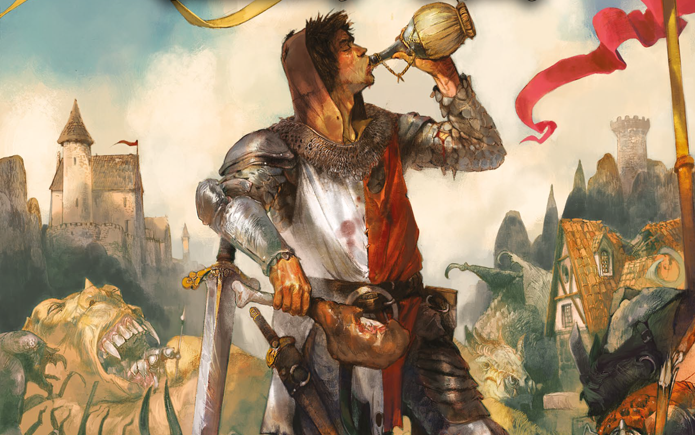
Brancalonia: D&D Meets a Lighter-Hearted Blades in the Dark

Those of you who’ve been with me for a while know that I’m not a big fan of the systems used for D&D. The older and wiser I get, and the more I come to understand game design, the more I see the justification for the choices the system makes. It seems that a lot of times, my upset with the design choices are amplified by traditional (mis-)interpretations of the intent of those systems. At the end of the day, D&D is a game people love, and there’s nothing wrong with preferring that system over others. For me, though, I prefer my games a little harsher and grittier, and while I think D&D should best be considered a toolkit along the lines of Fate or Cortex (certainly not marketed that way but treated that way by DMs by long tradition), I find that it would take as much or more work to kitbash D&D into something approximating what I want as to design a system particular to my tastes. In fact, a few weeks ago I got some of my gaming friends together in our first post-vaccination meet-up to discuss putting together a fantasy game using highly-modified D&D rules (for all my complaints about the system, I listen to actual play podcasts and get a desire to play all the same). Instead of spending a lot of time discussing changes and systems, as I’d expected, we relatively quickly came to the decision that they’d (and I don’t disagree) that I devote my time to setting and system for Avar Narn and that they help playtest rules.

That’s a long walk to the real beginning of this post, mostly to explain that I don’t usually review or spend a lot of time on D&D-related books or systems as part of the blog. Brancalonia, though, is just that captivating.

Brancalonia is a setting (with rules modules) for 5e D&D, taking place in a “spaghetti fantasy” version of late-medieval/early modern Italy. Those of you who know my background understand that my interest is immediately piqued. Even without my deep love for the Renaissance in Italy, a mashup of fantasy and the spaghetti western genres sounds like two great tastes that taste great together. In execution, the “western” influence gives way more to the Renaissance themes of misrule, the Commedia Dell’Arte, and the best parts of early-modern humor. The fantasy is low without being gritty (think of a greasier, sleazier, ne’er-do-well with a heart of gold sort of vibe).

The mechanics of the system accomplish this in several ways. First, the restriction of characters to level 6 (a common change to evoke “low” fantasy in D&D without much fuss), though there are character advances that may continue to occur after hitting maximum level. Second, the inclusion of subclasses that evoke the feel of the setting without requiring massive overhauls of the core D&D classes. Third, a bevy of rules additions (more than modifications) that reinforce the feeling of Brancalonia. Short rests are changed to a full night and long rests to a week in line with the suggested rules modification in the Dungeon Master’s Guide. The long rest is then incorporated into a downtime “Rollick” system.

Other rules include a system for Brawls (a non-lethal combat type indicative of both semi-good-natured contests between rivals and conflicts between criminals who know that drawing steel changes the context of the fight into something of interest to the authorities–to say nothing of lethality), methods for tracking characters’ bounties for their misdeeds (and the potential consequences thereof), the aforementioned “Rollick” system and rules for relationships to the characters’ band and company as well as an upgradable hideout. The standard D&D economy is changed not by complex changes to numbers in costs but by the vast lowering of the amount of gold characters are likely to have at any given time, limitations on magic items, a system for squandering winnings (reminiscent of Barbarians of Lemuria) and rules for “shoddy” equipment–what the characters will most often be using.

I make mention of Blades in the Dark in the title of this review not simply because it’s the previous game I reviewed, but because the systems in Brancalonia remind me of a (lighter) version of Blades in the Dark crew rules. Rather than managing the relationships between rival gangs as in BitD, the Knaves of Brancalonia are “Bounty Brothers” more often than deadly rivals. But the game does follow the same sort of job–downtime–job cycle as BitD, with a simple but perhaps more formalized system for managing the group’s hideout and its available amenities (described as Grandluxuries). The jobs set to a group of Knaves is implied to be a little more varied, both in context and geography, than the heists of Doskvol.

Also like BitD, characters regularly engage in their vices during downtime in Brancalonia, though the results in the latter are more often amusingly complicating than the self-destruction of the former. The best summary of the relationship between the two, I think is that Brancalonia takes itself less seriously, creating a picaresque tale of rowdy louts rather than a depressing story about desperate criminals.

Some notes about the writing itself: the game was originally written in Italian, and I get the feeling (or make the assumption) that part of the mastery of the feel of the setting is the immersion of the writers in both Italian culture and European history in ways that a Yank like myself can only dream of. The translation into English leaves a text that is clear and easy-to-understand–as well as very well-written. The book could have used some more editing, but the issues I find are typically minor mispellings and particularly the omission of certain letters in words (including within chapter titles!). Still, I found nothing that endangered comprehension or that reasonably compared with the first released draft of the latest Shadowrun rules.

I really can’t over-emphasize how well-written the setting material is. Not only from the standpoint of well-constructed and stylistically-impressive sentences, but also of language that evokes the feel the setting aspires to. I imagine both the original writers (the team of Epic Party Games) and the translator (Sarah Jane Webb) are to be commended for this feat. To boot, the artwork is amazing and highly evocative. I daresay that it’s worth the price of admission alone.

I must admit a certain forlorn agreement with all of the “What our party thinks it is/What our party actually is” memes when I see them, and herein lies another strength of Brancalonia–its tone is that sort of light-hearted foolishness often achieved by players of fantasy RPGs to begin with, so what may be considered a falling-short of the transcendent heights of “great roleplaying” in other conditions is right in with the theme and style of the game in Brancalonia. This alone is a huge strength.

If you’re a less-experienced GM looking for the style of BitD in an easy-to-run system, or a group who couldn’t care less about roleplaying as “Art” so long as everyone is having fun (always the first principle of committing free time to an RPG, I think, even if you want to make “Art” as well), a group looking for a grittier but light-hearted D&D setting, a new gamer wanting to learn to play RPGs, an aspiring designer looking for an excellent example of setting writing (rather than excellent worldbuilding–it may be that, too, but there’s so much material to draw on to create the setting that I’m not sure that it deserves that categorization), or a veteran gamer looking to do something decidedly fun and different, Bracalonia is definitely worth checking out.

Is it just me, or are we in something of a golden age for Italian game designers? I think of The One Ring as well and expect we’ll see more games of note from this group of designers as well.

How I Learned to Stop Worrying and Love the D&D

I generally don’t like D&D as a gaming system. So how did I get here? Well, given the general downtime for everyone, I started working on a roleplaying game to be played virtually with some friends. Since the Shadowrun game tapered off, I haven’t had a game running and there’s a part of me that’s just not happy whenever that’s the case.

I suggested to my friends a game using the Fate system based on the Tom Clancy’s Division games. I spent a lot of time working on some custom rules for the setting (which I’ll post in their unfinished state in a separate post) before two things happened: (1) several of us came to the conclusion that that setting probably doesn’t provide enough respite from every day life in the COVID-19 world, and (2) two other members in the group both offered to GM/DM if we played Dungeons & Dragons. I do a lot more running of games than playing in them, so, despite my reservations, I quickly agreed and we set about negotiating a rotating GMing situation, with our first game set for this Friday.

Here are some of the (admittedly subjective) reasons I’m not a big fan of D&D:

  1. I would prefer a more “realistic” rules approach to combat, particularly than large hit point pools, armor as making one more difficult to hit and no penalties for taking damage until you’re out-of-action.
  2. I don’t like classes and levels, generally. I tend to think that these constructs detract from roleplaying and character development in their rigidity. For instance, only Rogues get sneak attack bonus damage–other characters are mechanically incapable of taking full advantage of an ambush, no matter whether they’re a soldier whose survived a thousand ambushes himself or a gutter punk getting lucky with a sudden knife attack.
  3. As a corollary, D&D is a game (like Shadowrun) with a ruleset that draws me into ours of obsessive character-building to try to find the exact build that will do all the things I want it to, even while knowing that the character generation’s economy of resources won’t allow for it and I can’t (and shouldn’t) try to play characters that are good at everything.
  4. I see D&D as a system that pushes a game toward combat and the gamist side over the roleplaying side based on its design. As you know, my preference leans heavily narrativist. Basing XP on kills makes me uncomfortable on many levels–from the ethical and theological to game design itself. G.K Chesterton once wrote (and I agree): “Fairy tales do not tell children the dragons exist. Children already know that dragons exist. Fairy tales tell children the dragons can be killed.” But that’s a big leap from killing 100 orcs because, well, they’re orcs and “orcs bad!”
  5. Encounter building and levels work together in a way that, if playing strictly by the rules, makes some fights unwinnable. I fully believe that some fights should be unwinnable if the players aren’t resourceful, clever and maybe a bit lucky, but D&D as written militates in favor of a straight-up fight of hit-point attrition and forces the good GM to make-up whole cloth how alternative approaches work. Yes, we can talk about “rules versus rulings,” but I’d argue that, when we have to have that conversation at all, something it lacking in what the rules are communicating. That’s not to say that rules should address every eventuality and should be rigidly followed–far from it. The problem here is that the D&D books might say that they encourage this kind of player creativity that requires responsive and flexible GM/DM adjudication, but the rules give the impression of the opposite, and few tools are provided to assist in making such ad-hoc judgments. Put another way, I don’t like that Level 1 characters (or 5 or 8 for that matter) don’t have a chance against a dragon simply because they haven’t ground out enough levels yet. In addition to the ways the rules are written complained of above, a skills-based system over a level-based one can go a long way in this regard.
  6. The assumption that combat is the way you overcome monsters bugs me. Why not more interesting possibilities? Ghosts that you don’t hit with magic swords but that must be banished or appeased in some other way that relies on wits and skills more than fighting?
  7. D&D Physics. This is perhaps my biggest gripe, and it’s admittedly about certain players rather than the rules themselves. Some players assume that the rulebooks represent the physics of the worlds D&D games take place in–if something is technically allowable by the rules as written, no matter how ridiculous, then it’s a loophole in the spacetime continuum that should be exploitable by a player. One example: the player who thinks that, as long as he succeeds at a Deception/Persuasion check, he can convince anyone of anything, no matter how blatantly untrue or unlikely. Another, from 3.5e: a ladder costs less than two ten-foot poles, but is comprised of two ten-foot poles plus some other stuff. You do the math. If I remember correctly, in the forward to The Riddle of Steel roleplaying game (an amazing game on many levels, if not the easiest to run), Jake Norwood described a game of D&D where he realized he would take fewer hit points of damage jumping off the cliff he stood atop than fighting his way through the oncoming orc horde as an inspiration for creating a game with much more realistic combat (he’s also a talented western martial artist, so he was just the type of person to write that game).

Okay, that’s a fair amount of griping, and none of it’s new to anyone. While there are alternatives to D&D (some very good ones), D&D retains the large majority of market share in fantasy roleplaying, despite decades of competition. Why? For one, it’s the only name that most would-be roleplayers know. Additionally, it’s got a special nostalgia factor for a lot of gamers my age or older and a solid place within popular culture that grows every year (2 episodes of CommunityStranger Things, the Greetings, Adventurers! and The Adventure Zone podcasts, etc., etc.). But most of all, I must admit, it’s just a fun game. I’ve played several campaigns of D&D in the past, none of them especially-long running but usually going for a few months or so, and not one of the things I’ve mentioned above really factors into my overall-fond memories of those games.

I’ve decided to enter this upcoming D&D campaign with an eye toward throwing aside some of my complaints and design differences and enjoying the game for what it is–a time-tested engine for running enjoyable high-fantasy games. The other players in my group are all fans of D&D and familiar with it (to varying degrees, but certainly moreso on average than any other system I’d choose to run) and, if all goes well, I may well commit to (personally) running more D&D for them in the future.

Okay, so how am I stopping worrying and learning to love the D&D? Some counterarguments to my complaints above I’m trying to keep in my mind as I undertake this adventure:

  1. Hit points aren’t meant to be a reflection of damage (though they often are treated that way). They’re more like Stress in Fate RPG: a narrative indicator of the leeway a character has before receiving a serious injury. A character who loses hitpoints has lost some of that vigor and focus that keeps her from being injured and comes closer to the possibility, but shouldn’t be thought of as having taken a blow (instead having barely turned it aside, etc.). There are a few points that, as a GM, I’d have go along with this: (a) narrate hit point damage as a near miss and degradation of performance but not a blow actually received; (b) use lingering injuries when hitting zero HP to drive home the fact that that’s when injuries occur; (c) use alternative mechanisms over HP to adjudicate unavoidable damage where appropriate (falling, etc.). Under this approach, it makes good sense that armor serves as a buffer to having to use up HP rather than as a dampener on HP lost, so I get a double rationalization with this mindset!
  2. Classes really are a good conceit for certain types of roleplaying games. In D&D, classes give everyone’s character a chance to shine, clear delineations of where characters fit within the team of players, and accentuate’s cooperative, synergistic play as a group.
  3. Levels can make sense, too, within the conceit of the game mechanics. If we’re literally talking about the accumulation of experience that makes adventurers better at what they do, levels are an appropriate shorthand for that, even if not the choice I’d personally make in game design.
  4. A good GM can use the rules in creative ways (or modify/ignore them) to overcome issues about the game being too combat-focused or too restrictive in the allowance of creative problem-solving, and the occasional unbalanced encounter can be a good reminder to players that discretion is sometimes the better part of valor.
  5. I tend to take a very particular approach in what I want from roleplaying games–I expect deep immersion and something approaching high art. I rarely get it, so these expectations are just setting myself up for disappointment. If I’m willing to focus on entertaining stories, interesting characters, exciting encounters and generally having fun, I’d likely enjoy running games even more than I currently do. In other words, maybe I should just get over myself. D&D is an excellent system having fun and telling entertaining stories if I forego my pretensions. I retain the belief that RPGs can lead to deep, immersive stories with significant impact on the players’ thoughts and lives–but they don’t have to be, and if my gaming friends frankly aren’t that interested in that kind of roleplaying, maybe I should lighten up and just have more fun with them! After all, I am a writer, so I do have some outlet for the deep and artistic (if that’s actually more than just pretension and something that actually pervades my writing…).

So there it is. D&D may not be my first choice of RPGs, but there are certainly things about it I like, and could potentially grow to love. Now, if I could just figure out how to build the character I want to play…