Pilgrimage, Day 9: Souvenirs

For the previous entry, click here.

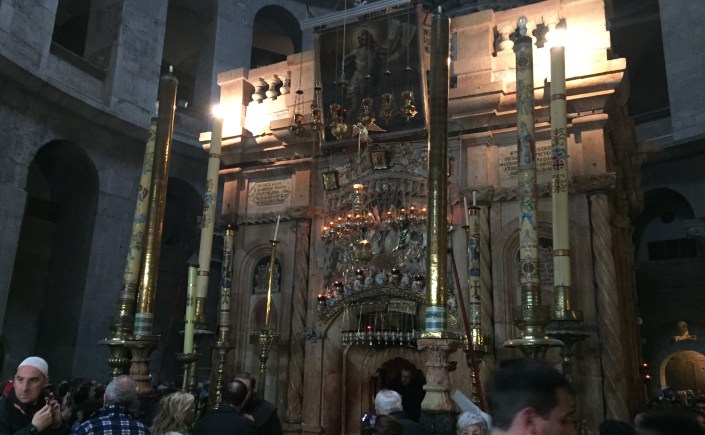
We had the morning to ourselves today. I found out shortly after posting yesterday that the Aedicule of the Church of the Holy Sepulchre is used for mass every morning from 4:30 to 7:30, which shot through my plans of an early-morning expedition to avoid the crowds. This was, in many ways a blessing, though, as I really did need a morning to catch up on sleep–at least somewhat.

I grabbed a quick breakfast to meet up with several others from the group at Razzouk’s at 8:30 to pick up my one necessary souvenir for the trip (pictured above).

The Razzouk family, a lineage of Coptic Christians, have been tattooists for over seven-hundred years, starting in Egypt and later making their way to Jerusalem. The Copts have a long tradition of tattooing a cross on one or both wrists as a clear sign of commitment to faith–members of the Coptic Christian group in Egypt are currently being persecuted, and their distinctive tattoos make them an easy target but also stand defiantly in acknowledgment of their faith despite the risk such a stance brings. Not only this, but the Razzouks have a long history of specialty in pilgrimage tattoos. Combine that with the fact that the shop is named one of the 5 best places to get a tattoo in the world, the history of pilgrimage tattoos (in general) going back to the middle ages and the fact that I’d long thought that, if I ever got a tattoo, it’d be a symbol of my faith, and I was sold.

It doesn’t hurt to have companions in the adventure, and even K got her own tattoo, one she designed herself after a time of prayer. The current representative of the family, Wassim Razzouk, demonstrated great kindness in opening on a Sunday morning to fit our hectic schedule. So, six of us went in to receive the indelible commemorative mark of our pilgrimage.

After deciding to get a tattoo in the first place (before the trip), I agonized over what kind of cross to get. I was immediately attracted to the Jerusalem cross, but weary of its crusader connotations, as very little about the crusaders matches either with my theological understanding or the identity and witness I want to present to the world. This conundrum forced me to resort to my basic instinct (not the movie): research.

Traditionally, the Jerusalem cross is attributed to the crusader, Godfrey of Bouillon, the “Advocate of the Holy Sepulchre” (he apparently rejected the title of “king” out of piety), who ruled Jerusalem after its capture in 1099 in the First Crusade. It has even been theorized that the symbol had been part of Godfrey’s family’s heraldry since before the crusades ever started. Additionally, the Jerusalem cross did not become part of the symbol for the crusader kingdom until the 13th century, long after Godfrey had died.

The Jerusalem cross was used by various European nations even after the ultimate failure of the crusades (whatever success may have actually looked like) and is still used by the Franciscan Custodians of the city’s holy sites.

After grasping the history, I looked to uncover more about the meaning of the cross. Many meanings have been assigned to the device: the five wounds of Christ, Christ and the four Evangelists, Christ and the four Gospels, Christ and the four corners of the Earth (a la Matthew 28). I would not consider myself Evangelistic under the meaning of word as a category of doctrine and belief, but I do belief in spreading the Gospel. I tend to believe that God’s love for all people will eventually bring them to paradise (through Christ’s redemptive act) and, regardless of what limits one believes in on the extent of salvation under Christian doctrine, I certainly believe that following the path of Christ is the only true way to sanctification and right relationship with all things in existence.

I can get on board easily with any of the other meanings commonly attributed to the Jerusalem cross, and can even add a few of my own: Christ and the Wesleyan Quadrilateral is a personal favorite. Additionally, the Jerusalem cross (as a tattoo) has for centuries been a sign of pilgrimage for Christians of all denominations and doctrines.

With this understanding, I decided to get my first (and probably only) tattoo.

This afternoon was taken up with a New Testament walk of the Old City of Jerusalem. We spent time discussing the likely location of the Upper Room, the appearance of Christ to the disciples after the Resurrection, and the start of Pentecost. Jack argues convincingly that the Pentecost must have quickly moved to the southern steps of the Temple Mount, as that’s the only space in 1st Century Jerusalem that was likely able to accommodate a crowd of the size described in scripture. We sat on the southern steps of the Temple Mount, where Jews would have ascended to the top of the Temple Mount during Jesus’s time, while we talked. We passed through the Hurva Square, where the rich and powerful–particularly the Sadducees–lived in palatial homes that would have rivaled modern American homes in size and splendor. There’s much to be said about the Sadducees of Jesus’s day and what we can learn from them in our own spiritual practice (mostly by not emulating them), but I’ll save that for a later date.

After all of this, we went to the Church of the Holy Sepulchre. Our group passed into the old cistern known as St. Helena’s Chapel, where St. Helena (the Emperor Constantine’s mother) reported finding pieces of the True Cross. There, we held a short worship with scripture reading, sermon, prayer and a song. I found the experience quite moving. From there, we went our separate ways to explore the Church. K and I opted to head upwards to the described by the church as Golgotha, the highest point of the 1st Century quarry (that still exists) that would have been near the place where Jesus was crucified if not the place. Our timing was good, as we didn’t have to shuffle shoulder to shoulder through a line for very long and the brief prayer against the rock (rather, against the glass that protects the rock) was an awesome experience.

Tomorrow, we head to Bethlehem and some sites in that area. Bethlehem itself is divided by a wall separating Jewish-Israeli territory from Palestinian territory. We will be able to cross through this barrier relatively easy, but I again expect the present tragedy of this place to intrude upon its sacred history.

For the next entry, click here.
Pilgrimage, Day 8: Geography

For the previous entry, click here.

My Fitbit says I’ve walked 8 miles today. I think it may be under-recording. I was told before I came that, “It’s uphill to and from everything in Israel.” You laugh, but it’s true.

Today, even more than the previous days, felt like a graduate-level field study, as Dr. Beck took us through the Hill Country of Judah and the Shephelah (the “humble hills” or foothills) to learn the geography, geology and vegetation of the areas. This had us making some extensive hikes through national parks where Israel has intentionally shepherded the flora toward what it might have looked like in earlier times.

The timing for this expedition had been well-selected, but nevertheless provided some additional obstacles. Being Shabbat, everything in the City was closed, so we were limited in the availability of sites to visit. However, many non-observant or non-Jewish Israeli citizens flood the parks and outdoors to enjoy some time away from work. And then there are the tourists, about whom I suppose I cannot complain.

One of the most important pieces of advice I’ve ever gotten was to “be interested in everything.” It was an off-handedly-given bit of wisdom, but one I took to heart. Today was one of those days when it is truly easy to be interested in everything.

I have studied geography and geology, both in school and informally to help me build better worlds for writing and roleplaying games. I’ve never heard large-scale geologic forces explained so clearly in such detail as done today by Jack Beck. We learned about the formation of three layers of different strata of limestone when the land was inundated by prehistoric seas. He taught about tectonic uplift that forced some of these layers into the ridges and valleys of the Hill Country of Judah and–to a lesser extent, the Shephelah. After that, Dr. Beck explained the processes of erosion that broke down some of those layers, carried off and redistributed some of the sediment created by that process, and left a land of varying hardness and fertility of soil.

This explanation segued seamlessly into a discussion of terrace farming (we were, of course, standing near the top of a ridge that had been terraced for just such purposes and looking down on both the macro-features of the landscape and the terraces themselves) and farming by scratch plow, as was done in Biblical times. Naturally, this then developed into an analysis of Jesus’s saying in Luke 9:62 that “no one who puts his hand to the plow and looks back is fit for service in the Kingdom of God.”

Before this string of instruction, we’d learned about the commonest plants in (these parts) of Israel and how that might influence our reading of passages that made reference to plants, whether specifically or by type or attribute.

This all took place in a national park in the Jerusalem Mountains around the ruins of Sataf–formerly a Palestinian village whose inhabitants were forcibly removed by Jews in 1948. Now, the terraces are being restored to give insight into historical agriculture, as well as providing some hobby gardens for nearby citizens.

From Sataf we went to Beth-Shemesh, just down the Sorek Valley from where we had hiked earlier. A village that changed hands between the Canaanites, Philistines and Israelites several times (Shamash was a Mesopotamian solar god, but the town name is probably more related to the sun in general, as in “House of the Rising Sun”), Beth-Shemesh is the site of 1 Samuel 6, when the Philistines return the Ark of the Covenant to the Israelites to undo the suffering that had fallen upon them since capturing it. It is, of course, now a ruined fortress, but a wonderful location to review the scripture from. Of special note, Beth-Shemesh was one of the Levitical cities, and what happens when the Ark arrives? They send it on to Kiriath-Jearim, because the Levites there, like the Philistines, don’t know what to do with it.

Samson’s story also takes place around Beth-Shemesh–the city of Timnah is just to the southeast.

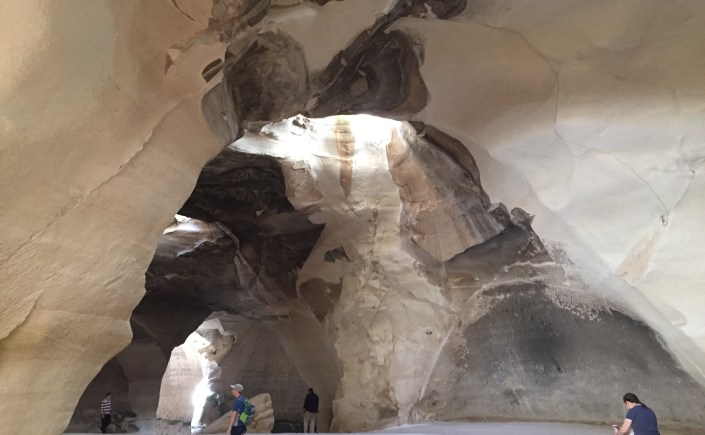
After Beth-Shemesh, we made a short stop at the Bell Caves. This is not a Biblical site, but an artifact of Roman occupation. The caves were formed when the Romans bored a small hole in the ground through which they extracted limestone blocks for building. Over time, the spaces began to form the bell shaped caves which exist there now. None of the bell caves (at least that we witnessed) were fully enclosed; all either joined adjacent caves or opened to the outside, the result of a combination of deliberate carving or accidental collapses.

Our last stop for the day was Shaaraim–“Two Gates.” The archeological site is unique for several reasons. First, it is a single-occupation site rather than a tel–study indicates that the site was active only between 1000 BCE and 925 BCE. More important, perhaps, is that the city has (as you might suppose) two gates. Despite the fortifications inherent to a gatehouse, a gate constitutes a weak point in a defensive wall, so most ancient cities only had one. Other unique features of this settlement were a 10,000 square foot citadel with a three-foot thick outer wall and the use of casement walls in the main town wall. Casement walls are a sort of double wall with space in between them. During peace, the space can be used for additional storage, but during war time stones can be taken from the interior of the city to quickly reinforce the exterior wall. Given the timing and the location, the site was probably built by David or Solomon.

And it was David who brought us there. From this elevated position, it is easy to see into the Elah Valley, to Socoh where the Philistine army containing Goliath had arrayed itself against Saul’s forces at the intersection of three roads leading deeper into Israelite territory–if the Israelites failed here, their interior cities would be threatened (the area that would become the”City of David” and later “Jerusalem” was still in the control of the Jebusites).

We talked at length about the story of David and Goliath, and in his typical style of half-teaching, half-preaching, Dr. Beck made the story come alive with new color and depth, as he is wont to do.

We have tomorrow morning free to do as we like. I intend to make a (very) early trip to the Church of the Holy Sepulchre, pick up the one souvenir I want to bring home, and spend a leisurely morning enjoying coffee and watching people pass. In the afternoon, we’ll be on a walking tour of New Testament Jerusalem.

For the next entry, click here.
Pilgrimage, Day 7: O Brother, Where Am I?

For the previous entry, click here.

Today we left Galilee, traveling first to the Harod Spring (where Gideon had his men drink the water to determine who would accompany him in battle against the Midianites) and the Jezreel Spring (at Tel Jezreel in Samaria, where King Ahab and Jezebel would make their capital).

From thence to Beth-Shean, the site of the palace of Egyptian governors in the 13th Century B.C.E. and the site of Scythopolis, one of the Greco-Roman Decapoli founded near the trade routes. Scythopolis was founded by the Ptolemys after they took control of the Egypt and the Levant in the wake of Alexander the Great’s death.

This brings me to my first point today: After conquering Egypt, Alexander turned West to visit the oracle at the Siwa Oasis (known to the Greeks as Ammonia). It was here that the oracle pronounced Alexander the son of a god and the man began to incorporate divinity into his own identity. Alexander’s conquest enabled the Ptolemys to build the Decapoli. Between Alexander and Augustus–not to mention the men who came before and after Christ claiming to be the prophesied messiah–I am struck by just how much the shadows of human men declaring themselves to be divine loomed over this land.

Scythopolis itself was nothing short of amazing, reminding me very much of Roman ruins found in Italy. Of course, many cultures had built at Beth-Shean at least as far back as the aforementioned Egyptians until an 8th Century earthquake caused the settlement to be moved. The Greco-Romans had built the largest city there, which was followed by the Byzantines, who rebuilt and expanded in their own time.

I must admit to completely nerding out about the ruins there (is anyone surprised?). Running water, heated bathhouses, Cyclopean architecture, a 7,000-person theatre, marble-clad streets (marble is not often found natively in Israel, if at all), intricate mosaics–all of the standards for Roman achievement. But I also realized a great deficiency in my own learning (much to my chagrin, of course). The Byzantines must have considered themselves the inheritors and reconcilers of the competing cultures of the Holy Land, combining the best of Roman knowledge and achievement with Christianity. Despite this, I know relatively little about them. I’ve read Precopius’s Secret History (though I don’t remember much of it), can recognize the artwork and can name some rulers and events. But almost all of my learning about the Byzantines is tangential, a side-effect of my Western-Eurocentric historical focus and mindset. There’s no time right now, but I must soon make it a priority to study that culture and civilization for its own sake.

From there, we headed south along the Jordan to Beth-arabah, the likeliest site for Jesus’s baptism by John the–well, you know. In a power play against Syria and Jordan, after seizing the Golan Heights and preventing the former from having access to Galilean water, Israel built a dam at the south end of the Sea of Galilee, allowing them to control the outflow of the Jordan River. I’m told the river flow volume is about 5% of what it once was. Standing on a platform by the side of the river, I did not doubt it. A plaque commemorating the 2013 water level was a good fifteen feet or more over my head.

That journey led us through the West Bank–the first of several times we’ll visit that area. I was moved by the obvious difference between that place and other parts of Israel–increased poverty, dilapidated buildings, an atmosphere of desperation. We passed a sign warning Israeli citizens that the road next to the sign led to a Palestinian settlement and that, therefore, that road was not safe for them. To be clear, Palestinians are also Israeli citizens, so the sign spoke volumes about the deep divides here.

I titled an earlier post “The Ancient and the Modern;” the clearest example of that juxtaposition to date was in the West Bank, where we watched young shepherds lead their flocks in the same manner as has been done for millennia–while playing on their cell phones.

Once to the Jordan, we held a short baptismal remembrance service–keep in mind that Methodists consider re-baptism anathema–followed by singing “Down to the River to Pray” before dipping our hands in the water and making the sign of the cross on our foreheads. There is a spiritual resonance at that place (assisted by the presence of white doves and a strong wind that picked up soon after we arrived), but, for me at least, it was overshadowed by the present-day realities. This spot on the Jordan is also the border between Israel and Jordan. As such, we had to pass through a road lined on either side with warnings of the mine fields laid nearby. The detritus of past warfare littered those fields, rusted remnants of the Six-Day and Yom Kippur Wars. At the river, a buoyed line provided the border between nations–we were warned not to approach the border lest the guards on either side go to high alert. Those soldiers–Jordanians on one side and two eighteen-year-old IDF soldiers on our side–eyed one another like gunfighters at high noon. What caught my eye–and my cynicism–most about this standoff was that all of the soldiers (on both sides) were armed with American weapons.

After passing through some of the Judean wilderness, we arrived back in Jerusalem to the Knight’s Palace Hotel at about 4:30. With 2 hours to kill until dinner, we spread out across the Old City. After investigating some nearby shops that had been recommended to us (I have little desire to bring home souvenirs), we made our way to the Church of the Holy Sepulchre. I’m not fond of crowds, or waiting, so I resolved to return to the Church to see the things I wanted to see: Golgotha and the Tomb.

I cannot be certain, of course, that the spaces asserted by the Church are the actual locations of Christ’s execution and (attempt at) burial, but having done some research, there’s a very good case to be made here. As the Church opens at 4:00 a.m., I’ve resolved to make an early-morning trip in hopes of avoiding the crowds.

After the Church, we headed back to the Western Wall for a second look. It’s Friday, so shabbat is being observed today and the Wall was understandably crowded, and becoming moreso by the moment.

Tomorrow, we venture into the Judean wilderness itself, as well as the shephelah (the foothills). I’m convinced that yesterday’s experience at Mount Arbel will be the lens through which I see the rest of this journey–another seven days.

For the next entry, click here.

Pilgrimage, Day 6: All Jesus All the Time

For the previous entry, click here.

We spent the majority of the day today in Capernaum and on Mt. Arbel. I’m not able to express my feelings about these experiences in words just yet, so I’ll share some of my thoughts instead.

Capernaum was Jesus’s “home base” during his ministry. The town sits on the northwest side of the Sea of Galilee (a glorified lake, really), firmly within Jewish territory but not too far from Gentile settlements. It makes great practical sense–Capernaum lies near the international trade routes and near many of the other major settlements of Galilee. Even more, archeology indicates that Capernaum was a manufacturing center for grain and olive oil–meaning that people from all the smaller villages nearby likely came to the town with their raw materials, allowing Jesus’s ministry to reach farther more efficiently.

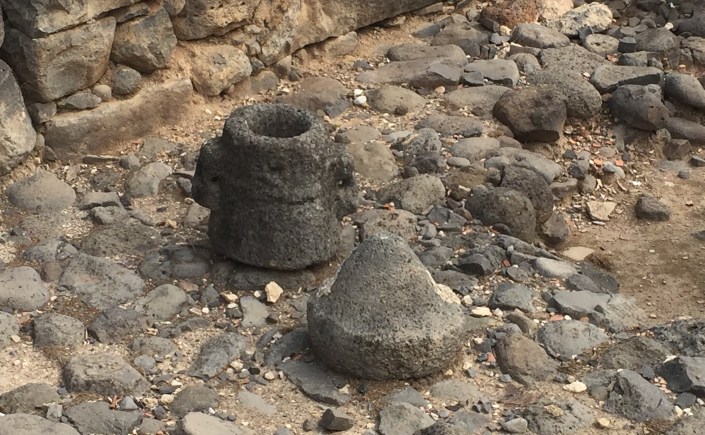
There were other realizations today. Prime among them, which has been building since we got here, is just how poor my mental imagery of Biblical scenes had been–the imaginative equivalent of a painted-craft-paper background in an elementary school play. This land is diverse in form and terrain, beautiful and full of life (both plant and animal). More than this, I’m starting to realize just how visual Jesus’s mode of speaking and teaching is. It’s axiomatic to say that Jesus spoke in parables that would make sense to the disciples, but it’s another thing altogether to say that Jesus had the objects he used in his analogies before him at the time he spoke the parables. This makes good pedagogic sense as he’s attempting to use the mundane to explain the complex and supernal. When you see a donkey mill–the kind of mill often used for milling grain in 1st Century Israel–and know that the device was so common that there was almost certainly one in front the disciples when Jesus says that it would be better to tie a millstone to your neck and throw yourself into the ocean (the Sea of Galilee, too, is likely in view at the time, a wholly different and more complete understanding comes into focus.

As Dr. Beck argues in his books and on this trip–very rightly so, I think–Jesus made great use of geography and the things that could be seen at the locations where he gave particular lessons and made particular statements.

This takes us to Mt. Arbel, the likeliest location for the Sermon on the Mount and the Great Commission. Rather than rehashing, I’ll refer you again to Dr. Beck’s books for the full laying-out of the argument. But, sitting on the mountain, going through the Sermon on the Mount, listening to Jack’s explanation, I could not help but be moved. Until today, I had not had the visceral emotional response to being were Jesus walked and taught that I had hoped to have. Today, though, things became real at a very fundamental level. There’s something about putting Jesus’s words into geographical and visual context that makes them feel more embodied (and therefore more “real” and relatable) and at the same time more spiritually profound.

I’m also realizing just how perfect the place and time of the Incarnation was. As I mentioned in previous posts, the Roman Empire makes a perfect example for the kind of craving for wealth, power and dominance that Jesus argues against. That Israel represents the great international route between the Middle East and Egypt by land and is linked to Europe and the rest of Africa by sea, means the message has a way to reach the world. The place itself and its history provides the context for a revelation that directly addresses the people of the place and yet remains universal in applicability.

For me, especially, with my heavy philosophical bent, this journey is really convicting me of the embodied, present and concrete nature of Jesus’s life teachings, and Passion. When we arrived, we were told that, like Abram, God has called us to Israel, that there is something for God to reveal to each of us here. This confrontation with the Incarnation as something no longer abstract and far away in time and place may be just the thing God brought me here to show me. It’s certainly something I needed, even if I didn’t know that I needed it.

For the next entry, click here.

Pilgrimage, Day 5: The Modern and the Ancient

For the previous entry, click here.

I’m trying to get a jump on posting for the day instead of, as I’ve done the past few days, waiting until the last moment. It’s about 4:00 p.m. local and, having finished our touring day (since the winter hours for Israeli national sites has them close at four), we are on the bus back to the Sea of Galilee.

As I mentioned yesterday, we spent today in the Golan Heights. We heard sporadic artillery fire, all of which came from an Israeli tank proving ground close to our first visited site. Burnt-out tank hulks left from the six-day war occasionally cropped up in the otherwise beautiful scenery. We spent about 10 minutes driving behind an IDF humvee with a remote-controlled turret boasting a 50-cal machinegun and a TOW missile launcher. Overhead were the vapor trails of fighter jets penetrating just into Syrian airspace just before hitting their afterburners back to sovereign skies. At least once, we passed a barbed wire fence warning of unexploded mines on the other side. Still, there was never a concern for safety, just an ever-present reminder of the frailty of human nature and the conflict that results from such weakness.

The closest we came to the actual border was on the (dormant) cinder cone of the volcano, Mt. Bental, where we surveyed the land while standing next to two U.N. observers tasked with keeping watch over the “no man’s land” that starts a scant few miles from the base of the mountain and its nearby twin. Just across the border, about due east, lay the ruins of Quneitra, destroyed in the Yom Kippur War. Just north of that, the town of New Quneitra, where the inhabits rebuilt after being unable to salvage the ruins. Damascus lay just outside of view, thirty-seven miles to the Northeast. It was a strange feeling to be so close to such tragedy and unable to do a damn thing about it.

Mount Bental was our second stop today. Our first was Gamla or Gamala (the “Camel”), a humpbacked hill set deep in a canyon to the northeast of the Sea of Galilee that had been heavily fortified by the Sicarii (sometimes called “Zealots”) who probably had many commonalities of thought with the Nazarenes. The whole thing quickly reminded me of the Rebel Alliances’s base on Hoth, a fortification from which to strike out at the (Roman) Empire during the 66 C.E. revolt. In 67, Agrippa II failed for seven months to take the fortress and kill its inhabitants. Vespasian then arrived with three legions and built ballistae to fire 1300 stone balls and 1600 arrows into the fortress. This caused a breach, but the Romans suffered heavy casualties in the close quarters combat that ensued, with the defenders going so far as to topple interior walls onto the invaders, forcing a general retreat. A second assault was successful, with tradition holding that the core survivors fled to the citadel at the top of the hill to cast off their wives and daughters before jumping off themselves. A northern Masada.

Josephus says that the Romans killed 10,000 at Gamla. I find that highly suspect, based on the size of the settlement (at least as is currently visible) and the poor likelihood that a defending force of that size (1) would have been able to withstand siege for seven months without running out of supplies and (2) would have chosen to turtle up in their fortress and allow the Romans to seize the initiative when they had superior numbers and knowledge of the terrain.

Our interest was in the first-century synagogue in Gamla, the lower architecture of which is relatively well-preserved. It is highly probable that Jesus taught their during his Galilean ministry. The trek down the ravine to the fortress (and back up!) was exhausting but worth it.

After Bental, we first visited Caesarea Philippi and then Dan. At Caesarea Philippi, the Romans built a temple to Pan inside an artificial cave in which sprang one part of the headwaters of the Jordan river–a cave that was often thought of as a gateway to hell. A temple to the genius of Augustus Ceasar was also erected. At Dan, the King of Israel Jeroboam had an altar built and a golden calf idol placed so that his people would not have to travel south to the Temple in Jerusalem in the Kingdom of Judah to worship (and be tempted to defect).

It was between these two places that Jesus brought the disciples when he asked them “Who is it that people say that I am?” Behind him, Mt. Hermon, the only “real” mountain in Israel and thus the likeliest spot meant by Matthew when he describes Satan taking Jesus to the mountain to show him the splendor of nations and to offer them to him. Mt. Herom overshadows the ancient international highway, where the caravans of goods from the various nations would have represented their splendor without any miraculous or “magical| move on Satan’s part. When (soon after answering that Jesus is the “the Anointed One, Son of the Living God”) Peter tells Jesus that he cannot go to Jerusalem to die, Jesus responds “Get behind me, Satan!” just as he had previously told (actual) Satan.

Additionally, Caesarea Philippi represented the waywardness of Roman paganism while Dan represented the errancy of the Kingdom of Israel in falling away from worship of Yahweh (and the Canaanite paganism with its idols as well). It was a perfect–if unexpected–placed to pose the question of identity and capability to the disciples. Satan, death, Hell, the Empire, paganism–all were present to view the declaration.

The ideas above came either from our wonderful guide, Jack Beck (I suggest reading his books and watching his documentaries) , or from some of the Methodist pastors with whom I’m traveling.

To conclude, I’ll give you an idea of my own. You have likely heard the comparison and juxtaposition of the Caesars as divine figures with Jesus as the Son of God. Let’s nuance that a little more: the Romans didn’t actually worship the Emperor; they worshipped the genius of the Emperor. This is a little hard to explain, and a scholar of Imperial Rome would do it far better than I, but let’s give it a shot, shall we?

The Romans believed in numen, something akin to the Hawai’ian idea of “mana.” Spiritual power infused things to different degrees, from the small gods of the household and the spirits of ancestors to the greater gods of the state pantheon. The genius of the Emperor, then, was the numinous or divine power behind and within the Emperor. This may have become one in essence with the personality of the Emperor upon death, but during life the Emperor himself and the Emperor’s genius were related–closely–but distinct. The Roman Emperor has a divine force within him but is not divine in essence.

Contrast that with the orthodox Christian doctrine of the nature of Jesus Christ–both fully human and fully divine, with those aspects inseparable from one another, the perfect union of humanity and divinity in the same (consubstantial) essence. While I’m not sure that this comparison addresses anything not already spoken to by the volumes of theology already written, it does provide a sort of bridge into discussion of the nature of Christ by way of comparison. Clearly, I’m still very much focused on the sharp contrast between the Roman as a representation of the faulty ideas the culture of the world gives us and the spiritual truth that Jesus speaks, and does, and is.

For the next entry, click here.

Pilgrimage, Day 4: First Revelations

For the previous entry, click here.

Today started at 5:30 a.m., as we scrambled to get our bags packed, eat breakfast and portage said bags out of the Jaffa Gate and down to the bus to leave before 7. Uncharacteristically for me, it’s about 11:00 p.m. local as I write this. Something about the combination of this place and the fellowship of those journeying with me has given me more energy than I typically have.

Our day started with a whirlwind trip through Ceasarea Maritima and its aqueduct, then to Muhraqa Carmelite Monastery (for its position on Mt. Carmel near where Elijah confronted the priests of Baal), to Tel Megiddo, to Nazareth (particularly Mt. Precipice, where the photo above was taken. Er–the photo that would be above if the internet would allow me to upload it) to our hotel on the eastern (formerly Gentile) side of the Sea of Galilee.

In case it wasn’t apparent, the day was packed, with over six miles walked and at least five hours in the bus.

I have much to say about the day’s experiences, but I’ll focus on one idea in particular and leave the rest to germinate further.

Consider on the one hand Caesarea Maritima, a piece of Rome in the Middle East created at the command of Herod the Great, lover of all things Roman as well as power and luxury. And perhaps genius builder. Herod wanted to have a palace (complete with swimming pool) that appeared to float on the sea. He also wanted to create an artificial harbor (reportedly larger than the Athens harbor) on the dangerously shallow coast line where Strato’s Tower had stood.

This required an unprecedented use of hydraulic cement–that is, cement that will set even underwater. The Romans had invented the stuff and used it to build bases for piers and other small-scale projects, but Herod used it both to lay the foundation of his palace and breakwaters for the harbor. The site had no potable water, so Herod built a Roman-style aqueduct to bring water in from thirteen miles away.

Not to be without the finer elements of Roman culture, Ceasarea Maritima boasts a large ampitheatre and a chariot stadium that could have fit 20,000 people. Unwilling to have the same beige limestone look as Jerusalem, marble and granite were imported by sea to create columns, statutes and sheathing for those facades that were not plastered and covered with frescos. Intricate mosaic tilework covered the floors of many buildings and homes, which had indoor heating through the innovative Roman technology for underfloor steamworks and used the tides to sweep latrine waste out to sea twice a day. The remnants of clay pipes providing running water remain evident.

The city must have passed the test, because Pontius Pilate lived in Herod’s Palace there as much as he could (when business did not call him to Jerusalem), as did later provincial overlords. Caesarea Maritima boasted trade (at least for the import of luxury items), the latest in first century CE technologies, and art and architecture worthy of the Empire.

On the other hand, consider Nazareth. If, as I was before today, you’re not familiar with the geography, here’s what you need to know: Though an urban sprawl today, Nazareth was a tiny village in the first century, perhaps a dozen homes and just enough land cleared for subsistence farming. Those homes–they were mostly caves, perhaps expanded for a little extra comfort, but caves nonetheless. These dozen or so cave-homes occupied an elevated bowl shape surrounded on all sides by rugged mountain terrain. Until the Israelis literally (I assure you that the word is being used correctly) cut through the mountainside to build a road, there was no easy way to get to Nazareth. Pick the spot you think will be easiest to climb, and set aside several hours to do it.

This is probably exactly how the people of Nazareth liked it. Given their proximity to the ultra-fertile Jezreel Valley below and the numerous nearby settlements (Nain and Shunem, to name two) where they could have lived, this village’s isolation must have been highly intentional. A handful of Jewish families willing to scratch out an independent living to practice the faith of their forefathers and to avoid contamination by the Greco-Roman culture seducing their many peers. The kind of place our dear President would likely call a “shithole.”

When Jesus uses Rome as an example of the often-corrupting influences of wealth, status and power, he can point to Caesarea Maritima (named for Augustus Caesar) on the coast as a very concrete example of his meaning. At the same time, the King of Kings himself hailed from the unlikeliest and humblest of origins–a dirt-poor and poorly-regarded settlement of religiously-fanatic survivalists. The juxtaposition of these two real, geographically significant places brings sharply into focus the tension between those seductive but ultimately unfulfilling vanities with the extent to which God proved willing to condescend to be present with us in the world. Two very different ideologies (and here I mean God’s in choosing to use Nazareth, not the Nazarene peoples’s own ideas) placed in such close proximity in the same land.

Let it sink in.

Tomorrow, we’ll spend much of the day in the Golan Heights, visiting a first-century synagogue where Jesus almost undoubtedly preached, the village of Dan in the far north of the country near the borders with Lebanon and Syria (if the weather is clear enough, it might be possible to see Damascus from there) and Caesarea Philippi. It’s hard to think that on this pilgrimage we’ll be so close to the continuing devastation and heartache of the Syrian civil war.

For the next entry, click here.

Pilgrimage, Day 3

For the previous entry, click here.

Today has been a long day. We started the day at the Jerusalem University College campus for a briefing on Dr. Jack Beck’s approach to geography in the Bible.

If it’s not clear that I’m a nerd, this may have been my favorite part of the day. By my understanding, Dr. Beck’s approach is essentially existential–the geography of the land formed a crucial and central part of the worldview and cosmic understanding of the Biblical authors. Understanding the geography of the Holy Land helps us to understand the way that they thought and felt about the subjects about which they wrote.

This existential–and unfortunately, mostly intellectual–understanding informed my day today more than I had anticipated.

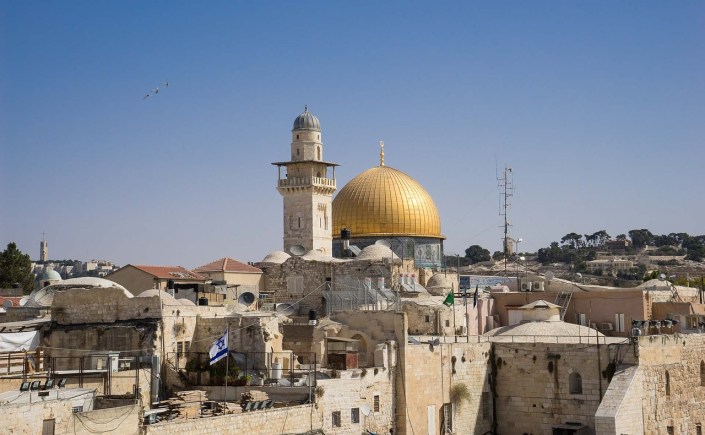
After our morning classroom session, we proceeded through Jerusalem’s Jewish Quarter to the Western Wall, the part of the late retaining wall built for the Second Temple that is closest to where the Holy of Holies once stood. Many of those traveling with our group felt the tangible presence and power of the Lord in approaching the wall. I, unfortunately, did not. I saw a pile of old stones. Historically and religiously significant, of course, but no more directly relevant to my spiritual understanding than any rock formation built from Creation. In some ways, I envy those whose experiences were more profound than my own, and I take some solace in the fact that that’s the majority of our group.

But my own experience also directly relates to some points that Dr. Beck has made as well as more expansive conversations I’ve had with fellow pilgrims. Both Judaism and Islam have significant attachment to physical location Christianity, focused ultimately on the person of Jesus Christ (and, perhaps, on orthodoxy rather than orthopraxy), does not have as strong a (institutional or faith-wide) focus on geographically significant places.

Considering the journey I’m on, with its particular focus on geography, that statement requires some unpacking. For Jews, the physical presence of the Lord within the Temple constitutes a central locus for the religion. For Islam, the Holy City of Mecca represents a physical place strongly tied to the faith it represents and embodies. For Christianity, however, the focus of embodiment is a focus on God adopting human flesh, not upon a geographic locale. And the God who dwells among us is simultaneously more universal and more ephemeral than geography–that is the way of all flesh. In some sense, that perhaps undermines the (temporal) power of Christianity. Ultimately, though, it makes the theology of Christianity far more applicable and far more enduring than those of the other “faiths of the book.”

If that is the case, then the geography of the Holy Land holds power to better help us understand the person and words of Jesus Christ without itself verging on idolatry as the physical bearer of what the Hawai’ians might call “mana.” But the land itself is not a source of salvation as it might be considered to be in Judaism and Islam. This analysis, I hope, is what influenced my lack of strong emotional response to the Western Wall. I found myself more moved by the significance of the devotion of worshippers at the site than the site itself.

After the wall, we traveled to the City of David, that hill to the south of the Temple Mount that likely represents Jerusalem after David seized it from the Jebusites (and, indeed, the city had been called Jebus before the Israelites conquered it). I found the geography here fascinating for its claustrophobic space–an entire settlement containing only 10 acres. Solomon would follow his father by building the First Temple of the Lord, expanding the are of Jerusalem to something closer to 32 acres. The archeology, which has been ongoing for over 20 years at the site, made it clear that the location matched both the Bible in description and the material culture for the period of David.

We had intended to travel through the “wet” tunnel built by King Hezekiah to bring water from the Gihon Spring in the Kidron valley to the Central Valley on the other side of Mount Zion (the ancient mount Zion on which the City of David was built, not the more modern “Mount Zion” partially contained within the Old City walls, on the outside of which the JUC campus sits) but were hindered by scheduling difficulties. We were only able to pass through the earlier Canaanite “dry” tunnel that allowed passage to the pool tower to which water from the spring flowed from behind the fortification walls. This was quite enough.

After that, we walked down Mount Zion to the Pool of Siloam (and then back up) and back to through the Old City to the hotel. My Fitbit marked over 15,000 steps before the end of the day.

After dinner, I went to find some baklava near the Jaffa Gate to debrief on our experiences. The camaraderie certainly vied for the best part of the day, though I have to say that, ultimately, it’s sharing these experiences with K that ultimately does that.

Tomorrow, very early, we leave to head to Caesarea Maritima, Nazareth, and the Sea of Galilee.

For the next entry, click here.

Pilgrimage, Day 2: Arrival

For the previous entry, click here.

This evening, at least by Israeli time, I write to you from the Gloria Hotel just inside the Old Jerusalem city walls near the Jaffa gate.

We arrived at about 4:20 p.m. local time after a mostly sleepless night on the plane. An hour-and-a-half or so to get through passport control and baggage claim, an hour from Tel Aviv to Jerusalem by bus, a fifteen minute walk up to the Jaffa Gate and the hotel, fifteen minutes to get room keys and take baggage up to the hotel room, and finally dinner at 7:30. After dinner, an intrepid companion and I decided on an evening stroll through the Old City.

It was breathtaking in a number of ways. The beauty of the old stone (the city wall dates from the 16th Century and is a fascinating combination of medieval design approaches. The Old City itself is a tangled ball of streets, sidestreets, alleys, closes and stone stairs, the historical equivalent of the steel canyons of a modern downtown, with stone buildings overhanging on both sides of each street.

My intent was simply to wander and wonder, to soak in all they I could of the environment without being to focused about it, to let it wash over me. This the city did without holding back. We wandered into the Muslim Quarter, where shopkeeps and their children were closing up for the evening. From the instant we encountered the Damascus Gate (we had exited the Old City through the New Gate and followed the outer wall to the Damascus Gate to re-enter), it was clear that things were different there. Four IDF soldiers with M4s stood watch over the entrance, cordoned off by steel traffic barriers like they occupied a make-believe guard tower.

Further into the Quarter, we encountered a squad of eight IDF soldiers in full tactical gear patting down a single young Palestinian man in soccer shorts and a jersey. He cooperated (who wouldn’t with that many assault rifles around) and the whole thing seemed rather low-key, quotidian. Perhaps that’s what bothered me most about the seen, the faces on both sides that resignedly said, “This is just the way things are.”

In an instant, that experience shook me from the reverie of this trip. I came for history. I came for spiritual reflection and introspection. I came for friends and theology. And I forgot that there’s a very real and ongoing struggle here, one with victims and perpetrators and perpetuators on both sides–and dozens of those who have become used to this way of life for each one who wants to do something about it.

To be clear, I have no solution for the Israeli-Palestinian conflict. I have too little real or meaningful experience from either perspective to do anything but naively say, “Why can’t we all just find a way to peacefully and respectfully co-exist?” I have sympathy for both Israelis and Palestinians and a belief that both sides have fault to claim and both sides will have to learn to forgive for their to be any hope.

And while the particulars of Israeli-Palestinian relations trouble me (to the meager extent that I understand them), what I really took away from the scenes I witnessed in the Muslim culture is a reminder. We cannot separate the past from the present just as we cannot separate the present from the past; they are inextricably bound together for eternity. The study of this trip has little meaning if it does not relate the present needs of the world. And I, of course, firmly believe that the message and redemptive work of the Incarnation, the Passion and the Resurrection are every bit as important now as they’ve ever been. As we start our serious work tomorrow, I’ll be going in with eyes open to the need to find something with modern applicability in every past location, person and event we discover.

For the next entry, click here.

Pilgrimage: Day 1

For the previous entry, click here.

This evening, I write from inside Gate C123 at Newark Airport, having just crossed through the security checkpoint at the gate (yes, apparently, flights to Israel have their own security at the gate–this should not really be a surprise).

Our group will begin to board the 777 for Tel Aviv in the next half hour; we’re scheduled to depart at 11:00 p.m. local time. I plan to watch Murder on the Orient Express (which I haven’t seen before) and then sleep. We’re scheduled to arrive at 4:20 p.m. Israel time, so I’m straddling the line between being tired now and trying to make sure I’m tired enough to sleep not too long after we arrive. It’s a precarious dance, to be sure.

We arrived at the airport this morning at 10:30 a.m. for a 2:30 flight to Newark. Early to be sure, but not unreasonably so in modern air travel–especially international travel and especially in a group. I must admit that today has mostly been a daze, a mild fugue state of waiting, killing time, and trying to enjoy every minute of the company I can. Nevertheless, it’s exhausting.

And that has me thinking about how spoiled I am compared to the pilgrims of the past. Those whose faith led them to Jerusalem before the luxuries of air travel, before even the luxury of assuredly-safe travel by land or sea, when pilgrimage meant risking everything to embark on a journey from which there was no guarantee of return. And that makes me feel like an imposter, like a tourist of faith in the worst kind of way.

Despite having been fortunate to have traveled internationally many times in my life, and to have flown with some frequency from a young age, I’m something of a timid flier. On the first leg of this trip, I found myself not quite as white-knuckled as I expected, but never quite comfortable hurtling through the air in a metal can that flies only through the magic of massive engines and Bernoulli’s Principle.

Still, that pales in comparison to the hardships endured by the pilgrims of the past, when the journey itself–and the hardships that inevitably defined it–could contain inherent revelatory power and spiritual realization. For me, the journey is merely the means to an end, something that must be endured but with little meaning (reference above my in-flight activities).

But tomorrow, tomorrow I’ll be in Jerusalem.

For the next entry, click here.

Pilgrimage: A Preface

On Saturday, K and I leave with a group of young clergy and their spouses (many of whom we are already close with; the rest of whom I assume we’ll be close with by trip’s end) for Israel for just about two weeks.

In perhaps unprecedented verbosity, I’ll be attempting to post notes about each day of the journey. We’ll be in Galilee early on and spend the rest of the trip staying within the walls of Old Jerusalem and making various day trips to bibliohistorical sites (not sure whether I’m inventing words here). I’m told we’ll be hiking about 100 miles over the course of the two weeks.

It’s been a while since we made the decision to go on this trip, but it’s only now feeling real. In previous posts, I’ve expressed some of my thoughts as I’ve done the preparatory work for the trip. I hope that the mini-travelogue of the journey will bring some clarity to those thoughts and inspire new ones to share. As with K, I think my biggest fear is that the journey will not be so profound as we expect and hope for it to be. Only time will tell, but I have faith.

My second fear has been dispelled just this morning–the Church of the Holy Sepulcher had closed in protest of a tax issue in Israel, but has reopened today.

I will be spending what (little) downtime I have during the trip (that is not spent enjoying the company of my fellow pilgrims or posting my daily post to the blog) continuing to work on my novel in-progress and other creative endeavors, though I don’t expect to be posting any of that during the trip. It’s also high time for another Avarian short story to pique the interest of prospective readers, so I’ll likely be devoting some time to that after my return. I am also working on a pen & paper roleplaying game for Avar Narn, pieces of which will likely be posted to the blog (or a “living document” as I’m writing and working out the kinks in rules). In addition to providing an innovative ruleset and deep setting for fantasy roleplayers (that’s a high bar to set, these days), it will provide a resource for the background of the setting as well.

But for immediate future, I hope you’ll join me on my pilgrimage to the holy land and finds something worth considering as my progressive and existential theology meets the geography and history of the place were the Bible took form, where the Israelites became a people and where God came to Earth. I hope that you’ll leave comments, thoughts and questions on the upcoming travel posts–I will endeavor to respond to anything posted to an entry by the day that follows (in local time).

For the next entry, click here.