Christianity and Fallout (Part 2: Redemption Stories)

Let’s start with a warning: if you haven’t played Fallout 4, or watched the TV show, this discussion may not make a lot of sense. I chose characters from 4 and the TV show in the expectation that the greatest amount of people were likely to have played that game, if any of them, or to have become interested because of the television program. Also, of course, spoilers for both the game and the show, so if you’re not caught up, you might want to avoid this post until you are.

The Fallout world is full of redemptions, both minor and major, amongst characters you encounter and those you only hear about. I think it would be difficult to avoid these kinds of stories–a post-apocalyptic world certainly carries the atmosphere of a fall from grace, and the struggle to survive in light of scarce resources and centralized civilization or authority begs the question of what people are and are not willing to do to others–and for what purposes.

I’m interested in examining some of those stories here, but not in some allegorical way. I don’t think you find any analogue of a sacrificial Christ in the games or the TV show (maybe there’s an argument based on your choices at the end of Fallout 3), but that’s just fine. In fiction, I’m more interested in investigations into the human experiences and struggles relative to morality and redemption than in having a symbolic retelling of the truth I already believe in (sorry, C.S. Lewis).

Hancock (Fallout 4) – The Redeemed Rogue

As one might expect for Fallout, this example’s a little ragged around the edges, as Hancock remains a somewhat questionable character given his prediliction for violence resolutions and, if you are persuaded that drug use is inherently immoral, add that to the mix. Maybe that’s why I’m starting with him: to show that, as is often the case in real life, redemptions are not black and white, and no human (or ghoul, as the case may be) becomes perfect. We do well to remember that all of our mortal heros have their moral failings.

Nevertheless, I think there’s a credible redemption story for Hancock. If you’re not familiar with Hancock’s back story, or need a refresher, here it is. Hancock was the younger brother of Mayor McDonough in Diamond City; he left Diamond City when he failed to stop his brother from expelling all of the ghouls. He became a drifter and a heavy chem user, eventually landing in Goodneighbor, a town ruled by a mobster. Hancock tried to get some of the displaced ghouls from Diamond City to take refuge in Goodneighbor, but this didn’t work out as well. The mobster in charge of Goodneighbor, Vic, ruled as a tyrant, allowing his goons to torment civilians for fun. Hancock witnessed these goons murder a fellow drifter and failed to intervene, further driving him into despair. It was this despair that drove him to take a unique chem that gave him the best high of his life and turned him into a ghoul. In conversation, he’ll tell you he’s happy he’s a ghoul now because he didn’t want to see his old face in the mirror ever again.

When Hancock came to from his bender, he was in The Old State House in Boston next to some of the clothes from the historic John Hancock–this is when he took on the name by which he is known. Returning to Goodneighbor, he organized a massacre of Vic and his goons before taking over the government of the settlement himself, where he seeks to protect those who need protecting under the maxim, “Of the people, for the people!”

In a certain sense, Hancock’s redemption has already occurred by the time you meet him. One of the reasons he chooses to accompany you in the wasteland is to avoid letting the power of his mayorship corrupt him into becoming the tyrants he finally found the strength to fight against. If you peek behind the scenes to the in-game actions that award you affinity with Hancock, it’s almost entirely about protecting the innocent or weak (with a smattering of delivering wasteland justice to those who would prey on them). His journey is not about discovering right from wrong–he knew this from the beginning. His redemption is about believing in his own agency to do something about the injustices of the world.

Hancock’s redemption is, tangentially, about the turning away from sloth. Although this category of cardinal sin formulated by the early church varied in its specific meaning from one theologian to the next, I think it’s safe to settle on two parts to the idea–particularly if we go back to the original word used, acedia. The term means either an apathy toward God and God’s desires for us or a knowledge of what is just and right but a reluctance to work for those things. As usual, I have some caveats. First, we must be careful in using this category, because there are places of significant overlap with mental health struggles, particularly depression. Second, when, as in Hancock’s case, the issue is a lack of courage or self-confidence rather than a desire to do what is just, I think we need to keep some charity in mind for the frailties of the human condition. This latter point, is exactly what I think Hancock’s “redemption” tells us.

In a game in which you play the redoubtable hero, expected to overcome any violent encounter, trap, puzzle, or ambush, the primary question is not about what you can accomplish (at least not in the long-run) but the choices that you make. Hancock stands as a reminder that that’s not the case for everyone. It’s not the case for the vast majority of us, especially when acting alone.

In the present time in the U.S., I think we can sympathize with both fear of standing up for justice and a lack of confidence in one’s ability to actually make a difference against the tide of hate, selfishness, greed, corruption and anti-democracy that has taken hold in this country. When ICE seems to be able to kill peaceful protestors with impunity, when trumped up charges are brought against political enemies and dissidents, when due process has been ignored and the rights of the people trampled upon, the danger of standing up for justice has become palpable in a way that I have never before seen in my lifetime. The dangers faced by the heros and advocates of the Civil Rights movement are the closest I can think of.

Had you asked me a decade ago, I would have foolishly thought that we (at least most of us) had moved beyond such discrimination, hatred, and exclusion as those faced by Black Americans, indigenous persons, people of color, members of the LGBTQIA+ community and all others who have been discriminated against because of race, ethnicity, nationality, skin color, gender, sexuality, self-expression or religion. But even now, Governor Greg Abbot and his cronies raise the old canard about “Sharia law coming to the U.S.” and the pathetic assumption that any organization related to Islam must be linked to terrorism so that they may use governmental power to deprive real people of real rights that they are guaranteed under our Constitution.

Both the costs of and the need for action in the pursuit of justice are very real in this country–and undoubtedly elsewhere abroad. Hancock’s redemption is about willingness to take the risks to make change, however, small, because it is the right thing to do, despite it not being the easy or safe thing to do.

To be clear–as is hopefully obvious to those who have read much of this blog, or even the first post in this series–the analogy and example ends where Hancock uses violence to achieve his ends. Morally, I do not believe that violence and evil can be truly defeated with more violence and evil. Pragmatically, violent protest in the U.S. would feed into the narrative that those in power want us to believe about those who are standing up to the totalitarian tactics of ICE and protesting the other outrageous actions of the current government and escalate conflict in an unproductive way. I think we’ve seen that non-violent protests where the protesters accept their vulnerability (despite it not being just that they should need to do so) and that have used creative tactics rather than aggressive ones (I think of the inflatable costume protests in Portland calling to attention the utter surreality and nonsense of the beliefs and actions of anti-immigration apparatus) have been most effective.

For me, my return to this blog is in part my attempt to do something, however small, to push back for justice. It is my hope that I can help lay out a Christian theology that wholeheartedly rejects the actions of those who are doing evil in our country without rejecting the people themselves–a hard line to walk, I fully admit. But, let’s onward to continue the point of this post in particular.

Cait (Fallout 4) –

Fallout 4’s Cait is a redemption story that follows all of the usual tropes–but it’s also the one that potentially hits closest to home. Here’s the recap:

Cait was born into an abusive family that tormented her until she was 18, and then sold her into slavery. That the designers made her Irish seems a low blow and a lazy stereotype given her story. As a slave, Cait was used for the “entertainment” of the slavers, only adding to the already significant emotional trauma she must’ve experienced as a child. She eventually bought her way out of slavery, tracked down her parents, and murdered them. She then became a cage fighter and a drug addict in attempts to stave off her pain, developing the tough outer shell to protect a fragile interior that makes her believable as a character despite the stereotypes. She is also the most sexualized character, or at least the one who makes the largest number of comments with innuendo (sometimes not so subtle); for someone who has come to view relationships as transactional, this rings true.

On its surface, Cait’s companion quest is about getting clean; you’re tasked with taking her to Vault 95, which possesses a machine that can remove even her deep-set addiction. But it’s not really about that, or at least not only about that. Your assistance of her in a time of need gives her, at least in theory, someone who cares for her without expecting something in return. It’s the first non-transactional relationship she’s experienced, and it shows her something about the world that she had stopped believing was true or possible. That, experiencing love (I mean this more in the sense of philia or agape than eros, despite her being a romanceable character), is her redemption.

I admitted that Hancock’s redemption, as I argued it, wasn’t really a sort of salvific redemption. Is Cait’s? I’d argue that it is, or at least the start of one. Let’s start with what I call the “transitive property of love.” That is, if God is love, and one knows love, then one knows God. Usually, I use that as an argument that people who practice love have a share in God’s redemption whether or not they speak particular words about what they believe theologically. Here, though, let’s flip this. If a person has never known love, real love rather than affection doled out as a means to an end, have they ever known anything of God? If there is no belief in the possibility of love, can there be a possibility of belief in God? Imagine the profundity of such despair if you have not experienced it directly; there are undoubtedly those who have suffered such a fate. Now imagine that someone breaks through the armor you’ve donned to protect you from such despondence and plants the seeds in your imagination of a world full of love instead of dark. Such an experience must necessarily be transformational. A theologian or biblical scholar would call this transformation metanoia.

Cooper Howard/The Ghoul (Fallout TV)

Now we get to what I think is the most interesting example. This could be a matter of my esteem for Walton Goggins as an actor, or it could be because the more traditional narrative format makes this arc easier to see. Maybe its that we’re getting to watch it unfold in realtime. Maybe, and this is what I’ll stick with, it’s because Cooper Howard’s story–provided the writers stick the landing–has a poetry to it that sings a harmony that suits me on some level.

Before the Great War, Cooper Howard is an idealist. He’s a war hero, an American patriot, an example of the American dream, and a man of principles. We watch as his naivite sloughs off and those principles are challenged. His wife, Barb, is instrumental in his fall. First, she convinces him to star in commercials for Vault-Tec. This is already a compromise of his values, as he’s never worked in advertisements before–and admits that he’s only doing it for Vault-Tec because his wife asked him to. As Charlie Whiteknife introduces him to Moldaver, the facade of the American ideal begins to crumble. At the same time, as he learns about Barb’s role in Vault-Tec, and Vault-Tec’s own plans, any hope of returning to the good ol’ American cowboy retreats from sight.

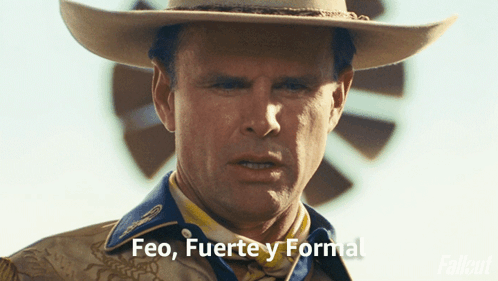
Two examples of the “poetry” (or at least good writing) in the story here. First, when Cooper is filming the movie scene in which he reluctantly shoots the bad guy instead of arresting him, pay attention to the short speech he gives: “Feo, fuerte y formal…it means he was ugly, strong, and had dignity.” (This phrase comes from what John Wayne wanted inscribed on his tombstone, which itself creates some interesting connections we won’t explore here). This is exactly what Cooper becomes when he transitions into The Ghoul. Dignified, yes, but also morally questionable (if not deplorable, which seems to be Lucy’s point of view), having lost all of the ideals he held as a human.

Second, the conversation between Barb and Cooper in the hotel after Cooper’s meeting with Robert House. He questions whether Barb was always a monster or became one working for Vault-Tec. When he incredulously asks whether she’d kill millions, billions, of people to save her daughter, she responds by asking, accusatively, “Wouldn’t you?” He may not be operating on Barb’s scale (Eddie Izzard might comment that she must get up very early in the morning), but as The Ghoul he certainly succumbs to her logic.

Here is the arc as we have it for Howard–weltschmerz has rendered him nihilistic, amoral. Can his view of the world, and thus himself, be redeemed and returned to the man of ideals and principles he began as? It’s a classic story of “the Fall” writ large in the blood of countless raiders and wastelanders.

With the latest episode (S2, E6), Howard says his real name as The Ghoul for the first time. We’ve learned more of his history with Hank MacLean, and he’s rejected an alliance with the super mutants for the war that is coming. In the latter act, he’s shown us that he has not fully succumbed to his nihilism, and I expect that his betrayal of Lucy, subsequent defenestration, and need to be rescued will function as the low point from which he begins his redemptive climb. I’m excited to see!

In the last post in this series we’ll look at the Fallout universe’s satire and criticism of late-stage capitalism, particularly in comparison to the Gospel according to Luke.
Christianity and Fallout (Part I: Violence)

One of my most popular posts (maybe the most popular) was a post about Christianity and the Warhammer 40k universe. I thought I might write on a similar subject with another beloved setting.

I cut my video-gaming teeth on Fallout, playing both 1 and 2 when they came out, and pining for Van Buren until it was finally cancelled. I’ve played through Fallout: Tactics, 3, New Vegas, and 4 multiple times, the non-canonical Brotherhood of Steel games (set in my home of Texas) spent more time fooling with Fallout Shelter than I ought to have, and have had my share of adventures in West Virginia (the only place I’ve lived outside of Texas, coincidentally) in Fallout 76 (although that’s been long enough I ought to go back, as there’s a lot of added content I’m haven’t played). I’ve loved the TV show so far; Walton Goggins has become one of my favorite actors (and the show has given him a character with a wide range in which he can shine), and I’m decidedly less grognardian about supposed retcons and changes to canon the show has made (I just don’t think it ultimately matters if Shady Sands was located in a slightly different place in the games than in the show, for instance). With my bona fides established, let’s talk about the setting and where it might or might not intersect with the Christian faith.

At the outset, I want to address a question that I see with some frequency on the internet: does Christianity survive in the late 23rd century of Fallout? The answer, emphatically, is “yes,” though the extent to which it does probably cannot be known. Rather than lay out the examples, I’ll point you to an article on the subject on the Fandom Fallout Wiki (which, I’m given to understand, may not be as reliable or accurate as some of the other available wikis, but it has plenty of citations from the games to make the point on this subject).

But, unlike my discussion of Warhammer 40k and Christianity, there will be fewer direct theological comparisons of in-setting ideas. Instead, Fallout provides a potential for examining Christian values in a setting that takes some of the moral dilemmas of our own world and dials them up to eleven.

If Warhammer 40k is “grimdark,” how should we categorize Fallout? Is it “grimlight?” I’d certainly argue it’s a grim setting; if you doubt that, read up on the Vault-Tec experiments in the vaults. Or consider the body horror of forced conversion into a super mutant or unexpected conversion into a ghoul. Or the things the raiders do to people for fun. Or maybe just the state of America before the Great War. Like cyberpunk settings, we daily find the ideas more prescient of the current history than is at all comfortable.

Here are a few additional examples: (1) Vault City is a slave-owning society; (2) New Reno is a hive of scum and villainy; (3) the Enclave represents the worst facets of American government and political discourse; (4) the Brotherhood of Steel, for all its initial ideals, is a fascist and intolerant organization that has deviated significantly from the spirit of its initial purpose.

But, while it’s certainly dark, there’s a lot more light in Fallout than in Warhammer 40k. There’s a lot more humor, and while “war never changes,” we’re beyond there being “only war.” Both the games and the TV show have a smattering of the comic, the satirical, and the “wacky” parts of the wasteland to balance out some of the grim and grit. But more than that, there are many examples of goodness in the Fallout world that do not exist in the same quality or quantity within Warhammer 40k. Naive as she may be, Lucy (as well as most of the other vault dwellers not in on Vault-Tec’s schemes) wants to do good. Shady Sands was a place of hope and tolerance. The NCR in general attempted to rebuild some semblance of a civil society.

These are beacons of hope in a largely corrupt world, good people fighting against the weight of the world for something better. And here is where the Fallout setting shines, I think: it doesn’t shy away from tough moral decisions and doesn’t leave decisions without their consequences. Neither do the games judge you for taking the low road and, in a fictional setting, it’s worth being able to explore the nuances of immoral or amoral behavior as a practical thought experiment or maybe just to let off some misanthropic steam–fantasy is a much better place to do that than the real world. That same factor–that Fallout is primarily encountered as a video game–is also its major weakness. If you don’t approach the game with the discipline of roleplaying a developed character encountering the Fallout world for the first time (and I don’t think most people do this or want to do this, and that’s fine), then meta-considerations creep in. Instead of asking “What is the right course of action in this situation?” or “What would my character do in this situation?” the question often becomes about the choices necessary to get the best game items. While there’s a potential investigation of amorality there, I think it largely breaks down the value of the moral quandaries that can be thought through in the Fallout world. This requires a sense of immersion.

I’ve been listening to Tom “Robots'” Fallout Lorecast the past week or so as a break from reading for school. If you just want to explore the lore of the Fallout world, I’d recommend you just follow rabbit trails on the several fan-made wikis. But what Robots does differently is that he often asks you to step into the shoes of someone in one of the Fallout situations: What would you feel and do if you were Paladin Danse upon his life-changing discovery? How would you feel and respond if you were a member of Vault X and discovered the experiment being conducted on you there? Robots’ background in philosophy comes to the fore as he uses the Fallout world to create immersive thought experiments.

It’s one of his podcast episodes that became the impetus for this post, in fact. If I remember correctly, it was his episode on Vault 3, where he discusses the naivite of the vault dwellers, their takeover by Fiends, and the philosophy of violence as necessary (with a mention of just war theory thrown in). Those of you who’ve followed the blog for a while know that the Christian ethics of violence is a topic that continues to fascinate and confound me. I think the Fallout setting is a great place in which we can look at the topic again.

If I understood him correctly, Robots’ core argument is that violence is necessary to keep evil from winning. I think that’s a commonly-held belief. Certainly, it’s the justification used by the “good guys with guns” argument in America, to which I once subscribed. But are things that simple?

Let’s except from consideration the Tactics and Brotherhood of Steel games which, by their very nature and design are fundamentally based in violence. In the true RPG Fallout games, the world seems like one in which violence is inevitable. You’re given weapons early on, and the wasteland is replete with creatures and people who unambiguously wish to do you harm. Within the genre itself, there’s an expectation that combat and violence will be aspects of the experience. There’s a whole ‘nother conversation to be had with why we often want combat and violence to be part of the games we play as a matter of interesting and high-stakes conflict, but this is a long post as it is.

If you’ve played through any of the Fallout games, did you ever consider that non-violence might be an option? I took for granted that violence would be part of my experience in every single one of the games–hopefully with me doing more of it than receiving. And yet, there are discussions and demonstrations of pacifist runs of the Fallout games all over the internet. Some people, whether through moral righteousness, creativity, or the simple love of a challenge, had the thought that they might survive the wasteland without becoming its moral victim. Until the most recent episode of the TV series (Season 2, Episode 4, “The Demon in the Snow”) and with the possible exception of her treatment of Snip-Snip, this was the journey Lucy trod. With the Ghoul as a ready foil, her character arc seems to be devoted to the question of whether one can maintain one’s values upon encountering and living in the wasteland.

Certainly, by “common” standards, much of the violence in the TV and the video games seems to be “justified.” There aren’t a lot of ways to talk a super mutant or a radscorpion out of violence, and–as with Vault 3–the raiders are an ever-present threat to those who would seek to live in the wasteland in peace and mutual cooperation. But terms like “justified,” and “just war” are often confused with “good violence” and “good war.” Is there ever really such a thing? Here’s maybe the more difficult question: is it ever acceptable to make a potentially immoral choice in favor of survival–yours or someone else’s?

Let’s take an example from Season 2 of the Fallout TV show (SPOILERS AHEAD!). Let’s look at Maximus’ killing of Xander Harkness. He does it to save lives, the lives of children no less, and in opposition to what amounts to racism. Certainly, in the moment, killing Xander and thereby preventing the murder of children is justified (and, in meta-narrative, I think the writers intended this moment to be a callback to the fact that the first Fallout games faced pushback and censorship because of the possibility of doing violence to children, but perhaps I’m reading too much into it). But every character who comments on what happened is clear that Xander’s death means war with the Commonwealth Brotherhood.

This, I think, is a good example of the theological belief I’ve come to (the argument for which must be relegated to another post) that one of the most profound messages of the Incarnation is that, on a cosmic level, evil cannot be overcome with violence or force; it can only be overcome by love. Violence begets more violence.

If we turn to very recent events in the U.S., let’s consider the violence perpetrated by I.C.E. Every tear gas cannister, every pepper-loaded gel round fired point-blank in the face of a peacefully-protesting pastor, every murder of an innocent woman, every violent arrest in violation of civil rights, every unnecessary use of force increases the likelihood that someone responds with more violence. I applaud the restraint and discipline of the many, many, peaceful protestors who have endured all of this violence without responding in kind; I believe that truly is the only way to achieve justice. If nothing else, it makes clear who the “good guys” and the “bad guys” are, and both the rest of America and the world are watching.

Not only is the response of non-violent protest the moral one, but it’s also the practical one. Should someone respond violently to I.C.E., our government will use that incident, no matter how limited, to justify the deployment of greater violence against the populace. Which will engender more violence from the populace. So on and so forth. When Ron Perlman’s gravely voice opens the early Fallout games with the now emblematic “War…war never changes.” This is what he means. Violence only begets more violence, one war only sets up the conditions from the next. It’s only when we choose non-violent resolutions that we truly move toward the peaceful world God wants from us, where no one “studies war anymore.”

But the brilliance of Fallout as moral thought-experiment is that it does not simply leave us with satire of the violence in human nature. Let’s consider Vault 3 again. Even accepting my argument that, at the level of eternal redemption, on non-violence drives out evil, the question remains of whether violence is necessary, acceptable, perhaps even “good” to buy some time for love to win out. Put another way, if we have to choose between the naive but generally moral vault-dwellers to survive or the violent, immoral, and–we’re tempted to say despite not knowing the truth of the statement–irredeemable raiders, is it moral to allow the raiders to kill the vault-dwellers?

The question may perhaps be boiled down to this: do we prioritize the possible redemption of the raiders over the current moral superiority (in a general sense, of course) of the vault-dwellers? The knee-jerk response is an easy one. Theologically, though, the question is extremely complex.

Our soteriology frames the question. If we believe that the only possible salvation comes through the confession of Jesus Christ as Lord and Savior, there isn’t a salvific calculus here: those who believe in Jesus are saved and those who do not are not, and that’s that, no matter who kills whom. But if we’re willing to consider a God who is more compassionate and less arbitrary than that (particularly in a world where the raiders may never have had an opportunity to hear the Gospel, depending on how things played out for them), the question is more complicated. And, if we consider the morality as a separate (but still theological) question from salvation, we cannot escape some sort of judgment at all.

Let’s work through this. If, arguendo, God redeems those who know and practice love in addition to those who have faith in Jesus as God1, we have to look more closely at the original question.

One might argue that, if one is assured of their own salvation and God’s promise of eternal, abundant, life, the determination of a need to kill someone else, however bad that person may be, to survive, is a rejection of faith in God’s ultimate justice. That, I think is where all of the complexities enter in. If moral questions prioritize this life over belief in eternal existence, then the idea of “just war” and “just violence” is easier to come to. But, if we believe in eternal life and cosmic justice over temporal concerns, what does it matter if someone assured of their eternal life is unjustly murdered by an immoral person? Faith in God’s promises is vastly more important. This idea lies behind the actions of the martyrs. What if God’s idea of justice is not about people “getting what they deserve?” I’ll argue that its not in another upcoming post, but even without those arguments, the sacrificial salvation through Christ of undeserving mortals seems to discount a cosmic justice as a matter of dessert.

And yet, if we’re called to make this world like the Kingdom of God (I need to discuss alternatives to this phrasing in a separate post and soon), doesn’t that include protecting the innocent against the iniquities of predators? Is there a sort of “double justice” we must try to pursue simultaneously–a “worldly” or “temporal” justice and a cosmic and eternal justice? How would we balance such an idea?

There is no easy answer. In this life, we have to weigh the possibilities and do the best we can, never knowing until we’re face to face with our Creator whether we did the right thing. We can say that violence is never the best or righteous act while acknowledging that, in a fallen world, it may sometimes be the lesser of two evils. But it’s also possible to reject that position in favor of unflinching pacifism. We might believe, as Aasimov tells us in Foundation, that “violence…is the last refuge of the incompetent;” that we only ever choose violence because it’s the easier option, never the better one.

Fallout as the best fiction does, gives you space to consider the possibilities, not with a heavy-handed resolution in view, but as a thought experiment to help you determine where you might best position your belief. Fallout unflinchingly gives us views of the best and the worst of humanity, it acknowledges both the baseness and sublimity of human nature, just as life does. It reminds me of a quotation from beloved Christian author Frederick Buechner: “Here is the world. Beautiful things will happen. Don’t be afraid. I [God] am with you.”

I’d hoped to make this a single post, but my loquaciousness again gets the better of me. Two more posts on Christianity in Fallout will be forthcoming: one about the many examples of the journey to redemption that Fallout gives us, and one about the meek and the powerful, particularly with reference to late-stage capitalism.

  1. For those who read this sentence and assumed we’re falling into a works-based or “Pelagian” idea of salvation, I disagree. There are several ways to get to my point. We might use simple logic through the transitive principle: If we accept the doctrine of the Trinity, then Jesus is God. If God is love, and those who believe in Jesus are saved, then those who believe in love are saved. We might also argue that the knowledge of Jesus as God and Savior is itself a transformative vehicle through which one achieves the totality of salvation, but if it is the transformation and not only the knowledge of God that is operative here (with Jesus being the clearest and most direct way to transformation, I’d argue) then the soteriological question remains complicated and mysterious in ways that should give us pause in going beyond attempting to “work out [our] own salvation through fear and trembling.” Yes, in making the argument above, I’m doing just the opposite, but this is one of the reasons I think we ought to hope for, if not definitively believe in, as expansive a view of salvation as possible–while perhaps holding in tension that God respects our free will and independence so much as to never force anyone into the acceptance of salvation. ↩︎

Review: Fallout 76: A Good Start

It seems that I’ve started most of my recent reviews this way, but the Fallout universe has a special place in my heart. I came of age in the late 90’s, and isometric RPGs were my video game of choice (surprised?).

I spent countless hours playing and replaying Fallout, Fallout 2, and Fallout: Tactics (I even played Fallout: Brotherhood of Steel, despite its many flaws). I lamented when the “Van Buren” project was cancelled and rejoiced when Bethesda announced Fallout 3. The nostalgia factor and fanboyness runs high with this title, so be warned.

And here we are now with a new offering in the Fallout universe, one that divurges greatly from that to which we’ve become accustomed. Multiplayer. Is it the Holy Grail of Fallout gaming, a despicable money-grab by Bethesda in recycling the core of Fallout 4, or something about which we should feel a little bit less extreme and a little more ambivalent?

Multiplayer is a strange thing for me. As an introvert, I’m far more inclined to adventure by my sullen self than to link up with some randos who do or say things that do not recommend themselves to further association. The anonymity of the internet, and multiplayer games, draws out the worst in people. I just don’t have time for that in my life.

On the other hand, playing video games with people I know and have built relationships with away from the glow of the LEDs is something I very much enjoy. In this hectic world, online gaming is sometimes how I best keep up with certain friends–we play and we converse while we play. Maybe it’s the modern equivalent of those long telephone calls I used to have in high school, before texting made such obsolete for high-schoolers.

I love open world video games and the hours of exploration that come with them–truth be told, that’s probably my favorite aspect of video games altogether, though at any other moment in time I might say that it’s strong and meaningful narrative, a well-crafted story.

I’ve had the pleasure of spending hours walking through the West Virginia wasteland as a lone wanderer and as part of a team with my friends–even a complete four-person team. None of us have had the time to hit the “end-game” activities yet, and I’m not fully certain what they are at this point. Did I mention I lived in West Virginia? Only for about two years when I was in kindergarten and first grade, so my memories of that part of my life are fragmented and vague, but this perhaps adds another touchpoint for me.

Okay, background to review complete. Now on to what you really came here for:

The Good

Fallout 76 is like getting a whole ‘nother Fallout 4 worth of locations to explore. That alone piques my interest.

There are new enemies (Mole Miners, Radtoads, Gulpers, the Scorched, and more), new weapons (my favorite for its weirdness is the “death tambo,” a tamborine with the cymbals replaced with blades) and a greatly-expanded crafting system.

The use of SPECIAL and hot-swappable Perks is a lot of fun and allows for a lot of different character builds–both within one character and those that necessitate running multiple characters for different SPECIAL arrays. The theorycrafting of character builds fascinates me in Fallout 76, much moreso than any other MMO-style game I’ve played.

Fallout 76 is, by default, like “Survival Mode” in previous Fallout titles. Not only must you manage your health and radiation levels, but you must manage hunger and thirst, disease and mutations! Your gear deteriorates relatively quickly, so keeping things maintained and finding plans to build new equipment or CAMP (the mobile equivalent of a settlement) items gives the player a lot to do without even interfacing with the quests. These needs create emergent narrative, the kinds of stories that begin, “So no shit, there I was, knee-deep in spent brass and hand -grenade pins, having drunk my last purified water and then a Deathclaw shows up.” I love that, even if no one else wants to hear my stories–especially my wife.

The consequences of dying are scaled well–you lose the junk you’ve been carrying but not all of the other precious items you’ve spent so much time finding or building. If you’re fast enough (or there are no other players around), you can return to the site of your death (if you dare) and retrieve these parts. There’s a cost, sometimes fairly steep, but not one that makes you want to ragequit anytime you die. Good job on this balance, Bethesda, that’s not an easy thing.

Another well-thought out idea is that you can change the sex and appearance of your character at any time. A minor thing for some, but a great convenience for those who may want to change up their character’s visuals every so often.

The Bad

If you’re reading reviews of Fallout 76, you’ve likely come across the complaint that it “feels empty.” I think that that’s a misleading statement (there’s another Location to scavange over every crag and just a short ways down every road), but it’s true that Bethesda’s choice not to include human NPCs in the game is a massive let-down. The self-conscious weirdness of characters in Fallout is one of the main draws, and finding the corpses of these characters and listening to holotapes to give you their background just doesn’t match encountering and dealing with the characters in life.

Yes, this simplifies a number of things for the designers: there’s no need to craft dialogue trees, to manage faction reputation, to deal with conflicting narratives and closing off certain quests to certain players, etc. But it misses one of the best parts of Fallout.

At least Bethesda had the good sense to write the narrative around this concept–there is a reason everyone in West Virginia is dead. But the idea that this approach accentuates player importance by making every living human you encounter a PC just doesn’t work. Quite the opposite, in fact, as it deprives players of a sense of agency. There’s no one to really save, no cause or ideal to support, no settlement or character to get attached to (as much as is psychologically healthy for a fictional character, I suppose). There’s no choice between the Minutemen or the Brotherhood of Steel or the Enclave or the Institute. There’s no choice of dialogue options. There are choices in branching quest lines. There are no choices.

As with any online game, you also have to deal with the jerk gamers on occasion–and they are legion. I’ve gotten into several PVP situations and had about half of them also involve the other player sending me insulting messages over Xbox live and other assorted jackassery. That is, I suppose, unavoidable.

The Ugly

Bethesda stubbornly resists logical physics in a number of ways. No, I don’t mean the super-sciency stuff, I can suspend disbelief for that. But despite many games in this series, Bethesda still thinks the average rifle weighs about 20 pounds (unless the weight units are not pounds–I’m honestly not sure). This is somewhat mitigated by the starting carry weight without penalty being 150 lbs (and Perks that allow certain items to be reduced in weight by up to 90%), but the numbers in weights across the board still bother me. I’m trying to remember back to Skyrim about whether this applies to their concept of medieval weapons as well (a real two-handed sword should weigh between about 3 and 4 pounds–though the massive zweihander could weigh 8 or 9, that’s a very specialized weapon for a very particular purpose and was used in the fashion of a spear as much as a sword).

There are a number of bugs in the game, some leading to program crashes, others causing questlines not to advance, items to suddenly disappear or other minor but infuriating issues. I have not found a glitch that restarting the program (or just logging out and back in) hasn’t fixed.

Hope for the Future

Bethesda has indicated that they intend to support Fallout 76 for the long haul. What exactly that means is unclear, but I assume that it means something like Destiny 2–at least a few years of support with new DLC quarterly or so.

If that’s truly the case, Fallout 76 could have legs–provided that Bethesda has realized that it needs to add human NPCs and everything that comes with that (factions, etc.). If not, it’ll be fun while it lasts; maybe it will tide me over until Fallout 5.