Pilgrimage, Day 2: Arrival

For the previous entry, click here.

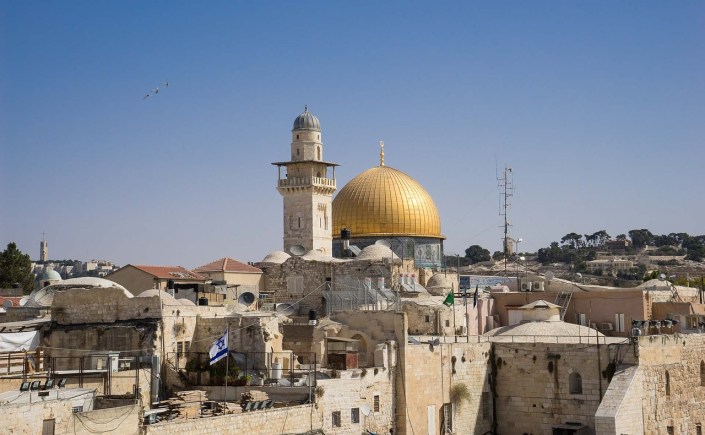
This evening, at least by Israeli time, I write to you from the Gloria Hotel just inside the Old Jerusalem city walls near the Jaffa gate.

We arrived at about 4:20 p.m. local time after a mostly sleepless night on the plane. An hour-and-a-half or so to get through passport control and baggage claim, an hour from Tel Aviv to Jerusalem by bus, a fifteen minute walk up to the Jaffa Gate and the hotel, fifteen minutes to get room keys and take baggage up to the hotel room, and finally dinner at 7:30. After dinner, an intrepid companion and I decided on an evening stroll through the Old City.

It was breathtaking in a number of ways. The beauty of the old stone (the city wall dates from the 16th Century and is a fascinating combination of medieval design approaches. The Old City itself is a tangled ball of streets, sidestreets, alleys, closes and stone stairs, the historical equivalent of the steel canyons of a modern downtown, with stone buildings overhanging on both sides of each street.

My intent was simply to wander and wonder, to soak in all they I could of the environment without being to focused about it, to let it wash over me. This the city did without holding back. We wandered into the Muslim Quarter, where shopkeeps and their children were closing up for the evening. From the instant we encountered the Damascus Gate (we had exited the Old City through the New Gate and followed the outer wall to the Damascus Gate to re-enter), it was clear that things were different there. Four IDF soldiers with M4s stood watch over the entrance, cordoned off by steel traffic barriers like they occupied a make-believe guard tower.

Further into the Quarter, we encountered a squad of eight IDF soldiers in full tactical gear patting down a single young Palestinian man in soccer shorts and a jersey. He cooperated (who wouldn’t with that many assault rifles around) and the whole thing seemed rather low-key, quotidian. Perhaps that’s what bothered me most about the seen, the faces on both sides that resignedly said, “This is just the way things are.”

In an instant, that experience shook me from the reverie of this trip. I came for history. I came for spiritual reflection and introspection. I came for friends and theology. And I forgot that there’s a very real and ongoing struggle here, one with victims and perpetrators and perpetuators on both sides–and dozens of those who have become used to this way of life for each one who wants to do something about it.

To be clear, I have no solution for the Israeli-Palestinian conflict. I have too little real or meaningful experience from either perspective to do anything but naively say, “Why can’t we all just find a way to peacefully and respectfully co-exist?” I have sympathy for both Israelis and Palestinians and a belief that both sides have fault to claim and both sides will have to learn to forgive for their to be any hope.

And while the particulars of Israeli-Palestinian relations trouble me (to the meager extent that I understand them), what I really took away from the scenes I witnessed in the Muslim culture is a reminder. We cannot separate the past from the present just as we cannot separate the present from the past; they are inextricably bound together for eternity. The study of this trip has little meaning if it does not relate the present needs of the world. And I, of course, firmly believe that the message and redemptive work of the Incarnation, the Passion and the Resurrection are every bit as important now as they’ve ever been. As we start our serious work tomorrow, I’ll be going in with eyes open to the need to find something with modern applicability in every past location, person and event we discover.

For the next entry, click here.

Pilgrimage: A Preface

On Saturday, K and I leave with a group of young clergy and their spouses (many of whom we are already close with; the rest of whom I assume we’ll be close with by trip’s end) for Israel for just about two weeks.

In perhaps unprecedented verbosity, I’ll be attempting to post notes about each day of the journey. We’ll be in Galilee early on and spend the rest of the trip staying within the walls of Old Jerusalem and making various day trips to bibliohistorical sites (not sure whether I’m inventing words here). I’m told we’ll be hiking about 100 miles over the course of the two weeks.

It’s been a while since we made the decision to go on this trip, but it’s only now feeling real. In previous posts, I’ve expressed some of my thoughts as I’ve done the preparatory work for the trip. I hope that the mini-travelogue of the journey will bring some clarity to those thoughts and inspire new ones to share. As with K, I think my biggest fear is that the journey will not be so profound as we expect and hope for it to be. Only time will tell, but I have faith.

My second fear has been dispelled just this morning–the Church of the Holy Sepulcher had closed in protest of a tax issue in Israel, but has reopened today.

I will be spending what (little) downtime I have during the trip (that is not spent enjoying the company of my fellow pilgrims or posting my daily post to the blog) continuing to work on my novel in-progress and other creative endeavors, though I don’t expect to be posting any of that during the trip. It’s also high time for another Avarian short story to pique the interest of prospective readers, so I’ll likely be devoting some time to that after my return. I am also working on a pen & paper roleplaying game for Avar Narn, pieces of which will likely be posted to the blog (or a “living document” as I’m writing and working out the kinks in rules). In addition to providing an innovative ruleset and deep setting for fantasy roleplayers (that’s a high bar to set, these days), it will provide a resource for the background of the setting as well.

But for immediate future, I hope you’ll join me on my pilgrimage to the holy land and finds something worth considering as my progressive and existential theology meets the geography and history of the place were the Bible took form, where the Israelites became a people and where God came to Earth. I hope that you’ll leave comments, thoughts and questions on the upcoming travel posts–I will endeavor to respond to anything posted to an entry by the day that follows (in local time).

For the next entry, click here.

Kingdom Come: Deliverance – Playing at History (an early review).

I backed Kingdom Come (KC:D) a long time ago–maybe more than two years. An open-world historical medieval RPG? Yes, please! Just the sort of thing that pulls at the desires of a person whose favorite video game is the Witcher 3 and who, for a time, was a professional student of the medieval.

There was, of course, a long roller-coaster of development that followed–teasers, delays, the realization that my computer wouldn’t be able to run the game, the revelation that it would be released on console and so my computer didn’t matter, etc., etc.

Finally, it arrived this week, and I’ve spent some significant time becoming immersed in the Bohemia of 1403. With the caveat that I’m nowhere near finished with this game, this is what I have to report to the present:

If you are the type of person who plays Fallout and Skyrim on survival mode, this game will appeal to you. You must sleep and eat. Your food rots over time, and spoilt food will make you sick. Eat too much and you’ll be sluggish. Take an injury (whether in combat or not!) and you might begin to bleed. Fix it with a bandage quickly or prepare to die. Keep your weapons and armor in good repair or they’ll become ineffective. Get your clothes bloody or dirty and people will notice–and they don’t take you as seriously when they do. Carry weights are (relatively) realistic, and you improve your skills by using them–not easy to do when it comes to using a sword.

The game is relatively “on rails” for the first few hours of play–while you can do your own thing for long whiles at a time, only advancing the main quest will get you to the point where you can seriously begin to play the game. It’s a slow start that left me, at first, with an unfavorable impression of how gameplay with develop that is still being dispelled as I move through the game.

So far, the game doesn’t feel as “open world” as I had hoped. It is true that there are sidequests (and perhaps I just haven’t discovered many of them yet) and you can easily spend hours just “living” in the medieval world–practicing a trade, acting as a merchant, traveling and fighting bandits, etc. In a certain way, I think you could ignore the quests altogether and simply view the game as a “medieval emulator.”

Further, there seems to be an intimation that the world will be expanded and even more opportunities for self-directed tasks will become available as the game progresses. Despite my several hours of play, I’m sure that I just have no gotten that far into the story yet.

And that main story is, at least, an interesting one. Set within a discrete historical event–King Sigismund of Hungary’s invasion of Bohemia on “behalf” of his half-brother King Wenceslaus IV (“the Idle”), who Sigismund had kidnapped, you are thrust into the world as the son of a blacksmith and the vassal of a lord loyal to Wenceslaus and targeted by Sigimunds’ invading army.

The attitudes and motivations of the characters seem deep. You get the expected behavior of some nobility toward the peasantry (particularly in Sir Hans), but this is never flat or without nuance:you earn the friendship and respect of Sir Hans as the story progresses and he is–in private at least–willing to admit his own faults and the shortcomings of his behavior. The struggle between adherence to duty and ideals when faced with the grim necessities of the day plays out on multiple levels, both personal and political. No assumption of medieval life is treated as straightforward, with a range of different lifestyles and living situations that more accurately portrays the era in a way we often miss in movies, dry history books and, especially, fantasy roleplaying, where the “medieval” is more often a pastiche or a facade than an actual description of setting.

Despite this, at least as far as I’ve played, the real joy of the game is in the way it immerses you into the historical world with a sense of realism and reasonableness. For instance, fighting several poorly armed bandits by yourself is difficult; attacking multiple well-armed or well-trained enemies (to say nothing of those who are both) is near suicidal. Unless you use tricks, like stealth, surprise and ambush, weakening the enemy with ranged weapons, hit and run tactics and any other approach that generally makes the fight less fair. This was the reality of the middle ages, just as it is today–no matter how good you are, fights are brutal and deadly, and fighting honorably will likely just get you killed.

Each fight is, however, very interesting. As a student of historical medieval martial arts myself, as both scholar (my Master’s Thesis was entitled “Shakespeare, the Sword and Self-fashioning”) and a martial artist (mostly with the Association for Renaissance Martial Arts or ARMA), I’m especially keen on in-game fighting that captures something of the speed, grace and precision of actual swordplay–something very difficult to do in a video-game because of the infinite array of techniques, maneuvers and responses in combat with a blade. KC:D does the best I’ve seen yet, with the combat not only accounting for the directionality of attacks, but incorporating parries, feints, grappling, counter-attacks and animations that perfectly capture some of the techniques used. This is no clumsy hack-and-slash; the only video game that has even come close to this kind of swordplay was Mount & Blade (whose new edition should be out later this year). While satisfying, this also means that combat is difficult and partially based upon your own twitchy-skill. It should be noted that there is only one difficulty mode for the game (so far as I’ve discovered): realistic.

As a side note, I am note a fan of the Dark Souls games. I just feel that should be said when I communicate how much I’ve enjoyed the difficulty of the game.

For the first few hours of the game, I was very frustrated by the save system. The game automatically saves when you sleep, complete an important quest step, or drink Saviour Schnapps. Saviour Schnapps is expensive, takes up inventory space, and can get you drink. At the beginning, when your skills are low and the game is at its most difficult, you will die a lot and have to replay moderate sections of the game (at least I did). As I progressed into the game and got into the mindset, I actually began to enjoy the save system. In a game that strives for immersion and realism, this save system reinforces these without becoming full-on rogue-like. You cannot get lucky for a minimal gain, save, and replay until you get the next minimal gain and save again. Three men in armor down that path? Best just to go a different way. This goes a long way into breaking the hero mentality we usually carry with us into video games; I particularly respect that.

This is not to say that playing heroic (or superheroic) characters in games is not appropriate, good design, or fulfilling–it certainly can be. But the occasional game that makes us live in an alternate world as a regular person–even one who may be an exceptional fighter (though still clearly mortal) provides a truly rewarding exception as well. In some sense, I do wish the game had some aspect of the fantastic to it, but that’s really only because I’m such a fan of fantasy. Realistically (and more sensibly), it’s great to see such an enjoyable game and interesting world and narrative created without any need to resort to the “unrealistic.”

As is probably indicated by the amount of words I’ve dedicated to this preemptive review, I’m really enjoying this game. If you’re willing to devote the time to acclimate to this game’s approach to play–and you’re willing to accept the design principles on which the game was built–I think you’ll find a lot to enjoy here.

In some ways, at its heart, this game is a history lesson you play–one about everyday living in the medieval world.

History and Historicity

I wrote in a recent post about some of the difficulties with issues of history and historicity in the Old Testament I’ve had in preparing for my impending journey to Israel. Having had some time to clarify my thoughts, I thought I’d share them.

First, I want to focus on an exemplum of my thoughts and then I’ll speak more generally. Let’s begin with the Bablyonian Captivity. Or, rather, a little bit before that.

In 1 Kings 18, the prophet Elijah confronts Ahab, the monarch of the Kingdom of Israel, on Mount Carmel in a rather memorable set of contests. Really, Elijah is confronting the worship of Baal in the Kingdom of Israel here, but Ahab is culpable for allowing the Israelites to stray from the worship of Yahweh alone.

The four-hundred and fifty prophets of Baal are asked to pick between two bulls brought to the mountain, to cut it to pieces and to smoke if over a fire; Elijah–as Yahweh’s sole remaining prophet–will do the same with the other. Then they will each call upon their respective gods and see who “shows up.” As the Baalite priests beseech their god, they get no response. With memorable taunts (Maybe your god is sleeping and needs to be awakened? Maybe he’s traveling? Maybe he’s busy defecating?), Elijah insults Baal’s prophets until it comes time for him to beseech Yahweh. When he does, the Israelite God sends his “fire” down to earth to light the prepared wood, burn up the bull carcass and the stones, soil and water prepared around the altar. After this, the priests of Baal are slaughtered by the gathered people.

I’m not actually interested in the historicity of this particular story but in what it tells us about the culture of the time (Ahab’s existence is attested outside of the Bible and he was probably king of Israel around the middle of the 9th Century BCE). As we find in the cultures surrounding Isreal-Palestine at that time, gods were viewed to be local; they were the gods of particular cities or nations. We see this explicit in other places even in the Bible, where the Isrealite God states that “he” is the God of Israel (hence the epithet “Israelite God,” I suppose).

What’s happening between the lines in this passage in Kings is a divine turf war. Baal (which is a title that means “lord” and which is borne by several distinct deity figures and used generally to mean “a god”) is a god of the Phoenicians in the city of Tyre. If you look on a map of Biblical Israel, you’ll see that Tyre is on the coast of the Mediterranean Sea (on an island, actually) just a short journey north from Mount Carmel. The question being answered by Elijah’s story is, roughly put, “If Baal is the god of Tyre, and Yahweh is the god of Israel, and they’re both geographically close to one another, which has dominion in the middle ground?” Clearly the answer is Yahweh.

I mention the above passage because it sets us up for the real point about history and historicity in the Old Testament that I want to make in this post. When in the (very early) 6th Century BCE the Babylonians under Nebuchadnezzer sacked Jerusalem and deported the Israelites to Bablyon, a crisis of faith occurred. Again, as a brief aside, this event is attested in the historical record outside of the Bible. If the Israelites were to worship the God of (the nation/land) Israel, how could they do that when they’d been transported to Babylon, the land of the Babylonian gods.

And here comes the prophet Ezekiel. In the verses that open the book that bears his name, Ezekiel tells us that he has a vision of God while among the exiled Israelites in Babylon “on the banks of the Kebar River.”

In this vision, as the Biblical historian Cynthia R. Chapman says, “God gets wheels.” Literally; Ezekiel sees God enthroned upon what I can’t help thinking of as a super-high-tech, four-likeness-of-living-creature-powered motorized wheelchair. That strange image aside, the point of the vision is that the God of Israel is mobile, that God is personally and actually present with the Israelites even in their exile. As a side note, my NIV says that Ezekiel is taken back to the “Kebar River near Tel Aviv”–this should be read as Tel Abib (in modern-day Iraq) by the Chebar River.

Hearing about the underlying spiritual-cultural concerns with regards to these (and other) Old Testament passages did much to “resolve” my problem of “historicity” in the OT (for purposes of this post, I have left aside all of the issues of the construction of the Old Testament text–whether discussion of the three hypotheses of its construction or the timing of its creation).

What I find here is something that makes much more sense to me than either extreme of the historicity debate–humans writing stories of their evolving understanding of and relationship with God. These stories are neither entirely myth nor entirely history; they are stories that draw upon historical experience (and the religious issues raised by that experience), mythological content that may or may not be based in fact (I’m not worried about the answer to that), revelation of the nature of God from God (there’s that spirit-breathed bit), and human reactions and struggles in response to that revelation.

I see this especially as the Israelite understanding of the nature of God breaks free from social precedent and evolves from polytheism to henotheism to true monotheism.

In some ways, what we have in the Old Testament is the macrocosm of Jacob’s struggle with God at Penuel–a back and forth between God and man that may defy explanation but results in relationship.

Does that make interpreting the Bible difficult? Absolutely; I don’t have an answer for you on how we best sort God’s intent from the voice of the writers from the historical record from the cultural context, etc. But I’m certainly willing to say that it’s not supposed to be easy. I can’t imagine that God would decide not to directly appear before all people in an unmistakeable way (which, to be clear, God hasn’t) and yet make Biblical interpretation something as simple as looking at words verbatim.

In the near future, I’m going to return to the Babylonian captivity and the Book of Job to talk a bit about theodicy in Christianity.