Pilgrimage, Day 3

For the previous entry, click here.

Today has been a long day. We started the day at the Jerusalem University College campus for a briefing on Dr. Jack Beck’s approach to geography in the Bible.

If it’s not clear that I’m a nerd, this may have been my favorite part of the day. By my understanding, Dr. Beck’s approach is essentially existential–the geography of the land formed a crucial and central part of the worldview and cosmic understanding of the Biblical authors. Understanding the geography of the Holy Land helps us to understand the way that they thought and felt about the subjects about which they wrote.

This existential–and unfortunately, mostly intellectual–understanding informed my day today more than I had anticipated.

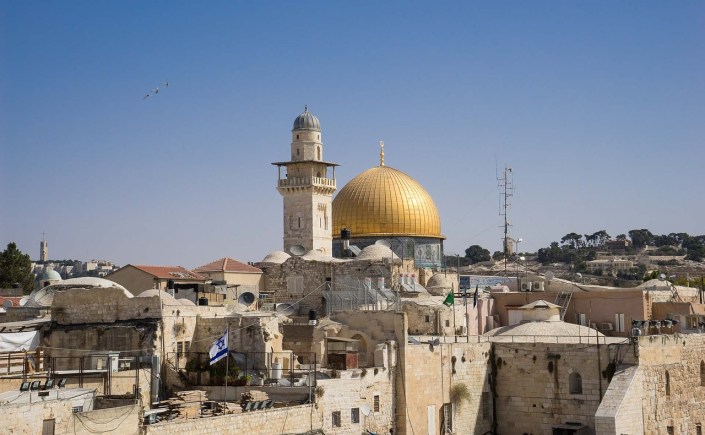
After our morning classroom session, we proceeded through Jerusalem’s Jewish Quarter to the Western Wall, the part of the late retaining wall built for the Second Temple that is closest to where the Holy of Holies once stood. Many of those traveling with our group felt the tangible presence and power of the Lord in approaching the wall. I, unfortunately, did not. I saw a pile of old stones. Historically and religiously significant, of course, but no more directly relevant to my spiritual understanding than any rock formation built from Creation. In some ways, I envy those whose experiences were more profound than my own, and I take some solace in the fact that that’s the majority of our group.

But my own experience also directly relates to some points that Dr. Beck has made as well as more expansive conversations I’ve had with fellow pilgrims. Both Judaism and Islam have significant attachment to physical location Christianity, focused ultimately on the person of Jesus Christ (and, perhaps, on orthodoxy rather than orthopraxy), does not have as strong a (institutional or faith-wide) focus on geographically significant places.

Considering the journey I’m on, with its particular focus on geography, that statement requires some unpacking. For Jews, the physical presence of the Lord within the Temple constitutes a central locus for the religion. For Islam, the Holy City of Mecca represents a physical place strongly tied to the faith it represents and embodies. For Christianity, however, the focus of embodiment is a focus on God adopting human flesh, not upon a geographic locale. And the God who dwells among us is simultaneously more universal and more ephemeral than geography–that is the way of all flesh. In some sense, that perhaps undermines the (temporal) power of Christianity. Ultimately, though, it makes the theology of Christianity far more applicable and far more enduring than those of the other “faiths of the book.”

If that is the case, then the geography of the Holy Land holds power to better help us understand the person and words of Jesus Christ without itself verging on idolatry as the physical bearer of what the Hawai’ians might call “mana.” But the land itself is not a source of salvation as it might be considered to be in Judaism and Islam. This analysis, I hope, is what influenced my lack of strong emotional response to the Western Wall. I found myself more moved by the significance of the devotion of worshippers at the site than the site itself.

After the wall, we traveled to the City of David, that hill to the south of the Temple Mount that likely represents Jerusalem after David seized it from the Jebusites (and, indeed, the city had been called Jebus before the Israelites conquered it). I found the geography here fascinating for its claustrophobic space–an entire settlement containing only 10 acres. Solomon would follow his father by building the First Temple of the Lord, expanding the are of Jerusalem to something closer to 32 acres. The archeology, which has been ongoing for over 20 years at the site, made it clear that the location matched both the Bible in description and the material culture for the period of David.

We had intended to travel through the “wet” tunnel built by King Hezekiah to bring water from the Gihon Spring in the Kidron valley to the Central Valley on the other side of Mount Zion (the ancient mount Zion on which the City of David was built, not the more modern “Mount Zion” partially contained within the Old City walls, on the outside of which the JUC campus sits) but were hindered by scheduling difficulties. We were only able to pass through the earlier Canaanite “dry” tunnel that allowed passage to the pool tower to which water from the spring flowed from behind the fortification walls. This was quite enough.

After that, we walked down Mount Zion to the Pool of Siloam (and then back up) and back to through the Old City to the hotel. My Fitbit marked over 15,000 steps before the end of the day.

After dinner, I went to find some baklava near the Jaffa Gate to debrief on our experiences. The camaraderie certainly vied for the best part of the day, though I have to say that, ultimately, it’s sharing these experiences with K that ultimately does that.

Tomorrow, very early, we leave to head to Caesarea Maritima, Nazareth, and the Sea of Galilee.

For the next entry, click here.

Pilgrimage, Day 2: Arrival

For the previous entry, click here.

This evening, at least by Israeli time, I write to you from the Gloria Hotel just inside the Old Jerusalem city walls near the Jaffa gate.

We arrived at about 4:20 p.m. local time after a mostly sleepless night on the plane. An hour-and-a-half or so to get through passport control and baggage claim, an hour from Tel Aviv to Jerusalem by bus, a fifteen minute walk up to the Jaffa Gate and the hotel, fifteen minutes to get room keys and take baggage up to the hotel room, and finally dinner at 7:30. After dinner, an intrepid companion and I decided on an evening stroll through the Old City.

It was breathtaking in a number of ways. The beauty of the old stone (the city wall dates from the 16th Century and is a fascinating combination of medieval design approaches. The Old City itself is a tangled ball of streets, sidestreets, alleys, closes and stone stairs, the historical equivalent of the steel canyons of a modern downtown, with stone buildings overhanging on both sides of each street.

My intent was simply to wander and wonder, to soak in all they I could of the environment without being to focused about it, to let it wash over me. This the city did without holding back. We wandered into the Muslim Quarter, where shopkeeps and their children were closing up for the evening. From the instant we encountered the Damascus Gate (we had exited the Old City through the New Gate and followed the outer wall to the Damascus Gate to re-enter), it was clear that things were different there. Four IDF soldiers with M4s stood watch over the entrance, cordoned off by steel traffic barriers like they occupied a make-believe guard tower.

Further into the Quarter, we encountered a squad of eight IDF soldiers in full tactical gear patting down a single young Palestinian man in soccer shorts and a jersey. He cooperated (who wouldn’t with that many assault rifles around) and the whole thing seemed rather low-key, quotidian. Perhaps that’s what bothered me most about the seen, the faces on both sides that resignedly said, “This is just the way things are.”

In an instant, that experience shook me from the reverie of this trip. I came for history. I came for spiritual reflection and introspection. I came for friends and theology. And I forgot that there’s a very real and ongoing struggle here, one with victims and perpetrators and perpetuators on both sides–and dozens of those who have become used to this way of life for each one who wants to do something about it.

To be clear, I have no solution for the Israeli-Palestinian conflict. I have too little real or meaningful experience from either perspective to do anything but naively say, “Why can’t we all just find a way to peacefully and respectfully co-exist?” I have sympathy for both Israelis and Palestinians and a belief that both sides have fault to claim and both sides will have to learn to forgive for their to be any hope.

And while the particulars of Israeli-Palestinian relations trouble me (to the meager extent that I understand them), what I really took away from the scenes I witnessed in the Muslim culture is a reminder. We cannot separate the past from the present just as we cannot separate the present from the past; they are inextricably bound together for eternity. The study of this trip has little meaning if it does not relate the present needs of the world. And I, of course, firmly believe that the message and redemptive work of the Incarnation, the Passion and the Resurrection are every bit as important now as they’ve ever been. As we start our serious work tomorrow, I’ll be going in with eyes open to the need to find something with modern applicability in every past location, person and event we discover.

For the next entry, click here.

Pilgrimage: Day 1

For the previous entry, click here.

This evening, I write from inside Gate C123 at Newark Airport, having just crossed through the security checkpoint at the gate (yes, apparently, flights to Israel have their own security at the gate–this should not really be a surprise).

Our group will begin to board the 777 for Tel Aviv in the next half hour; we’re scheduled to depart at 11:00 p.m. local time. I plan to watch Murder on the Orient Express (which I haven’t seen before) and then sleep. We’re scheduled to arrive at 4:20 p.m. Israel time, so I’m straddling the line between being tired now and trying to make sure I’m tired enough to sleep not too long after we arrive. It’s a precarious dance, to be sure.

We arrived at the airport this morning at 10:30 a.m. for a 2:30 flight to Newark. Early to be sure, but not unreasonably so in modern air travel–especially international travel and especially in a group. I must admit that today has mostly been a daze, a mild fugue state of waiting, killing time, and trying to enjoy every minute of the company I can. Nevertheless, it’s exhausting.

And that has me thinking about how spoiled I am compared to the pilgrims of the past. Those whose faith led them to Jerusalem before the luxuries of air travel, before even the luxury of assuredly-safe travel by land or sea, when pilgrimage meant risking everything to embark on a journey from which there was no guarantee of return. And that makes me feel like an imposter, like a tourist of faith in the worst kind of way.

Despite having been fortunate to have traveled internationally many times in my life, and to have flown with some frequency from a young age, I’m something of a timid flier. On the first leg of this trip, I found myself not quite as white-knuckled as I expected, but never quite comfortable hurtling through the air in a metal can that flies only through the magic of massive engines and Bernoulli’s Principle.

Still, that pales in comparison to the hardships endured by the pilgrims of the past, when the journey itself–and the hardships that inevitably defined it–could contain inherent revelatory power and spiritual realization. For me, the journey is merely the means to an end, something that must be endured but with little meaning (reference above my in-flight activities).

But tomorrow, tomorrow I’ll be in Jerusalem.

For the next entry, click here.

Pilgrimage: A Preface

On Saturday, K and I leave with a group of young clergy and their spouses (many of whom we are already close with; the rest of whom I assume we’ll be close with by trip’s end) for Israel for just about two weeks.

In perhaps unprecedented verbosity, I’ll be attempting to post notes about each day of the journey. We’ll be in Galilee early on and spend the rest of the trip staying within the walls of Old Jerusalem and making various day trips to bibliohistorical sites (not sure whether I’m inventing words here). I’m told we’ll be hiking about 100 miles over the course of the two weeks.

It’s been a while since we made the decision to go on this trip, but it’s only now feeling real. In previous posts, I’ve expressed some of my thoughts as I’ve done the preparatory work for the trip. I hope that the mini-travelogue of the journey will bring some clarity to those thoughts and inspire new ones to share. As with K, I think my biggest fear is that the journey will not be so profound as we expect and hope for it to be. Only time will tell, but I have faith.

My second fear has been dispelled just this morning–the Church of the Holy Sepulcher had closed in protest of a tax issue in Israel, but has reopened today.

I will be spending what (little) downtime I have during the trip (that is not spent enjoying the company of my fellow pilgrims or posting my daily post to the blog) continuing to work on my novel in-progress and other creative endeavors, though I don’t expect to be posting any of that during the trip. It’s also high time for another Avarian short story to pique the interest of prospective readers, so I’ll likely be devoting some time to that after my return. I am also working on a pen & paper roleplaying game for Avar Narn, pieces of which will likely be posted to the blog (or a “living document” as I’m writing and working out the kinks in rules). In addition to providing an innovative ruleset and deep setting for fantasy roleplayers (that’s a high bar to set, these days), it will provide a resource for the background of the setting as well.

But for immediate future, I hope you’ll join me on my pilgrimage to the holy land and finds something worth considering as my progressive and existential theology meets the geography and history of the place were the Bible took form, where the Israelites became a people and where God came to Earth. I hope that you’ll leave comments, thoughts and questions on the upcoming travel posts–I will endeavor to respond to anything posted to an entry by the day that follows (in local time).

For the next entry, click here.