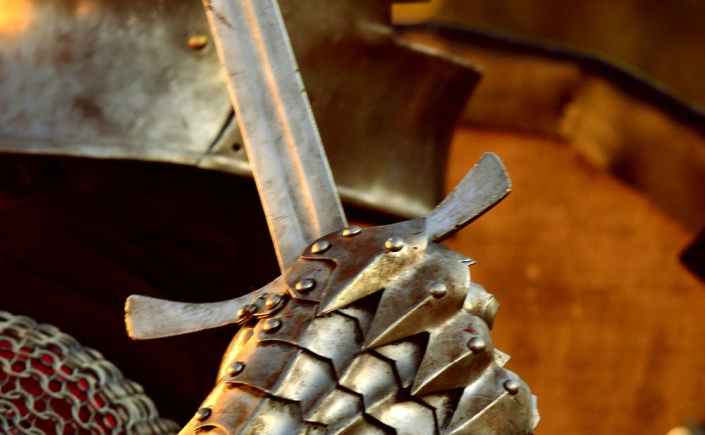
What Writers (and Roleplayers) Need to Know about Swordplay, Part II: Swords

For the introduction to this series, click here.

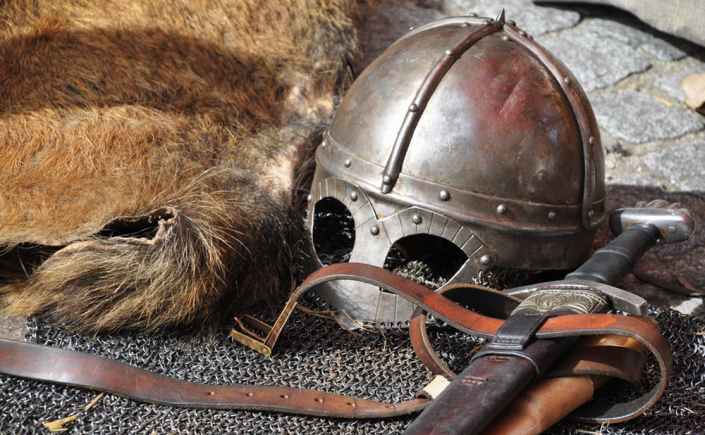
We ought to start with the Queen of Battle, oughtn’t we? By this, I mean the sword, of course.

Weights and Measures
Let’s get the most glaring error out of the way first: swords were not heavy, nor were they clumsy. You will still even hear some historians claiming that swords weighed 20 pounds or more; this is hogwash.

If you’re able, do a quick test. Get your beefiest friend and a weighlifting barbell (the big one, for benchpressing). These typically weight 15 to 20 pounds. Ask your meatloaf friend (without calling him that) to try to swing the barbell like a sword. Stand back and prepare to laugh. The results should be slow, clumsy and obviously ridiculous.

The average one-handed sword (an “arming sword”) of the medieval and Renaissance periods likely weighs between one-and-a-half pounds and three pounds. The average two-handed sword (what is properly called a “longsword” by the way) usually weighs between two-and-a-half to three-and-a-half pounds, give or take. If you’ve taken some time to watch videos on YouTube, now maybe you’ll understand how they’re able to move so fast and so agilely–we’ll return to this.

Where did we get the idea that swords are so heavy? Bad scholars is the likeliest reason. The heaviest swords actually used of which I’m aware are the zweihanders (the “true twohanders”) use by the Landsknecht mercenaries. These could weigh between six and eight pounds and could be six feet from tip to pommel.

First, it’s important to know that this was a very specialized weapon (see my next point below). By the early 16th century, when this weapon came to use, Europe had (debatedly, at least) undergone a “military revolution.” Gone were the shieldwalls and rough battle lines of the medieval period, replaced by professional or semi-professional soldiers who spent more time drilling in formations and maneuvers than their manual-of-arms for their weapons. The standard was the use of large pike formations protecting musketeers or archers (the Spanish “tercio” is a prime example of this). With their (very) long pikes and the ability to maneuver and angle their weapons together, a pike formation proved a very difficult formation to assault.

The zweihander was one tactical response to this problem. If you look at the weapon, you’ll see a long grip followed by the crossguard and a typically long-and-blunt ricasso (the base of the blade coming from the crossguard). Some examples had this section wrapped in leather and/or topped by parierhaken (parrying hooks). The design will help you to understand the use.

Gripped as a sword, with both hands on the hilt, the weapon could deliver powerful swings, excellent for knocking pike spearpoints out of the way, or potentially even cutting them off (there is not agreement about this).

Once you’re inside the length of the pike, it becomes mostly useless to its user. The pikeman would need to drop his pike and draw whatever shorter weapon he had to hand. The user of the zweihander, however, only had to position his off hand on the ricasso and he suddenly had a weapon that performed more like a short spear than a heavy sword. Advantage dopplesoldner (as these men were called). By gripping the blade with itself with one hand, the dopplesoldner could even simply push pikes up and hold them out of the way while his compatriots slid into the pike formation to do the dirty work.

This was dangerous work, especially so, and dopplesoldners (literally “double soldier”) were probably called that because they received double pay.

Over time, as the tactics of warfare continued to evolve, the zweihander became less and less useful. It retained, however, some significance as a symbol of certain military units, and versions that were intended only to be carried in parade were created. Without care given to weight and balance as is done with a useful sword, these became quite heavy. When antiquarians of the 19th century rediscovered them, they assumed that the parade swords they’d found were actual weapons of war and marveled at the strength necessary to wield them.

If you’d like to take a more scientific approach, let’s look to physics. Force exerted equals mass times acceleration, where acceleration is measured in units squared. So, all other things being equal, you get more force, comparatively, with a lighter weapon swung faster than a heavier weapon swung slower. Medieval minds may not have had the equation, but they were smart enough to look at the evidence and draw a conclusion. Add to this the fact that you have to actually hit your target to do any damage and the usefulness of a faster weapon becomes doubly apparent.

A Sword is a Tool
Like all weapons, a sword is a tool, albeit one with a macabre purpose. Understanding that goes a great distance to understand swordplay, I think. Two particularly important parts: First, force (pressure, really) applied increases diametrically to the area over which it is applied. This is the entire purpose of a blade–the edge reduces the area over which force is applied, focusing and increasing it over a small space. This is why all bladed weapons are useful–they increase the force applied to the target, hopefully sheering and cutting through it.

Second, a sword is a lever, again a tool to amplify the force exerted by the user. This amplification increases the longer the length of the lever, making the cutting area near the tip of the sword the most dangerous area (it also accelerates fastest).

This covers the most basic design purposes behind the weapon, but there is much more. Tools are often improved incrementally over time, and we see that with swords in the historical record, from early bronze weapons to the carbon steel of the medieval and Renaissance sword or with the addition of a hilt capable of blocking an enemy blade.

Some tools are generic, able to perform multiple tasks passably, but not excelling anywhere. Others are specialized, becoming more effective at limited tasks to the detriment of other capabilities. Bear in mind that at all points of human history, there is also an “arms race” between the capabilities of weapons to cause injury and the capabilities of armor to stop injury.

Swords evolved over time in relation to the armor available. Just two examples: the two-handed sword did not become a common weapon until the advent of more-effective armors–the transitional period of the 14th century as we see progress toward true plate mail: brigandine “coats of plates,” the addition of plates to protect joints and limbs, etc. When one could more reasonably rely on one’s armor to stop a blow, a shield became a less necessary item (as we’ll discuss later, a shield should really be thought of as a weapon, not armor), freeing a hand for a longer, weightier weapon, which in turn provided more advantage against that same armor than a one-handed sword.

The second example: as plate armor became more common, a different approach was necessary to the design of swords. Cutting is typically ineffective against plate armor; this is partially a matter of its rigidity and resistance to cutting, but also a matter of its design–plate armor is designed to deflect a blow, directing the force of the attack in a way less harmful to the wearer, rather than to simply stop the blow. The result of this were blades with more acute points. Much fighting in plate armor, at least with swords, results in grappling, with the combatants grabbing the blade of their sword with one hand (called “half-swording, and yes, this can be done without injury”) and aiming to maneuver the point of the weapon through the gaps between plates. Harnessfechten is truly terrifying stuff, with the end results as often as not being achieved through grappling itself (the breaking of limbs as such) or through close work at the half-sword or with the dagger.

Swords also changed as firearms altered the types and amount of armor worn, becoming lighter and developing (though not solely) into the rapier and later smallsword. Both of these, the rapier and smallsword, are excellent examples of the very-specialized sword; we’ll discuss rapiers in detail shortly.

What does this mean for the writer and/or roleplayer (especially a GM)? If you’re describing a sword, or determining what kinds of swords are likely to be found in your setting, you’d be well-advised to do some research into sword typology and the types of swords that existed at various time periods, so think about relationship between relative historical equivalents and–especially–what kind of armor is available and how that would affect sword designs and styles. There’s not necessarily a need to make mechanical distinctions between variant sword types in the gaming realm, though you certainly can if you lean heavily simulationist (or gamist, I suppose), but it will help to visualize the setting.

There are some other storytelling opportunities here–if yours is a setting with ancient and magical weapons and armor (like most games of D&D, for instance), think about how that ancient weapon may differ in appearance and design from the ones made in the setting’s present. Do ancient swords of power look more like 9th-century viking swords rather than the more acutely pointed 15th-century style swords used by most people? Would the sword be less effective against “modern” armor (whatever that may be in your setting) except for the magic within it?

A side note here–as in our own historical record, the development of sword types was not solely a linear progression. Multiple sword designs competed with one another, or performed different functions, in the same period. Changes in sword morphology did not occur simultaneously over all geographic locales, and the evolution of any weapon involves some amount of discovery, forgetting, uneven development or acceptance, throwbacks, etc.

Like any invention, the discovery of the technology itself is far from the only factor involved in the “success” or acceptance of the technology. Cost, societal and cultural views, changing needs, and many other factors may cause some technologies never to be fully realized despite the fact that they perform better than alternatives.

Additionally, because weapons are tools, context is important. The comparison of European swords and Japanese swords during their respective feudal periods provides a good example. The katana is not an inherently “better” weapon than the European longsword; of course the reverse is also true. The two weapons developed in, and made sense in, different contexts.

While I’m not as well-read in Asian history as I am in western history, my understanding is that the katana’s design is a very specific response to several factors in Japan. Primary among these was the reduced availability of quality materials from which to produce reliable, weapons-grade steel. Two conditions flowed from this: plate armor did not developed or see broad usage in Japan as it did in Europe, so the importance of acutely-pointed weapons that could be used against enemies in a wide range of armors (including that “white metal” plate armor) did not exist in the same way in Japan as in Europe–the needs to be fulfilled by the weapon were different. Likewise, the resources available with which to make weapons in Japan necessitated different techniques in sword-forging, and the katana (and its variants, which are similarly diverse as European weapons, I believe) represented the best balance of effective weapon and (relative) ease of manufacture. Some exquisite weapons were made in both locales. Both, I’m sure, also saw a number of subpar weapons created because of lack of skill, the demands of semi-mass production, the corner-cutting of greedy manufacturers, or the penny-pinching of those who commissioned the weapons.

Making Swords was Difficult
The medieval and Renaissance periods did not have access to modern metallurgy. The field of chemistry was in its infancy, and though the understanding of metals and their properties certainly improved over the centuries in question, smithing metal was art and science during the medieval and early modern periods.

A sword is made of carbon steel, which is iron fused with carbon to create an alloy with the desired properties. If you’re at your local Renaissance Faire and someone is trying to sell you a sword made out of stainless steel, it is a cheap display piece. If that’s what you want it for, no worries. But if you want something you could actually swing, test cut with, or safely use for WMA, you need carbon steel.

Those physical properties change based on the amount of carbon in the steel and the properties required of good swords are quite specific. The sword needs to be able to take and hold a good edge (which I understand is something of a metallurgic “sweet” spot). It needs to be hard, but not brittle, and the blade needs to be able to flex rather than to be perfectly rigid. There are some variations on these needs based on the sword design, of course, but those facts are generally true.

Here’s the problem: early modern smiths had no way to accurately gauge the carbon content of steel. They had to learn an intuition for the right amount of carbon, and smiths developed, even before our time period, techniques for controlling carbon content (relatively if not exactly). One such technique was to create the billet for the sword from individual layers of iron and carbon-containing metallic strips, heating them together and combining them to get a steel with a semi-controlled carbon content; this is called “pattern welding”. Viking swords were commonly made this way, with the pattern of the mixed steel visible in the blade or fuller when acid etching revealed the “serpent in the blade” as it was called.

By the Tudor period, other techniques were available for increasing carbon content in steel but, admittedly, I don’t remember the specifics well enough to describe them now.

The important thing to note is that making swords required special knowledge and skill–this is not something a blacksmith would do. Basic economic theory tells us that, the more specialized knowledge and skill a product requires, the lower the supply and higher the price commanded by the commodity. This is true of swords. While it’s very difficult to determine the actual costs of swords at various levels of quality or design, I would note that, in many of the medieval laws requiring the ownership of certain arms and armor, the weapon required of most men was a spear, not a sword.

We also have some evidence of out-of-date styles of sword continuing to see use despite the changes in the “modern” design of the weapons. This likely indicates, and there is some corroborating evidence in the historical record, that swords might be passed down in a family as heirlooms because of the value they had and relative difficulty of acquiring a newer weapon. Sometimes the blade was kept and the weapon’s fittings were changed.

On the other hand, there is much evidence of schools of swordplay becoming available to the (paying) public by the 16th century–we have a number of woodcuts showing training in just such a setting. This means that, for the burgeoning middle class, the acquisition of swords and time and money enough to learn their use was not out of reach. While swords were not nearly as common as they are often portrayed, neither were they rare.

To analogize to the modern period, I think we be well served by thinking about military-style rifles. A lot of them are made by governments for warfare, and they don’t simply disappear once the war is over. An AR-15 in the United States might run $500 for a very basic model and into the thousands of dollars. According to CNN, 40% of Americans do not have $400 available to them in the event of an emergency, so at least 40% of people probably couldn’t come up with the money to purchase such a weapon without taking on serious financial risk. I would imagine for another fair percentage, the acquisition could be made only if saved for over time, financed or the budget stretched. Bear in mind that credit did not work the way it does in modern times during the medieval and Renaissance periods (which is not to say that there was no lending or borrowing of money or other extensions of credit, but the ease of access to credit was far lower). And of course, there are some people who could afford to arm an entire town or county.

So, in writing or roleplaying, think about the social status and wealth of a character when determining whether that person owns a sword. Most peasants and desperate folk won’t–they’re more likely to use something simpler, less expensive and easier to acquire–a spear, and ax, a knife, etc. As we’ll discuss shortly, using a sword is not easy and requires significant training, so most peasants wouldn’t have had sufficient free time (or resources) to sufficiently study swordplay, even if they could acquire a sword.

As with the other sections, these are guidelines to think about, choices that must be made after reasonable consideration, not strict rules to be slavishly followed. Some societies or cultures by their nature will have a higher focus on producing weapons and putting them into the hands of the populace. Switzerland’s famous status as a “neutral” nation is not simply a matter of its refusal to intervene in the affairs of foreign nations, but also the fact that mandatory military service and weapons training (members of the military store their weapons at home!) means a nightmare for any would-be invader.

You Couldn’t Just Wear a Sword Anywhere
The systems of law enforcement and public safety were not so clearly defined, structured or regulated as they are now, but they became moreso over the medieval period and into the Renaissance. As we discussed above, because a sword was not the commonest or most affordable of commodities, it was also a status symbol–as social mobility increased somewhat after the Black Death and especially into the Renaissance (though still nothing like modern social mobility), more and more people wanted to show off their success by the wearing of one.

As is ever the case, those who held power didn’t want to share power or prestige with others and made concerted efforts to hold the lower classes down. One of these efforts was the creation of sumptuary laws. Sumptuary laws were concerned with how a person could and could not dress based upon their social status and wealth–you had to have a certain annual income to be legally able to wear ermine (a popular type of fur), for instance. This also extended to the wearing of weapons.

More than that, though, wealthy aristocrats had good cause to fear the peasantry–they largely enjoyed their wealth and status on the backs of those less fortunate, as the German Bundschuh movements and frequency of peasant revolts (England in 1340, 1381 and 1450, France in 1358 and 1382, Friuli in 1511, the German Peasants’ War in 1525-26, just to name a few) attest. The aristocracy didn’t really want their peasants to be well-armed.

But the simple matter of public safety was also a concern, and Machiavelli’s view that “an armed society is a polite society” was certainly not held by all. We know that the wearing of weapons was specifically permitted for travelers and pilgrims of the lower classes (because of the threat of brigandry and banditry, of course)

Many towns and cities had restrictions on the length of a blade that could carried inside its limits, though the specifics varied widely by time and place and exceptions seem to have almost always existed based on social class or social function.

This is to say that, contrary to common D&D tropes, at least, people (at least by the Renaissance) didn’t often walk around in full armor and festooned with weaponry–that made people nervous and attracted attention. People were restricted from the wearing of weapons in certain settings, and even social norms played a role as well.

Bear in mind that different levels of armedness were permissible in various situations. Wearing a dagger or knife was rarely forbidden, and it was common for the nobility to wear a sword (though more commonly of a lighter “civilian” design such as an “espada de ropa” or rapier) in social settings where combat was not expected. The wearing of armor in particular (when not in an official capacity requiring it) advertised that you were looking for trouble.

The types of weapons–even swords–carried also varied by social status. I’ll give an example about what certain weapons communicated later by looking at the gang fight scene at the beginning of Shakespeare’s Romeo and Juliet. For now, I’ll just give this example–in late medieval and early-modern England, the retainers of a nobleman who were commoners but who were allowed to carry weapons by virtue of their service in the nobleman’s retinue were most commonly armed with a simple single-handed sword and a buckler. They were commonly referred to as “sword-and-buckler” men and the term “swashbuckler” derives from the practice of letting one’s buckler (hung from the belt) clash against one’s (sheathed) sword as one walked, advertising armedness with a good dash of bravado. For various reasons, but among them armed clashes between groups of retainers, laws restricting the size and makeup of liveried retainers were a common feature of this period. That they were issued with such frequency most likely indicates trouble in enforcing them–or at least a high level of concern with the problem.

And if good fiction is any indication, there’s a lot of good drama to be had when a character is caught without his armor or the weapon he’d prefer to use to defend himself. I’m certainly of the mind that this should be pursued in both “conventional” fiction and roleplaying–don’t let your characters carry an arsenal whenever and wherever they feel like it!

Using a Sword is Difficult
We’ll talk about the actual features of swordplay in the next Part, but for now, let me expound briefly on why swords are difficult to use.

A sword is not a club. That seems obvious, but think about the fact that the edge must actually contact the target for a sword to maximize its effect. Not only that, but the edge must contact the target at an appropriate angle to have an optimal effect. “Edge control” is one of the first difficult tasks faced by a student of the sword.

Then there’s the whole “not-cutting-yourself” thing. You want power and acceleration behind each swing of the blade, but you also need to control the blade after it has missed, struck its target, or been deflected. While moving. While trying not to be hit by your enemy. I have seen or heard of injuries requiring emergency medical attention and stitches during test-cuttings. If you’re not familiar, a “test cutting” is the practice of cutting a stationary object with a sharp blade. You’ll find many videos of test cuttings performed on water bottles and rolled tatami mats. I have attended and participated in test cuttings on animal carcasses (if it matters to you, the animal was not killed for the purpose of the test cutting–and certainly not during it!–so this was a matter of making the most of the carcass. If you are offended by this, I certainly understand, and there’s a perfectly reasonable question and conversation to be had there).  These are the most controlled environments in the use of a sword that you could hope to have–and yet people still manage to hurt themselves. Factor in all the fighting stuff and you have some serious concerns.

The body mechanics of the movement of the sword, whether the transition between one “guard” or manner of holding the sword ready for use, the transition from one attack to another, or from attack to defense and vice versa, are not always intuitive until you build muscle memory. The options for how to respond to any given blade contact are myriad. You can move, you can grapple your opponent, you can act “on the bind” by pressing your blade against theirs, you can counterattack; and all of these approaches have a number of decisions to make within them. Without getting too far into the “how” of swordplay in this Part (already very long!), let’s take a brief look at the questions involved in choosing to grapple: where will you grip the opponent? Where will you move as you close to grapple and how will your orient your body to theirs? In what directions will you apply force as you grapple? What is your goal: to disarm, to break a limb, to buffet the enemy with fists and elbows, to throw them or trip them? As with all hand-to-hand martial arts, it takes time and practice to understand the theory behind these choices, more to develop the skill to implement them, and even more to be capable of making and implementing split-second decisions about these techniques in the heat of combat. Add a blade, which is dangerous to both you and your opponent, and it becomes clear, I think, that a blade is more difficult to use than a club (though many of the same techniques can be employed, really).

The idea that a character will pick up a sword and suddenly be effective with it (at least against a capable opponent) is dubious at best. Keep this in mind when structuring narrative.

What is a Rapier and How is it Different?
As one of the easiest examples of how widely swords can differ in their morphology and function, let’s look at the rapier versus other types of sword.

As an introductory note, it must be stated that research about the rapier is somewhat difficult, as the usage of language in historical sources do not make the strict categorical distinction between rapier and other types of swords as modern scholars and WMA enthusiasts tend to. This is partially a result of the fact that the rapier evolved over a fairly long period, with a number of very different designs and approaches during that period.

As the fighting manuals consider them, rapiers are swords (very) heavily focused on the thrust over the cut (though some treatises do make use of cutting techniques). Modern scholars debate whether those swords called “rapiers” that are alluded to as also cutting should truly be referred to as rapiers (under modern categorization) or should be placed in the same category as “cut-and-thrust” swords or in the more ambiguous category of “sword-rapiers.”

The rapier developed starting in the early 16th century and continued to see significant use into the 17th, when it began to be supplanted by the smallword (a lighter, shorter variant, essentially).

Generally, a rapier has several distinguishing features. First, it is a one-handed sword. Second, a thinner blade than other sword types, with that blade often being more rigid than other sword types (to strengthen the thrusting ability of the blade while sacrificing some of the blade flex that is useful to “winding and binding” with the blade (see the next Part). Third, rapier blades tend to be quite long, and longer as their development continues. Fourth, rapiers have increasingly complex hilts (over the course of their development), starting with simple rings built into the crossguard so that the index finger may be wrapped over the crossguard (next to the sword’s ricasso). This allows greater control over the thrust, while again sacrificing some authority in cutting. Ricasso rings and complex hilts were not only used for rapiers, however; the “cut-and-thrust” blades (as modern scholars call them) that have wider blades (often acutely pointed) that favor the thrust but still allow for strong cutting). This style of gripping the blade is still emulated in certain grips for modern fencing epees.

The most “extreme” rapier designs had hexagonal or octagonal blade cross-sections, almost like a piece of sharpened rebar (albeit much better balanced). These weapons were clearly designed only to thrust; their cross-sections did not allow for holding an edge.

While a “standard” rapier design is difficult or impossible to pin down, their function is not. As a lighter weapon (compared to other swords), the rapier was easier and more comfortable to carry (provided that the length was not absurd). The use of the thrust allows for a greater maintenance of distance from the opponent as well obviating the need to draw the weapon away from the opponent to prepare a swing. The downside of this is that resorting only to the thrust makes it very difficult to hold multiple attackers at bay at once (already a very difficult thing). But the lack of a need to swing proved especially useful in the often-cramped streets and alleys of Renaissance cities, where there may not have been room to swing a cutting sword at all.

Despite being a thrusting weapon, the rapier does not appear to have been effective or intended to be used against an opponent in armor. Against an unarmored opponent, however, the weapon is truly deadly–in one of the aforementioned test-cuttings I attended, I witnessed a (quality) replica rapier lightly tossed underhanded into a slab of deer meat to the hilt. As we’ll see later on, the reputation of the weapon in its contemporary time (at least in England) was that it was especially deadly compared to other weapons.

Combine the effectiveness of the weapon in urban settings and the convenience of carrying it with it’s lack of effectiveness in group combat (bear in mind that in the press of battle you may not have room to pull back a weapon for a thrust and, in a strange opposite of the alley, a cutting weapon may prove more useful), and you have a weapon very well suited to daily self-defense and to the duel, but not to military purposes.

In the next Part, we’ll talk a look at how swords are actually used. After that, we’ll look at medieval/Renaissance armor and some common misconceptions held by roleplaying games and some fantasy writers. I’ll conclude with a sort of bibliography, including books for further reading and even some roleplaying games that really get swordplay “right.”

What Writers (and Roleplayers) Need to Know about Swordplay, Part I: Introduction and Sources

I’m far from the first person to pick up this subject, but I continue to hear so many mistakes made about medieval and Renaissance weapons, armor and combat that I feel that the subject merits continued treatment.

To begin, let me set out my bona fides: My undergraduate degree is a B.A. in History, focusing on Medieval and Renaissance History, my senior thesis was written on Henry VIII’s use of Arthurian Legend as propaganda and included research at the British Library and National Archives. My master’s degree is in English, focusing again on medieval and Renaissance literature; my master’s thesis was about the use of particular weapons and fighting styles in Shakespeare’s works, 16th century English fighting manuals and adventure pamphlets as a method of establishing identity, particularly national identity.

I was a sport fencer in high school (which hardly counts for anything in this field, unfortunately, except in the rudiments of all hand-to-hand combat: distance, timing and footwork) and spent my college years as a member (and later study-group leader) of the Association for Renaissance Martial Arts (ARMA), having broken a rib and an eardrum in separate sparring engagements during that time (no, I did not get stabbed in the ear). Though I did not continue my affiliation with them after I left my original study group, I have continued to practice and develop my skills as a swordsman, off and on. I have experience sparring at full contact with padded weapons carefully designed to emulate the weight and balance of actual swords, with wooden “wasters” and with blunted steel. I’ve studied and worked through Ringeck, Talhoffer, Fiori dei Liberi, Silver, Swetnam and others, including some sword-and-buckler work in the I.33 and some rapier work with Agrippa, Di Grassi and Saviolo. My primary experience (in practice) is in the two-handed longsword, single-handed swords of the “cut-and-thrust” variety (mostly with dagger or a free secondary hand), the rapier (again with dagger or free hand), and grappling/dagger work. I have used a shield sometimes, mostly a buckler, and all of my experience is in the realm of “blossfechten,” that is, fighting without (plate) armor. I’ve seen a number of demonstrations of fighting in plate (harnessfechten) and understand the theory, but have no direct experience there.

The subject of “medieval and Renaissance martial arts,” “historical European martial arts,” (HEMA) or “Western martial arts”  (WMA) has become an increasing interest in Western culture over the past thirty years, though I’d still venture to say that the subject, as both research field and martial art form, remains in the early stages of reconstruction.

If you want to see what swordplay looks like, I recommend you go to YouTube and look for clips under the search terms in the preceding paragraph, with particular attention to some of the European competition clips. Each year, it seems, there are more competitions, the “sport” becomes more like other sports (with organizations, sponsors, etc.), and the competitors seem to have greater skill. This will give you some perspective on the topics we’ll cover in this series.

How did we get to a point where, after such a far remove from the times when these weapons were actually employed, we can begin to understand and reconstruct their usage?

There are museum pieces and archeological records of course, which give us much of our information on actual weights and designs of swords, armor and other weapons. The Royal Armouries in Leeds, England has, as far as I’m aware, one of the very best collections of early modern armaments anywhere in the world. Bear in mind though, that we find far fewer pristine examples of items than we do pitted and degraded examples, this being more the case the farther in time we look back.

For the technical aspects of medieval arms and armor, I would refer the student to begin with the works of Ewart Oakeshott, with the caveat that his interpretations are not the final say in the matter, that even he was unsure about some of his classifications, and that there has been much debate and revision of his ideas since.

We also have art and literature but, as we’ll see, the interpretation of these alone can sometimes lead to misunderstandings (that continue to defy correction)!

For the actual reconstruction of the martial “arts” of the medieval and early modern periods, we have written instructions, what are generally referred to as the “fechtbuchs.” The earliest of which I’m aware is the Royal Armouries’ I.33 sword and buckler manuscript, probably written sometime around the turn of the 13th century to the 14th.

We continue to see handcrafted manuals, but the invention of Gutenberg’s printing press in 1439 led to the “mass-” production of printed manuals as well. These texts were put down by masters of arms, those teachers of the craft who had earned sufficient fame and demonstrated sufficient skill, both as instruction manual and as advertisement, probably. A list of Western martial arts manuals may be found (on Wikipedia) here.

In the modern age, groups like ARMA and many others–local schools like any Eastern martial arts dojo are popping up in U.S. cities all the time–take these manuals, translate them into English (or, more likely, purchase translated copies), and then work through the examples and instructions within to figure out what is intended and what actually works. Many of the fechtbuchs are illustrated, though there’s often some debate over whether the pictures accurately reflect what is referenced in the text. If modern artists’ renderings of concept firearms are any indication, some artists understood what they were depicting well enough to be accurate, but many, perhaps most, did not.

The amount of scholarly attention to this field grows a little year-by-year, but it is still (as far as I’m aware) the focus of only a small handful of professors and professional scholars. The Martial Arts of Renaissance Europe remains one of the best scholarly surveys of historical fighting manuals available; it is approaching its twentieth anniversary.

If you get on Amazon, you can now find instructional manuals like those for any martial art, the authors having purportedly gone through earlier texts to recreate the skills and portray them in modern language and pictures.

As a person writing or roleplaying in a setting with swords and armor, should you feel compelled to join some reenactment group or martial arts collective participating in the HEMA/WMA world? It certainly wouldn’t hurt to have the experience. In this series, though, I’m going to try to cover the essentials of what you need to know so that you’re at least not making any glaring errors.

To continue to the next Part in this Series, click here.

Pre-Review: Shadowrun 6th Edition (Beginner’s Box)

In this short review, I’m going to focus mainly on changes in the Sixth Edition of Shadowrun (as they are explained in the Beginner’s Box) to earlier additions. I’ll do a full review when I get my grubby hands on the main rulebook in early-to-mid-August with the rest of the plebs.

The info on the tin says that the Sixth Edition is a “streamlined” version of Shadowrun, and the Quick-Start rules in the Beginner’s Box bear this out. Those familiar with Shadowrun will see much carried over from previous editions: rolls are generally Attribute + Skill to form a dice pool of d6s, 5s and 6s are “hits” which are compared to the Threshold in a simple test or the hits generated by the opposing person/object in an opposed test. Rolling more 1s than half the dice pool remains a “glitch,” and something bad happens.

The first change you’ll encounter in the new rules (in their simplified form in the Quick-Start) is how Edge is used. Each character still has an Edge attribute and starts each scene with a number of Edge points equal to the attribute. In contrast to earlier editions, Edge flows much more freely now and is expected to be spent more like the Plot Points of Fate. Mechanical effects can be chosen by spending between 1 and 5 Edge points, and the expenditure of 5 Edge points, with GM permission, can even be used to “Create a Special Effect,” much giving the player agency to add a new fact, event, or trait to the scene at hand–essentially an interposition into the narrative itself (again, much like Fate).

This new Edge system, at least based upon the Quick-Start, seems designed to take the place of large lists of modifiers to rolls seen in earlier editions. Edge is awarded when one character is on the better end of a large discrepancy between Attack and Defense Ratings, when the situation gives the character an advantage over others (low-light vision in a darkened room, for instance), or when the GM awards Edge for good roleplaying decisions (based on the wording it’s unclear whether they mean this as a “reward” for playing the character well or for creativity in approaching problems or both). The Quick-Start does not include any lists of modifiers to combat rolls (recoil, lighting, distance, etc.), giving the impression that Edge is to be awarded in lieu of having to track lots of numbers. If this bears out in the full ruleset, I think that this is an excellent idea, basically (in my mind, at least) taking a cue from more narratively-focused systems to streamline the mechanics.

Another big change I appreciate (if I’m reading the rules correctly) is to how initiative enhancement works. In previous editions, those characters with Adept Powers, Wired Reflexes or the like took additional turns in a Combat Round, meaning that they essentially were multiple times faster in all aspects than unaugmented characters. This created an impression that characters intended to have a lead roll in combat situations had to have initiative enhancement. The Quick-Start rules give everyone a single turn in a Combat Round. A character gets one Major Action, one Minor Action, and an additional Minor Action for each Initiative Die the character has. So, most characters will have one Major Action and two Minor Actions per turn, with (if the numbers for initiative enhancement translate) at most five Minor Actions. Four Minor Actions may be exchanged for an additional Major Action. This means that the most augmented characters will (at extensive cost in nuyen and Essence, presumably) be able to make two attacks in a turn at a maximum. This is a much better balance (in my opinion), make characters without augmentation much more viable in combat, and is probably how I’d run things even if the Core Book changes this.

Attacks remain opposed rolls similar to previous editions. The “Soak” roll following a defender losing the opposed roll remains as well, and I wish we’d seen some additional streamlining here by using a flat deduction from damage.

Although the Quick-Start rules contain no modifiers for recoil (or recoil compensation)–and I don’t expect the Core Book to either if I’m understanding the design philosophy correctly, it does retain Fire Modes–Single Shots, Semi-Auto (two rounds fired) and Bursts. A Single Shot does not modify the base rules, while Semi-Auto trades dice from the Attack Rating (for determining Edge, not from the Attack Roll) for additional damage and Burst Fire allows you to do the same or to split your pool between two targets (as if you’d fired at both in Semi-Auto). This maintains tactical options without resort to the dizzying amount of potential modifiers we Shadowrunners are used to.

Matrix and Rigging rules are, necessarily, simplified in the Quick-Start, but the Matrix rules look like they have become much more task-focused rather than the complexity of placing marks and then resorting to all other manner of shenanigans to achieve effects. GOD is still in control (of the Matrix). The result is a simplified system allowing a more seemless move back-and-forth between meatspace team members and deckers/hackers/technomancers. Shadowrun has needed this approach for a very long time, though it remains possible that the Core Book complexifies things and mucks it all up.

Riggers get two pages of rules, mostly some quick notes about which Attributes to use when “jumped-in” and some brief vehicle rules. The attention to “Meters per Combat Round” for vehicle distance seems a relic of former rulesets entirely unnecessary to this approach, but your mileage may vary.

Only sorcery is treated in the Magic rules here; the rules seem to have been streamlined here as well. The greater part of spell mechanics are now determined by the category of spell (retaining the standard categories of Combat, Detection, Illusion, Health and Manipulation), with individual spells now differing in smaller details (area of effect, target type, etc.). Drain remains a separate roll from casting (which again, I would have preferred to see streamlined out).

So far, so good–while I have some nitpicks and places I’ll likely houserule to further streamline (and it’s likely that I’ll want to use this ruleset), I think the design philosophy has by and large gone in the right direction.

What remains to be seen, of course, is the complexity of character creation, particularly in how augmentations (cybernetic, bioware or adept powers) and resources such as nuyen and contacts are worked out. Based on the weapons and decks described by the Quick-Start, the customization options for gear have been simplified in favor of ease of use, and the Edge system also seems to indicate that the details of what certain augmentations do will be left to the provision of Edge rather than factoring in tons of modifiers. I’d very much like to see character creation that no longer takes hours to do correctly. While I must admit that I find character creation in earlier Shadowrun editions an amusing exercise for its own sake, for actually running games a much-abbreviated design process is a must.

My understanding is that we’re about two weeks out from the release of the Core Rulebook, so expect a full review shortly after that!

A Short(ish) Note on Rolling Dice (in RPGs)

This morning, I’m re-reading through the Sixth World Beginner’s Box for Shadowrun 6th Edition to write a short review as a prelude to a full review when the core book releases. As I’m reading through, comparing to other roleplaying games, and thinking about the mechanics and systems that make our games run, a thought occurs to me.

We need a paradigm shift on dice rolling. For some of you, particularly those who play more narratively-styled games, this is likely already part of your repertoire, and a number of games that have been out for quite some time make a point of this explicitly, or at least imply it heavily. Others may say, “yeah, that’s not necessarily in the rules, but it’s the heart of ‘Old School’ gaming.” But I think that the approach I’m about to describe (wait for it!) should apply to all roleplaying games, because it’s fundamental and universal to the way stories are told.

Dice should only be rolled with the result increases drama and drives the story forward. Seems simple, right? But if it’s so simple, why do games keep using a different formulation, one that goes something like this: “Easy, mundane or routine tasks do not require a roll. Complex or more difficult actions do.”

If you want to lean heavy on the simulationist side of the GNS theory (and if that’s what’s fun for you, I’m not going to say you’re doing it wrong!), then this formulation does make some sense.

But from the standpoint of telling a story–even if aspects of that story are governed by intricate and complex systems to govern outcomes–the difficulty of a task is not the standard by which we should determine whether to pick up the dice. Novels and short stories often compress into tiny fractions of the narrative those tasks which, while difficult, are necessary to the story but not terribly interesting to focus on. Perhaps the epitome of this approach is the oft-maligned (and oftener-used) “montage” of film fame. The training or preparation depicted in the montage is crucial to understanding where the narrative goes next (or explaining why it goes where it goes), but it’s not where we want to spend our time. Rocky immediately comes to mind, right? All that training that the eponymous character does provides context and justification for everything that comes after, but if the film had two hours of watching Stallone work out as “character development,” many of us would never make it to the story’s climax.

Dice rolling should be treated similarly, and the best example I can give in practice is the Gumshoe system and its treatment of investigation. In an investigation adventure arc, the discovery of the clues to move the plot forward is essential and integral to the success of the story (unless the investigation is a side-story which will turn up again whether or not the characters are successful). Therefore, the characters must succeed at discovering the crucial facts, though it’s just fine if they don’t discover all of the available clues.

If you predicate the discovery of clues on successful dice rolls placing difficulty as the first concern, you get a realistic approach to be sure–but plenty of mysteries are never solved, and that’s just not interesting in a roleplaying game when the mystery serves as the main plot! So, as Gumshoe suggests, don’t roll the dice–just give the players the core clues in ways that match the particular characters’ skills and backgrounds. Sure, you can let them roll (or, as in Gumshoe, let them spend character resources) to gather additional helpful but non-essential clues, but we don’t want to hide the narrative ball (as it were) or put our foot on it to stop it altogether.

This goes well beyond investigation, though, and applies to all types of actions and scenes. Do the characters need to scale that castle wall–no matter how difficult–for the next central plot point to occur? Then success cannot be predicated on a roll of the dice, and the GM shouldn’t put himself in the situation where s/he must fudge the roll or the story hits an impasse.

There are plenty of narrative ways to keep these challenges interesting to the players (and GM), and we can return to the montage for one example. In our scaling the castle wall, maybe the characters need some manner of assistance to do it, so it’s not about a roll of the dice but the proper preparation. This may be as simple as having the players come up with a feasible strategy and concomitant preparation and having that influence the description of the ascent. The obstacle could simply require the expenditure of some character resource (to represent the difficulty) without being predicated on a dice roll. Or, you could make them do the legwork of the preparation as dedicated scenes in the adventure (if interesting), and have these subtasks involve dice-rolling, so long as the last feasible strategy available to the characters automatically succeeds (otherwise you’ve just move the same problem to a different location in the narrative).

Whether in the GM’s section of an RPG book, or in the growing number of books about the craft of GMing, it’s an axiom that a good GM will give each character (and therefore player) a chance to “shine” and take center-stage in the narrative for a bit of awesomeness. If there’s a challenging task in the characters’ way that must be successfully resolved, consider dictating that one of your player characters is able to accomplish it readily because of particular skills, backgrounds, or other character traits that make the character especially suited to success.

You could also use the “failure at a cost” principle on rolls that must succeed to drive the story forward. Rolling the dice isn’t about the success of the roll, but about the severity of the cost of that success. See the Powered by the Apocalypse games for an example of this principle writ mechanically. Like Gumshoe, though, the principle can be applied to any roleplaying game whether or not codified in the mechanics.

My key concern in this rant (which is already longer than I’d originally intended) is to decide when to roll the dice based on when doing so pushes the players toward the edge of their seats, not the objective/realistic difficulty of a task at hand. Choosing when to roll the dice is like zooming in the camera–you’re telling the players, “here’s where the story gets interesting.” Always make good on that promise!

There’s a corollary to that–always have a back-up plan when you roll the dice. If you’ve asked your players to roll, there ought to be an interesting result no matter how the dice fall. If there’s not, consider avoiding the roll altogether and simply dictating the interesting result.

At this point, if you’re working out in your head some criticism about player agency, let me address you specifically (I’m tempted to put a random name here in hopes of blowing the mind of some fortuitous reader, but I’ll not). Player agency is not an absolute in a roleplaying game (just as it’s not in real life); it ebbs and flows and is often a “negotiation” between player and GM. Sometimes the characters have more ability (and therefore agency) to freely respond to a situation than others. And the dice are not the only mechanism of player agency–far from it. On top of those points, most players intuitively understand the idea that their character’s agency changes from scene to scene and will accept that without complaint. Problems arise when (the lack of) player agency gets pushed beyond the breaking point and players feel “railroaded” or as (unwilling) participants in a story told solely by the GM. There is a great distance between dictating the occasional outcome without resort to the dice and reaching this point. If you’re basing dice rolls on drama anyway, you’re going to blow past the dictated results to focus on the times when the players have the greatest amount of agency in the story (and thus drama is at its peak). That’s the whole point.

I’m going back to my reread of the Beginner’s Box to hopefully get my pre-review up this morning as well. Rant over.

(Roleplaying) Gaming as an Adult

With kids in the house again, I’m reminded of how precious little time I often have for some of my favorite pursuits–reading, writing and games of all types. The change in lifestyle has brought about for me a new opportunity (or perhaps mandate is a better word) to consider my priorities (for both life and leisure) and develop some strategies to meet those priorities.

My Xbox One X developed an issue about six weeks ago–the HDMI out port has blown, meaning I can run the system if I stream it through my computer (which is a poor substitute) or otherwise not at all. It’s currently sitting in parts on my study table, waiting for me to receive the new HDMI port, finish desoldering the old port, and hopefully complete the repair without having damaged anything else on the motherboard. I’ve learned a lot about soldering in this effort, which is cool (I like learning and improving skills, not matter how tangential to everyday life), but I’m not yet sure of the cost. Given my past history with DIY electronics repairs, I may well have completely botched the whole thing.

Regardless, the break from my Xbox (between its state of disrepair and the kiddos taking up most of my time) has been an unexpected but welcome change. Even if I fix the Xbox (and I hope I do!), I’m looking forward to devoting more of my free time to analog gaming for a while–roleplaying games and (one of my first loves) miniatures games.

Writing is still the priority, and though the children have drastically slowed the rate of progress on my pending novel, I am still finding small bits of time where (for lack of distractions and sufficient energy and focus) I’m able to push things along ever so incrementally. My goal is still to have the first draft of the novel finished by the end of the year; the goal remains a seemingly reasonable one.

That brings me to my leisure activities. While I love writing and feel compelled to do it, it’s not always a leisurely thing. Sometimes I hit that magic “flow” state and the rhythm of it becomes intoxicating, sometimes I write that magically-worded sentence that causes me to glow with pride, sometimes I discover something new about my narrative that gives me an indescribable joy of creating something with a hint of life in it. Most of the time though, writing is work, and hard work at that. In some ways, then, it’s like running for me. While I sometimes enjoy running, I usually don’t. I do enjoy having run. I like writing a lot more, but it is often a difficult thing.

So, my writing remains a priority along with work, family and other obligations. But I need to look elsewhere for those times to recharge my creative batteries and replenish my energy while bleeding off some stress.

But, as all adults, and especially those with young children, time for other things is rare indeed. Gone are the days when I could call up a few friends on short notice for an all-weekend or all-night roleplaying session. Gone are the days when I got home from school at 3:00, finished homework in an hour, and had all the rest of the day to play videogames and paint miniatures.

Multiply that problem by however many other adults you have in your gaming group, and getting everyone together for a game at one time seems Herculean.

There’s no panacea to this ailment of course; it’s just a fact of life. But I have thought of some things (none of which are shocking or new, but I’ll tell you how I’m using them) to make my leisure goals a little more attainable. These ideas are specifically focused on “pen and paper” roleplaying games.

(1) Online Gaming

I don’t mean for video games, as I’m focusing on “analog” games here. About a year ago, I ran an online game for some Methodist pastor friends of mine (which arose out of the Israel trip, believe it or not). It lasted for a few months and played relatively smoothly. There are a lot of virtual tabletop programs out there, and we used (for a time) Roll20. It’s an excellent program, with many great features, but I’m of a mind just to use Skype or a different video-conference platform to run games.

A few reasons for this: First, as I’ll state below, I think running games of a more narrative style makes a lot more sense for the time-strapped gamer. Second, it became an extra time-burden for me to try to learn the systems that make Roll20 run smoothly in addition to all the other gaming-planning I had to do for the game. The KISS principle seems to work for my adult-oriented gaming schedule. No, that phrase isn’t the right one. You know what I mean.

I’m looking simply to recreate the feel of sitting at the table together as simply and authentically as possible. I think a lot of “set pieces” and battlemaps and miniatures focus a roleplaying game on the wrong things (as I prefer to play, not objectively–there’s no “one true way” to play an RPG, and that’s one of the wonderful things about them), so I don’t really need most of the features that Roll20 has to offer. If I can email or fileshare handouts easily enough, and if I really need to visually display something I can manipulate in realtime, I can set up an extra device to put a camera specifically on that.\

The online venue doesn’t fully substitute for all sitting down at the same table, but it does make things much easier in terms of scheduling everyone or being able to game with friends across large geographic distances.

(2) Pick a Ruleset

We all know that there’s a learning curve with any new roleplaying game, and even a “relearning” curve when returning to games that you haven’t played in a while. The fewer rulesets you can manage in your gaming group, the more you cut down on this learning curve and keep it easy to jump into a game with little preparation.

There are some rulesets that lend themselves to (relatively easy) adaptation across settings and genres–those of you who read regularly (or as regularly as I write!) know that I’m a big proponent of Fate and Cortex Plus/Prime.

But the Fifth Edition D&D rules are being constantly tweaked to be used in different genres and settings, so if that’s your bag (or GURPS or anything else for that matter), no reason not to use one of those.

The point is to find efficiency in consistency. The fewer rulesets to jump between, the faster character generation is and the faster gameplay goes.  That said, specific rulesets built for certain games are often better at evoking the mood for that setting (The One Ring comes to mind), so there’s a balancing act to consider here.

(3) Run Narrative-Focused Games

Quite simply, narrative-focused games run more intuitively (in my opinion) and keep the action focused on the story over the mechanics. I have a strong personal bias in this direction, admittedly, and if I want to focus on detailed tactical combat, I’ll play a video game or a miniatures game.

Games like Fate, Cortex Plus/Prime, the Powered by the Apocalypse games and the Forged in the Dark games have enough “crunch” to structure gameplay and create consequences for failure and success based on more than mere GM fiat, and I think they’re easier to run spontaneously (certainly at least the Apocalypse games were designed with that in mind).

What I don’t want to do is spend lots of time balancing “encounters,” looking up charts and carefully choosing enemies from lists with large stat blocks. That can be a fun exercise, but it’s not were I want to spend my personal gaming budget.

(4) Personal Setting Books, OneNote and “Emergent Gameplay”

This one is part well-trod ground and part personal eccentricity. For me, though I don’t think this is a necessary consequence, this goes hand-in-hand with running more narratively-focused games.

I’m not by most definitions an “old school” gamer. I cut my teeth on West End Star Wars, Shadowrun Second Edition and Vampire: The Masquerade (and its sister games). But I’ve always like the idea of the sandbox game and the hexcrawl.

My tack here is to adapt the mechanically-focused idea of the “old school” hexcrawl to a narrative focus. By that, I mean the creation of a narrative sandbox rather than a “physical” one. Instead of filling in hexes on a map and developing random generators for what players might find in that hex, I’m working on building the practical setting to run a game in–collections of NPCs and their relationships, important location descriptions, events and conflicts underway.

Right now I’m working on building a setting for Houston in the Shadowrun universe. I can do this a little bit at a time–do a quick write-up for an NPC who could be a contact here, fill out organizational charts of the important criminal organizations and local megacorp executives, etc. Since I can do one thing at a time, or even jot some notes down to return to and flesh out later, I can fit this kind of work easily into small opportunities to write. The more I develop, the more links between characters, events and locations that naturally develop, bringing the world alive.

This allows for emergent gameplay. You can drop the characters into the setting and you have all of the elements you need to organically respond to the actions they take and the direction they lead the narrative.

This makes the work persistent, as I can do this for each of the settings I know I’m likely to want to run in the future. I can start a Shadowrun game with what I’ve got in my “setting database,” add to it both as a result of play and in my free moments away from the table, and whether that game fizzles and dies, I’ve got the background material ready to go to run a fresh game immediately or later without going back to square one with a campaign idea. Efficiency is key here.

A setting can sit for a very long time and, when the urge to run that setting returns, it’s ready for you at a moment’s notice. You can even have your gaming group build characters in advance for various settings and you can play “pick up” games with very little prep-time. This takes a lot of the GM stress out of gaming and helps me be excited to run games and to enjoy them to the fullest when I do.

As an added bonus, this kind of writing seems lower risk to me than writing for Avar Narn, so when I’m feeling “stuck” in my “more serious” writing or just needing to get my creative juices flowing, I’ve got ready prompts to turn to where the work I do will be useful elsewhere.

You can also use these setting portfolios like gaming scrapbooks–see a character idea or an interesting location that would work for one of your settings (whether in an official book for the game or as a riff off of something you experience in the quotidian)–and you can create an entry for it, import text or inspirational pictures, etc.

This system can easily translate to a setting bible for your own fictional universes as well.

I prefer OneNote for this kind of work. It’s inexpensive, it’s relatively intuitive, and it has a lot of hypertextuality which allows me to link my work easily and access it effectively at the gaming table. I can save my OneNote notebooks to the cloud and have them both securely backed-up and easily accessible over multiple devices.

Conclusion

So there you have it, a few of my thoughts on managing to keep playing RPGs as a busy adult.

As I mentioned, I’m also trying to get back into miniatures games (and Frostgrave in particular; I’ll have to post on this separately). Strategies for this are more difficult–I try to do some modeling of both terrain and miniatures when the kiddos are sleeping and I’m not yet to the point of being ready to play games!

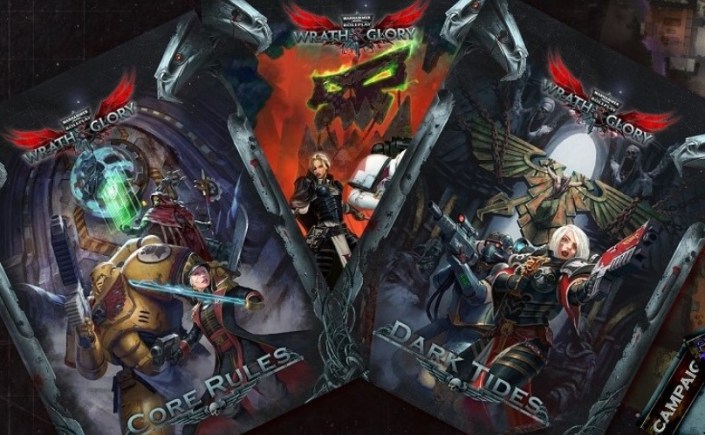
Introduction to Dark Inheritance (A Warhammer 40k Wrath & Glory Campaign)

(This is the 4th of seventeen posts remaining in my 200 for 200 goal. If you enjoy what I do on this blog, please share and get your friends to follow!)

I have obliquely referenced that I am working on a large-scale campaign for the new Warhammer 40k Roleplaying Game, Wrath & Glory, that I have titled Dark Inheritance. The depth and breadth of this campaign have made it the focus of my writing time lately and, while it’s still far from finished, I’m ready to share at least a summary of the campaign (safe for both GMs and players) with you. Here it is:

Campaign Summary

“The year is 12.M42. In the time since the Great Rift, the Rogue Trader captain Eckhardt Gerard Sigismund Immelshelder has operated his ship, the Righteous Obstinance, in a multitude of schemes to generate wealth and power. He is quite secretive, but often whispered about in gossip throughout the Gilead System. Rumors abound that he and his crew have been able to navigate the Warp despite the lack of the Astronomicon’s light, even successfully penetrating the Cicatrix Maleficarum and returning safely. Of course, there is no proof of any of this.

What is known is that Immelshelder has developed significant interests, business and otherwise, throughout the Gilead system. To what end is again the subject of many whispers but little substance. He is the distant relative of a noble family on Gilead Prime and the last of his own family.

One of the players will play the eldest child of the noble family on Gilead related to Immelshelder. The other players’ characters will represent other members of the noble household, retainers, or allies and confidants of the aforementioned noble character. When the campaign begins, the characters are gathered celebrating a reunion–members of the Astra Militarum are home on leave, those friends who have ventured to other planets in the Gilead system have returned to visit Gilead Prime, and the noble household has gathered its closest allies and its honored retainers.

But this party is interrupted by the sudden appearance of Inquisitor Amarkine Dolorosa, who bears strange tidings. Immelshelder and his closest companions have been assassinated. As a friend of Immelshelder and a person of power and stature within the Gilead System, Dolorosa has taken it upon herself to settle the Rogue Trader’s affairs. Therefore, she comes with both gifts and commands. Immelshelder’s will grants the Righteous Obstinance, his Warrant of Trade, and all of his other assets to the eldest child of the noble family. This character had met Immelshelder a handful of times but did not know him well. Dolorosa promises she’ll provide what assistance she can to see the noble scion settles into the life of a Rogue Trader as easily as possible.

In confidence, she explains that she also expects the newly-minted Rogue Trader’s help in finding and bringing Immelshelder’s killers to justice. Even with allies like the other player characters, can the young noble survive being thrown into the shark pool of Gilead politics and the web of allies and enemies that lead to Immelshelder’s demise? If they survive, will they bring Immelshelder’s killers to justice? How many ‘favors’ will Amarkine Dolorosa expect as fair exchange for her assistance?”

Additional Info for the Campaign

Dark Inheritance has been structured into three acts, with each part composed of numerous adventures playable in nearly any order (as the characters pursue various leads and clues to the final revelations and conclusions of each Act and, ultimately, the campaign). At present, I anticipate that each act will require ten or more gaming sessions (of 2 to 3 hours each) to complete.

Also included are subplots that can play out over the course of all three Acts as the GM sees fit (and as make sense given the actions of the characters in various places). It is my intention that the Campaign provide months, if not a year, of Wrath & Glory gaming.

Some Notes on Writing the Campaign (and Microsoft OneNote)

I’m using OneNote (for the first time), to write and organize the campaign. In the past, I’ve used Lone Wolf Development’s Realm Works to organize campaign materials, but I’m finding OneNote to be more intuitive and much more efficient. Yes, Realm Works has additional features and functionality over OneNote specific to the needs of the RPG campaign-writer, but–in all honesty–I’m not going to spend the time to learn all of the details of that functionality. For me, OneNote’s ability to allow me to focus on the writing, with just enough tools for organization and hypertextuality to order everything for maximum efficiency, provides exactly what I need.

I tend to write fiction with what I’m going to call the “accretion approach.” What I mean by this is that I begin with the barest ideas for a story: Dark Inheritance started as a combination of a Rogue Trader-type game with an idea for using a Warhammer voidship to tell haunted-house, sins-of-father type story influenced by games like The Room Series, the old Alone in the Dark games, Darkest Dungeon and numerous other tales (Lovecraft and the gothic horror of Clark Ashton Smith among others) and films (The Skeleton Key comes to mind). From that basis, I begin to add on more ideas and details–some that flow directly from the premise and others that at first seem discordant. After the basics of each new idea are added, I must go through and modify other concepts of the story (characters, plot devices and points, etc.) to account for the new material. Often, ripple effects from these changes beget the next set of ideas that get incorporated, until the basic story begins to take full narrative shape and the details come more and more into focus. OneNote has proved a godsend in as a tool for this approach.

For some fiction writing (particularly the novel I’m working on), I very much like Literature & Latte’s Scrivener program. In some ways, though, OneNote is a stripped down version of this (without functionality such as auto-compiling scenes and chapters, etc.) and I wonder if, for me, a more minimalistic approach might actually be better.

For Dark Inheritance, OneNote allows you to export the “binder” as just that–a PDF of linked pages in a binder sort of format. Unless I find something more efficient than that, Dark Inheritance will eventually appear for the public’s use in such a format.

I am preparing in the new year (as at least Act I becomes fully playable) to playtest the campaign with at least two different groups. If you’d like to help me with playtesting, please send me a message–I could certainly use the help and feedback!


Big Review: Wrath & Glory (Warhammer 40k RPG)

(This is the 2nd of 17 posts leading up to my 200th blog post for my “200 for 200” goal. It’s a long post instead of several short ones to conserve the number and buy myself some time for the goal!)

This review is going to be different from my previous reviews in several key ways: First, I happened to order the “All-In” Pre-Order package for the Wrath & Glory RPG from Ulysses Spiel, so I’ll be reviewing physical products alongside my review of substance. Second, I’ll be sharing some general, probably stream-of-consciousness thoughts about gaming in the 40K universe–some of which will be purely opinion and editorial with little to do with the review proper. Let’s dig in:

Roleplaying in 40k (Come for the War, Stay for the Stuff)

I grew up playing the Warhammer 40k miniatures game. Though I don’t currently play any minis games (having over the past few years played Warhmachine, Infinity and Malifaux) and I don’t really have the patience for 40k’s massive set-up time, I do constantly think about collecting the miniatures again for the joy of kitbashing and painting and finding some minis-rules sets that I liked better to run some narrative skirmish-level games with friends. Of course, there’s now new Necromunda (which I also played and loved in its first incarnation), Kill Team and Warhammer Quest: Blackstone (I spent many hours with the original, fantasy version of Warhammer Quest).

But, over the past ten-to-twelve years, my experience with 40k has been in reading some of the novels and running RPGs. I was so excited for a 40k RPG when Dark Heresy was announced, I immediately pre-ordered the deluxe, leather-bound version of the first edition rules.

This is all predicate to a discussion of my love/hate relationship with 40k. Perhaps there’s some deep-seated resentment of the cost of 40k gaming, but that is not where my angst really lies.

The long-used motto of the 40k universe is (say it with me, kids): “In the dark future of the 41st millenium, there is only war.” Let’s sidestep the fact that the source material has now carried the universe into the 42nd millenium.

My response to that motto has long been, “Come for the war, stay for the stuff.” A dark future of only war makes sense for a wargame, but not so much for a deep roleplaying setting. Without further, this constant, unquestioning conflict doesn’t have the depth I prefer for a roleplaying setting. Fortunately, even before the Dark Heresy RPG, there were some sources of that depth I sought.

I have read only a fraction of the available Warhammer 40k novels. I’ve mostly restricted myself to Sandy Mitchell (Caiphas Cain) and Dan Abnett (having read the Eisenhorn Trilogy, much of Gaunt’s Ghosts and the more recent Magos–which I’ll likely be finishing up today). Both Mitchell and Abnett do an excellent job of writing stories that stand strong on their own accord, even if they’d been written in a different setting, that also bring down some of the over-the-top “grimdark” of the 40k universe into a more relatable and–frankly–far less silly version of itself. They add the “stuff” to the 40k universe necessary to the setting to develop interesting stories for roleplaying.

I’ve started but not finished a number of other 40k books. Most of them, in my humble opinion, belong on the same shelf as Fifty Shades of Grey and Twilight; that is, the “do not read, ever!” shelf. They’re not well-written, have ridiculous plots, and mostly just string together action sequences with little in between to make me care. Abnett (whose non-40k fiction is also worth a read) and Mitchell seem to be the exceptions to the rule.

Since the release of Dark Heresy and its related 40k RPGs (though I never had much use for Only WarBlack Crusade or Deathwatch), much additional setting information conducive to running a satisfying RPG campaign has been produced, thankfully.

Even so, it strikes me that the 40k setting, as typically advertised and as displayed in the majority of the fiction written about it, can’t sustain a roleplaying setting as is. The setting is too over-the-top, too nihilistic for nihilism’s sake, too grimdark. Now, if you’ve read my blog posts or my fiction, you know that I have a preference for the gritty. Too far, though, and the gritty becomes like chewing sand–painful and to no purpose.

To run a successful roleplaying game, the tone of a 40k RPG needs to come down a few pegs. We need to see that the Imperium of Man is not simple a fascist totalitarian regime if you’re going to play characters who feel duty and loyalty to it (in my opinion, at least). You need to see that there is some happiness and good in the universe worth fighting for, or what’s the point? Roleplaying games, like the best fiction, are about creating meaning. If your game universe runs circles around you, skipping about and proclaiming that, “nothing matters, everything is the worst, and you’re all going to go insane and/or die in the next five minutes!” there’s going to be an issue.

Perhaps the upside, though, is that the 40k universe, in needing to be tweaked to work in the roleplaying milieu, invites us to do what we should be doing with all published settings we’re using to run a game: make it our own. Like Mitchell and Abnett, we need to inject some logic, some flickers of goodness and hope, and some depth of character into the setting. That invitation, perhaps buried under piles of lore (being a worldbuilder and writer, I hate the term “fluff”), has the potential to grant us great freedom in using the setting. The flipside of this, of course, is canon-mongers who will exclaim at the gaming table, “that’s not the way it is; on page 47 of Fulgrim it says…” Those players are heretics; I hereby denounce them to the Inquisition.

I’m not likely to run a Call of Cthulhu campaign, as the types of stories that setting tells are generally very limited in scope. But, at least once warp-twisted to our own designs, 40k has the potential to tell stories with the same themes as CoC when desired, while making way for many other types of stories as well.

Scaled back a few pegs from full-bore nihilism, the setting allows us to play games that are tough on characters (without being unfair to them) in line with the setting and theme. I’m a big fan of John Wick’s Play Dirty books; the Warhammer universes (both fantasy and 40k) have provided me with my best experiences in implementing those ideas (in my own way, of course). The rate of character deaths in my Warhammer games is exponentially higher than in other RPGs I run, and a proponderance of those deaths are inflicted on one player character by another. Fortunately–and this is partially because of the themes of the setting–those character deaths have always seemed to be aspects of good writing: meaningful and somehow simultaneously surprising and seemingly inevitable in retrospect. Because of that, the players have not had hard feelings about these events, instead having a sense of profound collective storytelling. For a GM, there’s not much better than players getting that feeling, however achieved.

In short–though it’s certainly too late for that, isn’t it?–the 40k universe provides a very problematic roleplaying setting if used as labeled on the box, but if that difficulty is instead viewed as an invitation to make the setting your own (and the RPG material and the Mitchell/Abnett fiction are the best guides for that), there’s a lot of fun that can be had in 40k.

[Aside: While originally intending to put the linked material in this post, I thought it would be kinder to those not interested to separate out a digression on Christianity and 40k into a separate post. I invite you to read if that’s something that piques your curiousity.]

Updates to Setting (Immediate and Meta)

Wrath & Glory debuts after Games Workshop has implemented some radical changes to the 40k universe. With the (re-)appearance of Roboute Guilliman, the partially successful summoning of the Aeldari god Ynnead (and the changing, undoubtedly for copyright purposes of “Eldar” to “Aeldari,” just as “Imperial Guard” was changed to “Astra Militarum), the breakout of the great Cicatrix Maleficarum dividing the Imperial of Man into the Imperium Sanctus (still within the sight of the Astronomicon) and the Imperium Nihilus (on the other side of the massive warpstorms composing the Cicatrix Maleficarum and thus outside the light of the Astronomicon), the 40k universe is now a drastically different place, with many systems partially or wholly cut off from the rest of the Imperium.

Wrath & Glory does a good job of using this new situation for fullest effect, referring to it as a reason a disparate group of heroes with vastly different backgrounds might be working together. This gives easy permission to roleplaying bands that include an Aeldari corsair and a Primaris Space Marine next to the human characters who may be commissars, Rogue Traders, Inquisitors and the like. In short, it allows a justification for a smorgasbord of characters that would have been difficult to rationalize in earlier incarnations of 40k roleplaying (especially segmented into different game lines: Rogue Trader, Dark Heresy, Only War, etc., etc.).

The “default” setting for Wrath & Glory is the Gilead System, a collection of planets technically within the Imperium Sanctus but cut-off by surrounding warpstorms navigable only along a near-mythical path called the “Straits of Andraste” (now where have I heard that name before?). The Gilead System is designed to have a collection of the Imperial Planet types (Forgeworlds, Agri-Worlds, Shrine Worlds, Hive Words, Forbidden Worlds, etc.) so that each planet type is available without the characters needing access to a Warp-capable starship. Other than this, the Gilead System only has the barebones information given–a few names and factions that might serve as patrons or antagonists to the characters and some high-level story hooks.

This is both a boon and a bane, as it gives a GM great leeway in filling in details–but requires the GM to fill in details. If that’s not something you want to spend your time on, there’s nothing stopping you from setting your campaign before the Cicatrix Maleficarum and using the voluminous materials for the Scintilla area of the galaxy (or other published locations) from previous editions. For that matter, you could simply take that material and update it to the present in-universe time.

The Rules

I very much appreciate the new rules. If you’ve read some of my other writing about RPGs, you’ll know that I’m not so found of percentile systems and quite fond of dice pool systems. Wrath & Glory has moved 40k roleplying from the former to the latter, so from my initial approach I expected a positive reaction to the system. Not so much so that it was guaranteed, but I’ve found that the system is well-written. I’ll hit some of the high points.

Core Mechanics

The dice pool system uses attribute + skill, familiar to most roleplayers and six-sided dice, available everywhere. Certain things, like items, may add bonus dice, but most negative circumstances will adjust the difficulty level rather than the dice pool, allowing for faster logistics in making tests, as GM and player can calculate their respective parts simultaneously. A test must generate a number of icons equal to the difficulty level for the action to succeed. A result on a die of 4 or 5 generates a single icon, while a roll of 6 on a die generates 2 icons. In certain situations, icons in excess of the difficulty level can be “shifted” to achieve additional effects.

As a side note, the rules use the word “dice” for both the singular and the plural. This annoys me greatly. Other than this infelicity of language, the rules are clearly written and easy to understand.

Giving dice the potential to generate 2 icons allows for a much greater range and granularity of difficulty levels than might ordinarily be expected with a dice pool system. While I lack both the coding and mathematical skills to easily run statistics on this arrangement (my favored roll percentage calculator does not have the bandwith to make calculations this complex, apparently), the benefit should be relatively obvious.

Wrath & Glory (& Ruin & Campaign Cards)

Each test uses a single Wrath die (in the case of psyker powers, described below, multiple Wrath dice may be employed). A six on the Wrath die generates a point of Glory for the rolling character (which can be spent on bonus dice, damage and critical hit severity in combat, and seizing the initiative in combat). A roll of “1” on the Wrath die generates a complication to the scene at hand. These effects are independent of the success or failure of the test itself.

Characters also have Wrath points (hence, one supposes, “Wrath & Glory“). Wrath points are gained through good roleplaying, accomplishing objectives and through campaign cards. Wrath is used to re-roll failed dice, restore shock (non-fatal damage), improve Defiance tests (not dying when severely injured) and to make narrative declarations (I very much like this choice, both from a roleplaying design perspective and because it appropriately softens some of the grimdark of the 40k universe).

The GM also has a points pool called “Ruin,” allowing for similar boosts to NPCs.

As an additional side, the Wrath & Glory rules contain a full-page sidebar on failing forward. This, I think, reveals the modern gaming influences on the system design, but also indicates a conscious move away from the pure grimdark of the setting (and perhaps the earlier rulesets) just as the player ability to make “narrative declarations” does.

You may have noticed that I mentioned “campaign cards” a little ways back. A deck of the cards is available for purchase seperately from the rulebook. Each player is supposed to receive one campaign card at the beginnign of each session, which is lost if not used, but use is not required. When played, its effects are immediately resolved. Admittedly, I have not yet spent a lot of time with the campaign cards, but my sense is they are designed to give players a little more agency. Could you play without them? Absolutely, but I’m honestly not sure how much that would change the feel and play of the game. It may not be an extreme change.

Tracking Wrath, Glory, Ruin and Campaign cards (and other available cards) may seem to be a lot of fiddly-bits during play. On the other hand, if you’re comfortable with games like Fate, Cortex Plus/Prime or FFG’s Star Wars/WFRP3 games, you won’t have issues.

Combat

You’ll find many of the combat rules to be familiar territory if you’re a veteran roleplayer. I’m going to just pick out a few highlights.

First, the book explicitly states that there is no set time unit for a combat round, instead specifying that the narrative should inform the length of each round. This is relatively minor, but I think it provides some good insight into the design approach, and I like that.

Second, Initiative is handled quickly and efficiently. Under most circumstances, at the top of the combat round, the players decide which one of their characters will act first. After that character’s turn, a GM character acts, followed by another player character and back and forth until all actions are resolved. Ruin and Glory can be spent by a character to break the normal procedure and act next in a combat. Some circumstances (ambush) may also change this routine. Randomized initiative is offered as an option.

The rules include provisions for “mobs” to handle groups of less-talented foes. In my mind, this is an essential aspect of modern and effective game design.

There are rules to accommodate miniatures but they are not necessary. While I like minis games, I don’t like the drag on play efficiency that minis create in most RPGs.

Like many dice pool combat systems, the active character rolls against a static Defense number to determine whether an attack is successful.

Reloads are abstracted so that bullet-counting is unnecessary. That said, bonuses for “spending” reloads are available, giving players a reason to risk the dramatic position where they are out of ammo. Best of both worlds, in my mind.

Combat has enough variance in choices of actions for tactical complexity, has gritty critical hits, and all your favorite 40k weapons and armor.

Overall, combat appears to be a good compromise between narrative efficiency, gamist tactics, and “realistic” detail.

Psykers

I’m not going to spend much time on Psykers, but I want to point out one or two things. If you’ve played past 40k RPGs, you’ll be familiar with the psychic “disciplines”–biomancy, telepathy, telekinesis, pyrokineses, divination, etc. “Minor” psychic powers available to any Psyker are also available, though some (like “Psyniscience”) seem like they should be innate abilities rather than require a player to choose them as specific powers–the number of which a character may have are relatively limited.

A character using a psyker power must choose the mode of its use, from most conservative to most reckless: Bound, Unbound, Transcendant. The more reckless forms of employment grant extra Wrath dice but also increase the chance of Perils of the Warp–this is exactly what psyker powers should do in my opinion. Further, once you move up the scale, you can’t move back down in the same scene. The genie doesn’t go back in the bottle. Again, this matches the fiction and the feel of the setting.

“Magic” of any type in a roleplaying game is difficult from a design perspective. For a game to feel “balanced” you ideally want your “magical” characters to be somewhat limited in the types of effects that they can use and to have a very real cost to achieving those effects. Fortunately, the setting in 40k matches with this approach; in many fantastic settings the lore is difficult to fairly “balance” mechanically. The implementation here is about the best I’ve seen.

Character Creation

From the GM perspective, the core rulebook offers “Campaign Frameworks.” These are basically campaign hooks with recommendations for tier level, character types, theme and expected content.

Character creation itself is done by point-buy, though “standard arrays” are given for each Tier level to speed the process for those new to the setting or wanting to create a character quickly.

The Tier represents the campaign’s overall power level, both by determining the number of build points players have for their characters and which archetypes are available to them (Psykers require Tier 2, Inquisitors Tier 4, etc.).

Build points are used to purchase an Archetype, attributes, skills, special abilities, wargear, etc. The system is not so complex as Shadowrun, per se, but it does have enough depth to it that I would say you should expect an hour or two for character generation, perhaps more fore those unfamiliar with this or other RPGs.

On the other hand, the point-buy system allows for great flexibility in character creation, which I appreciate. Additionally, unlike previous 40k RPG incarnations, rules for playing Aeldari, Orks and Space Marines (regular and Primaris) are right there from the beginning.

Other Rules

Basic rules for vehicles and voidships are included in the Core Rulebook.

Overall

I’ll have to update this once I’ve been able to run a few sessions (be on the lookout for posts about the Dark Inheritence campaign I’m currently writing and hoping to run soon), but my readthrough leaves me impressed. Modern game design and a more narrative approach that lightens the grimdark just enough meets with a setting I’ve loved for a long time.

Physical Products

IMG_1832.jpg

I pre-ordered the “All-In” package when Ulysses Spiel US announced the opening of pre-orders. The above is the scope of what I received: the core rulebook, battle maps, pre-genned character booklets, the Dark Tides adventure book, the Blessings Unheralded adventure book, the soundtrack CD, acrylic tokens for characters and enemies, dice, a GM screen, themed poker chips for tracking points and six sets of cards (Campaign, Wargear, Psyker Powers, Perils of the Warp, Combat Complications Deck and Wrath Deck). The cards are of the quality I associate with CCGs, like Magic or Doomtown.

The books are bound as is typical for RPG books, with beautiful art and color. One difference enthusiasts will notice right away is that the art is distinctly lacking in “Blanchitsu.” I’m not sure that that’s necessarily a bad thing, especially given that the game design dials back the grimdark a few clicks. But, the art does border on the cartoony.

Everything came in a large box of heavy cardstock:

IMG_1833.jpg

Overall, I’m very pleased with the construction quality of the materials. I’m actually tempted, despite my usual preference for digital books, to spend a good deal of time with the printed materials. That’s a pretty high praise for me.

Conclusion

If you like the 40k universe and want to game in it, I highly recommend the Wrath & Glory game. Again, I’ll update when I’ve had a chance to run and/or play it, but by all accounts I expect a satisfying experience.


RPG Design Journal #1: Choosing a Core Mechanic for Avar Narn RPG

Reader beware: this post is as much me working through design ideas as it is describing design choices. If that’s not interesting to you, but RPGs are, just wait until I’ve posted something more concrete about the Avar Narn RPG’s systems.

I can’t tell you how many times I’ve started work on an RPG ruleset for Avar Narn and then stopped.

Here’s a list of rulesets I’ve used to run games in the Avar Narn setting over the years (as the setting has developed and grown): The Riddle of Steel, D&D, Fate, Cortex Plus, various custom systems.

And here’s a list of systems I find (to varying degrees) influential on my own design approaches: Shadowrun, World of Darkness (particularly nWoD Mage: The Awakening), Dogs in the Vineyard, Fate, Cortex Plus/Prime, TRoS, Warhammer Fantasy, Apocalypse World, Barbarians of Lemuria, Artesia: Adventures in the Known World, Shadows of Esteren, The One Ring, Stoltze’s One-Roll Engine (and particularly Reign), John Wick (especially Houses of the Blooded), Blades in the Dark, Fantasy Dice, GUMSHOE, FFGs system for Star Wars and WFRP3e, Burning Wheel and Torchbearer. Yes, that’s a lot of varied designs with some ideas that are incompatible with others.

Having mostly cut my teeth on dice pool systems, that’s my typical starting place. I’ve read a fair bit on game design and, this time I’ve decided to start at the very beginning, without preference for a core mechanic. Here are some links to give you some background on things I’ve been thinking about as I do this:

“How Do I Choose My Dice Mechanic”
“All RPGs Are FUDGE” (while I see a little more significance to the variation between systems than this author, the point that statistical variations in the most-frequently-employed core mechanics are not as significant as we might think seems pretty sound)
“Design Patterns of Successful Roleplaying Games”
The Kobold Series on Game Design
Robin Law’s Hamlet’s Hit Points and John Wick’s Play Dirty (although these are more about running games than designing them)

I’ve spent a lot of time trying to analyze the statistical differences between core mechanics (though math is not my strong suit, and particularly when it comes to complex probability equations) only to come down with a bad case of analysis paralysis.

Here’s what my recent reading (and experience) has led me to conclude:

(1) When the rules serve their purpose well, it’s the story that gets remembered, not the results of dice throws.
(2) The actual statistics of a core mechanic are less important than the way we perceive them–the way (our view of) the dice mechanic reinforces (or undercuts) the feel of the game and setting is what matters.
(3) The most interesting thing about a core mechanic is how it can be manipulated with interesting rules that are intuitive and yet reinforce setting ideas. Thus, a core mechanic should be selected more with an eye to what it can do for subsystems and design goals than its own merit.

Here are some of my analytical conclusions so far:

(1) Efficiency is paramount. The more you can resolve with a single die roll the better. Dice pools are often faster in use than roll and add/subtract systems because counting successes is easier than addition. Is it easier enough to force a design change? No.

(2) Inspired by the FFG custom-dice game: if a single roll can give you both the main pass/fail and degree of success information and give you cues for scene complications or opportunities, so much the better. The One-Roll Engine is also good at this. Additionally, checking the dice for multiple conditions should be simplified as much as possible so that this feature does not carry with it too hard a hit on efficiency.

(3) For a gritty setting like Avar Narn, a bell-curve or Gaussian distribution makes sense for three reasons: (a) extreme results are made more rare for a more “realistic” feel, (b) character stats are more significant in a bell-curve distribution than a linear distribution, and (c) along with (a), these distributions give more predictability to players as to results, which is important in a game where consequences of actions (including but not limited to lethality) are severe. The binomial distribution of dice-pool systems aren’t so far off as to be ruled out by this, but do not fit as well as a multiple-dice roll-and-add system.

(4) Along with a bell-curve or similar statistical distribution, the “bounded accuracy” of the latest iteration of D&D helps create expectations reliable enough for players to reasonably predict the results of courses of action.

(5) Combat requires a delicate balance–it must be fast, but it must also grant enough tactical depth to be interesting for its own sake. Additionally, it must be intuitive enough that advanced lessons in martial arts are not necessary to use the system to its fullest. One of the ways to make combat quick is to make it deadly, but combat that is too deadly is not fun for players. This is exacerbated if (1) the game intends deep and serious character development, (2) the “adventuring pace” means that injured characters must take a back seat for an extended period, or (3) character creation is time-consuming and/or complex. I’ve got a number of ideas for streamlining combat, but that’s for another time.

(6) Rules principles that can be applied to many different scenarios are far better than complex rulesets. Fate and Cortex are the best at this, in my opinion.

So what does all of this mean for Avar Narn RPG? Despite my love for dice-pool systems, I’ve currently leaning toward a 3d6 system, or perhaps even the use of Fudge/Fate dice. The 3d6 is more accessible for newbies into RPGs, but it’s probably more realistic to expect this to be a niche game. And, to be honest, I’d rather have a dedicated group that loves the system and setting than having to try to cater to a large base with very diverse expectations–especially for a first “published” (read: publicly available) system.

My apologies if you were expecting a solid answer on the core mechanic in this post! Right now, my action items in making a final decision are as follows: (1) determine the subsystems the game will need/benefit from, (2) play around with manipulation rules for various core mechanics, (3) find the core mechanic that checks off the most boxes.

Thoughts from those of you who have tried your hand at RPG design?

Review: Warhammer Fantasy Roleplay, Fourth Edition

Warhammer Fantasy Roleplay, First Edition, was the first fantasy roleplaying game I ever owned. It was the early nineties, and like all good Christian parents, mine denied me access to Dungeons & Dragons, fallout and carry over from the demonic-worship craze of the late eighties. As we all know, but I didn’t question as a child, there was nothing inherently demonic or evil in D&D (the opposite mostly, though one of Tom Hanks’ early films told a different story). But, not knowing better, they allowed me this gem of a game, darker, grittier, and far less wholesome than the high-fantasy cheese of AD&D.

Ownership of this vaunted tome (which I lost or gave away or sold somewhere along the way, much to my present chagrin) had a very formative effect on me. It solidified my love of roleplaying games, proved the gateway into my miniature gaming hobby, and gave me my first real taste of dark fantasy (a penchant I cannot shake even now). As someone, even in elementary school, deeply interested in medieval and early modern history and wanting some semblance of verisimilitude in my roleplay, it’s little wonder that WFRP, warts and all–no, warts especially–has a special place in my heart. Before high school, I’d also purchased several of the Rolemaster FRP books so, though I didn’t know it, 80’s “realism” in RPGs became my foundation.

I never ran or played a game of First Edition WFRP, though I did manage to collect most of the books at one point or another. When Second Edition was released (I was now in college), I scrupulously and slavishly purchased each of the books as it was released and ran a few games with those rules (though I admittedly used the Riddle of Steel rules, released close in proximity, for those Warhammer Fantasy-based games I most enjoyed). My miniature gaming had focused mostly on 40K, but something about the Tolkien pastiche smashed up with a more historically-influenced setting always called me back to WFRP in my gaming (of course, the first edition of Dark Heresy had not yet been hinted at even–though that’s a story for when I review Wrath & Glory, I suppose).

Likewise, when FFG published the third edition of WFRP, I couldn’t help but go all in on that system as well. For all of the quirks and fiddly-bits of the 3rd edition (much of which I found very innovative and fascinating from a design standpoint), I ran some of the most narratively deep scenes based on those strange custom dice. The board-game like pieces really did provide some opportunities for building unique subsystems to support the story, from chases to countdown clocks. The “stances” adapted just enough from Riddle of Steel (which remains one of my favorites for three reasons: (1) at the time of its release, I was a study group leader for the Association for Renaissance Martial Arts and deeply invested in the study of real swordplay; (2) the writer of TRoS was also a member of ARMA, one with whom I’d had the fortune to spar with; (3) there are design ideas, like spiritual attributes, that I still find amazing, even if I now find the combat system too intricate for my gaming needs and desires) to sate my desired treatment of combat at the time.

I don’t want to participate in “you-should-have-been-there”-ism too much, but I will relate one fascinating development in one of the WFRP games I ran. When the PCs stumbled across some warpstone, one of the characters decided to squirrel some away to sell later. As it tends to do, the warpstone started to have an effect on this character, and a fellow PC (a staunch and suspicious Kislevite), discovered this. While the first character slept soundly, the Kislevite snuck up on him and, pressing the barrel of a pistol to the first character, ended the foolish threat to the party. What surprised and pleased me was the response of the murdered character’s player: “Yeah, that’s what you should of done. That was not going to go well.” That’s mature roleplaying from dedicated players. Drama!

I should also note that, perhaps the result of my fumbling with Rolemaster, I’ve never been a huge fan of d100/Percentile RPG systems. I fully admit that this is a personal thing and not some objective complaint about that style of system itself (my preference, almost certainly a side-effect of my playing White Wolf games, Shadowrun and TRoS, is for dice pool systems).

When I heard that Cubicle 7 had the contract for Warhammer Fantasy Roleplay, Fourth Edition, two things excited me: first, I’ve found the One Ring to be both the most faithful RPG version of Tolkien’s world yet and mechanically innovative to boot; and, second, I’d hoped that the new ruleset would veer away from the d100 system used in the past (as Wrath & Glory has done). One of those things proved true.

Perhaps the best compliment I can give WFRP4 is that it’s a percentile system I’d actually consider running. Even with my preference for the Fate or Cortex Plus/Prime systems, this ruleset reinforces the grittiness and darkness of the setting in what I feel merits the additional crunch. Reading the rulebook has also reminded me that, second only perhaps to D&D/OSR rules, how much material there is out there that could be easily adapted for subsystems or alternative/house rules for WFRP4. I’ve found myself very interested in some of the things that the Mythras system has done with d100, and then there’s all of the Chaosium, Runequest, Zweihander (particularly appropriate) and Rolemaster stuff out there as well.

My personal confession to the versatility and playability of percentile RPGs is not the point of this post, however. Let me instead focus on the (many) things that I really enjoyed about this system, especially as an iteration of the first and second editions (which I’ll assume you’re familiar with).

First, the art is beautiful. Andy Hepworth and Jon Hodgson, who worked on The One Ring illustrations also worked on this tome, and the artwork is similar to that of TOR: watercolory, somber and evocative of the setting’s tone. As I said in my Witcher RPG review, the artwork itself is almost worth the price of admission–but I’m a very visual person.

Additionally, in the style you’ll remember from the FFG version of the game, much of the setting information is given in-character through letters and reports. The beginning of the book combines pictures with a skillful economy of words to highlight the Empire, giving just enough detail for even a newbie to the setting to run a session that a seasoned veteran would say, “Yep, that feels like Warhammer.” I just love this.

I’ve gotten ahead of myself, though. I really should have led with the thing that I love most about WFPR4–its transparency that the players and GM should make the setting their own personal version of the Warhammer Fantasy world, supplemented with reminders about this throughout the text on the subjects of both mechanics and setting, and supported by optional rules and reminders that rules that don’t fit your game should be ignored or changed.

Let’s talk about some of the changes to the previous incarnations (of course skipping the outlier that was 3rd Edition). Fourth Edition has “softened” character generation and brought it into the world of “modern” gaming. Where the early editions of the game relied entirely on random generation of player characters (yeah, everyone wants to be a Ratcatcher, but no one wants to play the poxy doxy), the latest edition has kept the random generation tables but has given rewards to sticking to them rather than making them mandatory. For instance, for your starting career, you first roll one result. If you take that result, you get a substantial XP bonus you can either hoard or spend on starting upgrades to your character. Didn’t like that result? You roll two more, and if you pick one of the three, you still get an XP bonus (though not as substantial as when you only had the one option). Don’t like any of the three results? Just choose what you want to play. No XP bonus, sure, but at least you’re playing something you find interesting. This goes for most aspects of character generation.

Above, I mentioned the Spiritual Attributes of The Riddle of Steel RPG. While WFRP4 doesn’t use those per se, it does join the forefront of modern player-driven (narrative) gaming by giving both the individual players and the group as a whole ambitions. Ambitions are short- and long-term goals that, when completed, grant XP for character improvement (in addition to the normal XP of session survival and accomplishment). Like 13th Age’s “One Unique Thing” or Milestones in Fate, they give the GM some guidance on what players are interested in dealing with in the narrative of their game.

As well, ambitions are a call-to-action for players to learn about the game world (so that they can craft good ambitions) and help define those elusive both most-important aspects of character–character itself (as in the inner life, personality, beliefs and psychology of a fictional entity beyond the mechanical numbers on the page).

My other favorite new thing in Fourth Edition? The “Between Adventures” chapter. These optional rules recall the “township events” of Warhammer Quest (God that we would get an updated version closer to the original instead of the bastard “End Times” game that was produced–oops, my rabid fanboy is showing). I spent a good deal of my youth (when I was but had not realized that I was an introvert) playing that game. In WFRP4, the Between Adventures chapter gives the players interesting complications that might arise while not in the wilderness fighting orcs or Chaos as well as endeavors that might be undertaken to gain small–but perhaps lifesaving–advantages during the next adventure. It’s a clever way to provide for some roleplaying opportunity and character development without having to devote large amounts of playtime to characterization–though if that’s what your group wants, there’s no reason you can’t do that, either!

Much of the rest of the rules will prove familiar to the player of the first or second editions–nasty critical hits, rules for corruption and disease, limited magic, careers that range from the extraordinary to the ultra-mundane (if historically accurate), Skills and Talents, etc.

Petty magic is back for those who missed it (I did). Each Career now has four tiers of advancement, so the Apprentice Apothecary and the Master Apothecary are within the same write-up instead of spread across four different careers that represent incremental steps in the same line of work and training. Character social status (as within the Bronze, Silver and Gold tiers of society) is more explicitly treated and made relevant to gameplay. Task difficulty has been more effectively balanced (Very easy tasks are now +60 to Attribute+Skill Ranks) given the relatively low attribute and skill values of starting characters. Advancement, XP and skill ranks have been streamlined in a way I find to be an improvement.

First and second edition adventure material should require little or no adaptation to be usable, and previous mechanics or careers will be relatively easy to adapt.

In short (though perhaps it’s too late for that), if you liked the first and second editions of WFRP, you’re very likely to enjoy Cubicle 7’s take. If you didn’t, I’d take a look anyway.

The main competitor for WFRP4, I think, is the indy-game Zweihander (itself an iteration of WFRP2), though Shadow of the Demon Lord may be a better fit for those who want a game closer to classic D&D but heavily influenced by modern gaming mechanics and the approach and feel of Warhammer (the creator, Robert J. Schwalb, worked on WFPR2 among other things).

The release of the book has very much tempted me to return to the Empire circa 2511. If I do, I’ll probably even use this ruleset rather than trying to adapt to a more narrative-focused system, as WFRP4 seems a decent compromise between massive crunch (which I ideologically though not practically miss) and the narrative-focused games to which I’ve become more focused.

Have you had a chance to read through the book? What did you think?

Blog Update

I completely missed posting last week and haven’t posted anything this week. This post is not going to be as substantive as usual, unfortunately (I’ll try to get a substantive post up over the weekend!), but I wanted to let my readers know what’s going on and what to expect in the near future.

NaNoWriMo is not a go.
Last November, I made very good progress on the first draft of my first novel set in Avar Narn by participating in NaNoWriMo (National Novel Writing Month). I had hoped to participate again this year to get the first draft finished. Unfortunately–at this point–I’ve made the decision not to participate this year.

K and I are still waiting on a placement of kiddos, which could happen at any moment now but (obviously) hasn’t happened yet. I’m concerned that, as November nears, I’ll need to be focusing more of my time on the kids when they arrive. As much as I’m yearning to get the first draft (and then revisions) done on this novel, it simply must take a back seat to the children and their needs.

Additionally, K and I are purchasing a house and will be closing and moving around November. K’s got a lot going on with her worklife right now and into the near future, so I intend to take on the better part of the moving efforts.

That doesn’t leave much room in my schedule to try to fit in 1667 words a day in November, so I’ve decided to give myself a little break on that front.

This does not mean I won’t be writing–just probably not as intensely as I would be if participating in NaNoWriMo. I’ve been spending time working on (and reworking) some of the setting information for Avar Narn (mythology, legends and history, religion, geography, etc.) that will be the basis for (hopefully) many short stories and novels in the future. Expect some posts related to this “background” information.

I’ve got one Avarian short story currently underway (though I’m not sure I’ll end up happy enough with it that it will get posted) and plotting in the works for at least half-a-dozen more. I have more plotting to do for the rest of the novel (and some changes in the part that’s already written, which I’ve been slowly working through) and I hope to get some writing done towards the novel in the near future.

I had said not long ago that I’d be working on some sci-fi short stories (and a few are in their infancy), but Avar Narn is my truest passion and that’s where I’ve decided to really focus.

On Publishing
I’ve been thinking a good bit about how to approach publishing some of my work. That’s a daunting set of decisions, and I’m not fully decided, but I am currently leaning toward some form of self-publishing. While I’d love to have a large readership, I’d rather follow some advice from Joss Whedon. On talking about making TV shows, he reportedly said (and I’m paraphrasing), “I’d rather make something that a few people have to watch than something that a lot of people want to watch.”

For me, the major issue (other than perseverance through mountains of rejection letters, which I could live with) is control over my projects, staying true to the story for its sake rather than caving to market demands, and taking things in the direction I want them to go. This likely means a smaller audience and less money (to the extent that there will ever be any money in my writing, which is not a guarantee) but more personal freedom. It is a quirk of my personality to prioritize my independence and doing things my way over most other advantages–for better or for worse.

This may merit a full post, and I’d love to hear the thoughts of any readers who are themselves published (I know there are a few of you out there!).

On Theology
One of the reasons I failed to get a post out last week is that I’ve recently been teaching for a Sunday school class at the church. I love to teach and its an honor to have been asked to teach by people I so deeply respect and admire. We did two weekends on the history and polity issues confronting the United Methodist Church relating to our position on homosexuality (and the LGBTQI community in general) and are now doing two weekends on the Trinity.

There are certainly some posts in the works based on this research and some other reading/studying I’ve done recently. I’ll of course have a post on the Trinity in the near future (and why it’s such an amazing aspect of orthodox Christiany faith), but I’ve also got some ideas kicking around about theories of salvation, about William of Ockham and his theology, about (modern) Gnosticism and more.

On Reviews
I’ve finished a few Great Courses on medieval history recently and I’m currently in the midst of one on Imperial China (which, as K will attest, has really gotten me geeking out a fair deal, though perhaps no more than usual). I may do some reviews on these sometime soon.

I’m also working through a few theology books which I may have some comments on.

There are a number of video games either recently out or that will be out in the next few months that I’d, one, like to play, and, two, like to share some thoughts about. The Pathfinder: Kingmaker isometric game just released; it both takes me to an RPG setting and ruleset that’s always interested me (though that I’ve found far too complex and, ultimately, flawed to play on the tabletop) and to the isometric RPGs of the 90’s that were the mother’s milk of my early (digital) gaming life. The last installment of the recent Tomb Raider trilogy is also out and I’m definitely interested in following up on the first two very-well-done games of that series.

Of course, Red Dead Redemption 2 and Call of Cthulhu will be out soon, both of which I’m excited about. I was in law school about the time the first Red Dead Redemption came out, and I distinctly remember sitting with a judge in his late-sixties or early-seventies at lunch during a summer internship as he ranted about how great the game was. He wasn’t wrong.

On Roleplaying Games
As those of you who are interested in such things may have noticed, most of my recent posts on the truest-and-highest art of gaming–the tabletop RPG–have been about the Cortex Plus/Prime system. I’ll be continuing to post about my Shadowrun conversion for those rules.

I have always dreamed of an RPG to go along with Avar Narn. I’ve run several games set in the world over the years (using rulesets as diverse as The Riddle of Steel, Cortex, Fate, and D&D), but my ultimate desire is to build a roleplaying game specifically designed for the unique nature of the world (said every RPG designer with a pet setting ever, I know). While I love “generic” roleplaying games like Fate and Cortex for a wide variety of play, I am also a believer that systems specifically designed for particular settings are usually better, because the mechanics can reinforce the setting and vice-versa.

One of the most annoying things I see in D&D is the assumption by some players that the rules of D&D are the immutable physics of any setting using that ruleset rather than the rules serving the setting (and being subordinate to both normal and narrative logic).

Both Fate and Cortex intend to be rulesets that bridge the gap between the completely generic ruleset and the one-setting ruleset by using modularity and a toolbox approach that encourages customization. But even this, I think, will not be sufficient for my purposes.

I see games like The One Ring with mechanics that really bring forward the themes and motif of the game as a whole–not to mention indy games like Dogs in the Vineyard, Houses of the Blooded and Torchbearer that really push the envelope of rules for narrative games or RPGs (however you parse those two out)–and I am inspired. We’ll see what comes of it, so expect posts as I struggle through issues of design and ask for feedback (and, hopefully, some eventual assistance with playtesting).

I had mentioned a ways back that I was working on a massive campaign set in the Warhammer 40k universe. That is on a backburner, to be sure, but still in the pipeline.

I’d like to do some review of the newer Warhammer Fantasy and 40K rulesets in the future as well.

Reader Involvement
In case it isn’t apparent, thinking critically and imaginatively and then writing about those thoughts. Maybe it’s a disease–I’m just not happy if I’m not doing it, and I find a lot of fulfilment just from writing and from posting here.

But that doesn’t mean I don’t want to know that people find some usefulness in what I write! I’d love to have more comments, requests for topics, questions to follow up on from posts and more reader involvement in general! Drop me a line, even if it’s just to tell me what you think of the blog in general–or if you think there’s something I could improve on. And invite your friends!

Conclusion
Well, that’s a long list of things I’d like to do, perhaps more than can reasonably be accomplished. But it seems worth trying to do anyway, so we’ll see what comes of it.