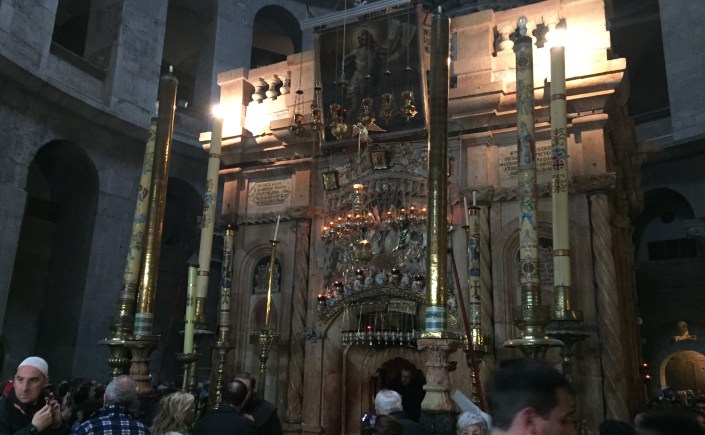
Pilgrimage, Day 6: All Jesus All the Time

For the previous entry, click here.

We spent the majority of the day today in Capernaum and on Mt. Arbel. I’m not able to express my feelings about these experiences in words just yet, so I’ll share some of my thoughts instead.

Capernaum was Jesus’s “home base” during his ministry. The town sits on the northwest side of the Sea of Galilee (a glorified lake, really), firmly within Jewish territory but not too far from Gentile settlements. It makes great practical sense–Capernaum lies near the international trade routes and near many of the other major settlements of Galilee. Even more, archeology indicates that Capernaum was a manufacturing center for grain and olive oil–meaning that people from all the smaller villages nearby likely came to the town with their raw materials, allowing Jesus’s ministry to reach farther more efficiently.

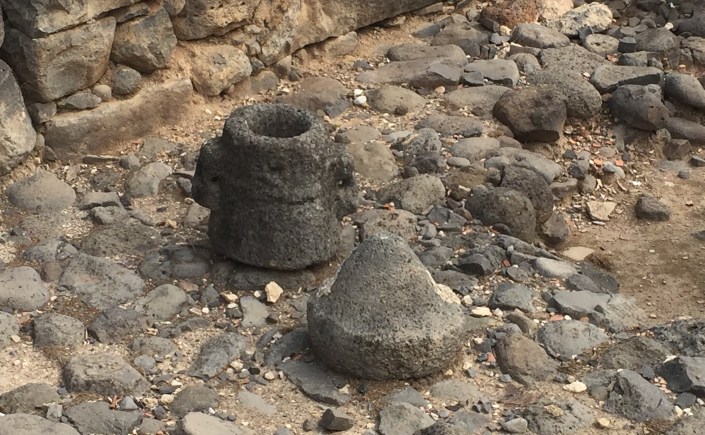
There were other realizations today. Prime among them, which has been building since we got here, is just how poor my mental imagery of Biblical scenes had been–the imaginative equivalent of a painted-craft-paper background in an elementary school play. This land is diverse in form and terrain, beautiful and full of life (both plant and animal). More than this, I’m starting to realize just how visual Jesus’s mode of speaking and teaching is. It’s axiomatic to say that Jesus spoke in parables that would make sense to the disciples, but it’s another thing altogether to say that Jesus had the objects he used in his analogies before him at the time he spoke the parables. This makes good pedagogic sense as he’s attempting to use the mundane to explain the complex and supernal. When you see a donkey mill–the kind of mill often used for milling grain in 1st Century Israel–and know that the device was so common that there was almost certainly one in front the disciples when Jesus says that it would be better to tie a millstone to your neck and throw yourself into the ocean (the Sea of Galilee, too, is likely in view at the time, a wholly different and more complete understanding comes into focus.

As Dr. Beck argues in his books and on this trip–very rightly so, I think–Jesus made great use of geography and the things that could be seen at the locations where he gave particular lessons and made particular statements.

This takes us to Mt. Arbel, the likeliest location for the Sermon on the Mount and the Great Commission. Rather than rehashing, I’ll refer you again to Dr. Beck’s books for the full laying-out of the argument. But, sitting on the mountain, going through the Sermon on the Mount, listening to Jack’s explanation, I could not help but be moved. Until today, I had not had the visceral emotional response to being were Jesus walked and taught that I had hoped to have. Today, though, things became real at a very fundamental level. There’s something about putting Jesus’s words into geographical and visual context that makes them feel more embodied (and therefore more “real” and relatable) and at the same time more spiritually profound.

I’m also realizing just how perfect the place and time of the Incarnation was. As I mentioned in previous posts, the Roman Empire makes a perfect example for the kind of craving for wealth, power and dominance that Jesus argues against. That Israel represents the great international route between the Middle East and Egypt by land and is linked to Europe and the rest of Africa by sea, means the message has a way to reach the world. The place itself and its history provides the context for a revelation that directly addresses the people of the place and yet remains universal in applicability.

For me, especially, with my heavy philosophical bent, this journey is really convicting me of the embodied, present and concrete nature of Jesus’s life teachings, and Passion. When we arrived, we were told that, like Abram, God has called us to Israel, that there is something for God to reveal to each of us here. This confrontation with the Incarnation as something no longer abstract and far away in time and place may be just the thing God brought me here to show me. It’s certainly something I needed, even if I didn’t know that I needed it.

For the next entry, click here.

Pilgrimage, Day 5: The Modern and the Ancient

For the previous entry, click here.

I’m trying to get a jump on posting for the day instead of, as I’ve done the past few days, waiting until the last moment. It’s about 4:00 p.m. local and, having finished our touring day (since the winter hours for Israeli national sites has them close at four), we are on the bus back to the Sea of Galilee.

As I mentioned yesterday, we spent today in the Golan Heights. We heard sporadic artillery fire, all of which came from an Israeli tank proving ground close to our first visited site. Burnt-out tank hulks left from the six-day war occasionally cropped up in the otherwise beautiful scenery. We spent about 10 minutes driving behind an IDF humvee with a remote-controlled turret boasting a 50-cal machinegun and a TOW missile launcher. Overhead were the vapor trails of fighter jets penetrating just into Syrian airspace just before hitting their afterburners back to sovereign skies. At least once, we passed a barbed wire fence warning of unexploded mines on the other side. Still, there was never a concern for safety, just an ever-present reminder of the frailty of human nature and the conflict that results from such weakness.

The closest we came to the actual border was on the (dormant) cinder cone of the volcano, Mt. Bental, where we surveyed the land while standing next to two U.N. observers tasked with keeping watch over the “no man’s land” that starts a scant few miles from the base of the mountain and its nearby twin. Just across the border, about due east, lay the ruins of Quneitra, destroyed in the Yom Kippur War. Just north of that, the town of New Quneitra, where the inhabits rebuilt after being unable to salvage the ruins. Damascus lay just outside of view, thirty-seven miles to the Northeast. It was a strange feeling to be so close to such tragedy and unable to do a damn thing about it.

Mount Bental was our second stop today. Our first was Gamla or Gamala (the “Camel”), a humpbacked hill set deep in a canyon to the northeast of the Sea of Galilee that had been heavily fortified by the Sicarii (sometimes called “Zealots”) who probably had many commonalities of thought with the Nazarenes. The whole thing quickly reminded me of the Rebel Alliances’s base on Hoth, a fortification from which to strike out at the (Roman) Empire during the 66 C.E. revolt. In 67, Agrippa II failed for seven months to take the fortress and kill its inhabitants. Vespasian then arrived with three legions and built ballistae to fire 1300 stone balls and 1600 arrows into the fortress. This caused a breach, but the Romans suffered heavy casualties in the close quarters combat that ensued, with the defenders going so far as to topple interior walls onto the invaders, forcing a general retreat. A second assault was successful, with tradition holding that the core survivors fled to the citadel at the top of the hill to cast off their wives and daughters before jumping off themselves. A northern Masada.

Josephus says that the Romans killed 10,000 at Gamla. I find that highly suspect, based on the size of the settlement (at least as is currently visible) and the poor likelihood that a defending force of that size (1) would have been able to withstand siege for seven months without running out of supplies and (2) would have chosen to turtle up in their fortress and allow the Romans to seize the initiative when they had superior numbers and knowledge of the terrain.

Our interest was in the first-century synagogue in Gamla, the lower architecture of which is relatively well-preserved. It is highly probable that Jesus taught their during his Galilean ministry. The trek down the ravine to the fortress (and back up!) was exhausting but worth it.

After Bental, we first visited Caesarea Philippi and then Dan. At Caesarea Philippi, the Romans built a temple to Pan inside an artificial cave in which sprang one part of the headwaters of the Jordan river–a cave that was often thought of as a gateway to hell. A temple to the genius of Augustus Ceasar was also erected. At Dan, the King of Israel Jeroboam had an altar built and a golden calf idol placed so that his people would not have to travel south to the Temple in Jerusalem in the Kingdom of Judah to worship (and be tempted to defect).

It was between these two places that Jesus brought the disciples when he asked them “Who is it that people say that I am?” Behind him, Mt. Hermon, the only “real” mountain in Israel and thus the likeliest spot meant by Matthew when he describes Satan taking Jesus to the mountain to show him the splendor of nations and to offer them to him. Mt. Herom overshadows the ancient international highway, where the caravans of goods from the various nations would have represented their splendor without any miraculous or “magical| move on Satan’s part. When (soon after answering that Jesus is the “the Anointed One, Son of the Living God”) Peter tells Jesus that he cannot go to Jerusalem to die, Jesus responds “Get behind me, Satan!” just as he had previously told (actual) Satan.

Additionally, Caesarea Philippi represented the waywardness of Roman paganism while Dan represented the errancy of the Kingdom of Israel in falling away from worship of Yahweh (and the Canaanite paganism with its idols as well). It was a perfect–if unexpected–placed to pose the question of identity and capability to the disciples. Satan, death, Hell, the Empire, paganism–all were present to view the declaration.

The ideas above came either from our wonderful guide, Jack Beck (I suggest reading his books and watching his documentaries) , or from some of the Methodist pastors with whom I’m traveling.

To conclude, I’ll give you an idea of my own. You have likely heard the comparison and juxtaposition of the Caesars as divine figures with Jesus as the Son of God. Let’s nuance that a little more: the Romans didn’t actually worship the Emperor; they worshipped the genius of the Emperor. This is a little hard to explain, and a scholar of Imperial Rome would do it far better than I, but let’s give it a shot, shall we?

The Romans believed in numen, something akin to the Hawai’ian idea of “mana.” Spiritual power infused things to different degrees, from the small gods of the household and the spirits of ancestors to the greater gods of the state pantheon. The genius of the Emperor, then, was the numinous or divine power behind and within the Emperor. This may have become one in essence with the personality of the Emperor upon death, but during life the Emperor himself and the Emperor’s genius were related–closely–but distinct. The Roman Emperor has a divine force within him but is not divine in essence.

Contrast that with the orthodox Christian doctrine of the nature of Jesus Christ–both fully human and fully divine, with those aspects inseparable from one another, the perfect union of humanity and divinity in the same (consubstantial) essence. While I’m not sure that this comparison addresses anything not already spoken to by the volumes of theology already written, it does provide a sort of bridge into discussion of the nature of Christ by way of comparison. Clearly, I’m still very much focused on the sharp contrast between the Roman as a representation of the faulty ideas the culture of the world gives us and the spiritual truth that Jesus speaks, and does, and is.

For the next entry, click here.

Pilgrimage, Day 4: First Revelations

For the previous entry, click here.

Today started at 5:30 a.m., as we scrambled to get our bags packed, eat breakfast and portage said bags out of the Jaffa Gate and down to the bus to leave before 7. Uncharacteristically for me, it’s about 11:00 p.m. local as I write this. Something about the combination of this place and the fellowship of those journeying with me has given me more energy than I typically have.

Our day started with a whirlwind trip through Ceasarea Maritima and its aqueduct, then to Muhraqa Carmelite Monastery (for its position on Mt. Carmel near where Elijah confronted the priests of Baal), to Tel Megiddo, to Nazareth (particularly Mt. Precipice, where the photo above was taken. Er–the photo that would be above if the internet would allow me to upload it) to our hotel on the eastern (formerly Gentile) side of the Sea of Galilee.

In case it wasn’t apparent, the day was packed, with over six miles walked and at least five hours in the bus.

I have much to say about the day’s experiences, but I’ll focus on one idea in particular and leave the rest to germinate further.

Consider on the one hand Caesarea Maritima, a piece of Rome in the Middle East created at the command of Herod the Great, lover of all things Roman as well as power and luxury. And perhaps genius builder. Herod wanted to have a palace (complete with swimming pool) that appeared to float on the sea. He also wanted to create an artificial harbor (reportedly larger than the Athens harbor) on the dangerously shallow coast line where Strato’s Tower had stood.

This required an unprecedented use of hydraulic cement–that is, cement that will set even underwater. The Romans had invented the stuff and used it to build bases for piers and other small-scale projects, but Herod used it both to lay the foundation of his palace and breakwaters for the harbor. The site had no potable water, so Herod built a Roman-style aqueduct to bring water in from thirteen miles away.

Not to be without the finer elements of Roman culture, Ceasarea Maritima boasts a large ampitheatre and a chariot stadium that could have fit 20,000 people. Unwilling to have the same beige limestone look as Jerusalem, marble and granite were imported by sea to create columns, statutes and sheathing for those facades that were not plastered and covered with frescos. Intricate mosaic tilework covered the floors of many buildings and homes, which had indoor heating through the innovative Roman technology for underfloor steamworks and used the tides to sweep latrine waste out to sea twice a day. The remnants of clay pipes providing running water remain evident.

The city must have passed the test, because Pontius Pilate lived in Herod’s Palace there as much as he could (when business did not call him to Jerusalem), as did later provincial overlords. Caesarea Maritima boasted trade (at least for the import of luxury items), the latest in first century CE technologies, and art and architecture worthy of the Empire.

On the other hand, consider Nazareth. If, as I was before today, you’re not familiar with the geography, here’s what you need to know: Though an urban sprawl today, Nazareth was a tiny village in the first century, perhaps a dozen homes and just enough land cleared for subsistence farming. Those homes–they were mostly caves, perhaps expanded for a little extra comfort, but caves nonetheless. These dozen or so cave-homes occupied an elevated bowl shape surrounded on all sides by rugged mountain terrain. Until the Israelis literally (I assure you that the word is being used correctly) cut through the mountainside to build a road, there was no easy way to get to Nazareth. Pick the spot you think will be easiest to climb, and set aside several hours to do it.

This is probably exactly how the people of Nazareth liked it. Given their proximity to the ultra-fertile Jezreel Valley below and the numerous nearby settlements (Nain and Shunem, to name two) where they could have lived, this village’s isolation must have been highly intentional. A handful of Jewish families willing to scratch out an independent living to practice the faith of their forefathers and to avoid contamination by the Greco-Roman culture seducing their many peers. The kind of place our dear President would likely call a “shithole.”

When Jesus uses Rome as an example of the often-corrupting influences of wealth, status and power, he can point to Caesarea Maritima (named for Augustus Caesar) on the coast as a very concrete example of his meaning. At the same time, the King of Kings himself hailed from the unlikeliest and humblest of origins–a dirt-poor and poorly-regarded settlement of religiously-fanatic survivalists. The juxtaposition of these two real, geographically significant places brings sharply into focus the tension between those seductive but ultimately unfulfilling vanities with the extent to which God proved willing to condescend to be present with us in the world. Two very different ideologies (and here I mean God’s in choosing to use Nazareth, not the Nazarene peoples’s own ideas) placed in such close proximity in the same land.

Let it sink in.

Tomorrow, we’ll spend much of the day in the Golan Heights, visiting a first-century synagogue where Jesus almost undoubtedly preached, the village of Dan in the far north of the country near the borders with Lebanon and Syria (if the weather is clear enough, it might be possible to see Damascus from there) and Caesarea Philippi. It’s hard to think that on this pilgrimage we’ll be so close to the continuing devastation and heartache of the Syrian civil war.

For the next entry, click here.

Pilgrimage, Day 3

For the previous entry, click here.

Today has been a long day. We started the day at the Jerusalem University College campus for a briefing on Dr. Jack Beck’s approach to geography in the Bible.

If it’s not clear that I’m a nerd, this may have been my favorite part of the day. By my understanding, Dr. Beck’s approach is essentially existential–the geography of the land formed a crucial and central part of the worldview and cosmic understanding of the Biblical authors. Understanding the geography of the Holy Land helps us to understand the way that they thought and felt about the subjects about which they wrote.

This existential–and unfortunately, mostly intellectual–understanding informed my day today more than I had anticipated.

After our morning classroom session, we proceeded through Jerusalem’s Jewish Quarter to the Western Wall, the part of the late retaining wall built for the Second Temple that is closest to where the Holy of Holies once stood. Many of those traveling with our group felt the tangible presence and power of the Lord in approaching the wall. I, unfortunately, did not. I saw a pile of old stones. Historically and religiously significant, of course, but no more directly relevant to my spiritual understanding than any rock formation built from Creation. In some ways, I envy those whose experiences were more profound than my own, and I take some solace in the fact that that’s the majority of our group.

But my own experience also directly relates to some points that Dr. Beck has made as well as more expansive conversations I’ve had with fellow pilgrims. Both Judaism and Islam have significant attachment to physical location Christianity, focused ultimately on the person of Jesus Christ (and, perhaps, on orthodoxy rather than orthopraxy), does not have as strong a (institutional or faith-wide) focus on geographically significant places.

Considering the journey I’m on, with its particular focus on geography, that statement requires some unpacking. For Jews, the physical presence of the Lord within the Temple constitutes a central locus for the religion. For Islam, the Holy City of Mecca represents a physical place strongly tied to the faith it represents and embodies. For Christianity, however, the focus of embodiment is a focus on God adopting human flesh, not upon a geographic locale. And the God who dwells among us is simultaneously more universal and more ephemeral than geography–that is the way of all flesh. In some sense, that perhaps undermines the (temporal) power of Christianity. Ultimately, though, it makes the theology of Christianity far more applicable and far more enduring than those of the other “faiths of the book.”

If that is the case, then the geography of the Holy Land holds power to better help us understand the person and words of Jesus Christ without itself verging on idolatry as the physical bearer of what the Hawai’ians might call “mana.” But the land itself is not a source of salvation as it might be considered to be in Judaism and Islam. This analysis, I hope, is what influenced my lack of strong emotional response to the Western Wall. I found myself more moved by the significance of the devotion of worshippers at the site than the site itself.

After the wall, we traveled to the City of David, that hill to the south of the Temple Mount that likely represents Jerusalem after David seized it from the Jebusites (and, indeed, the city had been called Jebus before the Israelites conquered it). I found the geography here fascinating for its claustrophobic space–an entire settlement containing only 10 acres. Solomon would follow his father by building the First Temple of the Lord, expanding the are of Jerusalem to something closer to 32 acres. The archeology, which has been ongoing for over 20 years at the site, made it clear that the location matched both the Bible in description and the material culture for the period of David.

We had intended to travel through the “wet” tunnel built by King Hezekiah to bring water from the Gihon Spring in the Kidron valley to the Central Valley on the other side of Mount Zion (the ancient mount Zion on which the City of David was built, not the more modern “Mount Zion” partially contained within the Old City walls, on the outside of which the JUC campus sits) but were hindered by scheduling difficulties. We were only able to pass through the earlier Canaanite “dry” tunnel that allowed passage to the pool tower to which water from the spring flowed from behind the fortification walls. This was quite enough.

After that, we walked down Mount Zion to the Pool of Siloam (and then back up) and back to through the Old City to the hotel. My Fitbit marked over 15,000 steps before the end of the day.

After dinner, I went to find some baklava near the Jaffa Gate to debrief on our experiences. The camaraderie certainly vied for the best part of the day, though I have to say that, ultimately, it’s sharing these experiences with K that ultimately does that.

Tomorrow, very early, we leave to head to Caesarea Maritima, Nazareth, and the Sea of Galilee.

For the next entry, click here.

Pilgrimage, Day 2: Arrival

For the previous entry, click here.

This evening, at least by Israeli time, I write to you from the Gloria Hotel just inside the Old Jerusalem city walls near the Jaffa gate.

We arrived at about 4:20 p.m. local time after a mostly sleepless night on the plane. An hour-and-a-half or so to get through passport control and baggage claim, an hour from Tel Aviv to Jerusalem by bus, a fifteen minute walk up to the Jaffa Gate and the hotel, fifteen minutes to get room keys and take baggage up to the hotel room, and finally dinner at 7:30. After dinner, an intrepid companion and I decided on an evening stroll through the Old City.

It was breathtaking in a number of ways. The beauty of the old stone (the city wall dates from the 16th Century and is a fascinating combination of medieval design approaches. The Old City itself is a tangled ball of streets, sidestreets, alleys, closes and stone stairs, the historical equivalent of the steel canyons of a modern downtown, with stone buildings overhanging on both sides of each street.

My intent was simply to wander and wonder, to soak in all they I could of the environment without being to focused about it, to let it wash over me. This the city did without holding back. We wandered into the Muslim Quarter, where shopkeeps and their children were closing up for the evening. From the instant we encountered the Damascus Gate (we had exited the Old City through the New Gate and followed the outer wall to the Damascus Gate to re-enter), it was clear that things were different there. Four IDF soldiers with M4s stood watch over the entrance, cordoned off by steel traffic barriers like they occupied a make-believe guard tower.

Further into the Quarter, we encountered a squad of eight IDF soldiers in full tactical gear patting down a single young Palestinian man in soccer shorts and a jersey. He cooperated (who wouldn’t with that many assault rifles around) and the whole thing seemed rather low-key, quotidian. Perhaps that’s what bothered me most about the seen, the faces on both sides that resignedly said, “This is just the way things are.”

In an instant, that experience shook me from the reverie of this trip. I came for history. I came for spiritual reflection and introspection. I came for friends and theology. And I forgot that there’s a very real and ongoing struggle here, one with victims and perpetrators and perpetuators on both sides–and dozens of those who have become used to this way of life for each one who wants to do something about it.

To be clear, I have no solution for the Israeli-Palestinian conflict. I have too little real or meaningful experience from either perspective to do anything but naively say, “Why can’t we all just find a way to peacefully and respectfully co-exist?” I have sympathy for both Israelis and Palestinians and a belief that both sides have fault to claim and both sides will have to learn to forgive for their to be any hope.

And while the particulars of Israeli-Palestinian relations trouble me (to the meager extent that I understand them), what I really took away from the scenes I witnessed in the Muslim culture is a reminder. We cannot separate the past from the present just as we cannot separate the present from the past; they are inextricably bound together for eternity. The study of this trip has little meaning if it does not relate the present needs of the world. And I, of course, firmly believe that the message and redemptive work of the Incarnation, the Passion and the Resurrection are every bit as important now as they’ve ever been. As we start our serious work tomorrow, I’ll be going in with eyes open to the need to find something with modern applicability in every past location, person and event we discover.

For the next entry, click here.

A Rebuttal to Materialist Science

Yesterday, I came across an article (“Are you sleepwalking now?”) on the digital magazine Aeon that I could not help but respond to, because it seems to be such a patent example of someone misusing science to “prove” things well beyond science’s ken.

The article is here: https://aeon.co/essays/are-you-sleepwalking-now-what-we-know-about-mind-wandering. It is well written and certainly thought-provoking, so it’s potentially worth reading on its own. More to the point, it is required reading for this post.

To practice what I preach, here’s my fair disclosure at the beginning, in case this is the first of my posts that you’re reading. I’m a faithful progressive Christian who believes in both science and God. As an existentialist theologian and somewhat of an epistemological pessimist (I’d say “healthy skeptic,” I believe that personal consciousness and experience is the foundational starting place of examining metaphysical questions. Hence why I might take the article so personally, though I think that my arguments stand on their own and I’m explicitly trying to go out of my way (unlike Dr. Metzinger, I think) to admit to what I believe that cannot be proved and what does or does not actually meet with standards of scientific inquiry.

The article was posted on the 22nd of this year by Dr. Thomas Metzinger, a professor at the university of Mainz, where he teaches theoretical philosophy with a focus on the philosophy of the mind (the subject of his article). He has written numerous books, given a TED talk and is undoubtedly a highly-intelligent person well-versed in the subject matter.

Nevertheless, I have to take issue with the assertions he makes in his article.

The article begins with what I can only describe as a masterful metaphor for the movement of “thoughts and ideas” from un- or subconscious to conscious, one that equates them to the motion of dolphins traveling at speed, occasionally breaking the surface of the water and often under it.

From there, Metzinger poses the questions he believes he can answer. He writes, “Philosophers of mind often fall into the trap of assuming that goal-directed, rational thought is the paradigmatic case of conscious cognition. But if we are only ever partly aware of what is happening in our own minds, surely we can’t be in absolute command of our thoughts, let alone causing them? Is it ever possible to distinguish between mental actions, which we can direct and select, from the more general category of mental events, which simply happen to us? In what sense are we ever genuinely mental agents, capable of acting freely, as opposed to being buffeted by forces beyond our control?” (emphasis Metzinger’s).

This question perhaps the most fundamental philosophical question when it comes to thinking about the mind. Experientially, I think that we can agree that we have thoughts that we would assert we have consciously and willfully called to mind and formed and those thoughts that seem to be generated spontaneously and inexplicably—in other words, the conscious and the subconscious.

The only complaint that I have with Metzinger’s formulation of these questions is the rhetoric that subtly slips in to begin his arguments from the inception of the question. On the other hand, this is easily forgivable as something most, if not all, of us are likely to do even unintentionally.

The next paragraph begins Dr. Metzinger’s tenuous assertions. Relying on the “empirical findings” of neuroscience and experimental psychology in mind-wandering, he asserts that, “Much of the time we like to describe some foundation ‘self’ as the initiator or cause of our actions, but this is a pervasive myth” (again, emphasis is Dr. Metzinger’s).

Here’s my first complaint: there is no description of these “empirical findings.” Dr. Metzinger does not explain what experiments have been conducted, whether they are peer reviewed, whether they have been replicated, what the specific results are—or, really anything other than that they exist and we should allow him to interpret them for us. This is not evidence; this is the basic rhetorical technique of asking the audience to rely on your authority as evidence enough.

The first sentence of the following paragraph gets to the heart of the matter: “Mind-wandering research suggests that we need to get rid of naïve, black-and-white distinctions such as ‘free-will’ versus ‘determinism’, ‘conscious’ versus ‘unconscious’, and what philosopher’s call ‘personal’ versus ‘subpersonal’ processes (roughly, accounts of cognition that look at the whole person’s reasons and beliefs, versus those based on biological or physiological functions).” What!?! How did we go from “empirical findings” suggesting that there are a lot of subconscious activities going on to positing that we should look to a solely biological basis for consciousness? This is a logical non-sequitur in the extreme.

Nevertheless, the statement is revealing: it’s a 21st Century version of the “bag of chemicals” argument made in the early 20th Century (i.e., that all of our thoughts and actions are really the result of chemical reactions in body and brain without any real volition or self) so readily rebutted by G.K. Chesterton in Orthodoxy.

Rather than solely referring to Mr. Chesterton (whose arguments should most definitely be read), I’ll point out a few of the specific problems: (1) lack of any evidence for this provided; (2) lack of consideration of the broader findings of neurological research (which I’ll refer to in more detail in a moment); (3) the solipsism and circularity of the argument (how is it that Dr. Metzinger is so special as to realize the falsity of the illusion and then to explain it to others by random chance of his own mental events)?; (4) the complete and willful ignorance of the human experience. We might phrase the last objection in terms of Occam’s Razor: which is more likely, that when we feel we are exercising our will we are or that there are multiplicative, subtler and (so far) inexplicable mental processes going on that cause this illusion?

In the case of neurological research that seems to point to other than a solely materialistic explanation for cognition, I’d point you to Dr. Mario Beauregard’s The Spiritual Brain: A Neuroscientist’s Case for the Existence of the Soul in counterargument. In that book, Dr. Beauregard (a neuroscientist rather than a philosopher) explains how in certain experiments regarding addiction relief, it has been shown that the active cognition of the mind can actually alter the material function of the brain over time by creating new neural pathways. The whole topic of “neuroplasticity,” which is showing us that our brains remain more subject to change in adulthood than we previously thought, seems to cut against Dr. Metzinger’s argument.

As a caveat, when Dr. Metzinger says we ought to get rid of “black-and-white distinctions,” I think he’s right in that we need more complex and nuanced ways to think about the topic of free will as some interaction between personal volition and influence (or perhaps deterministic) influences. But this is nothing new in the philosophy of the mind (or theology, for that matter) and I’ve myself argued for such a position in previous posts. But when Dr. Metzinger’s seemingly-suggested resolution is to ignore one half of the equation entirely, we’re stepping backward instead of forward.

The logic further falters as Dr. Metzinger continues, writing: “As the dolphin story hints, human beings are not Cartesian egos capable of complete self-determination.” I would remind you that the dolphin story is a metaphor, by itself it cannot logically hint at anything except the to extent that it can be shown that the metaphor validly represents the things it is trying to explain (though this article contains none of that).

There’s a glimmer of reason after this, though, where Dr. Metzinger says, “Nor are we primitive, robotic automata. Instead, our conscious inner life seems to be about the management of spontaneously emerging mental behavior. Most of what populates our awareness unfolds automatically, just like a heartbeat or autoimmune response, but it can still be guided to a greater or lesser degree.”

I’d like to point out in the above that Dr. Metzinger wisely uses the words “seems to be” to indicate that he is speculating here. The problem, though, is that despite these subtle hints about the actual logical foundation of his argument (being very slight), he presents most of his ideas as authoritative through the rest of the article’s language.

For sake of time and space, I’m going to skip a few paragraphs where Dr. Metzinger discusses the positive and negative effects of daydreaming. He continues, “My view is that the mind-wandering and the DMN [what he calls the default-mode network of the active parts of the brain during rest periods) basically serve to keep our sense of self stable and in good shape. Like an automatic maintenance program, they constantly generate new stories, weaving back and forth between different time-horizons, each micro-narrative contributing to the illusion that we are actually the same person over time” (this time, emphasis is mine).

Again, Dr. Metzinger begins with words of speculation (“My view is…”) but then makes assertions as if they are fact. He’s put the cart before the horse here by assuming that the idea of the self is an illusion rather than a reality. And he’s done that without any evidence whatsoever. It seems here, as I think has become fashionable for some intellectuals investigating the still relatively terra incognita of the mind, to assume a Buddhist sort of worldview and then force the science to fit that mold. But the Buddhist idea that the self is an illusion is a religious and philosophical idea, not a scientific one. There is no defensible logic to starting with that assumption and working backwards. That’s simply not how science works.

The truth will out, as they say, and it certainly does in the next paragraph. Dr. Metzinger writes, “I should come clean at this point and confess that I don’t believe in any such entity or thing as ‘the self’” (emphasis mine). It’s a little late in the game here to make that confession—honest scholarship starts with a confession of biases that are known to the writer and probably unknown to the reader so that the reader can read critically. I think that this drives home the disingenuity on Metzinger burying the language of speculation with such extensive assertions of truth.

But it’s the assertion itself that is so ironic—who is making the confession if there is no self? The sentence, under Metzinger’s argument, is itself nonsense. And therein lies perhaps the biggest problem with the materialist approach to the mind—even the people who maintain that position cannot (and do not seem to try to) live as if it were true. The only way it is possible to interact with the world is through an understanding of self. That understanding may see itself as more or less connected to everything around it, but no one acts or thinks without reference to an “I.” If that “I” is an illusion, then there’s really no “I” to make the discovery that it is an illusion in the first place. Hence the circularity of this kind of logic.

To drive the weakness of Dr. Metzinger’s philosophy home, he then refers to “evolutionary psychology,” that perennial favorite of materialist thinkers like Richard Dawkins and Stephen Pinker. Evolutionary psychology is the field of making unfalsifiable assumptions about the development of the brain (and therefore mind) according to subjectively selected “societal needs” and then presenting those assumptions as fact. Dr. Metzinger joins in by arguing about the societal role of the “fiction” of the self, how “[h]umans have evolved to be a bit like method actors,” and asserting that “The self-as-agent is just a useful fiction, a neurocomputational artefact of our evolved self-model.”

This statement is unfalsifiable by scientific method because consciousness and self are, by their very nature, subjective. And yet, Metzinger presents his assumptions as the inevitable conclusions of science despite the fact that true scientific method (nor basic philosophical logic) would touch such a conclusion with a 10-foot pole. Further, Metzinger delicately (and probably quite deliberately) avoids issues like the “hard problem of consciousness” by simply denying that there is one.

In a further bout of spontaneous honesty, “But just as there is no ‘real’ character, there’s also no such thing as ‘a self’, and probably nothing like an immortal soul either.”

Metzinger is, for such an esteemed scholar, remarkably willing to conflate belief with fact and then to work backward from there.

I think it is sufficient to stop with a detailed rebuttal of Metzinger’s argument there, as the rest of the (lengthy) article simply repeats the same logical errors, rhetorical slight-of-hand and materialism as religious belief (in that it is the given from which all other inquiry begins) as science.

On the one hand, perhaps it is the arguments of the religious that have generated this kind of reactionary response. When we deny the usefulness of science because of religion (which, as I’ve often argued, we oughtn’t) it seems a natural (though not logical) response to use science to deny religion. And that’s really what these kinds of arguments are ultimately about (otherwise, why explicitly deny the existence of an immortal soul when the very argument makes such a distinction meaningless).

Frankly, I’m tired of it, on both sides. I’m tired of atheist materialists trying to claim philosophical and metaphysical truth through science and I’m tired of fundamentalist Christians denying evolution because the Bible doesn’t mention it.

To be clear, I have no problem with atheists saying that science leads them to believe in a solely materialist explanation for existence—they’re well within their right to draw that conclusion, even if I think it is the wrong one, just as some are led to faith because of their interpretation of metaphysical likelihoods based on science. Reasonable people may disagree, as we lawyers like to say. It’s when they claim that science proves their belief that I become offended as a person of deep faith who nevertheless is willing to make careful distinction between what science shows us (and often defers to science to inform theology) and what must be left to faith and belief.

At the same time, I’m upset both by the closemindedness and bad theology of those who question science based on Scripture that in no way asserts that that’s a proper (or even valid) way to analyze the world and the fact that, knowing I’m a Christian, many people with whom I’d like to have a real (and respectful) conversation about these kinds of topics will not listen logically because they somehow assume I’m that kind of Christian.

As I’ve said many times in the past, science is simply not equipped to answer metaphysical questions, which unfortunately must be relegated to the realm of belief, conviction, uncertainty and doubt. Let’s use science to examine and explore the material world, to learn what we can about all that we can. But let’s also admit when science is of no use and properly categorize those beliefs about the metaphysical as matters of faith, no matter who they come from, believer or not.

The God Who Chooses Us

It’s Advent, and I’ve been thinking about the Incarnation (no surprise there).  I am less concerned with the “how” of the Incarnation and more concerned with the “why.” My faith in the sovereignty of God means that I believe that God could have invented all manner of possible solutions to the problem of sin (not that we humans have intellect sufficient to speculate very effectively about what those infinite possibilities might be).

Nevertheless, there can be no doubt that the Incarnation tells us something about the nature, purpose and personality of God. What I find in exploring these issues is one of the most profound aspects of my faith, one I’d like to share with you.

Let’s begin with the question of God’s “passibility.” This is often defined as “the ability of God to suffer,” but this is not entirely correct. The truer definition of passibility is “the ability of God to be affected by some force or influence external to God’s self.” In plainer terms: can something make God be or feel a certain thing or do a certain thing?

The question is important because it presupposes a problem: If God is “passible” there is something in the universe that is more powerful than God because it can overcome God in some way, challenging God’s sovereignty. On the other hand, if God is “impassible” and cannot be affected by any external thing, can God feel sympathy with us? Does God “feel” anything, since feelings are responses caused (at least sometimes) by external forces?

This is perhaps the most fundamental question of theology–can God be both sovereign and good? If the answer is yes, then the basic nature of existence should be one of hope. If not, despair. All aspects of theology are influenced by the answer to this question. In theodicy, the question of evil only exists in such a troublesome state if God is both good and all-powerful. If not, we have an easy explanation for the existence of evil. The meaning of scripture, of the working out of salvation, of the Incarnation, all of these turn on this answer.

Let me propose that there actually is no problem in the question of passibility, though what the solution tells us is nothing short of amazing in its furtherance of the understanding of our God. We affirm that God is sovereign over all things and cannot be unwillingly affected by something external to God’s self. But if God cannot allow God’s self to be affected by some external factor, than God would not be sovereign, for God could not overcome God’s self. The God who cannot self determine is not impassible.

So, it does not follow that the all-powerful God is not good or cannot feel–God has chosen to be good and God has chosen to feel, to be affected by God’s Creation. To be in active and meaningful relationship with all of Creation.

The theologian Thomas Jay Oord has very convincingly argued exactly this–that God is impassible but has affirmatively chosen to suffer with us. For me, though, the realization of this came from G.K. Chesterton’s Orthodoxy:

“Christianity is the only religion on earth that has felt that omnipotence made God incomplete. Christianity alone felt that God, to be wholly God, must have been a rebel as well as a king. Alone of all creeds, Christianity has added courage to the virtues of the Creator…But in the terrific tale of the Passion there is a distinct emotional suggestion that the author of all things (in some unthinkable way) went not only through agony, but through doubt. It is written, ‘Thou shalt not tempt the Lord thy God.’ No; but the Lord the God may tempt Himself; and it seems as if this was what happened in Gethsemane. In a garden, Satan tempted man; and in a garden God tempted God. He passed in some superhuman manenr through our human horror of pessimism. When the world shook and the sun was wiped out of heaven, it was not at the crucifixion, but at the cry from the cross: the cry which confessed that God was forsaken of God….”

The Incarnation and the crucifixion represent God’s choice about so many aspects of existence. Much has been written about its meaning as God’s choice to redeem humanity (I, personally, favor Karl Barth for this investigation and discussion), but I think that far too little has been put to paper (or screen as the case may be) about what the Incarnation says about God’s justice.

In the Incarnation we see God’s choice of (semi-)passibility as one of the few answers to the problem of evil that we humans can actually understand: No matter what suffering God has allowed to befall humanity, no matter why this suffering has been allowed (which we are ultimately incapable of explaining), God is so just as to not allow God’s creation to suffer anything that God will not suffer with us in the most personal and intimate of ways.

In Christ’s birth, we see God’s choice to be with us, not just physically, but existentially. How amazing is it that the God of all Creation willingly suffers with us for us. God is all-powerful; God has chosen to be good to infinite extents we cannot possibly imagine.

I invite you to keep this in your heart as we await the Christ child.

Rooted

This seems a great follow-up to my last post.

In Chicago, from August 11-13th, the Rooted conference was held. Rooted was a conference for trans and gender-noncomforming Christians. That’s right, despite popular belief and common misconception, there is room for all people within Christianity–our God is everyone’s God.

More of a testament, I think, is the fact that there are enough people of non-binary gender or who are transgendered who manage to reach out to God despite what “mainstream” and (too-)conservative demagogues tell them Christianity is. They have a faith that speaks to the foremost issue currently confronting the Church–our getting in God’s way when we should be making the path to God easier. That they can overcome such obstacles gives me hope that perhaps others will, too–those we refer to as the “unchurched” who by upbringing or by bad experiences in churches have rejected Christianity because it is easier to see fallen people describing our faith than it is to see Jesus who creates our faith.

As I’ve argued in the past, I don’t believe that secularism is simply the result of the evolution of science and technology. Science and technology show us that there are gaps in our understanding and methods of human inquiry that can only be filled by faith, whether it’s faith in God’s provenance or in cold materialism. Thus, the next obvious answer for the push to increased secularism is that the faith isn’t living up to its calling. As a student of theology, I find that there are sound and well-argued philosophies about Christianity that incorporate science and critical methodologies into them; secularism is not the failing of our theology (though it might be a failing of those theologies which remain most popular). Instead, it is the failing of us as the Church to project Christ rather than to hide him.

My soapboxy tangent aside, I’m especially proud that Rooted was coordinated by the Reconciling Ministries Network of the United Methodist Church, an unofficial group of likeminded Methodists in support of full inclusion. I am a member of Reconciling Ministries through my participation in Reconciling United Methodist Texas Conference (formerly “Breaking the Silence.”) At the same time, I’m slightly dismayed by the fact that I only found out about Rooted almost a month after it happened.

I am not one to blow inherent media biases out of proportion (they’re there, but most mainstream journalists–at least in “neutral” outlets–have the integrity to mitigate and minimize them whenever possible) or to give much credence to the “fake news” outcry of the alt-right (boy, is that crying “wolf” if ever I’ve seen it), but I am curious as to why something like the Nashville Statement gets so much press and the only place that I’ve seen Rooted reported on is within the United Methodist News.

Maybe its that the internecine conflict over sexual and gender identity issues within Christian congregations is old hat now–the Episcopals have done it, the Presbyterians have done it, and we Methodists are still in the thick of it. On the other hand, though, I wonder if it’s that the Nashville Statement plays into the popular conception of Christianity, but that Rooted does not. Those of us convicted that full inclusion and the celebration of sexual and gender diversity rather than calling it “sinful” represents the truer understanding of Christianity ought to be looking for more ways to be more vocal about our theologies.

As I’ve also argued in the past, it’s unfortunate that–within Methodism at least– issues of sexuality and gender have become the battleground for a proxy war over hermenuetics and the theology of interpreting scripture. Hence the common buzzwords in issues of sexual and gender theology: “scriptural authority.” That’s not fair to people of faith with non-cisgendered identities or non-heterosexual desires.

Nevertheless, the Rooted conference is evidence of hope, that most necessary of spiritual gifts in any dark time. I am so proud of my siblings in Christ who attended and declared that they know and feel the love of our God despite what the world–and our own denomination–may throw at them.


A Response to the Nashville Statement

Having read the “Nashville Statement” issued by the (self-proclaimed) “Council on Biblical Manhood and Womanhood” (viewable here), my gut response is to respond with vim and vitriol, fire and brimstone—I am infuriated that people may engage in such hatred, fear and bigotry and yet have the nerve to call it Christianity.

However, the properly sarcastic response has already been made, so I would simply direct you to John Pavlovitz’s “Plain English” translation of the statement.

My intent here is to do two things: (1) provide a careful response to the language of the statement and (2) invite you to flood social media with response bearing the #againstnashvillestatement hashtag.

My response:

Scriptural Reference

I understand that the intro reference to Psalm 100:3 is an attempt to latch onto that conservative slogan “Biblical authority,” but the irony here is that in releasing a “manifesto” in the Nashville Statement presumably aimed at those outside their club, the CBMW has used a statement that could just as easily be construed against them—the member of the LGBTQI community responds by saying, “Yes! God made me this way, so who are you to tell me I’m bad/wrong?”

Preamble

The preamble opens with a lament that we live in a “post-Christian” society and that the “spirit of our age no longer discerns or delights in the beauty of God’s design for human life.” I do not disagree with the fact that we live in a post-Christian society, but I see this as a failing of the Church as a whole to accurately be the disciples and ambassadors of Christ to the world, not as a moral failing of those who disagree with my own faith.

And in this supposition, more than the microcosmic debate about human sexuality, is where the CBMW commits theological crime. The Nashville Statement is a thinly veiled argument for a dying theology, one that I believe is dying because of its utter failure to focus on the most important aspects of Christianity and to accurately portray the nature of God.

Like many ultra-conservative Christian groups, the CBMW’s first error is to insist upon the Bible as the literal word of God; this despite the fact that the Bible never claims to be an inerrant and literal message from the divine and points elsewhere for the source of the authority of the Word of God—to the person of Jesus Christ. The fatal error here is substituting a dead book for the Living God. Vehicle of divine truth though the scriptures are, there is no way to justify making an idol of them that usurps the place of Jesus in our theology.

From a logical standpoint, the CBMW, like most fundamentalists, refuse to acknowledge that what they purport to offer is an interpretation of the Bible and that such a massive and sometimes idiosyncratic document does not have meaning uncolored by the interpretative preferences of the reader. To accomplish this, the CBMW and those likeminded must ignore both logic and the by now well-developed field of literary criticism. They must plead ignorance to maintain their position.

But the problem goes well beyond the denial of intellectualism—to maintain its position, the CBMW must deny any competing spiritual authority: it must deny the movement of the Holy Spirit through both personal revelation and life experience, Christ’s example of loving your nature without caveat or command to “fix” their sinfulness, it must deny the validity of persons whose sexuality conflicts with their interpretation—telling them that despite their feelings to the contrary, they fall into the LGBTQI community by choice.

“It is common to think that human identity as male and female is not part of God’s beautiful plan, but is, rather, an expression of an individual’s autonomous preferences,” the Statement reads. This is logical garbage of the basest sort. First, this statement uses the flimsiest of strawmen: the argument of the faithful in the LGBTQI community is not that God gave them the right to self-determine their sexuality, but that God created them the way that they are and thus God’s “design for human life” must include a spectrum of sexuality rather than a binary. The statement ignores the argument altogether. As an aside, I ask how often our Triune God has made existence complicated versus how often our God has made existence simple and binary—simply playing the odds of likelihoods militates against the statement above.

Even if the argument were that God’s design gave us the right to self-determine our sexuality, is that an indefensible position? Of course not; we spend most of our waking hours creating our selves: pretending not to be the things we are ashamed of, struggling to become more like the ideals we’ve set for ourselves and, for the faithful at least, endeavoring to become more like Jesus Christ. If God’s commandments to us are to love God and love our neighbor, there are nearly limitless methodologies for both maintaining individuality and complying with our marching orders. The choice of sexuality itself, then, seems to at best be morally neutral—it doesn’t prevent a person from loving God and neighbor. Still, that’s exactly what CBMW wants to argue, as we’ll see. And, to reiterate, all available evidence of which I’m aware—most important the self-reporting of the LGBTQI community—indicates that human sexuality is rarely, if ever, a choice.

To follow, in pseudo-cryptic expression, the CBMW attempts to maintain the position that non-binary sexualities necessarily “ruin human life and dishonor God.” No support is given for this statement and none is available. Further, the sentence indicates a very fragile image of God if God’s glory may be diminished by human action.

If the CBMW wants to condemn promiscuity, sexual assault, adultery and other aspects of human sexuality that are destructive to self and others, that’s just fine. But these items are all entirely separate from the identities of the people involved in them. This comports with the Bible, probably to the chagrin of the CBMW—all but two of the references to homosexuality in the Bible (those being Leviticus 20:13 and Paul’s reference to the same in 1 Corinthian 6:9) include some universally-agreed upon sexual offense—slavery, pederasty, rape, etc. Therefore, those scriptures that denounce the acts as immoral never reach the question of homosexuality because of the other act also described—the homosexuality may well be irrelevant to the condemnation.

By my judgment, aside from societal influences, a homosexual relationship really isn’t different from a heterosexual one, because people are people and the genitalia with which they are equipped actually means little in relational dynamics. Societally-constructed gender expectations seem to be far more influential, though it must be emphasized that genders are thought constructs not necessarily based in any objective reality.

The Statement continues: “This secular spirit of our age presents a great challenge to the Christian church.” Before I logically destroy this sentence, let me first point out the position that it comes from—a view of Christianity as embattled, a Christianity that imperialistically needs to suborn all others to it. That’s not the Christianity of Christ.

Logically, the causation is backwards. The Church is not where it is today because of outside forces secularizing in a vacuum—the Church is where it is today because vocal aspects of it (like the CBMW) cling to antiquated and ultimately indefensible interpretations of the nature of existence.

Again, the statement must deny competing sources of authority whole cloth to stand. C.S. Lewis described the conscience as a sort of “natural law,” the Spirit moving within us to usher us toward truth even when we are consciously ignorant of it.

In our age, conscience demands a cessation to the creation of “others” of any category, morality requires respect and value for all humans in equality. When these mandates conflict with the teachings of the Church, which will win? Natural law, every time. I’d argue that this is God triumphing in the human spirit in spite of God’s Church rather than because of it.

From this perspective, it is the failure of Church to provide a true image of our God focused upon the person of Jesus Christ that has pushed others away from Christianity. The rejection of an interpretation of Christianity that increasingly focuses on judgment, identity and supremacy and decreasingly focuses on humility, diversity and sacrificial love lacks the power to resonate in the human spirit—but the Truth of the Gospel is not victim to these things and, when experienced, does not fail. The problem, then, is that fundamentalist sectors of the Christian faith offend the conscience so completely as to cause people to become unwilling to open themselves up to the experience of the Word of God in Jesus Christ. The attitude of Biblical literalism—with its single agreed-upon interpretation of God and God’s design—seeks to replace the ineffably true experience of God with the puerile and emasculated dogma of man.

I’m a big fan of cyberpunk novels, and one of the most memorable lessons from one came from my reading of Neal Stephenson’s The Diamond Age: Or, A Young Lady’s Illustrated Primer. In the world of relativity in social constructs and morality, one of Stephenson’s characters explains that hypocrisy becomes the only means of judging another group—you can’t judge their ideology, but you can sure as hell judge them if they don’t act in accordance with their espoused ideals. To many, this is what the Christian church has become. Whose fault is that, really?

The preamble now asks, “Will the church of the Lord Jesus Christ lose her biblical conviction, clarity, and courage, and blend into the spirit of the age?” In America, fundamentalist Christianity has been a prime force in the “spirit of the age,” not in a positive way. More important, why doesn’t the statement read: “Will the church of the Lord Jesus Christ become an instrument of social justice and equality, an agent of healing in turbulent times and a hand of mercy to the oppressed and downtrodden?” Priorities, people.

Ironically, the CBMW then attempts to set itself up as counter-cultural. Christianity is, in fact, counter-cultural in that it asserts that the things that have meaning in existence are not the same as the things that mainstream society tells us have importance. But the Nashville Statement is about clinging desperately to the cultural-Christianity of the past, where we made statements like, “You can trust him; he’s a good Christian man,” that served as cultural shorthand and an affirmation of the dominance of white culture over all others while having nothing to do with the declaration of the Gospel of Jesus Christ. This is the dying mainstream culture of an old empire, not the living water of the life-affirming counter-culturalism of love found in Christ.

The language of the third and fourth paragraphs in the Preamble is telling. It tells us that each person “owes” to God “glad-hearted thanksgiving, heart-felt praise, and total allegiance.” It is good and righteous to give our praise and thanks to the Lord, and as a matter of logic all things that are ultimately derive from God. But the insistence of a feudal paradigm of the relationship between God and man is not what Christ taught, nor how Christ related to us. Not much farther down the page, it is explained that the purpose of God’s design for creation is to bring God glory.

A God who needs anything to complete God’s glory is not complete in and of God’s self and thus does not meet with our traditional Christian understanding of the nature of God. A god who creates purely for self-aggrandizement is not the kind of god I am interested in worshipping. Fortunately, the One True God as revealed through Jesus Christ is as far from that as can be—our God is not about glory, but love and relationship. Why else go to the cross?

At this point, it’s not even worth going through the declarations of the Articles—these kinds of statements have been discussed and dissected ad nauseum. To me, the poor theology expressed by the Preamble says everything one needs to know about the Nashville Statement—that it is not reflective of the intent of our God and doesn’t even reflect a strong understanding of the scripture it asserts is paramount.

The ultimately irony, of course, is how self-destructive this text is. It serves only to cause people to believe that the ignorant authors of this drivel stand for true Christianity, to reaffirm the preconceived and inaccurate understandings of the Christian faith and the Creator God at is heart—to make our culture more secular rather than more faithful by portraying faith as backwards, judgmental, bigoted and fearful.

As such, I invite you to share your own thoughts about the Nashville Statement on social media under the hashtag #againstnashvillestatement. Yep, it’s a long hashtag and it really cuts into the characters you have to use on Twitter, but consider that an additional challenge (and try to show some mercy for the fact that I usually treat hashtags with as curmudgeonly an attitude as is humanly possible, so I am unfortunately ignorant in their best usage).

As a final thought, the Nashville Statement does affirm one thing for me—why I am passionate about communicating the theology I have developed over the past few years and continue to develop through the writing of this blog. It is my sincere belief (and hope) that the theology I offer here is cogent, logical, well-supported by both scripture and the person of Jesus Christ and that offers an uplifting view of both God and man in line with God’s intent for us. I hope that this strongly contrasts with the oppressive theologies espoused by groups like the CBMW.

Brief Outline of My Theology

Since this blog is, in part, about my theological ideas, I figured it’s only fair to provide some background into my approach and the broad-strokes theory of my approach to Christian theology. I have been working on a book laying out the core tenants of this approach (an early chapter draft of which was posted on the blog), but I don’t expect to be returning to moving forward on the book until after finishing at least the first draft of one of the two novels I’m currently working on.

Let us begin with the brief statement that I take as true the statements of the Apostles’ Creed—to keep this a “brief” outline, I’m going to need to take a few shortcuts.

We begin with an existential approach. I mean a few things by this. First, I start with human perception and experience to develop philosophy and theology—there simply is no other good place to start. Second, I acknowledge the difference between essence and existence—what things are and what they seem are not always the same. We may sometimes approximate the objective truth—which I maintain does exist as the true creation and will of God—but our own failings in understanding and perception mean that we must be constantly be guarded about our confidence in our own understanding. Hence, I adopt a position of epistemological skepticism regarding human knowledge with the caveats that I believe that direct revelation from God is possible to reveal objective truth to individuals (but because of the existential divide between individuals objective truth must be experienced directly and cannot be argued or explained to others with true efficacy) and that I believe that limited human understanding is sufficient to approach absolute truth, though we may never understand the absolute in its glorious infinitude of complexity. Human understanding is at best asymptotic—we may veer ever closer to the Truth, but it yet remains out of our full grasp.

As a minor aside, this approach acknowledges the value of human logic and rationality for building arguments to draw our understanding closer to absolute Truth while admitting the limitation of logic to fully do so—we are to be critical thinkers and to weigh evidence (thus relying on science were appropriate) while acknowledging that not all Truth is to be derived from logic—some may only be derived from ineffably experience.

The existence of God and God’s will underlying creation means that I must break with non-religious existentialist philosophers. I do not believe that the result of the existentialist approach is meaninglessness in the universe. Rather, the divide between objective truth and meaning as established by God and our own limited existential understandings creates a slippage that is best referred to, I think, as ambiguity. I’ve written several posts about ambiguity and the results of such a state on the blog, but they’re probably worth summarizing here.

Ambiguity creates a space of freedom for mankind. To paraphrase Joss Whedon: “If nothing we do in the universe matters, the only thing that matters in the universe is what we do.” In other words, ambiguity allows us to create meaning—God has called us to be agents of co-creation through this existential quandary. With God’s absolute meaning not readily available to us, we are forced to participate in creation in defining what has meaning and what meaning should be assigned to all aspects of existence. There is, I think, of necessity some amount of suffering that must be attached to such a state of being, though I acknowledge that this assertion fails to provide anything approaching a complete theodicy (though human inability to fully resolve the problem of evil seems to reinforce my arguments about epistemological skepticism and our ability only to approach the approximation of Truth). Thus, the existential approach to Christian theology (at least as I argue it) sees a great goodness in ambiguity, despite the existential angst it may sometimes cause us. Ambiguity allows for freedom of will, relationship and participation in Creation—an active role for humanity. In particular, I follow Paul Tillich’s ideas about humans as creators of meaning—primarily as storytellers. There is neither room nor will at present to address other aspects of his own existential theology.

Humans create meaning through relationship—Thing A is more like Thing B than Thing C. Only by comparison can we create meanings; unlike God we do not create ex nihilo but only from the building blocks with which we have been provided. We determine what is hard by opposing it to what is soft, what is pleasant to what is unpleasant, what is good to what is evil. Again, it is important to understand the careful distinction here between God and man. God may know good without evil, because God creates and understands the absolute. We do not. This is not relativism, where meaning itself is flexible. Our meaning may be measured against the absolute meaning of God, though not by us.

It is no coincidence that we create meaning by relationship—our purpose is relational. We are told that our God is love and love, of course, is about relationship. I believe there is good reason to believe that we were created for relationship—with God and each other.

If one accepts that we create meaning through vast webs of cognitive relationships, categories and comparisons, then we find a ready definition of both sin and holiness through the comparison of the meanings we create for ourselves with the meanings God intends in the creation and maintenance of the absolute. Sin is a state of being—one caused by ascribing to improper meanings (and thus improper relationships to the detriment of both sides). “Greed is good,” a definitional meaning clearly rejected by God in the person of Jesus Christ provides a ready example. One who accepts that meaning will be pushed out of positive, righteous relationships—with money and material things, with others, with justice, with self, with God.

On the other hand, we are told in the Sermon on the Mount to make ourselves “perfect as [our] Father in Heaven is perfect.” We define this as holiness; it is the natural consequence of adopting meanings and relationships between things more and more in line with the absolute meanings established by God. Often, we call this process of re-evaluation and re-definition of meaning “sanctification.”

Therein lies the power of Christianity—by the will of the Father, through the redemptive work of Jesus Christ and with the help of the Holy Spirit, we are able to desire to redefine our world as God would have us do. The start of this journey is, I believe, the heart being “strangely warmed” as Wesley would recall or, in another sense, being “born again.”

Why all of this? Because God desires relationship with us, but relationship itself only has meaning when freely entered into. Thus, God created humans to have free will, that we may create meaning and relationship for ourselves, but also gave us grace, that we might learn to choose what is good and to reject what is not. God wants us to be both free and good, for that is where relationship with God lies. I invite you to ponder the complexity of that combination—it is no surprise that faith is full of mystery, theology full of frustration.

In a previous blog post, I’ve stated that I call this theology “New Mysticism.” This is a matter of the acknowledgment of the non-logical (perhaps I should say “extra-logical”); that any knowledge we have of absolute Truth comes from God’s revelation. The most powerful form of this revelation is the Word of God—as Barth would define the term—the person of Jesus Christ. This must be separated from our understanding of the Bible as the “Word of God.” The Bible contains divine revelation for us, undoubtedly, but the true power of the Bible is its propensity for drawing us into a personal experience of the person of Jesus, not simply its usefulness as a tool to scour with our logic for glimpses of the absolute. In other words, the person of Jesus Christ is the divine manifestation of absolute meaning and Truth, our “north star” as it were. Jesus is not simply the teacher of the Truth (although he is that); Jesus is Truth itself. This understanding supersedes logic because Truth is the very nature of the universe itself, to which logic is subservient.

This approach allows us to appreciate other religions—these are full of people who are actively seeking after divine Truth and meaning, and perhaps finding some modicum of it here and there—while maintaining the assertion that Christianity is “the more excellent way,” because the center of Christianity—the Triune God—is Truth itself knowable only through direct experience of relationship with the Truth.

Please understand that such short space does a poor job of laying out the theology I have been (and still am) developing according to my own understanding and experience. It absolutely fails here to explore the many ramifications and consequences of such a theology. I have at best only touched upon some the expected points of a systematic theology—Christology, pneumatology, etc.

Nevertheless, I hope that this brief outline piques your interest—these ideas pervade all of my theological posts on the blog and you will be able to explore it more fully by reading through my various posts. One day, soon if God is willing, I will present it in greater length in book format, stepping through these points and more chapter by chapter.

In the meantime, I look forward to your comments, criticisms and questions as I continue to develop this theology into something truly systematic and—as much as any theology can be (which is to say “not really”)—complete.