What Writers (and Roleplayers) Need to Know about Swordplay, Part III: (The Basics of) How Swordplay Works

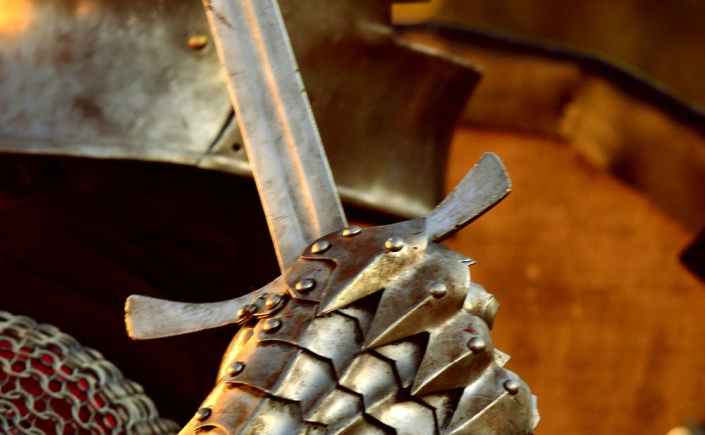
Nota Bene: The techniques and conditions described in this part are primarily concerned with unarmored fighting (or at least fighting in anything less than plate armor). This, despite the picture above.

Also, an apology: I’m verbose on good days, but this post is a bit of an infodump. Sorry.

Forget Chivalry
If you believe that medieval and Renaissance swordplay was all about a sense of honor and fair play, check yourself. I spent some time studying krav maga, and the approach of the fechtbuchs to swordplay is similar–the only thing that matters is winning (surviving), so it doesn’t matter how underhanded, unfair or dastardly a technique is if it means you walk away and the other guy doesn’t.

Scholars of the medieval period perennially return to the debate over whether the ideals of chivalry actually ever existed outside of the period’s literature. My personal belief is probably, “yes, it did,” albeit in localized appearances–people who choose to put such ideas before the exigencies and pragmatisms of the day, rare as they must have been (and continue to be).

I have two examples for you from the fighting manuals to allay your sense of chivalry having a place here:

(1) How to Kill a Fallen Enemy: If you’ve watched Kingdom of Heaven or the Lord of the Rings/Hobbit movies, you’ve seen the move where, after knocking an opponent down, our hero takes his sword, one hand on the grip and one on the quillions (crossbar) and drives the blade downward into his foe’s stomach. It looks badass, I guess, but that’s a good way to risk your opponent stabbing you back before he dies.

The “proper” way to easily dispatch an opponent who you have knocked to the ground is to wait. Once they roll onto all fours to pick themselves up, you chop of their head and thank them for presenting such a clean angle on their neck. Not that they’ll hear it. Far less risk that way.

(2) How to Rob a Peasant: If I remember correctly, this technique–with pictures–is in the Codex Wallerstein. It goes like this: you grab you victim by the neck in your off hand while drawing your dagger. You pinch some of the skin of the victim’s neck between your fingers and slice this with the dagger–not hard, just a nick. You just want the man’s money, not his life, after all. In thinking that you’ve just slit his throat, his hands will go to his neck, conveniently leaving the purses and poaches on his belt free from obstructions. Your dagger’s already out, so it’s hardly anything at all to quickly cut what you want free and walk away before the poor man has realized what’s happened.

All of this is to say that biting, eye gouging, groin strikes, sand throwing and all manner of other nasty trick is fair game in a real fight. At the same time, though, we have the very good fortune of not having to live or die by our swordplay, so maybe think of exercising some restraint when sparring so that your opponent is still your friend after it’s over.

Three Results
There are three primary results in a swordfight, with only one of them positive: (1) you walk away and your opponent dies or is significantly wounded, (2) your opponent kills or significantly kills you and walks away, and (3) you manage to kill or seriously wound each other.

When you think about it that way, the odds are stacked against you from the outset.

Everyone Dies
Even the best fighter makes mistakes, and even an untrained person gets lucky every once in a while. There is no swordfight without risk. Maybe this is obvious to you, but there’s a common assumption, particularly in some roleplaying game mechanics, that a disparity of skill can make a fighter invulnerable in some circumstances. Untrue. Unrealistic, if you care about verisimilitude.

It should be rare that your characters are so self-assured as to not realize that any fight potentially means their death. There are some characters (just as there are some people) too foolish to have this realization, but its best (in my opinion) that it’s clear that that kind of attitude is portrayed as foolishness.

If any of you decides to take up sparring and the practice of western martial arts as a result of reading this series, take this warning: sparring with swords, whether wooden stand-ins or blunt steel, requires trust and control. I have seen more very talented swordsmen and -women injured by someone who did not know what they were doing trying to spar at full speed without the ability to pull a blow they knew was going to correct, or who was too eager and couldn’t wait for their partner to be ready before executing a technique. I got my nose broken that way while sparring once (I left that one out before, didn’t I? It’s crooked to this day.) I’m lucky it wasn’t my eyes–and stupid for not wearing a helmet at that time. In my defense, I was in college, stupid, and there was a machismo endemic to WMA that led us to eschew protective gear for “authenticity” sometimes. Like I said, stupid. If you take up sparring, make sure you wear–at a minimum, a fencing helmet and protective gloves, preferably more than that. Even in practicing techniques at speed and “with intent” protective gear should always be worn.

Parts of a Sword
To understand descriptions of techniques, you need to understand the parts of a sword.

1280px-Sword_parts-en.svg

Traced by User:Stannered; original by Nathan Robinson of myArmoury.com. This SVG image was created by Medium69. Cette image SVG a été créée par Medium69. Please credit this : William Crochot – Derivative of File:Sword Parts.jpg

Our primary focus in the above will be with the blade, and particularly the weak and strong parts of the blade. If, considering that I mentioned earlier that the force of a swing is greatest toward the weapon’s tip, you’re wondering why the base of the blade is called the strong part and the tip the weak, it’s because we’re thinking from a different perspective now. It is easier to push your opponent’s blade (or to resist your blade being pushed) toward the hilt (where the opponent is less able to make use of the lever that your sword is); the opposite is true toward the weapon’s point. We’ll discuss this more in the section on winding and binding, below.

There is a further distinction not depicted in the above, the true (sometimes “long”) and false (alternatively, “short”) edges of the blade. Simply put, if you’re holding the sword out in front of you, the true edge is the one that faces your enemy, while the false edge faces you. Some techniques indicate that the strike should be made with the true edge (which is what someone unfamiliar with the use of a sword would assume is true of all strikes), but others use the false edge. This requires some contortion of the arms but allows for very rapid attacks alternating between the two edges of the blade. This is the time, I feel, to point out that the use of the phrase, “a double-edged sword,” to point out something with both advantages and disadvantages is rather stupid in context. Two edges means I can cut you twice as often. I should also note that a two-handed weapon is necessary to get the most out of the false edge of a blade, because it is the movement of the “off” hand around the sword’s pommel that gives the greatest force to false edge movements–with only one hand on the grip, a false edge attack is as likely to see you lose the weapon as it is to be effective. Someone with greater strength and/or experience than I may have a different opinion, but I saw little use for the false edge when sparring with a one-handed sword.

Timing and Distance
The most fundamental aspects of any hand-to-hand combat, armed or not, are timing and distance. If you cannot accurately judge the distance between yourself and your opponent and combine this with a realistic intuition about your reach, you run a high risk of either overextending yourself or allowing the opponent to slip closer than you are prepared to attack. The important of footwork, in all forms of fighting but especially in swordplay, is largely related to the control of distance and, if possible, to causing your opponent to misjudge intentions and distance by the use of movement.

Likewise, timing is at least as important in swordplay as it is in telling a joke; moreso if you like living, I guess. Some techniques (especially “master strokes”) only work with excruciatingly precise timing. Even without resorting to those high arts of swordplay, there’s always an advantage in attacking when your opponent isn’t expecting it, or being ready to respond in sufficient time to your opponent’s attacking.

If you’ve heard it said in regards to hand-to-hand fighting that “distance is time,” you ought to believe it. The two are inseparable.

Many techniques, at least within the German school of longsword fencing with which I am most familiar, are very specific as to their timing. They fall into three categories: (1) before your opponent takes an action, (2) after your opponent has just completed an action, and (3) while your opponent is acting (that seems to cover all the possibilities, doesn’t it). Whether or not based on conscious analysis or the result of intuitive understanding after many sparring matches or duels, the timing of particular techniques, I believe, has much to do with body-mechanics: timing is based on the amount of time (on average) it would take an opponent to take or complete an action compared to the amount of time needed for the actor to complete his own technique.

Movement
As an arbiter of timing and distance, movement is the foundation of all swordplay (you didn’t think it was your arms, did you?). Here, there are several counter-intuitive aspects of the art. First, because of human physiology and body-mechanics, at least in using a two-handed sword, your reach on an attack extends farther on the later part of the swing than on the earlier part. This means that dodging a blade may be more effective when you dodge in the direction of the attack is coming from (horizontally, not directly into the swing, of course) than away.

Bear in mind also that dodging can be a high-risk, high-reward exercise. The closer you are to the swing of the opponent’s blade without being hit by it, the more you have controlled the distance of the fight. Stepping close to an opponent after he has swung the weapon while pulling your weapon close to you is a very effective way to keep your opponent from being able to protect himself against your next attack (often a thrust).

Ideally, most movement in a swordfight should be at an angle to your opponent, not directly toward or away from him (or her–there were some famous swordswomen and certainly are some very talented women with a blade in modern practice). There are two advantages here: first, it forces your opponent to turn to maintain facing with you. Second, it gives you more control (and increased deceptive ability) in determining distance.

If you’ve watched Olympic fencing, you’ll notice that the fencers are usually on a linear strip. In epee fencing, this strip has a special layer on it, because the epee has a small button on the end that completes a circuit when depressed, allowing for precise scoring of points. The covering of the fencing area prevents false positives with the tip of the epee hits the floor.

As I mentioned above, this is inaccurate as to historical swordplay.

The manuals describe moving in two ways: stepping, which is movement in which your lead leg remains your lead leg (one leg moves and the other follows, essentially) and passing, where either your back leg moves forward to become your lead leg or your lead leg passes backwards, again making the back leg become the lead leg.

Holding the Sword
The first thing you must know about how to grip a two-handed sword is that it is not a baseball bat. You do not lock your hands on it like a vise. As you transition between stances, defenses and strikes, your hands will rotate around the grip as necessary to preserve edge alignment and to ensure maximum force and retention as the weapon swings and rotates. With the two-handed sword, you may even find that your non-dominant hand sometimes pushes the weapon’s pommel like a lever or a gearshift!

There are many stances common between fechtbuchs. In German: Ochs (the ox), Pflug (the Plow), Zornhut (the wrath guard), Vom Tag (from the roof), Auber (the Fool), Wechsel (the “changer”) and those whose German names I can’t remember or never knew: tail and the hanging guard. Those stances where the sword is held away from the center line of the body have variants for the right side and the left side (and indeed, “it works on both sides” is a common note to techniques in the fighting manuals).

There are other more specialized stances less-often used: the Iron Door (open and closed, of course), Unicorn, Long Point, for instance.

The foundation of a swordsperson’s training is in learning these stances and how to gracefully transition between them. You see a little of this in the brief fight between Jaime Lannister and Ned Stark in the Game of Thrones TV show (with Jaime transitioning between ox on the left side and the right side as he “tests” Ned’s stances and footwork).

Pictures are worth a thousand words, so look them up, but I’ll give some descriptions of major stances here (assuming that nothing has changed in interpretation and scholarship since I last seriously studied).

The Plow: when I started my practice of WMA, Plow was treated as holding the sword slightly out in front of you down your centerline, point oriented at about your opponent’s neck. Think the classic “we’re about to fight with lightsabers” pose in the original Star Wars trilogy. This is now referred to sometimes as the “long Plow.” Later, scholars and practitioners decided that it made more sense that your hands were actually pulled back and low to the side of the body, with the blade still pointed at your opponent’s neck, but the tip of the blade not far from about where your face is because pulling your hands back. On your non-dominant side, you actually rotate your grip so that the true edge is facing up, making for easier rising strikes. Your opposite leg (from the side the sword is on) is forward in this stance.

Ox: In the Ox stance, your hands are oriented up near the side of your face, with the blade running parallel to the ground, again aimed about at your opponent’s neck. This is an aggressive stance, quick for the thrust and also for strikes. It transitions easily and quickly to and from the hanging guard stance, and one may change sides in the Ox stance either by thrusting and recovering or using a zwerchau strike (see below). Like Plow, the leg opposite the side your sword is on leads.

Hanging Guard: A defensive stance that nevertheless rapidly transitions into strikes; your hands are held high, above your head and on one side or the other, so that the blade is angled about forty-five degrees from your hands to the ground and about forty-five degrees relative to your opponent’s centerline as it crosses in front of your body. Either leg can lead on either side if I remember correctly.

The Roof: The sword is held over your head, the point at about 45 degrees behind you from the vertical. This is a strong aggressive stance for overhand strikes or quick transition to rising strikes (by moving into the Tail stance). Either foot may lead.

Wrath Guard: Like the Roof, but the sword is held just over your shoulder at the same angle rather than over your head, opposite leg leading. like Plow, when on the non-dominant side, the wrists are rotated so that the false edge points to the foe, making for a fast and powerful rising strike from your non-dominant side.

Tail: In this stance, the sword is held with your hands almost resting on your hip, blade pointed behind and away from you. This stance is primarily used on the dominant side, with a variant stance called Wechsel often substituted on the non-dominant side. Why would you hold your blade behind you? For one, it conceals the length of your blade from easy assessment and so makes a decent starting stance. Additionally, it transitions quickly into Ox and a thrust, allowing you to compensate for the starting point of the blade with an attack that has longer reach than a swing.

The Fool: You’ve been wondering about this one the whole time, haven’t you? There’s some debate about why it’s called the Fool–the swordsman using the stance may look foolish, but the true fool is the one who strikes against this stance, I think. This sword is held in front of the body, like the “long” Plow, but with the tip of the blade pointed toward the ground rather than toward the enemy’s neck. This appears to be a stance of vulnerability to those who don’t know better, even taunting the foe to attack. But the Fool transitions into a nasty rising thrust, or quickly to Tail, Ox or the Hanging Guard and, as it draws the opponent forward, helps with tricks involving management of distance.

Three Wonders
The German masters described the “three wonders” of sword attacks–the cut, the thrust, and “everything else.” That third category typically refers to the “draw cut,” when damage is done not by hacking or swinging at the enemy but by drawing the edge of the blade against them, slicing as it goes by lateral movement.

Swings: The two-handed sword is most commonly swung in one of eight directions–overhanded or “falling” from the right or left, aimed at shoulders or neck, “rising” from below on right or left to the legs or torso, straight up (not terribly common except to create distance) or straight down (at the head), or horizontally. Horizontal attacks are usually made (at least in the German system) at the head or upper body using the horizontal zwerchau, which, when employed from The Roof, the Wrath Guard or the Hanging Guard looks like a helicopter blade sort of motion, especially when several are executed in rapid succession. You can see lots of these used in the lightsaber fight between Obi-Wan Kenobi and Anakin Skywalker in Episode 3 of the Star Wars films.

Thrusting: This doesn’t need much explanation, right? It’s the simplest of all instructions with the sword: “stick ’em with the pointy end.” It does bear mention, though, that the lunge, in which the lead leg is rapidly moved forward in a long extension dragging the following leg, does not appear to have been used until systems of rapier fighting. My own interpretation is that the ability to cut as an alternative to repeated thrusting made the over-extension less useful as it later became.

Draw Cutting: In my experience, draw cutting is opportunistic more than anticipated. It’s a technique best used when footwork brings you in close proximity to one another, to counter an attempt to grapple or when leaving a grapple that was not determinative of the fight.

Other Strikes: Yes, the pommel is a not-infrequent weapon, and the quillions, the flat of the blade, fists, headbutts and feet also represent valid attacks as opportunity presents. Even with the two-handed weapon, having a dagger at hand to be drawn in the midst of a grapple can be a “lifesaver”–or at least an analogue thereto in sparring.

The masters agree that aggression is to be desired over defensiveness–when the opponent is struggling to not get hit, he’s less likely to be striking back (but there are plenty of techniques, like the master strokes, that are both attack and defense, or where one quickly follows the other).

The key to successful attacks, when not simply a matter of sneaky tricks with timing and distance (which are common, mind you), is a flurry of blows rapidly alternating between strike zones. We have diagrams (the later the Renaissance, the more mathematical fencing theory attempted to become) and images of students in fechtschules (to be discussed later) practicing against targets split into quarters to be quickly attacked with strikes alternating both target quarter and whether the true or false edge is used.

Defend Thyself!
The first thing that you need to know about defending against a sword strike with your own sword in the western/European system of fighting is that you block an incoming strike with the flat of your blade. For God’s sake, do not block with the edge!

There are myriad reasons for this; videlicet: (1) Banging edge against edge ruins the blades of both weapons. This is a valued possession, one you rely on with your life–you don’t want to ruin it without necessity. (2) Physics: If you block with the flat side of your blade, there is more area with which the opponent’s edge makes contact, decreasing the pressure exerted by the strike. (3) If you were to block with the edge of your sword–assuming that the swords don’t fuse together as they both deform so that, like idiots, one of you has to put his foot on the other and push so that you can separate them again–the edge of your sword is pointed at the enemy’s blade and must be withdrawn before you can use it. On the other hand, if you block properly with the flat of the blade, the edge is still free and, conveniently, probably pointed at your opponent. With a simple rotation, you may be able to counterattack.

It is also possible to catch the blade of a strike with your quillions. This type of block usually involves violently pushing your hilt toward the incoming strike, catching the opponent’s blade high so that you can then use a falling strike with the false edge. It is also used as an entry to grappling and/or a disarm attempt.

Static blocks are not the only way, not necessarily even the best way, to stop an enemy attack with your blade. Sometimes, it is more effective to swing your weapon into your opponents, knocking it out of its path. Combined with movement, this can delay your opponent’s follow-up enough to create an opening for a counterattack or to create time and distance. I often found that, when using a one-handed sword against an opponent with a two-handed sword (assuming I did not have a shield or parrying dagger), this was necessary to deflect attacks; static blocks would result in the longsword blowing through my defense despite my interposed weapon. When used preemptively against an opponent’s blade, this is called a “beat” (in modern parlance). It is possible, but I’m not entirely sure, that the verb “to ward” is intended in the parlance of the time to indicate a moving block rather than a static one.

It is, of course, also possible to stop an attack with another attack. This is particularly true of counterattacks to the wrist and forearm, where the connecting attack cuts (literally) against the force of your opponent’s strike as well as potentially reducing its range and changing its direction. The “stop-thrust” still used in sport fencing (although in modern epee practice, this is likelier targeted for the top of the opponent’s sword hand or arm into the pocket of the elbow) and constitutes an example of this as an alternative to cutting.

With the right distance and timing, it is also possible to catch your opponent’s wrist, arm, or even the grip of his sword if there’s space enough and to stop the attack with your hand. If this is done with one hand while simultaneously readying the sword for an attack (usually a thrust), it can be a fight-ending maneuver. Again, high risk, high reward. One of my favorite variants (because of its impressiveness if it could be pulled off) of this is, upon the opponent’s initiation of an overhand strike, to grip your own longsword in the half-sword grip and use it almost like a stick to catch the opponent under his wrists before his swing gains much momentum. If you’re fast and aggressive enough (and tall enough!), you can even push the sort back over the opponent’s head and behind his back, at which point you’ve probably disarmed him (or he’s let go his sword preemptively and you find yourself grappling). Conversely, the awkwardest of positions is when you and your opponent have each grabbed each other’s sword or dominant hand and you’re thus connected and both probably moving your arms ridiculously in the manner of rowers to try and shake each other off for a moment before one or both of you realizes you should be trying something different.

Master Strokes
Master strokes are strikes that simultaneously defend the user of the technique while counterattacking, usually based upon the principle of physics that two objects cannot occupy the same physical space simultaneously. The master stroke works against a very particular strike and must be executed with precision and perfect timing–usually just after the opponent has begun the strike to which the master stroke is a defense.

Winding and Binding
The practice of “winding and binding” is the collection of techniques and moves once the blades have made contact and stay in contact–either because one fighter is intentionally attempting to enter this kind of contest, or because the two fighters have both executed maneuvers that put them in this situation for more than a split-second.

Unlike the movies, (think the Princess Bride) this is not the point at which the fighters push meaninglessly against one another like rugby players and trade witty banter. Winding and binding is far too fast, complex, and delicate for that. At any given point once the blades have come into contact, you have what are essentially two options: withdraw your blade from contact to ready another blow or push against your opponent’s blade to gain advantage. It’s the latter that is truly winding and binding. But this is a game of geometries and vector physics, not of brute strength. While winding, you are not pushing your blade directly into your enemy’s; that would be too simple. You are instead trying to angle your blade, maintaining contact between the strong part of your blade and the weak part of your opponent’s to have dominance in the pushing (it’s rarely about physical strength) while maneuvering the point of your sword for a thrust or the edge for a draw cut. If you push too far too fast, your opponent will simply withdraw from contact and strike at you–perhaps before you can recover to defend. Likewise, if you choose to withdraw with your enemy’s blade in too advantageous a position, he’ll simply stab or cut you while you’re drawing your own blade back to strike. It’s a three-dimensional tug-of-war with many possible outcomes. It’s fascinating to watch, frustrating and exhilarating to participate in, and quite difficult to get good at.

A note: provided that your opponent hasn’t done it first, it may be appropriate here to turn the edge of your blade into your opponent’s sword (provided that this doesn’t put you edge against edge). Again, it’s a matter of reducing surface area over which force is applied to increase pressure in pushing against the opponent.

How Important is Strength?
Outside of grappling, not very (in my experience). Physical conditioning, stamina, agility and dexterity are all more important in the fight, and it takes a very large disparity in strength between combatants before an appreciable difference is noted. A more skilled combatant through understanding of body mechanics and good technique can negate any advantage enjoyed by a stronger but less skilled opponent.

Height is a greater advantage than strength in my experience, for several reasons. Under most circumstances, the taller fighter has superior reach, putting his opponent at disadvantage. That’s multiplied by the fact that the taller fighter probably uses a longer sword as well–it was generally agreed by fencing masters that a longsword of proper size for its wielder ought to have its pommel reach comfortably into your armpit with point on the ground. This increased reach combined with an advantage in the taller person regarding leverage makes height a significant factor.

Back when I was heavily involved in ARMA, there were two people in a nearby study-group, a skilled man and an equally skilled and tough-as-nails woman, who had very unfortunate relative heights–on multiple occasions, she had her thumb broken by him while sparring, likely a function of the angle of the strike on her hand influenced by the height difference. This occurred once during a public demonstration, so she simply switched to a single-handed sword in her off-hand rather than a longsword and continued sparring. Told you she was tough-as-nails.

Put Altogether, What is it Like?
My experience as a practitioner of western martial arts, and not a historical reenactor, is limited to one-on-one duels and small skirmishes (no battle lines, no shield walls, etc.).

In these instances, swordplay is marvelously fast and typically graceful, with pitiable exceptions when someone takes a bad step and bites it before making contact, fumbles their weapon, etc. Usually there is a flow to combat that begins with footwork, maneuvering, changing stances and the like to size up and/or psych-out an opponent while gauging distance followed by a flurry of blows, blocks and counterstrikes exchanged over two or three seconds, sometimes longer. If the engagement hasn’t gone to winding and binding or grappling by the end of it, and neither party has been injured, the fighters will disengage and start the process over again. But, like any fight, this dilates and contracts, with sometimes long spaces between attacks and sometimes just time enough for a breath before the combatants reengage. Usually, though, someone has been struck a significant blow in a matter of seconds. These drawn-out swordfights in films are beautiful to watch, and certainly dramatic, but don’t represent what experiences has told me is the average length of a fight with swords–short.

Hit Locations and Injuries
The commonest locations struck by blows (based on my experience sparring) are the head, hands and forearms. If you’re designing a roleplaying game that uses hit locations, consider that the standard distribution used by most games doesn’t reflect reality. On the other hand, getting one-shotted in the head all of the time (or even a third of the time) won’t make for happy players, so some liberties probably ought to be taken.

If you want to understand (as best as we can morally, ethically and legally) the potential severity of sword wounds, look into the archaeology of the Battle of Visby in 1361 (excavations were done in 1928). There were multiple instances where a single blow managed to cut through both of a combatant’s legs. There are also multiple instances where a body was discovered to have a significant, but not necessarily mortal wound (to a limb) as well as a fatal head wound. It is likely that the attacker first injured the other combatant with and initial strike and, when the defender was stunned and in shock and pain from the that strike, the attacker took the opportunity to strike a fatal blow.

Again, there’s no easy translation of this information to a roleplaying game, where being hit once meaning almost certain death is not going to be particularly fun. In “traditional” fiction, this information can add verisimilitude.

Asymmetric Warfare (or at least uneven odds)
Fighting one person is difficult enough; holding off several attackers at once–all of you armed with swords–is especially daunting.

The good news is that only about three attackers can simultaneously attack a single defender without risking a high probability of accidentally striking one another, presuming that they’re using cutting weapons that must be swung; you can fit a lot more people in if all they’re doing is stabbing.

The bad news is that that’s still two other people ready to hack at you while you’re focused on their friend. Since most of us do not have superhuman speed, we have to rely on footwork and maneuver to try to counteract the advantage held by multiple attackers. Specifically, the single combatant should be constantly moving so that she keeps one of her three counterparts between herself and the other two, a sort of “human shield.” With continued maneuver, a skilled combatant can, for a time at least, limit the fight to one attacker at a time. Nevertheless, this is not foolproof, you still have to defend yourself from that one attacker right in front of you, and it’s quite tiring.

Conclusion
There really is no substitute for seeing swordplay by skilled practitioners if you want to understand the speed and elegance of historical fencing. Nor is there for studying the fight manuals and working through the techniques–even if very slowly and with a simple dowel rod from Home Depot.

Nevertheless, I hope that I’ve conveyed the deep complexity of the art of the sword in this Part of the series; it really is so much more than swinging a chunk of metal. It should be in your games and your stories as well. Even if you’re playing a ruleset that, by and large, doesn’t account for all of these factors (and, from a design perspective, most games probably shouldn’t), an understanding of the mechanics of fencing will allow you to narrate much more exciting combats. If you’re a writer of conventional fiction, hopefully this illustrates to you the wide range of ways in which you can show, not tell, the martial skill (or lack thereof!) of your characters.

In the next Part, we’ll talk about armor. I think I’ll squeeze in a post on some of the social and cultural aspects of learning swordplay in the early modern period, and we’ll finish up with the promised reading list and recommendations.

What Writers (and Roleplayers) Need to Know about Swordplay, Part II: Swords

For the introduction to this series, click here.

We ought to start with the Queen of Battle, oughtn’t we? By this, I mean the sword, of course.

Weights and Measures
Let’s get the most glaring error out of the way first: swords were not heavy, nor were they clumsy. You will still even hear some historians claiming that swords weighed 20 pounds or more; this is hogwash.

If you’re able, do a quick test. Get your beefiest friend and a weighlifting barbell (the big one, for benchpressing). These typically weight 15 to 20 pounds. Ask your meatloaf friend (without calling him that) to try to swing the barbell like a sword. Stand back and prepare to laugh. The results should be slow, clumsy and obviously ridiculous.

The average one-handed sword (an “arming sword”) of the medieval and Renaissance periods likely weighs between one-and-a-half pounds and three pounds. The average two-handed sword (what is properly called a “longsword” by the way) usually weighs between two-and-a-half to three-and-a-half pounds, give or take. If you’ve taken some time to watch videos on YouTube, now maybe you’ll understand how they’re able to move so fast and so agilely–we’ll return to this.

Where did we get the idea that swords are so heavy? Bad scholars is the likeliest reason. The heaviest swords actually used of which I’m aware are the zweihanders (the “true twohanders”) use by the Landsknecht mercenaries. These could weigh between six and eight pounds and could be six feet from tip to pommel.

First, it’s important to know that this was a very specialized weapon (see my next point below). By the early 16th century, when this weapon came to use, Europe had (debatedly, at least) undergone a “military revolution.” Gone were the shieldwalls and rough battle lines of the medieval period, replaced by professional or semi-professional soldiers who spent more time drilling in formations and maneuvers than their manual-of-arms for their weapons. The standard was the use of large pike formations protecting musketeers or archers (the Spanish “tercio” is a prime example of this). With their (very) long pikes and the ability to maneuver and angle their weapons together, a pike formation proved a very difficult formation to assault.

The zweihander was one tactical response to this problem. If you look at the weapon, you’ll see a long grip followed by the crossguard and a typically long-and-blunt ricasso (the base of the blade coming from the crossguard). Some examples had this section wrapped in leather and/or topped by parierhaken (parrying hooks). The design will help you to understand the use.

Gripped as a sword, with both hands on the hilt, the weapon could deliver powerful swings, excellent for knocking pike spearpoints out of the way, or potentially even cutting them off (there is not agreement about this).

Once you’re inside the length of the pike, it becomes mostly useless to its user. The pikeman would need to drop his pike and draw whatever shorter weapon he had to hand. The user of the zweihander, however, only had to position his off hand on the ricasso and he suddenly had a weapon that performed more like a short spear than a heavy sword. Advantage dopplesoldner (as these men were called). By gripping the blade with itself with one hand, the dopplesoldner could even simply push pikes up and hold them out of the way while his compatriots slid into the pike formation to do the dirty work.

This was dangerous work, especially so, and dopplesoldners (literally “double soldier”) were probably called that because they received double pay.

Over time, as the tactics of warfare continued to evolve, the zweihander became less and less useful. It retained, however, some significance as a symbol of certain military units, and versions that were intended only to be carried in parade were created. Without care given to weight and balance as is done with a useful sword, these became quite heavy. When antiquarians of the 19th century rediscovered them, they assumed that the parade swords they’d found were actual weapons of war and marveled at the strength necessary to wield them.

If you’d like to take a more scientific approach, let’s look to physics. Force exerted equals mass times acceleration, where acceleration is measured in units squared. So, all other things being equal, you get more force, comparatively, with a lighter weapon swung faster than a heavier weapon swung slower. Medieval minds may not have had the equation, but they were smart enough to look at the evidence and draw a conclusion. Add to this the fact that you have to actually hit your target to do any damage and the usefulness of a faster weapon becomes doubly apparent.

A Sword is a Tool
Like all weapons, a sword is a tool, albeit one with a macabre purpose. Understanding that goes a great distance to understand swordplay, I think. Two particularly important parts: First, force (pressure, really) applied increases diametrically to the area over which it is applied. This is the entire purpose of a blade–the edge reduces the area over which force is applied, focusing and increasing it over a small space. This is why all bladed weapons are useful–they increase the force applied to the target, hopefully sheering and cutting through it.

Second, a sword is a lever, again a tool to amplify the force exerted by the user. This amplification increases the longer the length of the lever, making the cutting area near the tip of the sword the most dangerous area (it also accelerates fastest).

This covers the most basic design purposes behind the weapon, but there is much more. Tools are often improved incrementally over time, and we see that with swords in the historical record, from early bronze weapons to the carbon steel of the medieval and Renaissance sword or with the addition of a hilt capable of blocking an enemy blade.

Some tools are generic, able to perform multiple tasks passably, but not excelling anywhere. Others are specialized, becoming more effective at limited tasks to the detriment of other capabilities. Bear in mind that at all points of human history, there is also an “arms race” between the capabilities of weapons to cause injury and the capabilities of armor to stop injury.

Swords evolved over time in relation to the armor available. Just two examples: the two-handed sword did not become a common weapon until the advent of more-effective armors–the transitional period of the 14th century as we see progress toward true plate mail: brigandine “coats of plates,” the addition of plates to protect joints and limbs, etc. When one could more reasonably rely on one’s armor to stop a blow, a shield became a less necessary item (as we’ll discuss later, a shield should really be thought of as a weapon, not armor), freeing a hand for a longer, weightier weapon, which in turn provided more advantage against that same armor than a one-handed sword.

The second example: as plate armor became more common, a different approach was necessary to the design of swords. Cutting is typically ineffective against plate armor; this is partially a matter of its rigidity and resistance to cutting, but also a matter of its design–plate armor is designed to deflect a blow, directing the force of the attack in a way less harmful to the wearer, rather than to simply stop the blow. The result of this were blades with more acute points. Much fighting in plate armor, at least with swords, results in grappling, with the combatants grabbing the blade of their sword with one hand (called “half-swording, and yes, this can be done without injury”) and aiming to maneuver the point of the weapon through the gaps between plates. Harnessfechten is truly terrifying stuff, with the end results as often as not being achieved through grappling itself (the breaking of limbs as such) or through close work at the half-sword or with the dagger.

Swords also changed as firearms altered the types and amount of armor worn, becoming lighter and developing (though not solely) into the rapier and later smallsword. Both of these, the rapier and smallsword, are excellent examples of the very-specialized sword; we’ll discuss rapiers in detail shortly.

What does this mean for the writer and/or roleplayer (especially a GM)? If you’re describing a sword, or determining what kinds of swords are likely to be found in your setting, you’d be well-advised to do some research into sword typology and the types of swords that existed at various time periods, so think about relationship between relative historical equivalents and–especially–what kind of armor is available and how that would affect sword designs and styles. There’s not necessarily a need to make mechanical distinctions between variant sword types in the gaming realm, though you certainly can if you lean heavily simulationist (or gamist, I suppose), but it will help to visualize the setting.

There are some other storytelling opportunities here–if yours is a setting with ancient and magical weapons and armor (like most games of D&D, for instance), think about how that ancient weapon may differ in appearance and design from the ones made in the setting’s present. Do ancient swords of power look more like 9th-century viking swords rather than the more acutely pointed 15th-century style swords used by most people? Would the sword be less effective against “modern” armor (whatever that may be in your setting) except for the magic within it?

A side note here–as in our own historical record, the development of sword types was not solely a linear progression. Multiple sword designs competed with one another, or performed different functions, in the same period. Changes in sword morphology did not occur simultaneously over all geographic locales, and the evolution of any weapon involves some amount of discovery, forgetting, uneven development or acceptance, throwbacks, etc.

Like any invention, the discovery of the technology itself is far from the only factor involved in the “success” or acceptance of the technology. Cost, societal and cultural views, changing needs, and many other factors may cause some technologies never to be fully realized despite the fact that they perform better than alternatives.

Additionally, because weapons are tools, context is important. The comparison of European swords and Japanese swords during their respective feudal periods provides a good example. The katana is not an inherently “better” weapon than the European longsword; of course the reverse is also true. The two weapons developed in, and made sense in, different contexts.

While I’m not as well-read in Asian history as I am in western history, my understanding is that the katana’s design is a very specific response to several factors in Japan. Primary among these was the reduced availability of quality materials from which to produce reliable, weapons-grade steel. Two conditions flowed from this: plate armor did not developed or see broad usage in Japan as it did in Europe, so the importance of acutely-pointed weapons that could be used against enemies in a wide range of armors (including that “white metal” plate armor) did not exist in the same way in Japan as in Europe–the needs to be fulfilled by the weapon were different. Likewise, the resources available with which to make weapons in Japan necessitated different techniques in sword-forging, and the katana (and its variants, which are similarly diverse as European weapons, I believe) represented the best balance of effective weapon and (relative) ease of manufacture. Some exquisite weapons were made in both locales. Both, I’m sure, also saw a number of subpar weapons created because of lack of skill, the demands of semi-mass production, the corner-cutting of greedy manufacturers, or the penny-pinching of those who commissioned the weapons.

Making Swords was Difficult
The medieval and Renaissance periods did not have access to modern metallurgy. The field of chemistry was in its infancy, and though the understanding of metals and their properties certainly improved over the centuries in question, smithing metal was art and science during the medieval and early modern periods.

A sword is made of carbon steel, which is iron fused with carbon to create an alloy with the desired properties. If you’re at your local Renaissance Faire and someone is trying to sell you a sword made out of stainless steel, it is a cheap display piece. If that’s what you want it for, no worries. But if you want something you could actually swing, test cut with, or safely use for WMA, you need carbon steel.

Those physical properties change based on the amount of carbon in the steel and the properties required of good swords are quite specific. The sword needs to be able to take and hold a good edge (which I understand is something of a metallurgic “sweet” spot). It needs to be hard, but not brittle, and the blade needs to be able to flex rather than to be perfectly rigid. There are some variations on these needs based on the sword design, of course, but those facts are generally true.

Here’s the problem: early modern smiths had no way to accurately gauge the carbon content of steel. They had to learn an intuition for the right amount of carbon, and smiths developed, even before our time period, techniques for controlling carbon content (relatively if not exactly). One such technique was to create the billet for the sword from individual layers of iron and carbon-containing metallic strips, heating them together and combining them to get a steel with a semi-controlled carbon content; this is called “pattern welding”. Viking swords were commonly made this way, with the pattern of the mixed steel visible in the blade or fuller when acid etching revealed the “serpent in the blade” as it was called.

By the Tudor period, other techniques were available for increasing carbon content in steel but, admittedly, I don’t remember the specifics well enough to describe them now.

The important thing to note is that making swords required special knowledge and skill–this is not something a blacksmith would do. Basic economic theory tells us that, the more specialized knowledge and skill a product requires, the lower the supply and higher the price commanded by the commodity. This is true of swords. While it’s very difficult to determine the actual costs of swords at various levels of quality or design, I would note that, in many of the medieval laws requiring the ownership of certain arms and armor, the weapon required of most men was a spear, not a sword.

We also have some evidence of out-of-date styles of sword continuing to see use despite the changes in the “modern” design of the weapons. This likely indicates, and there is some corroborating evidence in the historical record, that swords might be passed down in a family as heirlooms because of the value they had and relative difficulty of acquiring a newer weapon. Sometimes the blade was kept and the weapon’s fittings were changed.

On the other hand, there is much evidence of schools of swordplay becoming available to the (paying) public by the 16th century–we have a number of woodcuts showing training in just such a setting. This means that, for the burgeoning middle class, the acquisition of swords and time and money enough to learn their use was not out of reach. While swords were not nearly as common as they are often portrayed, neither were they rare.

To analogize to the modern period, I think we be well served by thinking about military-style rifles. A lot of them are made by governments for warfare, and they don’t simply disappear once the war is over. An AR-15 in the United States might run $500 for a very basic model and into the thousands of dollars. According to CNN, 40% of Americans do not have $400 available to them in the event of an emergency, so at least 40% of people probably couldn’t come up with the money to purchase such a weapon without taking on serious financial risk. I would imagine for another fair percentage, the acquisition could be made only if saved for over time, financed or the budget stretched. Bear in mind that credit did not work the way it does in modern times during the medieval and Renaissance periods (which is not to say that there was no lending or borrowing of money or other extensions of credit, but the ease of access to credit was far lower). And of course, there are some people who could afford to arm an entire town or county.

So, in writing or roleplaying, think about the social status and wealth of a character when determining whether that person owns a sword. Most peasants and desperate folk won’t–they’re more likely to use something simpler, less expensive and easier to acquire–a spear, and ax, a knife, etc. As we’ll discuss shortly, using a sword is not easy and requires significant training, so most peasants wouldn’t have had sufficient free time (or resources) to sufficiently study swordplay, even if they could acquire a sword.

As with the other sections, these are guidelines to think about, choices that must be made after reasonable consideration, not strict rules to be slavishly followed. Some societies or cultures by their nature will have a higher focus on producing weapons and putting them into the hands of the populace. Switzerland’s famous status as a “neutral” nation is not simply a matter of its refusal to intervene in the affairs of foreign nations, but also the fact that mandatory military service and weapons training (members of the military store their weapons at home!) means a nightmare for any would-be invader.

You Couldn’t Just Wear a Sword Anywhere
The systems of law enforcement and public safety were not so clearly defined, structured or regulated as they are now, but they became moreso over the medieval period and into the Renaissance. As we discussed above, because a sword was not the commonest or most affordable of commodities, it was also a status symbol–as social mobility increased somewhat after the Black Death and especially into the Renaissance (though still nothing like modern social mobility), more and more people wanted to show off their success by the wearing of one.

As is ever the case, those who held power didn’t want to share power or prestige with others and made concerted efforts to hold the lower classes down. One of these efforts was the creation of sumptuary laws. Sumptuary laws were concerned with how a person could and could not dress based upon their social status and wealth–you had to have a certain annual income to be legally able to wear ermine (a popular type of fur), for instance. This also extended to the wearing of weapons.

More than that, though, wealthy aristocrats had good cause to fear the peasantry–they largely enjoyed their wealth and status on the backs of those less fortunate, as the German Bundschuh movements and frequency of peasant revolts (England in 1340, 1381 and 1450, France in 1358 and 1382, Friuli in 1511, the German Peasants’ War in 1525-26, just to name a few) attest. The aristocracy didn’t really want their peasants to be well-armed.

But the simple matter of public safety was also a concern, and Machiavelli’s view that “an armed society is a polite society” was certainly not held by all. We know that the wearing of weapons was specifically permitted for travelers and pilgrims of the lower classes (because of the threat of brigandry and banditry, of course)

Many towns and cities had restrictions on the length of a blade that could carried inside its limits, though the specifics varied widely by time and place and exceptions seem to have almost always existed based on social class or social function.

This is to say that, contrary to common D&D tropes, at least, people (at least by the Renaissance) didn’t often walk around in full armor and festooned with weaponry–that made people nervous and attracted attention. People were restricted from the wearing of weapons in certain settings, and even social norms played a role as well.

Bear in mind that different levels of armedness were permissible in various situations. Wearing a dagger or knife was rarely forbidden, and it was common for the nobility to wear a sword (though more commonly of a lighter “civilian” design such as an “espada de ropa” or rapier) in social settings where combat was not expected. The wearing of armor in particular (when not in an official capacity requiring it) advertised that you were looking for trouble.

The types of weapons–even swords–carried also varied by social status. I’ll give an example about what certain weapons communicated later by looking at the gang fight scene at the beginning of Shakespeare’s Romeo and Juliet. For now, I’ll just give this example–in late medieval and early-modern England, the retainers of a nobleman who were commoners but who were allowed to carry weapons by virtue of their service in the nobleman’s retinue were most commonly armed with a simple single-handed sword and a buckler. They were commonly referred to as “sword-and-buckler” men and the term “swashbuckler” derives from the practice of letting one’s buckler (hung from the belt) clash against one’s (sheathed) sword as one walked, advertising armedness with a good dash of bravado. For various reasons, but among them armed clashes between groups of retainers, laws restricting the size and makeup of liveried retainers were a common feature of this period. That they were issued with such frequency most likely indicates trouble in enforcing them–or at least a high level of concern with the problem.

And if good fiction is any indication, there’s a lot of good drama to be had when a character is caught without his armor or the weapon he’d prefer to use to defend himself. I’m certainly of the mind that this should be pursued in both “conventional” fiction and roleplaying–don’t let your characters carry an arsenal whenever and wherever they feel like it!

Using a Sword is Difficult
We’ll talk about the actual features of swordplay in the next Part, but for now, let me expound briefly on why swords are difficult to use.

A sword is not a club. That seems obvious, but think about the fact that the edge must actually contact the target for a sword to maximize its effect. Not only that, but the edge must contact the target at an appropriate angle to have an optimal effect. “Edge control” is one of the first difficult tasks faced by a student of the sword.

Then there’s the whole “not-cutting-yourself” thing. You want power and acceleration behind each swing of the blade, but you also need to control the blade after it has missed, struck its target, or been deflected. While moving. While trying not to be hit by your enemy. I have seen or heard of injuries requiring emergency medical attention and stitches during test-cuttings. If you’re not familiar, a “test cutting” is the practice of cutting a stationary object with a sharp blade. You’ll find many videos of test cuttings performed on water bottles and rolled tatami mats. I have attended and participated in test cuttings on animal carcasses (if it matters to you, the animal was not killed for the purpose of the test cutting–and certainly not during it!–so this was a matter of making the most of the carcass. If you are offended by this, I certainly understand, and there’s a perfectly reasonable question and conversation to be had there).  These are the most controlled environments in the use of a sword that you could hope to have–and yet people still manage to hurt themselves. Factor in all the fighting stuff and you have some serious concerns.

The body mechanics of the movement of the sword, whether the transition between one “guard” or manner of holding the sword ready for use, the transition from one attack to another, or from attack to defense and vice versa, are not always intuitive until you build muscle memory. The options for how to respond to any given blade contact are myriad. You can move, you can grapple your opponent, you can act “on the bind” by pressing your blade against theirs, you can counterattack; and all of these approaches have a number of decisions to make within them. Without getting too far into the “how” of swordplay in this Part (already very long!), let’s take a brief look at the questions involved in choosing to grapple: where will you grip the opponent? Where will you move as you close to grapple and how will your orient your body to theirs? In what directions will you apply force as you grapple? What is your goal: to disarm, to break a limb, to buffet the enemy with fists and elbows, to throw them or trip them? As with all hand-to-hand martial arts, it takes time and practice to understand the theory behind these choices, more to develop the skill to implement them, and even more to be capable of making and implementing split-second decisions about these techniques in the heat of combat. Add a blade, which is dangerous to both you and your opponent, and it becomes clear, I think, that a blade is more difficult to use than a club (though many of the same techniques can be employed, really).

The idea that a character will pick up a sword and suddenly be effective with it (at least against a capable opponent) is dubious at best. Keep this in mind when structuring narrative.

What is a Rapier and How is it Different?
As one of the easiest examples of how widely swords can differ in their morphology and function, let’s look at the rapier versus other types of sword.

As an introductory note, it must be stated that research about the rapier is somewhat difficult, as the usage of language in historical sources do not make the strict categorical distinction between rapier and other types of swords as modern scholars and WMA enthusiasts tend to. This is partially a result of the fact that the rapier evolved over a fairly long period, with a number of very different designs and approaches during that period.

As the fighting manuals consider them, rapiers are swords (very) heavily focused on the thrust over the cut (though some treatises do make use of cutting techniques). Modern scholars debate whether those swords called “rapiers” that are alluded to as also cutting should truly be referred to as rapiers (under modern categorization) or should be placed in the same category as “cut-and-thrust” swords or in the more ambiguous category of “sword-rapiers.”

The rapier developed starting in the early 16th century and continued to see significant use into the 17th, when it began to be supplanted by the smallword (a lighter, shorter variant, essentially).

Generally, a rapier has several distinguishing features. First, it is a one-handed sword. Second, a thinner blade than other sword types, with that blade often being more rigid than other sword types (to strengthen the thrusting ability of the blade while sacrificing some of the blade flex that is useful to “winding and binding” with the blade (see the next Part). Third, rapier blades tend to be quite long, and longer as their development continues. Fourth, rapiers have increasingly complex hilts (over the course of their development), starting with simple rings built into the crossguard so that the index finger may be wrapped over the crossguard (next to the sword’s ricasso). This allows greater control over the thrust, while again sacrificing some authority in cutting. Ricasso rings and complex hilts were not only used for rapiers, however; the “cut-and-thrust” blades (as modern scholars call them) that have wider blades (often acutely pointed) that favor the thrust but still allow for strong cutting). This style of gripping the blade is still emulated in certain grips for modern fencing epees.

The most “extreme” rapier designs had hexagonal or octagonal blade cross-sections, almost like a piece of sharpened rebar (albeit much better balanced). These weapons were clearly designed only to thrust; their cross-sections did not allow for holding an edge.

While a “standard” rapier design is difficult or impossible to pin down, their function is not. As a lighter weapon (compared to other swords), the rapier was easier and more comfortable to carry (provided that the length was not absurd). The use of the thrust allows for a greater maintenance of distance from the opponent as well obviating the need to draw the weapon away from the opponent to prepare a swing. The downside of this is that resorting only to the thrust makes it very difficult to hold multiple attackers at bay at once (already a very difficult thing). But the lack of a need to swing proved especially useful in the often-cramped streets and alleys of Renaissance cities, where there may not have been room to swing a cutting sword at all.

Despite being a thrusting weapon, the rapier does not appear to have been effective or intended to be used against an opponent in armor. Against an unarmored opponent, however, the weapon is truly deadly–in one of the aforementioned test-cuttings I attended, I witnessed a (quality) replica rapier lightly tossed underhanded into a slab of deer meat to the hilt. As we’ll see later on, the reputation of the weapon in its contemporary time (at least in England) was that it was especially deadly compared to other weapons.

Combine the effectiveness of the weapon in urban settings and the convenience of carrying it with it’s lack of effectiveness in group combat (bear in mind that in the press of battle you may not have room to pull back a weapon for a thrust and, in a strange opposite of the alley, a cutting weapon may prove more useful), and you have a weapon very well suited to daily self-defense and to the duel, but not to military purposes.

In the next Part, we’ll talk a look at how swords are actually used. After that, we’ll look at medieval/Renaissance armor and some common misconceptions held by roleplaying games and some fantasy writers. I’ll conclude with a sort of bibliography, including books for further reading and even some roleplaying games that really get swordplay “right.”

What Writers (and Roleplayers) Need to Know about Swordplay, Part I: Introduction and Sources

I’m far from the first person to pick up this subject, but I continue to hear so many mistakes made about medieval and Renaissance weapons, armor and combat that I feel that the subject merits continued treatment.

To begin, let me set out my bona fides: My undergraduate degree is a B.A. in History, focusing on Medieval and Renaissance History, my senior thesis was written on Henry VIII’s use of Arthurian Legend as propaganda and included research at the British Library and National Archives. My master’s degree is in English, focusing again on medieval and Renaissance literature; my master’s thesis was about the use of particular weapons and fighting styles in Shakespeare’s works, 16th century English fighting manuals and adventure pamphlets as a method of establishing identity, particularly national identity.

I was a sport fencer in high school (which hardly counts for anything in this field, unfortunately, except in the rudiments of all hand-to-hand combat: distance, timing and footwork) and spent my college years as a member (and later study-group leader) of the Association for Renaissance Martial Arts (ARMA), having broken a rib and an eardrum in separate sparring engagements during that time (no, I did not get stabbed in the ear). Though I did not continue my affiliation with them after I left my original study group, I have continued to practice and develop my skills as a swordsman, off and on. I have experience sparring at full contact with padded weapons carefully designed to emulate the weight and balance of actual swords, with wooden “wasters” and with blunted steel. I’ve studied and worked through Ringeck, Talhoffer, Fiori dei Liberi, Silver, Swetnam and others, including some sword-and-buckler work in the I.33 and some rapier work with Agrippa, Di Grassi and Saviolo. My primary experience (in practice) is in the two-handed longsword, single-handed swords of the “cut-and-thrust” variety (mostly with dagger or a free secondary hand), the rapier (again with dagger or free hand), and grappling/dagger work. I have used a shield sometimes, mostly a buckler, and all of my experience is in the realm of “blossfechten,” that is, fighting without (plate) armor. I’ve seen a number of demonstrations of fighting in plate (harnessfechten) and understand the theory, but have no direct experience there.

The subject of “medieval and Renaissance martial arts,” “historical European martial arts,” (HEMA) or “Western martial arts”  (WMA) has become an increasing interest in Western culture over the past thirty years, though I’d still venture to say that the subject, as both research field and martial art form, remains in the early stages of reconstruction.

If you want to see what swordplay looks like, I recommend you go to YouTube and look for clips under the search terms in the preceding paragraph, with particular attention to some of the European competition clips. Each year, it seems, there are more competitions, the “sport” becomes more like other sports (with organizations, sponsors, etc.), and the competitors seem to have greater skill. This will give you some perspective on the topics we’ll cover in this series.

How did we get to a point where, after such a far remove from the times when these weapons were actually employed, we can begin to understand and reconstruct their usage?

There are museum pieces and archeological records of course, which give us much of our information on actual weights and designs of swords, armor and other weapons. The Royal Armouries in Leeds, England has, as far as I’m aware, one of the very best collections of early modern armaments anywhere in the world. Bear in mind though, that we find far fewer pristine examples of items than we do pitted and degraded examples, this being more the case the farther in time we look back.

For the technical aspects of medieval arms and armor, I would refer the student to begin with the works of Ewart Oakeshott, with the caveat that his interpretations are not the final say in the matter, that even he was unsure about some of his classifications, and that there has been much debate and revision of his ideas since.

We also have art and literature but, as we’ll see, the interpretation of these alone can sometimes lead to misunderstandings (that continue to defy correction)!

For the actual reconstruction of the martial “arts” of the medieval and early modern periods, we have written instructions, what are generally referred to as the “fechtbuchs.” The earliest of which I’m aware is the Royal Armouries’ I.33 sword and buckler manuscript, probably written sometime around the turn of the 13th century to the 14th.

We continue to see handcrafted manuals, but the invention of Gutenberg’s printing press in 1439 led to the “mass-” production of printed manuals as well. These texts were put down by masters of arms, those teachers of the craft who had earned sufficient fame and demonstrated sufficient skill, both as instruction manual and as advertisement, probably. A list of Western martial arts manuals may be found (on Wikipedia) here.

In the modern age, groups like ARMA and many others–local schools like any Eastern martial arts dojo are popping up in U.S. cities all the time–take these manuals, translate them into English (or, more likely, purchase translated copies), and then work through the examples and instructions within to figure out what is intended and what actually works. Many of the fechtbuchs are illustrated, though there’s often some debate over whether the pictures accurately reflect what is referenced in the text. If modern artists’ renderings of concept firearms are any indication, some artists understood what they were depicting well enough to be accurate, but many, perhaps most, did not.

The amount of scholarly attention to this field grows a little year-by-year, but it is still (as far as I’m aware) the focus of only a small handful of professors and professional scholars. The Martial Arts of Renaissance Europe remains one of the best scholarly surveys of historical fighting manuals available; it is approaching its twentieth anniversary.

If you get on Amazon, you can now find instructional manuals like those for any martial art, the authors having purportedly gone through earlier texts to recreate the skills and portray them in modern language and pictures.

As a person writing or roleplaying in a setting with swords and armor, should you feel compelled to join some reenactment group or martial arts collective participating in the HEMA/WMA world? It certainly wouldn’t hurt to have the experience. In this series, though, I’m going to try to cover the essentials of what you need to know so that you’re at least not making any glaring errors.

To continue to the next Part in this Series, click here.

Expeditions in the Western Wilderness

The first of the two novels I’m currently working on—and the one I think I’ll write first, as it is in its nature the narratively simpler of the two (though I wouldn’t call it narratively simple)—is about an expedition into the Wilderness of the West in Avar Narn (I’m going to ask you in advance to forgive the seeming randomness of some of my capitalization—I blame this on too much time studying texts written before orthography, punctuation and capitalization were standardized). I thought I’d share some information about the background of the novel to see if anyone would like to offer feedback.

These notes are tentative and potentially subject to change.

The Background

Long ago, the Aenyr people came to the known world from the West (legend says from an island). The Aenyr were powerful thaumaturges and magi; this power made their dominance over the peoples of the Avar all but assured. They founded great cities of wondrous artifice and thaumaturgical genius, but their ascendency was built on the backs of enslaved humans. The Aenyr Empire expanded as far as the Altaenin island in the Central Sea before internal conflict and abuse of their sorcerous powers caused civil war, rebellion and eventually collapse. The Aenyr retreated from the Avar for over a thousand years. Though they have returned in small numbers more recently, they are no longer the masters of thaumaturgy they once were, no longer interested in dominating the Avar (at least most of them are not), and they have forgotten most if not all of the secret knowledges they had once discovered.

When the Aenyr abandoned the Avar (a story for another time), they left their magnificent cities to rot and crumble. Farther east, many of the current great cities (each of the Seven Sisters, like Ilessa, for instance) are built upon the ruins and remains of those ancient dwellings. In the West, though, these cities—some of the greatest built by the Aenyr—were abandoned fully by civilized folk.

But there is much coin to be made in the realm of thaumaturgical advancements and Artificial devices (those powered by arcane energies). While some research to innovate on their own, the Artificer Houses, the universities, and those looking to make a name for themselves (or just put coin in their pouches) look to these forgotten places to rediscover secrets of the past—to monetize them.

Elderyn

From the town of Elderyn, venture companies form to search the Wilderness of the West for ancient ruins to be looted for their knowledge (and gold).

The town started small but has grown to great proportions to harbor the trade that spawned it. Once merely a last stop before the Wild, now Elderyn caters to the every need of venturers and expeditions. Tradesmen and craftsman make the weapons and tools for surviving the Wild; brothels and taverns provide respite from the weariness of travel and adventure for those who return successful.

At the edge of the Western Wild, Elderyn is beyond the reach of the lordlings who rule elsewhere. A Governor rules Elderyn, one elected by a combination of the town’s landowners, “registered” members of venture companies and expedition patrons. The Governor’s primary role is providing some rule of law for the business of expeditions bound for Aenyr ruins—a buffer against the might of the Artificer Houses, cheats and swindlers. Of course, the Governor himself is amenable to the occasional bribe, and skullduggery remains the status quo except for the vilest of offenses. Petty crimes—minor thievery, murder and the like—are handled by popular justice.

Venture Companies

The men and women of venture companies are no shining heroes—they are a desperate lot who find themselves unfit—by history or by inclination—for life in civilization. They are cutthroats, murderers and oddballs willing or forced by circumstance to risk their lives for gold and glory. Mercenaries, thugs, thieves and assassins, many came to Elderyn to avoid their deserved justice.

And these are just the type of people that sponsors of expeditions west want in their employ—rough men and women who have few qualms about doing what it takes to return from the Wild with something to show for themselves.

The typical arrangement between an expedition patron and a venture company is a contractual one—the Governor’s foremost role is to enforce these contracts once written. The customary arrangement is that the patron is entitled to all discoveries of written goods and Artifice, for which the company will be compensated at a rate determined by a neutral appraiser. Valuable objects that are not significant vehicles of lost knowledge are loot kept by the company—after they are studied and logged by the group’s scholars.

Venture companies are no small affair. A company needs wilderness scouts and trackers; barber-surgeons to tend to the inevitable injury and disease; scholars and scribes to understand and document any finds; cartographers to preserve the way for the company’s future expeditions; thaumaturges to protect the company and assist in finding valuable ruins; handlers for the expedition’s pack animals, etc.

To somewhat reduce the number of people required for an expedition (and thus increase each company member’s share), there is an “everyone works, everyone fights” mentality. No one in the company is dedicated to only one task, no one is exempt from the heavy labor required in the field, and no one may refuse to fight when necessary.

Some expected occupations among the company are lacking. No company brings a member on to be a cook, though a venturer who can prepare tasty meals rarely lacks for employment. Unlike mercenary companies, which venture companies superficially resemble, no camp followers are brought on expedition. Company members are expected to satisfy such needs “catch as catch can,” though such issues are not infrequently the causes of jealousies and fights between company members.

The average size of the venture company is sixty souls.

A venture company is perhaps one of the most egalitarian organizations in the Avar. Members are judged on merit, not on gender or appearance—remember that they’re all outcasts together. Women are as valuable as men if they pull their own weight. As important, venture companies are democratic—they elect their captain and vote on major decisions. Only when the company is in crisis or under direct threat is the rule of the captain absolute and infallible.

Despite the possibility of new elections at any time the company is not threatened, most captains maintain their positions solidly, resting on the reputation of past successes and trust built in the crucible of conflict.

The Great Game

Thaumaturgical know-how and the secrets of Artifice are perhaps the most valuable commodities in the Avar at present, so it should be no surprise that those involved in expeditions to discover lost secrets in Aenyr ruins are willing to resort to unsavory ends to increase their profit margins.

In the Wild, the only rule of law is the steel you bring with you; armed and violent conflicts between rival venture companies are not uncommon when one has made a discovery. Some companies—under patronage or not—attempt to make their fortune by following other companies and poaching their finds by force. If discovered, such companies face harsh retribution from the Governor and the security forces of Elderyn (undoubtedly supplemented by angry fellow venturers). Few, though, leave witnesses to their crimes.

Espionage also is a constant threat. A company’s maps and experience are its prized possessions in securing patronage for ventures West, and rare is the company wealthy (or foresighted) enough to be able to fund its own expedition. Both the theft of company secrets and espionage are punished in almost unthinkable ways. Yet, the lure of gold still outweighs such deterrents for some.

As might be suspected, the Artificer Houses are the most to be feared when it comes to poaching and espionage. Though they can fund the best equipped and supplied venture companies, they are always looking for ways to maximize profits while minimizing costs, and any opportunity to limit knowledge of Artifice to their own makers has a value of its own. Their airships allow them to send men into the Wild to steal another company’s find with alacrity, though the ancient wards of Aenyr cities make them impossible to spot from the air and the limitations of such craft make them unfit to deliver whole expeditions into the great wilderness, they are useful for suddenly overtaking an unwary venture company that’s made a find—the House men delivered by airship may then appropriate the slain company’s equipment to bring back their treasures to Elderyn.

What does it all mean? 

The idea for a novel based in this commerce is manifold. Some of these ideas arose out of the worldbuilding for Avar Narn itself—the commerce in Artifice is fundamental to many of the setting’s inherent conflicts.

But I’ve also always wanted to write a more modern take on the classic fantasy quest. Here, hard and desperate men and women are cogs in a machine of commerce—not valiant heroes saving the world. Though there is much wonder in the Wild, the life of an adventurer is more commonly one of suffering, labor and boredom punctuated by moments of terror. At its heart, I just love fantasy fiction that is gritty and “realistic.”

Don’t mistake my stated goals here for pure cynicism. Classic fantasy quests are morally instructive tales—look to the Grail Quest, The Hobbit, The Lord of the Rings. But I believe that both moral instruction and fantasy that are more mature are able to provide morality and ethics in a more complicated world—one of pragmatism and expedience, ambiguity in righteousness, competing needs. A world in some ways more like our own. I think that the novel (still without a working title) based on these ideas has a chance of doing just that. We shall see.

The Aenyr Language

What follows is some of the work I’ve done (plus notes) on the language of the Aenyr people.

As a preparatory note, I’ll be using the International Phonetic Alphabet (IPA) for description of phonemes but will later shift to other symbols (with a guide) to depict how I intend to write the language within stories in Avar Narn. The language will have its own alphabet, but currently does not.

I’ve been using a combination of Mark Rosenfelder’s The Language Construction Kit and my own linguistic research to inform the choices made below. I highly recommend the book. I have a few similar ones on my shelf, but his is the one I usually start and end with.

A little bit of introduction–the language of the Aenyr is an ancient one, seldom used in the Avar except in remaining place names and its influence on subsequent languages (such as the Altaenin tongue). As I post more about the history of the Avar and of the Aenyr people, you’ll see this fleshed out.

To begin, I needed to decide on the sound of the language. I found the following quotation on the Wikipedia page for “cellar-door”: “it at once brings to mind a word from one of those warm-blooded languages English speakers invest with musical beauty, spare in clusters and full of liquids, nasals and open syllables with vowel nuclei–the languages of the Mediterranean or Polynesia, or the sentimentalized Celtic that Lewis and Tolkien turned into a staple of fantasy fiction.”

I used the quotation as something of a guide in selecting phonemes for the Aenyr language. Following Tolkien, I first looked at Welsh and Finnish, but I also looked to Sanskrit, Serbo-Croatian and a few other Earth languages in the process.

First, I satisfied the guidepost of the above-written quote by adding the liquids: /r/, /l/, /ɹ/, /ʎ/ and the nasals: /m/, /n/, /ɲ/, /ɳ/ (the latter two being influenced by Sanskrit). I added in the other consonants mostly based on some of the words that I already had that I’d decided came from the Aenyr language. The same with the vowels.

Aenyri Phonography

Here’s where, for me at least, things got interesting. I had made a decision (mostly for ease of vocabulary building) to use the agglutinative aspect of Finnish (suffixes may be added to a noun core by standardized rules to create a number of other nouns). I had also decided long ago the meaning of “Avar Narn,” Aenyr words approximating the “the world reborn.”

So, it was time to engage in a little reverse engineering–I needed to make those words mean what I wanted them to mean, and this provided the start of the language.

Before I get too far into this, a note on (current) pronunciation. Here is a little chart of my current pronunciation notes for vowels:

Aenyr Vowel Sounds

Our starting place, with some pronunciation guidance: Ävär Närn.

I took “är” as the core word and made “Äv-“, “n-” and “-n” prefixes and suffixes in agglutinative style.

To get where I needed to go, I decided that “är” means “to be born, to come into being.”

“Äv-“, then, became a prefix to create a noun from a verb, specifically a noun meaning “the place where [verb] happens.” This gives us “Ävär” = “birthplace.”

“n-” then became a prefix for a verb equivalent to English “re-“, while “-n” became a suffix to form a past participle/adjective, making “Närn” = “reborn, resurrected.”

Breaking down the prefixes and suffixes, and adding some more, yielded the following list:

n-           “to do again”, “re-”                                                                   När = “to be reborn”
-n            to create past participle/adjective from infinitive           Ärn = “born”
-tälё       “an agent, one who does [verb]”                                          Ärtälё = lit. “birther,
mother”
Närtälё = “necromancer”,
“resurrectionist”
-ёnyn     creates adjective from verb                                                  Ärёnyn = “fertile, arable,                                                                                                                      productive”
-vё         creates noun meaning a master of the verb                       Ärvё = “midwife” or
“matron”
-tön        “without, lacking”                                                                    Ärtön = “unborn,
inanimate”
Ärtälёtön = “motherless”,
“orphan”
-ys         an instrument or tool used with the verb                          Ärys = “birthing chair”
-yr         a (general) collection or group                                              Aenyr = “the Aen people”
Äryr = “the born, the
living”
Ärtälyr = “mothers
(general/abstract)”
-ёn        to pluralize a noun                                                                  Ärtälёn = “(the) mothers”

That’s a lot of mileage from two original words! There’s a lot to be continued here (declension of nouns, verb conjugation, grammar, regular/irregular words, etc.) and I’m sure I’ve made some mistakes that will have to be corrected, but I feel like it’s a good start.

Here’s one particular issue I’m trying to wrap my head around: I’ve already used some words with vowel clusters in them (“Aenyr”, for one) where the vowels elide together (that should have a long “a” sound at the beginning) and others (“Ellembaё”) where the vowels are pronounced separately. Not sure what I’m going to do here, but there are a few possibilities: it may be that the orthography of the language solves the problem (when written in its own script the “Ae” is a single letter corresponding to the “(aɪ)” phoneme) or it may be that I have to go back and start respelling that word to fit in with a coherent pronunciation scheme for readers.

I don’t intend to go so far as to create complete working languages–I have neither time nor skill for that. Instead, the languages of Avar Narn will be used to create names for places, people and things with consistency and immersion.

Avar Narn: An Introduction to Magic

In this post, I want to talk about the place of magic in fiction in general and in my own fantasy setting, Avar Narn, in particular.

First, the general. What does magic represent in fiction? Many things are possible: a convenient plot device or deus ex machina; the power of words (ref. Earthsea and Dresden Files for examples); a dualistic or non-material worldview; the power of the mind and/or will; and, quite simply, the fantastic.

When I studied medieval and renaissance literature at the University of Texas for my master’s degree, one of my areas of interest was in cultural ideas and constructs about magic and the occult. While the age of serious witch-hunting was later than the period on which I focused, there were nevertheless plenty of opportunities for the study of both folk beliefs and scholarly beliefs in the efficacy of magic. One of my favorite books on the subject is Keith Thomas’s Religion and the Decline of Magic. Thomas convincingly argues that people increasingly turned to folk magic as the Reformation deprived them of Catholic apotropaic rituals and  miraculous healings that had formed a key part of their worldview served fundamental psychological needs.

In my own studies, what occurred to me in the study of real-world attitudes toward magic in the medieval and early modern periods was that magic represented a threat to traditional forms of power. Qabbalistic and Hermetic systems of magic represented the belief that “knowledge is power” stripped down to its barest form, challenging ideas of power through land ownership, military might and birthright. This aspect of beliefs in supernatural powers fascinated me and has undoubtedly informed in part my own approach to magic in Avar Narn.

I do not intend to spend much time talking about how to build a magic “system” for fictional settings–there are plenty of well-written articles, blog posts and other resources on this subject. Instead, I want to examine why a setting might have magic at all.

As you know, good magic systems have a cost associated with them–think of the blood magic of A Song of Ice and Fire or the sanity-sapping occult knowledge of the Cthulhu mythos. Thus, integral to a magic system is dramatic conflict of a type recognizable to any reader–what price are we willing to pay to get what we want? There are few conflicts more visceral or primal than that. In fact, we might consider that conflict to be a core part of any conflict whatsoever.

If willingness to pay the cost of magic is an archetypal dramatic conflict, the ability to pay the cost is also a prime ground for the kinds of conflict that drives stories–think of the destruction of the One Ring or the quest for the Grail. When certain conditions or materials are required for the successful use of magic, this itself can be a primary plot around which to build a story. This, I think is more commonly used in role-playing games than novels, but has a place in both.

In addition to providing ready conflicts to write about, magic tells us something (often much) about the nature of the setting. Magic with a high cost usually results in dark fantasy (think the Warhammer Fantasy universe, for instance), while magic with a low cost might become what we’d call “epic” or “high fantasy” but (in my opinion) more often looks more like a superhero story. In at least most cases, a magic system alone is insufficient to readily categorize the genre of a story (to the extent that such categories are really helpful anyway), but it is nevertheless a great contributor to the atmosphere of a setting. Where magic is rare a reader will take note when it occurs; when plentiful it will have far-reaching effects on economics, politics and the like. If your magic system doesn’t influence the way your world works in some way, it will feel “stuck-on” or compartmentalized and that does not contribute to the willing suspension of disbelief.

What is more interesting to me about what magic tells us about a setting is that the definition of magic is, essentially, a cosmological task. The why, what, how, when and where of magic tells you something about how the very fabric–the “reality”–of a setting works. Magic as a latent force to be manipulated and studied scientifically is quite different from a mysterious magic that cannot be fully understood and is used only tenuously.

With these thoughts in mind, let me tell you about “magic” in Avar Narn.

First, I try to avoid using the word “magic” within the setting. For semiotic ease, I don’t mind talking about that aspect of the system as “magic,” but the characters in the world don’t think of it with that word–it’s got too much fantasy baggage. Instead, the force of magic in Avar Narn is usually referred to metaphorically as “the Power” and its use as “the Gift” or “the Art.” Likewise, Avar Narn stories do not talk about “spells,” they speak instead of “workings.”

Is this a cheap trick? Is an elf by any other name still really an elf? More important, do readers balk when your story has stereotypical elves but you call them something else? I don’t know the answer for sure, but I definitely see this risk here. So, does playing games with the nomenclature of magic hurt or help in the long-run? I’ve made my choice and I’ll live with the consequences.

With all of that in mind, here’s some description of magic in Avar Narn:

Meaning: All of the details of the arcane in Avar Narn flow from the meaning I’ve set for this aspect of the setting. Magic, in this world, is about the power of the will writ large–the ways in which we use our freedom of will for good or for evil (or, as is more often the case in Avar Narn, some gray area quite in-between). Not just the details about how the arcane works, but the very history of its use show how mortals typically twist the good gifts they’ve been give to selfish and self-destructive purposes.

Source: The Power, the source of arcane workings of any sort in Avar Narn, is the stuff of Creation itself, raw possibility that The One (or whichever divine power a person happens to believe in) has made available to some.

Availability: Not everyone has access to the Power, and even among those who do the ability to shape the Power into an actual working is limited for most. Why this is the case is a mystery to scholars–to a certain extent, differences in the effectiveness of practitioners can be explained by the thoroughness of their studies and discipline. Nevertheless, the question of why some have the Gift at all and others do not remains open. Some say that those who wield the Gift have returned to this world in a higher state of being after gaining some modicum of enlightenment in past lives, but the tendency of so many practitioners to fall to corruption through their use of the Power undercuts this idea. Regardless, I’m not willing to explicitly explain this–nor do I need to, as having multiple theories and no concrete answer feels more realistic.

Difficulty: Magic in Avar Narn is difficult to perform properly, even under the most favorable of conditions. Scholars of the arcane believe that this is because the natural state of Creation resists mortal attempts to reshape it through the Power of raw possibility–the more radically a desired effect differs from expectations of natural law and causation, the more difficult it is to achieve.

This means that magic is more often subtle than flashy, more often a component of a larger undertaking rather than a replacement for mundane action. Yes, truly fantastic effects are possible, but often they are simply achievable through other means. Magi with the right training and preparation may make for devastating battlefield artillery, but cannon are cheaper and easier to replace. It is the flexibility of arcane workings that makes magi a force to be reckoned with more than the Art’s raw force.

The Cost: Like any good magic system, the use of the Power is fraught with costs–some minor, some significant. At perhaps the most minor level, the use of the Power is fatiguing on mind and body–sometimes to the point of lasting physical injury. As important, controlling the Power to form a working is difficult at best, and uncontrolled raw possibility bleeding into the world is anything but safe. Not only do practitioners have to worry about losing control of their intended working, but even successful workings may have unintended side effects. Even without immediate side effects, small amounts of the Power bleed into the world from even the most tightly-controlled workings. This is called Flux. If Flux accumulates before it naturally dissipates, it can cause random and unlikely events to occur. From this comes the stories of a magus’s presence spoiling milk or turning candles blue; this reality has done much to generate fear and persecution of practitioners over time.

Additionally, there is what I’m currently calling “the Practitioner’s Dialectic.” The Dialectic is the observation that the emotional and mental state of a practitioner when performing a working will affect the nature of the working, and the types of workings wrought will subtly influence the mind and emotions of the practitioner. One who uses the Power for malicious ends may find himself corrupted into a “natural” state of maliciousness, even if the first steps down such a path were intended to ultimately be for good. In other words, practitioners who use the Power under the idea that the end justifies the means often find that the means become the end. Remember, the use of the Art is symbolic of the use of free will writ large, and the use of free will is recursive–every choice we make sets us on a new path and changes or affirms (if ever so slightly) who we are.

These costs are known in the Avar as the “Fourfold Curse” of the Art–the risk of physical injury, the difficulty of controlling workings and their side effects, Flux and the Practitioner’s Dialectic. In Avar Narn, magic is capable of truly wondrous and miraculous things (although its use is not so wanton or commonplace as, say, a Dungeons & Dragons setting), but the narrative conflict of magic is whether it is worth the cost.

The Practices: There are five Practices of magic in Avar Narn–at least according to the widely used Ealthen system of categorization. These are:

Sorceries: Sorceries are brute force workings, the quick summoning of the Power combined with a raw exertion of the will. They do not create long-lasting effects, are relatively weak compared to other Practices and are messy in application. On the other hand, they are the fastest possible applications of the Power and some individuals (known as “Sorcerers” and “Sorceresses”) are able to wield sorceries without formal training. Other Practitioners view Sorcerers as especially dangerous given their unpredictability and the heightened influence of the Practitioner’s Dialectic on sorceries.

Thaumaturgies: Thaumaturgies are what most people think of when they think of “spells.” A thaumaturgy is the careful formation of the Power into an intended effect. This requires time, focus and skill–thaumaturgies typically employ incantations, hand gestures and at least a whole minute to complete. Rather than simply directing the Power with the will as in a sorcery, a thaumaturgy involves creating mental structures and sequences of thoughts to deliberately and cautiously create a desired effect. These effects are typically relatively short-lived; while noticeably more powerful than sorceries, the wonders created by thaumaturgies often pale in comparison to the power of ritual workings.

Ritual: The most powerful and lasting “immediate” effects are achieved through rituals. Rituals make use of arcane diagrams and occult sympathies to create the structure for a working (rather than requiring the practitioner to form everything in her mind). It takes time to set up a ritual–a magic circle is necessary and the items and ingredients for such an undertaking are usually not readily available. Further, the Flux of a ritual working adheres to the place of the working rather than the worker–this has its own advantages and disadvantages.

Perhaps the most important aspect of ritual workings is that their effects may be created so as to be longer-lasting, persisting for days, weeks or months. Powering such persistence can be quite costly, however, and any effect meant to be permanent–such a Fleshcrafting–requires permanent sacrifice of some sort or another.

Alchemy: Alchemy is the use of occult sympathies, proto-science and the Art to store effects in consumable items. This allows the practitioner to pay the cost of a working in advance and to delay the use of the working until situationally appropriate. Alchemical effects are typically on par in power with sorceries or thaumaturgies but not rituals.

Artifice: Artifice is the set of closely-guarded secrets that involve using the Power as a source of energy for driving mechanical creations. The practice requires magical skill, engineering talent, competency in alchemy and many other esoteric knowledges to perform. Artifice plays an important historical, social and economic role in the Avar, as you’ll see in upcoming stories.

This really only scratches the surface of the details of arcane power in Avar Narn–I’ve found working on magic within the setting deeply fascinating and rewarding so it has developed what I hope is dramatic nuance and complexity that properly limits the effectiveness of magic while making it capable of wondrous things in ways that will be narratively exciting. More to come, on the subject, I’m sure.

Worldbuilding Exercise, Part V: Development of a Community

For the previous post in this series, click here.

Having spent some time looking at high-level issues for the course of this sci-fi setting, I’m now going to shift gears in this post and “zoom in” to create one of the lower-tiered communities I’ve vaguely described before.

This community will be one that, because of its value systems, largely stands alone from the tiered system entirely, as those communities with extreme ideologies, experimental societies or strong adherence to values of self-sufficiency tend to do.

This community starts with a social movement that arose just as body augmentation began to become a regular part of society. While all augmentations—including cybernetics and bio-engineered prostheses—caused a deepening in the already-wide gulf between the haves and the have-nots, the pinnacle of this technologically-based fracturing occurred with high-level genetic manipulation.

Those who could afford to have themselves or their children genegineered, as the neologism went, created individuals who were smarter, more attractive, more physically capable, and less susceptible to disease and injury than “baseline” humans, perpetuating the regime of dominance they already enjoyed through social influence and wealth.

The community we’re concerned with developed as a backlash and form of social resistance to the so-called genobles. This began in traditional punk fashion: the incorporation of alternative political ideologies—anarchist, socialist and otherwise—with other value systems and a look that set them apart from “mainstream” society. The loose community of like-minded individuals challenged the “perfected human” ideal through their own forms of body modification and augmentation. Members of the community sought to outdo one another with extensive and grotesque physical forms that questioned the meaning of humanity and brought attention to their cause. They styled themselves Revoltists, both because of their revolt against mainstream values and because of their practice of adopting revolting physical forms.

As society evolved toward the tier system, so did the Revoltist movement. Anarchist ideology became dominant among members, and a system of meaning crept into the physical forms adopted by adherents. Eventually, the scientists involved with the Revoltist movement created genetic templates for different physiognomies, further standardizing the various “looks” of Revoltists. The technologies of body augmentation had become less expensive and more affordable as the decades passed, further enabling the consolidation of the movement.

During this time, the Revoltists co-opted parts of the Otherkin community (some of whom had used body augmentation to create bodies that matched the creatures they believed they really were; this nevertheless caused a schism in the Otherkin community) and decided that the use of faery mythology provided a symbolism readily-adaptable to their ideologies. Revoltists began to create themselves as elves, goblins, trolls, and all other manner of creature connected with the various faery mythologies of the world, with each different physiology representing certain sub-ideologies, arguments or schools of thought within the collective.

Following the faery paradigm, the Revoltists divided themselves into a Seelie Court and Unseelie Court, with the Seelie Court representing collectivist anarchists and the Unseelie Court representing individualist anarchists. Further subcategories—trouping faeries and solitary faeries, seasonal “courts” and other constructs borrowed from faery mythology—provided further categories for belief systems within the larger whole of Revoltist anarchy.

Eventually, the group began to refer to themselves as the Fae, dropping the Revoltist moniker altogether. As humanity established colonies on other worlds, the Fae participated by establishing their own communities, though the majority of the organization elected to make their home in a massive flotilla of ships, often referred to as the “Faery Fleet.”

The problem with genetic modification is that—without intervention—you pass to your children the traits you’ve chosen for yourself. The latest generation of the Fae have many members who are Fae in appearance only—they do not subscribe to the values and ideologies on which their community was founded, leading many of them to leave the Faery Fleet or other Faery colonies to find a place where they can feel that they belong. Some undergo the genetic modification to return to more human physiologies, but a great many take their look with them, a reminder of where they came from even if it is not a place they can remain. This new diaspora has resulted in a sort of “manufactured racism,” as members of the Fae who attempt to reincorporate into “mainstream” societies still represent the other, physically, socially and ideologically.

Worldbuilding Exercise, Part IV: Warfare

For the previous post in this series, click here.

To fully understand the politics of a setting, one must also understand warfare. For now, I’m not going to address space-based combat—though I’ll have to eventually. Here are some notes upon the general nature of modern warfare in this setting:

Large-scale battles are a rarity, but they do exist. Because of the privatization of military resources, warfare in the common sense of the term only occurs when there are broad-scale clashes between high-tier associations and/or powerful corporations that have not been resolved by diplomatic measures or arbitration. Most often, large-scale warfare occurs when one or more parties attempts to resist abiding by their contractual agreements and refuses to accept arbitration of differences.

Instead, asymmetric warfare is the order of the day. Mass communication networks and the prevalence of virtual reality interfaces mean that anyone with determination, time and access can learn combat skills individually—anyone can become a trained soldier or killer. Meanwhile, body augmentation allows for individuals to become capable of exceptional physical and mental feats without the dedication necessary for grueling athletic training.

Autonomous manufacturing resources allow the untraceable (or at least not-easily-traceable) production of weapons, armor and militarized devices. The tiered-system of communities makes the regulation of such items difficult at best. Even anti-proliferation of weapons of mass destruction seems almost a lost cause, with humans’ best solace the fact that the diaspora amongst the stars makes extinction of the entire human race through warfare or weaponry extremely unlikely.

This means that small, motivated groups have all the tools they need to become effective fighters on a small scale. This is true of regular citizens with above-board defensive interests, criminal organizations, terrorist groups, and communities built around militaristic principles.

Thus, skirmishes and small-scale actions between highly-trained and well equipped teams are far more common than wholesale warfare.

This style of combat lends itself to operations that would have fallen to “special operations soldiers” in the 20th and 21st centuries. The limited resources (all considered) of smaller teams of operators influence mission types, which are more often focused on strategic, infrastructure, economic or political targets over “take & hold” missions that require large groups of infantry and other personnel to maintain. Quick, surgical strikes and terrorist-style attacks are unfortunately common, as these allow even the smallest of communities to influence sociopolitics without having to secure the support of their higher-tier patrons.

Informatics and informational warfare are of course key. Ubiquitous connectivity incentivizes hacking attacks as much as more traditionally-combative ones—though it is increasingly the case that information warfare has become in inseparable part of tactical operations rather than an independent means of warfare.

As with all asymmetric warfare, identification of combatants and non-combatants is a constant issue. Despite the use of special tactics and technologies, innocent bystanders are common victims of the disputes—ideological, political, economic—between small and self-contained tactical teams composed of individuals armed-to-the-teeth.

Despite heightened awareness of the psychological maladies that stem from participation in combat and new treatment techniques, post-traumatic stress disorder and related conditions remain a constant personal and social issue. Psychologists attribute this in part to empathic atrophy caused by the overuse of technological communication over interpersonal, face-to-face encounters, but also by the fact that many who learn their combative skills do so through games and simulations that allow for training in the physical methodologies of combat without preparing participants for the psychic stress of walking the edge between life and death and the taking of human lives.

Even though most military encounters are fought by small groups of people—often between four and thirty to a side—combined arms tactics and strategies remain at the forefront of the most effective warfare techniques. The use of semi-autonomous robots, such as drones, computerized artillery, and adaptive vehicles gives tactical teams opportunities to use combined-arms resources even on small scales with requiring the dedication to a large number of people to control those aspects of the fight. A single operator assigned toward informatics and hacking needs and a second set to supervise and coordinate the operation of drones and other automata is often enough to allow the rest of the team to focus on taking the fight directly to the enemy.

For the next post in the series, click here.

Worldbuilding Exercise, Part III: Politics in Broad Strokes

For the previous post in this series, click here.

Having addressed some of the preliminary issues, and having decided that this setting will deal with political and ideological struggles, it’s time to let the rubber start to hit the road. I prefer to start with the big ideas first and then see how multiple big ideas influence one another to determine the details.

Today, then, we’re going to look at politics in the setting.

I’ve done a fair bit of research on the speculations of political scholars and futurists about what kind of government systems the future will hold. Here’re some brief conclusions from that research that will influence the choices that follow:

(1) Francis Fukuyama’s “End of the World” hypothesis is dead. In fact, I’m of the mind that it was DOA.

(2) A number of writers see an end to nationalism in the globalization of society because technology allows us to form bonds that transcend national boundaries through newfound communicative outlets. These writers see ideologies and interests as the boundaries on which future sociopolitical groups will define themselves.

At the same time, we’ve witnessed in the start of the 21st century a decided throwback to nationalist sentiment, largely as a response to mass emigrations of refugees from middle-eastern countries in conflict, but also as a response to a feeling that the East is reaching greater parity in influence with the West, ending centuries-old Euro-/Anglo-centrism. We can point to Trump’s election and the rise of extremist nationalist organizations (some of which ought to be classified as terrorist groups) as well as the growing anti-immigration, cultural-supremacy and nationalist sentiments expressed in Germany and France.

I am curious as to whether these phenomena represent the death throes of historic nationalism or refute the “end of nationalism” theories espoused above.

(3) If nationalism does—at least for the most part—die in our future, what do governmental systems look like?

Some of the writers above see a sort of neo-feudalism in our future, where patron-vassal relationships on various scales replace strict national boundaries.

Other scholars note growing dissatisfaction (justified or not) with the ability of governments to effectively provide the essential services demanded by their citizens. These thinkers see an increase in private organizations providing services formerly the purview of government agencies. There’s plenty of evidence to support this—Space-X and Blackwater come immediately to mind.

While this latter idea appeals to my inner cyberpunk, I have significant doubts about the extent to which corporations and other businesses would insert themselves into direct governance. Why? Because the goal of corporations is to make money; the bureaucracy of governance and the tasks associated with providing for the common good are good ways to sap the bottom line. If recent American politics is any indication, corporations seem to be better served wielding great influence over governance without the attached responsibility.

With those things in mind, here’s what I’ve decided on for this sci-fi setting:

Free Association and Tiered-Relationships: I’m going with the idea that enhanced communication, the interchange of cultural ideas and opportunities to colonize other worlds and/or find secluded places for experimental societies will indeed cause newer communities to form based on ideological constructs over nationalism. Of course, some of these ideological constructs will be based on religion; ethnicity and traditional language and culture and even, sometimes, nationality. But, on the whole, we would expect to see a greater number of smaller ideologically-organized communities rather than a smaller number of larger “nations.”

Economics would dictate that these smaller communities would find an advantage to organizing for the provision of traditional governmental services—infrastructure, defense, etc. Those communities closest to one another (provided that they can get along) will have a common interest in local matters and may have resources enough to direct provide some services to citizens either collectively or individually.

For larger scale needs—long range shipping and post, military defense and security, medical care and the like—the average small scale community cannot provide alone. By collectivizing—at least in terms of bargaining and paying for traditionally-governmental services—small communities may retain their individuality and autonomy while enjoying infrastructure and services benefits formerly only provided by larger-scale government organizations.

Not all services would be bargained for at the same level. A collection of a handful of communities—micro-city-states, if you will—might band into an association for the provision of waste removal services and local utility provision. For larger scale needs, though, they need a larger collective, so their association joins with other similarly-sized associations to form a bigger bargaining bloc—a higher tier of collectivization. This larger association may then negotiate for the provision of more expensive services—long-range communication or healthcare, for instance.

Three or four tiers of associations would be sufficient to provide for the majority of services and governmental functions needed by the average community, meaning that a community (in addition to being an autonomous “local government”) would belong to several tiers of organizations, each higher tier acting as a sort of patron to its lower-member tiers in what we might call a collective feudalism.

Privatized Service Providers

Some corporations have developed specifically to provide various governmental functions by contract with the tiered associations described above. One corporation might specialize in security and law-enforcement services, another in medical services and hospital maintenance, another in data-management and bureaucratic processes (licensing, maintenance of health and safety codes, etc.) and a fourth might maintain s standing army for the defense of its contracted communities.

Of course, the savviest corporate directors and executives will diversify their business interests, with a “mega-” or “hyper-” corporation having a plethora of subsidiaries involved in various fields. By forming subsidiaries to provide governmental services, these larger corporations enjoy a number of benefits. They gain influence over civilian governments while being paid by those same communities for the privilege of the services. This allows the corporations an influential role in many aspects of daily life without requiring a loss to the bottom line for purchasing such influence. Additionally, when a subsidiary provides government services to a community or association, that naturally creates a market for the goods and services of the corporation’s other subsidiary operations.

The New Transparency

The system of collective bargaining with privatized service providers does not provide corporations with a tyranny over civil life. Because they operate by contract, they have a responsibility to their customers to show that they are providing for the consumer’s best interests and performing their functions efficiently and effectively.

In theory, this is simply a formalization of the social contract philosophy espoused by Hobbes, Locke and Rousseau. Some scholars argue that, at least in the abstract, this system provides definite democratic advantages—the governed may sever the relationship with a governmental agency that seems inept or corrupt without the necessity of bloody revolution—renegotiated contracts and legal maneuvers now serve a function that formerly required musket or machinegun.

In practice, however, the system—like perhaps any human system of government—has its share of flaws and disadvantages as well. At their heart, corporations are driven by the profit motive rather than a desire to selflessly better the lives of others. While many corporate directors hope to accomplish both ends simultaneously, there is a natural conflict of interest here that requires strict scrutiny from the governed to keep in check. The less scrupulous see only the need to provide the appearance of a fair and equitable provision of government services, and the governing ideals of some communities and associations reject traditional democratic ideas anyway, allowing for as broad a range of abuses and exploitations as any found in the 21st century.

Subscription Citizenship

While the diversity of ideologies behind the myriad communities in existence across known space makes generalization a typically foolhardy task, it is nevertheless true that the majority of autonomous communities have resorted to subscription memberships for citizenship rather than traditional taxation. Beyond the general idea of “pay to belong,” are an ever-expanding list of variables in how citizenship subscriptions are handled, including: non-monetary contribution requirements, exclusivity of citizenship, the effect of criminal conviction, whether tiers of citizens are available, the method of calculating the cost of a citizenship subscription and the scope of governmental services provided for citizens.

Citizenship in a particular community naturally entails membership in the tiered associations to which the community belongs—allowing both associations and individual communities to deal with non-citizens based upon the legal and economic relationships between the various associations at each tier, much as certain countries once favored some foreign nations over others.

Additionally, a community’s attitude toward and treatment of those without any citizenship varies greatly, with some communities or associations requiring the provision of at least basic support and rights to those without citizenship and others treating them as non-persons.

Those who lack citizenship in any collective or combine—and there are plenty—are known by various names: scavs, scavvers, wastrels, wastelanders, outcasts and more. As one might surmise, most of these epithets originate from the fact that these individuals often live in the wasteland between communities, where they must forage and scavenge for their basic needs. Non-associated communities—those who belong to none of the tiered collectives of mainstream communities, must be self-sufficient or rely upon the benevolence of other communities for their continued survival. Without a powerful defense force, these communities may be forced away from valuable resources or “annexed” by those communities whose ideologies make a place for slaves or other subclasses of citizens.

The largest corporations have citizenships of their own, though not everyone involved in their company (or companies) has (or is even eligible for) corporate citizenship.

If both communities and tiered associations allow, one may change one’s citizenship as easily as redirecting the destination of one’s subscription payments (and the amount, as necessary). The extent to which this is possible varies greatly even within the same associations.

Quis custodiet ipsos custodes?

All of these contractual and negotiated relationships require some mechanism for their enforcement. To that end, several independent judiciary bodies have developed. Professional jurists and scholars of jurisprudence in the employ of these organizations have developed uniform codes of law and a privatized system of courts—based on the old concept of civil arbitration—to provide a framework for the relationships and contracts between communities, their associations, and service providers.

Each contract designates the specific organization whose law and arbiters will be used to resolve disputes and to control contract interpretation for that relationship. There are several such organizations, some specialized in particular types of law—interplanetary shipping, employment, healthcare, etc. The most powerful judiciary organizations are Curia Ultima, the Interplanetary Arbitration Syndicate (IAS) and Secured Transactions and Relationships (STR).

These organizations deal only in what we might call “civil” law—providing for money damages and the redistribution of property to compensate for contractual breaches or tort offenses—criminal punishment is not addressed by the arbitration organizations and is usually a matter of international diplomacy.

On the other hand, the arbitration organizations do have their own military forces and the ability to hire mercenary outfits to enforce their judgments. While small-scale skirmishes sometimes result when a losing party resists enforcement of a judgment, large-scale confrontations are rare as they are likely to bring the contracted militaries of the mega-corporations and community associations to bear for the sake of preserving this entire system, which operates based on consent.

The arbitration organizations are funded in several ways. First, those organizations wishing to use them must premiums—not unlike insurance payments—based on that organizations estimated use of the system. Second, the arbitration organizations are themselves the recipients of fines levied for bad behavior (as opposed to damages awarded to the other party as compensation for wrongdoing).

For the next post in this series, click here.

A Worldbuilding Example – Part II: Sci-Fi Technology

For the previous post in this series, click here.

We’ve got a lot of high-level decisions to make before we get into the gritty details. Since this’ll be a sci-fi setting, deciding on the availability and prevalence of various technologies—particularly those staples of the genre—seems a good next step. What follows are the decisions I’ve made for the setting.

Consciousness Transfer/Mind Uploading: This is a popular topic lately, both in speculative science and fiction. Ray Kurzweil and his like assure us that we will soon be able to digitally transfer our minds into mechanical bodies and live forever. The ability to do this is an important facet of Altered Carbon and the Eclipse Phase RPG. I, however, don’t believe that this will ever be possible. Most important, we’ll never actually know if it works—I cannot with surety know that another person is actually conscious. Yes, this is somewhat solipsistic, but we simply don’t have an objective test to prove consciousness, just a set of tools that leads us to assume consciousness. This leads to some problems when a “transfer” of consciousness could result in a resemblance of transferred consciousness but with the actual result of killing the actual possessor of the consciousness.

The Kurzweil argument, while having a strangely spiritual component, is a materialist one. As I’ve discussed on the theological side of the blog, I don’t find materialist science to be very convincing when it comes to existential questions.

Add to this that we don’t really understand the origin or nature of consciousness (see the “hard problem” of qualia, for instance) and I have substantial doubts about the possibility of mind uploading.

Possible or not (and, in all candor, we don’t know whether it is or not and maybe advances in science will find some way to answer the question definitively), there is no denying that mind-transference makes for interesting stories. If digital immortality is included in your world, you have the potential to create some truly mythopoeic stories.

Nevertheless, I have decided that, in this setting, this technology has either been proved to be unsuccessful or that there is insufficient confidence in the effectiveness of the available technologies for anything to have been widely adopted. This preserves the dramatic power of death and the threat thereof and helps push us toward some grit in the setting.

DNI (Direct Neural Interface): Current science is making great strides in the interface between the brain and technology for multiple purposes—prosthetics, mental control of computers, even devices that—with training—can roughly predict what a person is looking at based on brainwaves.

Whatever the possibility of transferring consciousness from a meat-brain, there’s no question about the possibility of the brain interacting with computerized devices. Thus, this technology will be prevalent and in many forms—electronic “telepathy,” direct mental control of devices and machines, full-immersion virtual reality (almost indistinguishable from “real” reality), memory recording and transference (think Strange Days).

Ubiquitous Computing: We’re already starting to see more and more devices connected to the internet to gain even the slightest of advantages over offline versions. With inventions such as “smart dust” and more effective signals transmission, very few places would be out of the reach of the equivalent of the internet. Combined with “standard” augmentations, most people have the opportunity to be “online” to the extent that they wish to be and to mentally interface with most constructed objects (systems security aside, of course) in their immediate environment.

FTL Travel and Communication: I don’t know what it is, exactly, but I find the possibility of being unable to travel to the vast majority of the universe kind of depressing. While there are a few theoretical methods for beating Einstein’s speed limit (like the Alcubierre Drive), it seems that faster-than-light travel is not in our near future.

I don’t care. Faster-than-light travel is fun and I don’t want to get into the existential horror of relativistic time. I’m going to use the classic “hyperspace/slipspace” conceit—a spacecraft with the proper type of engine can shift into a physical dimension with a different geometry or rules of physics than our own that, with caveats and complications, allows for travel at much greater than speed of light.

Under the rationale for FTL travel, I could potentially see some ability to send data through the same medium for instantaneous communication. However, I want to complicate things somewhat—a delay in the receipt of an important message may have Shakespearean proportions of drama, and I’d like to capture some of that. So here’s what I’m going to say: FTL communication requires an open connection between two places in “normal” space through “hyperspace.” Data can’t simply be converted into data in hyperspace and transmitted, it must be “beamed through” a wormlike tunnel through hyperspace.

This means that ships will need to have the capability to send messages by opening up temporary connections to known communications hubs to send messages. This makes the manufacture and control of those communications hubs strategically valuable, provides for some time-delay for communications, requires spaceships to hold a position to receive reply messages and requires ships communicating through FTL to route through communications hubs. This nuance I think will give us some ready story hooks.

Human Augmentation: The types and qualities of human augmentation will be extensive. The cyberpunk genre has focused on “chrome” and mechanically-based augmentations or bio-engineered alternatives. Certainly there will be some of each, but current research seems to indicate that much human augmentation will be a hybrid of the biological and digital, with researchers working on making biological computer analogues (on a small-scale, of course) and the embedding of artificial substances in biological ones (like enhanced eye lenses or retinal structures).

I’m not sure that any sentient alien species in this setting will necessarily have much real communication and contact with humanity, so augmentation will provide for a broad array of differentiated “subspecies” of the Homo genus.

Human augmentation will also be responsible for a widened socio-economic gap between the “haves” and “have-nots.” Manufacturing techniques (see below) may be in the process of democratizing augmentation, but the sharp divide in wealth exacerbated by the earliest waves of limited-availability augmentations still has continuing effects.

In addition to having practical benefits, I expect human augmentation to have become an important means of self-expression—tattoos and piercings on the next level, so to speak.

Terraforming: Human colonization will have been heavily supported by the science of terraforming. Planets must have certain inherent characteristics (like being in the habitable zone of a star) to be eligible for such transformation, but the process itself (probably provided by AI) has been mostly successful.

When first set to thinking about this setting, I thought to avoid space opera “one-terrain” worlds—the jungle moon of Endor, the one-massive-desert of Tatooine that people still somehow decided was a good place to make a home, etc. However, when I decided that terraforming would be a distinct technology, I started to think about places with artificially-created and not-entirely-but-close homogenous biomes. This makes sense especially for small “luxury” worlds

Manufacturing: Nanofactories, or “nanofacs” are essentially highly-advanced 3-d printers. With the proper raw materials, a nanofac can construct anything that will fit within it and for which it has the schematics. Contemporary design (as is largely already the case) is computer-based rather than through the construction of physical prototypes.

This creates some subissues for economics and society that I’ll have to work through: How are schematics controlled? What is the current state of intellectual property law and how extensive is schematic piracy? Is the economy based almost solely on the provision of raw materials and services?

AI and Robotics: There is much fear about artificial intelligence in our modern society (and perhaps rightly so). Reference I, Robot or Terminator. However, I’m going to go a different direction from many sci-fiction settings:

The major qualm about “artificial intelligence” is that we can’t really know if the highest-level hardware/software programs are actually sentient or only very good Turing machines. Nevertheless, humans actually managed to achieve what AI they have in a responsible and precautionary manner. Only limited AI with strict programming protocols and protections from “emergent” features are allowed any autonomy or connectivity. Agent/Assistant programs and robots alike are significantly limited in their capacities—usually only able to perform a limited number of tasks with superhuman effectiveness and otherwise possessing capabilities below that of the average human.

“True AI” as humans think of it are built in self-contained units without any wireless or general connectivity to the world at large. Data is input either by hand or through portable storage devices rather than through the kinds of free data-exchanges used by most technological devices.

AI is used only for research—for the creation and analysis of large-scale simulations to improve scientific and technological understanding. Much of the work of AI research is “catching up” to an understanding of the data output by an AI to make something useful from the machine’s own conclusions.

Rather than approach things from the robot’s side, as Aasimov and others have done, I want to look more at how humans react to living in proximity to artificially created entities that probably aren’t really sentient but about which one cannot truly tell. Some recent sci-fi work has already started to explore this topic (Robot and Frank; Her).

Spaceships: Spacecraft capable of FTL travel will be too large and heavy to exit the gravity of most planets upon landing, so smaller “landers” and “lifters” are used to transport people and goods from a planet to a true starship.

I have identified a need to do some research into what current scientist think that ship-to-ship warfare between starships would look like. While I like the idea of age-of-sail-in-space type combats, I have a distinct feeling that actual starship battles would be far more like a big game of Battleship—trying to find the enemy at extreme range before he finds you.

Artificial Gravity: I have to admit being pretty torn about this one. There are really two things we’re talking about when we talk about artificial gravity. The first is essentially “anti-gravity,” the ability to provide lift significant-enough to allow hovering without the heat and energy of some sort of thruster. There are enough alternatives with actual scientific plausibility (ground effect vehicles and the like) to provide this without resorting to the scientifically implausible, and I appreciate that.

The rub comes about with “true” artificial gravity—the ability to simulate gravity in a spaceship and thus avoid the inconvenience and strangeness of weightlessness in space. While there are ways (rotating structures, for instance) to simulate gravity, current science predicts that—because gravity is a part of the shape of the cosmos and not particle-based force—artificial gravitic fields are essentially impossible.

I remain undecided whether to use artificial gravity anyway or resort to more real-world solutions.

Power Sources: I’m going to use antimatter as a source for large-scale power, fusion for smaller applications and very advanced batteries for most portable power solutions.

For the next post in this series, click here.