Let’s start with a warning: if you haven’t played Fallout 4, or watched the TV show, this discussion may not make a lot of sense. I chose characters from 4 and the TV show in the expectation that the greatest amount of people were likely to have played that game, if any of them, or to have become interested because of the television program. Also, of course, spoilers for both the game and the show, so if you’re not caught up, you might want to avoid this post until you are.
The Fallout world is full of redemptions, both minor and major, amongst characters you encounter and those you only hear about. I think it would be difficult to avoid these kinds of stories–a post-apocalyptic world certainly carries the atmosphere of a fall from grace, and the struggle to survive in light of scarce resources and centralized civilization or authority begs the question of what people are and are not willing to do to others–and for what purposes.
I’m interested in examining some of those stories here, but not in some allegorical way. I don’t think you find any analogue of a sacrificial Christ in the games or the TV show (maybe there’s an argument based on your choices at the end of Fallout 3), but that’s just fine. In fiction, I’m more interested in investigations into the human experiences and struggles relative to morality and redemption than in having a symbolic retelling of the truth I already believe in (sorry, C.S. Lewis).
Hancock (Fallout 4) – The Redeemed Rogue
As one might expect for Fallout, this example’s a little ragged around the edges, as Hancock remains a somewhat questionable character given his prediliction for violence resolutions and, if you are persuaded that drug use is inherently immoral, add that to the mix. Maybe that’s why I’m starting with him: to show that, as is often the case in real life, redemptions are not black and white, and no human (or ghoul, as the case may be) becomes perfect. We do well to remember that all of our mortal heros have their moral failings.
Nevertheless, I think there’s a credible redemption story for Hancock. If you’re not familiar with Hancock’s back story, or need a refresher, here it is. Hancock was the younger brother of Mayor McDonough in Diamond City; he left Diamond City when he failed to stop his brother from expelling all of the ghouls. He became a drifter and a heavy chem user, eventually landing in Goodneighbor, a town ruled by a mobster. Hancock tried to get some of the displaced ghouls from Diamond City to take refuge in Goodneighbor, but this didn’t work out as well. The mobster in charge of Goodneighbor, Vic, ruled as a tyrant, allowing his goons to torment civilians for fun. Hancock witnessed these goons murder a fellow drifter and failed to intervene, further driving him into despair. It was this despair that drove him to take a unique chem that gave him the best high of his life and turned him into a ghoul. In conversation, he’ll tell you he’s happy he’s a ghoul now because he didn’t want to see his old face in the mirror ever again.
When Hancock came to from his bender, he was in The Old State House in Boston next to some of the clothes from the historic John Hancock–this is when he took on the name by which he is known. Returning to Goodneighbor, he organized a massacre of Vic and his goons before taking over the government of the settlement himself, where he seeks to protect those who need protecting under the maxim, “Of the people, for the people!”
In a certain sense, Hancock’s redemption has already occurred by the time you meet him. One of the reasons he chooses to accompany you in the wasteland is to avoid letting the power of his mayorship corrupt him into becoming the tyrants he finally found the strength to fight against. If you peek behind the scenes to the in-game actions that award you affinity with Hancock, it’s almost entirely about protecting the innocent or weak (with a smattering of delivering wasteland justice to those who would prey on them). His journey is not about discovering right from wrong–he knew this from the beginning. His redemption is about believing in his own agency to do something about the injustices of the world.
Hancock’s redemption is, tangentially, about the turning away from sloth. Although this category of cardinal sin formulated by the early church varied in its specific meaning from one theologian to the next, I think it’s safe to settle on two parts to the idea–particularly if we go back to the original word used, acedia. The term means either an apathy toward God and God’s desires for us or a knowledge of what is just and right but a reluctance to work for those things. As usual, I have some caveats. First, we must be careful in using this category, because there are places of significant overlap with mental health struggles, particularly depression. Second, when, as in Hancock’s case, the issue is a lack of courage or self-confidence rather than a desire to do what is just, I think we need to keep some charity in mind for the frailties of the human condition. This latter point, is exactly what I think Hancock’s “redemption” tells us.
In a game in which you play the redoubtable hero, expected to overcome any violent encounter, trap, puzzle, or ambush, the primary question is not about what you can accomplish (at least not in the long-run) but the choices that you make. Hancock stands as a reminder that that’s not the case for everyone. It’s not the case for the vast majority of us, especially when acting alone.
In the present time in the U.S., I think we can sympathize with both fear of standing up for justice and a lack of confidence in one’s ability to actually make a difference against the tide of hate, selfishness, greed, corruption and anti-democracy that has taken hold in this country. When ICE seems to be able to kill peaceful protestors with impunity, when trumped up charges are brought against political enemies and dissidents, when due process has been ignored and the rights of the people trampled upon, the danger of standing up for justice has become palpable in a way that I have never before seen in my lifetime. The dangers faced by the heros and advocates of the Civil Rights movement are the closest I can think of.
Had you asked me a decade ago, I would have foolishly thought that we (at least most of us) had moved beyond such discrimination, hatred, and exclusion as those faced by Black Americans, indigenous persons, people of color, members of the LGBTQIA+ community and all others who have been discriminated against because of race, ethnicity, nationality, skin color, gender, sexuality, self-expression or religion. But even now, Governor Greg Abbot and his cronies raise the old canard about “Sharia law coming to the U.S.” and the pathetic assumption that any organization related to Islam must be linked to terrorism so that they may use governmental power to deprive real people of real rights that they are guaranteed under our Constitution.
Both the costs of and the need for action in the pursuit of justice are very real in this country–and undoubtedly elsewhere abroad. Hancock’s redemption is about willingness to take the risks to make change, however, small, because it is the right thing to do, despite it not being the easy or safe thing to do.
To be clear–as is hopefully obvious to those who have read much of this blog, or even the first post in this series–the analogy and example ends where Hancock uses violence to achieve his ends. Morally, I do not believe that violence and evil can be truly defeated with more violence and evil. Pragmatically, violent protest in the U.S. would feed into the narrative that those in power want us to believe about those who are standing up to the totalitarian tactics of ICE and protesting the other outrageous actions of the current government and escalate conflict in an unproductive way. I think we’ve seen that non-violent protests where the protesters accept their vulnerability (despite it not being just that they should need to do so) and that have used creative tactics rather than aggressive ones (I think of the inflatable costume protests in Portland calling to attention the utter surreality and nonsense of the beliefs and actions of anti-immigration apparatus) have been most effective.
For me, my return to this blog is in part my attempt to do something, however small, to push back for justice. It is my hope that I can help lay out a Christian theology that wholeheartedly rejects the actions of those who are doing evil in our country without rejecting the people themselves–a hard line to walk, I fully admit. But, let’s onward to continue the point of this post in particular.
Cait (Fallout 4) –
Fallout 4’s Cait is a redemption story that follows all of the usual tropes–but it’s also the one that potentially hits closest to home. Here’s the recap:
Cait was born into an abusive family that tormented her until she was 18, and then sold her into slavery. That the designers made her Irish seems a low blow and a lazy stereotype given her story. As a slave, Cait was used for the “entertainment” of the slavers, only adding to the already significant emotional trauma she must’ve experienced as a child. She eventually bought her way out of slavery, tracked down her parents, and murdered them. She then became a cage fighter and a drug addict in attempts to stave off her pain, developing the tough outer shell to protect a fragile interior that makes her believable as a character despite the stereotypes. She is also the most sexualized character, or at least the one who makes the largest number of comments with innuendo (sometimes not so subtle); for someone who has come to view relationships as transactional, this rings true.
On its surface, Cait’s companion quest is about getting clean; you’re tasked with taking her to Vault 95, which possesses a machine that can remove even her deep-set addiction. But it’s not really about that, or at least not only about that. Your assistance of her in a time of need gives her, at least in theory, someone who cares for her without expecting something in return. It’s the first non-transactional relationship she’s experienced, and it shows her something about the world that she had stopped believing was true or possible. That, experiencing love (I mean this more in the sense of philia or agape than eros, despite her being a romanceable character), is her redemption.
I admitted that Hancock’s redemption, as I argued it, wasn’t really a sort of salvific redemption. Is Cait’s? I’d argue that it is, or at least the start of one. Let’s start with what I call the “transitive property of love.” That is, if God is love, and one knows love, then one knows God. Usually, I use that as an argument that people who practice love have a share in God’s redemption whether or not they speak particular words about what they believe theologically. Here, though, let’s flip this. If a person has never known love, real love rather than affection doled out as a means to an end, have they ever known anything of God? If there is no belief in the possibility of love, can there be a possibility of belief in God? Imagine the profundity of such despair if you have not experienced it directly; there are undoubtedly those who have suffered such a fate. Now imagine that someone breaks through the armor you’ve donned to protect you from such despondence and plants the seeds in your imagination of a world full of love instead of dark. Such an experience must necessarily be transformational. A theologian or biblical scholar would call this transformation metanoia.
Cooper Howard/The Ghoul (Fallout TV)
Now we get to what I think is the most interesting example. This could be a matter of my esteem for Walton Goggins as an actor, or it could be because the more traditional narrative format makes this arc easier to see. Maybe its that we’re getting to watch it unfold in realtime. Maybe, and this is what I’ll stick with, it’s because Cooper Howard’s story–provided the writers stick the landing–has a poetry to it that sings a harmony that suits me on some level.
Before the Great War, Cooper Howard is an idealist. He’s a war hero, an American patriot, an example of the American dream, and a man of principles. We watch as his naivite sloughs off and those principles are challenged. His wife, Barb, is instrumental in his fall. First, she convinces him to star in commercials for Vault-Tec. This is already a compromise of his values, as he’s never worked in advertisements before–and admits that he’s only doing it for Vault-Tec because his wife asked him to. As Charlie Whiteknife introduces him to Moldaver, the facade of the American ideal begins to crumble. At the same time, as he learns about Barb’s role in Vault-Tec, and Vault-Tec’s own plans, any hope of returning to the good ol’ American cowboy retreats from sight.
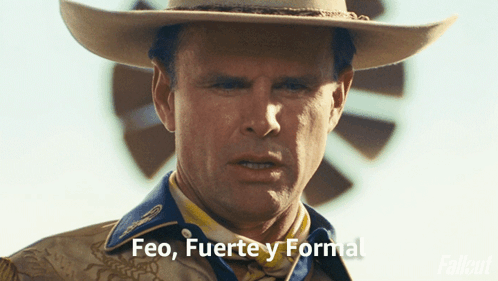
Two examples of the “poetry” (or at least good writing) in the story here. First, when Cooper is filming the movie scene in which he reluctantly shoots the bad guy instead of arresting him, pay attention to the short speech he gives: “Feo, fuerte y formal…it means he was ugly, strong, and had dignity.” (This phrase comes from what John Wayne wanted inscribed on his tombstone, which itself creates some interesting connections we won’t explore here). This is exactly what Cooper becomes when he transitions into The Ghoul. Dignified, yes, but also morally questionable (if not deplorable, which seems to be Lucy’s point of view), having lost all of the ideals he held as a human.
Second, the conversation between Barb and Cooper in the hotel after Cooper’s meeting with Robert House. He questions whether Barb was always a monster or became one working for Vault-Tec. When he incredulously asks whether she’d kill millions, billions, of people to save her daughter, she responds by asking, accusatively, “Wouldn’t you?” He may not be operating on Barb’s scale (Eddie Izzard might comment that she must get up very early in the morning), but as The Ghoul he certainly succumbs to her logic.
Here is the arc as we have it for Howard–weltschmerz has rendered him nihilistic, amoral. Can his view of the world, and thus himself, be redeemed and returned to the man of ideals and principles he began as? It’s a classic story of “the Fall” writ large in the blood of countless raiders and wastelanders.
With the latest episode (S2, E6), Howard says his real name as The Ghoul for the first time. We’ve learned more of his history with Hank MacLean, and he’s rejected an alliance with the super mutants for the war that is coming. In the latter act, he’s shown us that he has not fully succumbed to his nihilism, and I expect that his betrayal of Lucy, subsequent defenestration, and need to be rescued will function as the low point from which he begins his redemptive climb. I’m excited to see!
In the last post in this series we’ll look at the Fallout universe’s satire and criticism of late-stage capitalism, particularly in comparison to the Gospel according to Luke.








 Faith, Fiction & Fatherhood