Kenning

(So I’ve been promising for some time that I’d post some short stories set in Avar Narn on the blog. Well, I’ve been slow in the writing and even slower in the editing of those more “official” stories and they’re still likely a short ways off. So, in the meantime, I’ve decided to publish the short short story below, written rough and mostly to shake the dust off, edited only slightly, and on the lighter/sillier side of things. )

(You can read this short story in PDF here: JM Flint – Avar Narn – Kenning)

“Tardarse? Why do they call him that?” Hrogar asked.

Ranald grinned. “We took on Vix when he was just a lad. His parents had fallen on hard times and we got him cheap—mother needed to keep her forge going or some shite like that. Anyway, he’d done what growing up he’d done learning to pound steel, so he had a fair bit of muscle on his scrawny frame. The boys and I figured we needed a porter and someone to tend the campsite, polish the armor, do all the shite we’d grown tired of, yeah?

“He’d been with us about a year; must’ve been about fifteen or so, and he’d fallen in just fine with the Ravens. So there we were in the west of Eldane, just about to set out on an expedition for one of the Houses toward some place o’ death and fortune; I forget which.
“It was uncharacteristically hot for the start of the campaigning season, so we hadn’t made it too far trekking that day, loaded down with our baggage train as we were. Exhaustion fell on us all and we stumbled about like shamblers as we made camp. No one talks about what shite adventuring is, a lot of discomfort and boredom punctuated by sudden terror.

“In the small hours of the morning, a facking orcene wanders into the camp, stirred I guess by the warm night air and its own hunger. Filthy facker it was, skin grey and scabrous, hair matted and mottled, coated in a layer of shite and mud, fungus growing in the creases of its gluttonous form like it had been some boulder sitting in one of valleys of the hill-country. Half again as tall as a man, and its dark eyes flashed with hatred for all things civilized and human, hungry to destroy, defile and devour.

“Apparently Marten, who’d been supposed to be on watch at that time, had fallen asleep at his post. Only embers glowed in the fire pit we’d dug and we awoke to the sounds of the monster ripping apart one of our horses with its bare hands. It’s hard to think with the screams of a dying horse filling your ears, but me and the boys have been through worse shite than that and, groggy as we were, it weren’t long before we were unsheathing swords and yelling to each other in our battle-tongue, preparing a concerted counter-attack.

“So I take a peek out of the flap of my tent, and sure enough, there’s the facking thing starting to come into the camp proper, dragging Marten by the foot. Now he’s screaming along with the damned horse and it’s getting harder to hear me mates as we form a strategy. I see our patron look out of his tent. As soon as he sees the orcene he starts facking screaming, too, like he were a little girl and you’d just ripped his dolly from his hands.

“Course, this gets the beast’s attention and it wheels around, leaving Marten and moving towards the patron. I’m just about to call the boys to attack when out facking rushes Vix from his tent, naked as the day he was born, screaming at the top of his lungs. I guess he’d taken his clothes off to sleep in the heat, but he looked like one of the wild folk on a raid into a mountain village, on the warpath to rape and pillage.

“The only thing he’s got in his hands is a wooden practice sword we’d been training him with. Bravest, stupidest thing I ever saw. So now Vix is charging the orcene and it turns to face him with a look of shock and confusion. He brings the waster down on the beast’s knee, breaking the wooden weapon and sending splinters everywhere. I hear some of the boys start laughing, and can’t help but do the same—it’s the strangest thing, this naked boy screaming like some blood-crazed berserker, the monster yelling back in sheer disbelief and the sword-stick still coming up and down like an ax, like Vix is trying to chop down the tree of the monster’s leg. Only it’s not really that funny, because we’re about to watch this boy die.

“The orcene raises its hands to smash Vix, and I’m sure I’m about to watch the boy’s head explode like a jar of jam. But Vix takes the opening and facking swings the fragment of the wooden sword in a rising strike at the creature’s groin. There’s a sickening splunch as the stick connects with the beast’s stones. As one, the men of the Company grunted in sympathy; enemies though we were, no man wishes such a wound on another.

“Like he’s some facking dancer in a mummery, Vix rolls between the thing’s legs before it brings its hands down to its wounded manhood. Now it’s screaming louder than the horses or any of us, doubled over and clutching at itself as you or I would do in its place.
“And Vix, this look of grim determination on his face, like he’s never facking heard of that thing called fear, walks his way back around to the front of the beast while it’s distracted and proceeds to stab the facker in the face with the stub of the wooden sword, spraying blood and ichor across him as he destroys the thing’s eyes.

“The orcene’s unsure whether to protect its manhood or its face, and I swear the thing’s sobbing to itself. Now it’s the one who’s scared, and Vix is going about his business like he’s facking saddling the horses, taking his time and—ask the boys—humming to himself. He walks over to me tent and picks up a spear I’d leaned against a nearby tree. He’s still buck naked, mind you, and he looks up at me, surprised to see a human face. The shock of the recognition drains the calm from him and he starts to shake as his nerves take hold.

“‘Finish it, boy,’ I tell him.

“Still shaking, he readies the spear in both hands and charges the orcene, jumping at the last moment and bearing the spear in a downward arc that pierces the monster’s neck, driving the facker onto its back and pinning it to the Avar. There’s a fountain of blood spews up from the wound and covers the boy, and now he really looks like one of the wild folk all painted up on a raid from the mountains.

“The boys and I come out of the tents hooting and clapping and carrying on like we’d just seen a show in an Altaenin brothel. Apparently, this scares Vix and he lets out a shrill scream as he turns to see us. This scares him after he’s brutally and efficiently skewered a monster that by rights could have given us all a good fight. Now he’s trying to cover his manhood with his hands, like he’s some virginal maid we’ve come upon bathing. He’s got this stupid look on his face like he’s done something wrong and he’s about to get whipped for it.

“Marten wraps an old cloak around him and hands him a mug of ale. ‘Faaaaaack. Stupidest thing I ever saw,’ Marten’s telling him, ‘that thing could’ve smashed you to bits. What in the Abyss drove you to such a thing?’

“‘I—I thought you was all dead,’ Vix stutters. ‘I’s angry is all, I guess.’

“‘Tardarse,’ Greygan says, smiling. ‘But better stupid than good, I ‘spose.’

“And it stuck. We all called him Tardarse from that point on, and he was one of us. Not some porter or servant boy we brought along to ease the hardship of travel, but a man of the Company. A Raven. It wasn’t the last stupidly brave thing I’ve seen him do and survive, neither. There’s good Wyrgeas on that one. Got to be, as much trouble as he gets himself into and finds a way out again.”
Writing “Race” in Fantasy

Every aspiring fantasy author or worldbuilder must eventually answer the question of what kind of sentient beings will populate his or her world. At that juncture (again) myself, I thought I’d write my way through the problem(s). I’ve agonized over and over again in designing Avar Narn about what “races” (they should really be called “species,” I think) would occupy that world. I’ve made changes and undone them, remade them and tweaked them over and over and (I hope) I’m ready to finally make the decision once and for all. We’ll see at the end of this post.

So what are the problems about “race” in fantasy works?

(1) Ideas of race have meaning and are problematic. Since you’re on the internet to read this, I’m going to assume that you’re aware of how big a deal race currently is in our world (and in the U.S. in particular). How we discuss and think about race is important, and it’s quite easy to make a misstep.

From one perspective, having various races (I’m just gonna say species from now on) in your fantasy world can do a lot for you.

First, the genre is called “fantasy”—readers want to see the fantastic. It’s part of the fun. Second, you have an instant source of potential conflict (and therefore plot) when you have groups of people (in this case fantastic species) who are unlike one another.

If we want to be highbrow, the encounters between different species allow us to look at “otherness” (to borrow the academic term) in a lot of interesting ways—we can analyze and critique how we (by our culture, our ideologies or our very humanity) define and react to the Other. We can, if we want to be heavy-handed, even talk about specific races race-relation issues in the real world through the metaphor of created fantastic species. To be honest, I’m not sure how you could portray enslavement in a written work and not have an American reader not think about the historical slavery of blacks, and the line between what is said about slavery in general and what is a specific commentary on the experience of a particular people is blurry at best.

At the same time, when we create a fantasy species, we have to bring them to life and individuate them. It’s no use saying “these people are like humans, but they’re blue and have an extra eye.” If our differences are only cosmetic, readers will be understandably disappointed in the lost opportunity. But defining peoples and cultures is difficult, and it’s tempting to resort to shorthand: “These guys are like Tolkien’s orcs, but they’re more intelligence and have a culture like ancient Egypt.” Time constraints and a desire to give the reader quick access to understanding of a story push us in this direction. But there’s a trap here—this sort of cribbing can easily drive us to base our fantastic species off of racial stereotypes.

Even Tolkien was guilty of this. He later acknowledged without reservation that the dwarves in his stories had a lot in common with European Jews. Re-read the stories (or re-watch the movies) and think about that—Tolkien’s dwarves have big noses, are geographically displaced, are often greedy and selfish. If the dwarves weren’t such beloved characters, we’d really see some elements of anti-Semitism here. I’m not saying that Tolkien was anti-Semitic; I have no idea about the answer there. But if it’s possible to say that his portrayal of the dwarves perpetuated negative Jewish stereotypes (mostly medieval ones that somehow persist in this case), something negative has been accomplished through writing, and that’s to be avoided.

(2) Clichés. Look at some of the most popular works of current fantasy fiction (A Song of Ice and Fire and The Name of the Wind both come to mind) and you’ll see settings in which you will not find elves and dwarves and Hobbits. There are several reasons for this.

If you want to have fantastic species in a setting or story, ask yourself, “why?” really. Can you tell the same type of story (or even the exact same story) with humans instead of different species? In most cases, the answer is “yes.” If there’s an Occam’s Razor of writing, maybe this is where it best fits—don’t put things in the story you don’t need. That advice sounds really good, but that doesn’t mean I can bring myself to follow it, necessarily. Sometimes there are things I want a story to have.

The more important reason, I think, that there’s a current move away from fantastic species in modern fantasy, or at least the “standard” species (elves, dwarves, halflings, etc.) is that the portrayals of these species has become hackneyed. We’ve had the same pointy-eared elves and pseudo-Norse dwarves for seventy years and, after a while, that starts to lose its fantastic luster.

This is partially a result of Tolkien’s looming presence over the genre—if you’re not doing it like him you’re not doing it right—but it’s also a result of the influence of Dungeons and Dragons. Multiple generations of fans of fantasy have grown up with the roleplaying game’s definition of elves and dwarves (influenced, of course, by Tolkien) setting the standard. We writers now must worry that, if we change the stereotype, readers will say, “that’s not what orcs are like!” while established writers (and many readers) also say, “if you’re using the same old stereotypes, you’re not writing something worthwhile.” I don’t think that the latter statement is necessarily true, but the risk of writing overly-derivative works certainly increases with the use of the “stock” fantasy species. As an aside on that note, perhaps we could argue that the “stock” species should be thought of in the same line as Commedia dell’Arte: as stereotypes that allow us to quickly pull in the reader and get on with the story. After all, avoiding an infodump is usually a good thing.

To be clear, there are modern writers doing wonderful things with (at least mostly) traditional stereotypes. The books of The Witcher world contain elves and dwarves but manage to depict them in a believable and relatable conflict with humanity (that disturbingly resembles a race-war, because it is one). Of course this works especially well for Sapkowski in the larger context of taking traditional fairy tales and twisting them for his own purposes.

(3) It’s impossible to get inside the head of ultimately alien creatures. As humans, we simply cannot fathom what it would be to be a thousand-year-old elf with confidence in her immortality. How differently we would view the world.

To be fair, that’s a surmountable obstacle. We also cannot create a character who is actually every bit as complex and idiosyncratic as a real person. But we can create the illusion of the same. The same principle applies to writing about fantasy species (or alternatively, alien cultures in sci-fi settings)—we can create the illusion of unfathomable otherness.

Though crafting the illusion is possible, it’s nevertheless very difficult. It requires great care and thought to do well, otherwise you end up with phenotypically-variant humans and nothing more.

It’s not enough to give them a culture based on human cultures, I think. If you’re going to create species that really deserve to be something other than humans, they should really feel different, probably even uncomfortable (but not necessarily frightening).

(4) Complicated Relationships. I grew up a big fan of the Shadowrun setting. One of the things that bugged me about it though, is how they treated race. By this, I don’t mean the fact that there were Orks and Trolls and Elves and Dwarves, but about the ethnic differences we tend to mean when we use the word “race” in modern context. The Shadowrun rationale was just too simplistic.

The explanation went something like this: “Twentieth-century racism is a thing of the past. People don’t care about someone’s skin color anymore when the troll over there can crush you with his bare hands.” In other words, the existence of the alternative species of the Shadowrun world had completely subsumed “traditional” racism.

There’s no reason to believe that that would be the case even if people in our world were to suddenly turn into elves and such. There’d still be plenty of “good ol’ fashioned racism” to go round.

This is just an example of a problem that’s really inherent to all fantasy writing–the need to balance complexity with both the writer’s time and energy and the importance to the story.

(5) Monocultures. This relates closely to (4). Humans have a diversity of very different cultures, ideologies and values, but fantasy species tend to be portrayed as monolithic. This practice is most prevalent, at least in my experience, in roleplaying games. A setting may have many different human cultures for players to choose from for their characters, but only one for any character of a non-human species. Sometimes there are two or three options, but these are not terribly fleshed out and are based more on in-game bonuses than real cultural differences. The ad absurdum example, of course, is early D&D, where you could have either a class (magic user, thief, fighting man) or a “race” (like elf). That’s right, all elves are so similar that they need only the name of their species to define their abilities.

The point is, believable species must have individuation between groups and between individuals. If you’re using elves in your fantasy world, they shouldn’t all be flower-loving hippies (or, even more offensive, all be evil if they happen to have black skin). It takes extra time, yes, but if you’re going to be using fantastic species in your writing, they ought to be diverse like humans are diverse (or there had better be a good reason why they have a monolithic culture).

(Potential) Solutions

(1) Avoid the subject altogether. Just don’t use fantastic sentient creatures. Throw in all the griffons and gargoyles and what not that you want, but leave the thinking, feeling characters human.

(2) Cheat. Here’s what I mean: in Avar Narn, several of the fantastic species used to be human—they were reformed, accidentally or on purpose, willingly or not, by magic. That’s happened long ago enough that they’ve developed somewhat alien perspectives on existence and certainly cultures that vary from those of most human cultures, but it leaves within them a core of humanity that somewhat eases the problem of creating an entirely alien culture—humans will definitely be able to relate to these beings on some level, but not completely. One of the reasons that I’ve chosen this path for some (but not all) of the fantastic species in Avar Narn is that it reinforces one of the setting’s themes—the horrible things that humans would do to themselves if given the power to reshape the world through magic.

(3) Be defiant. Just say, “Damn the torpedoes; full speed ahead!” and use the traditional fantasy “races” in your stories or setting. If you write those peoples in a believable and interesting way, and especially if the other aspects of your stories are well done, you won’t have to worry about most people complaining. Ignore the ones who complain anyway.

(4) Use alternate mythologies. Tolkien was a philologist, a student of (ancient) languages. He had spent a long time studying Old English and Old Norse, and he drew from Germanic mythology to create his elves and dwarves. But there are many other cultural mythologies from which could be drawn a plethora of new and interesting species to populate your fantasy world. There are plenty of authors, published and not, taking this tack, though, so move quick (this is what Miéville did in Perdido Street Station and the books that follow, for instance).

(5) Use Archetypes. Here I mean Jungian or Campbellian archetypes. I’m not sure that I buy into the whole “monomyth” thing, and I’m a little skeptical about there being a collective unconscious from which we separately derive the same concepts (fascinating as that idea is—especially for fantasy writers). But there are some very common “places” occupied in various mythologies around the world—there are “hidden folk” in both Scandinavia and Southeast Asian countries, smith creatures in all manner of cultures, creatures to be sought for wisdom in many mythologies. So, find those common themes and, instead of drawing upon an existing mythology to find your fantastic species, create your own that fits the motif. Both dwarves and giants are associated with smithing in various European cultures, so what other type of creature might fit there?

(6) Do the twist. Take a traditional fantasy race and tweak it until it’s either an interesting and innovative take on the species or no longer resembles the original concept.

(7) Use biology. Look to how organisms develop and change based on environment and use that to create your fantastic creatures. There’s a caveat here, though—you’re creating a world that readers will be willing to suspend disbelief for, not an alternative science textbook (unless, of course, that’s your postmodern, avant garde sort of writing style), so use what you need and maintain plausibility to the extent you can, but don’t worry too much about having things perfect. And avoid the math. For the love of God, avoid the math.

(8) Create from scratch. This is not “create ex nihilo,” which humans are incapable of doing. But, if you take your building blocks from less-visited wells, you can create something that feels different and unique.

(9) Relax. At the end of the day, the important question is not whether you include or exclude elves in your fantasy—it’s whether you craft a world that seems to make sense (that is at least internally consistent and plausible-seeming based on human experience), craft species and characters that are entertaining and interesting to read about, and tell stories that draw the reader in and make him not want to finish. Can you do that with stories that include elves? Yes. Can you do it with stories that have unique fantasy species? Of course. Could you do either badly, absolutely. So suck it up, figure out what you want to have in your world, do your homework to create diverse and interesting inhabitants for your setting, and get writing.

Have I made my own decisions now? Not exactly, but at least I’ve given myself the kick in the pants I needed to make my final decisions and let it ride.

Avar Narn

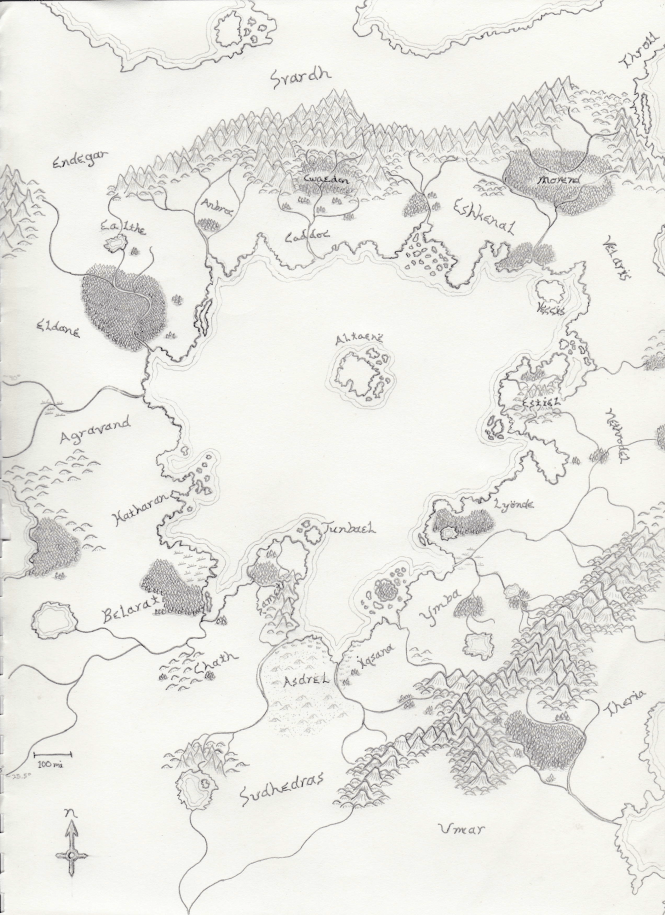
Avar Narn Hand-drawn B&W Complete.png

As most aspiring fantasy writers do, I think, I have had for over a decade a fantasy world being built inside my head. For more than a decade, I’ve called that world Avar Narn.

There have been major changes and reworkings to the world over time, and it is currently under what I hope is its last set of major revisions before I’m content enough (emphasis on enough–I’ve discovered, if only recently, that if I wait for it to be perfect it will never go anywhere) to start writing seriously within the setting for publication. In fact, I hope to soon finish editing on a few short stories set within the Avar that will be posted to the blog.

Avar Narn is an eclectic place, influenced as it is by a wide range of authors. It’s neither Tolkien nor Martin, but the influence of both are undeniable. There’s definitely a streak of Miéville (one of my favorites for so many reasons) and, I think, some tone if not theme borrowed (stolen, really) from Mark Smylie’s Artesia graphic novels and setting. Undoubtedly, my long experience with various roleplaying game settings has formed some of my opinions about what makes a good fantasy setting. I could go on, but it’s perhaps best to let it stand on its own rather than to list a bunch of people whose works I can strive for but about whom I make no pretentious affectation of emulating.

Like Tolkien and Lewis, my faith is an important factor in the design of the world. Unlike those fine gentlemen, I prefer my theological assertions to be a bit less heavy-handed. I do not want to use the Biblical narratives as the core of my plots, nor do I want my works to come across as a form of thinly-veiled apologetics. My hope is that the ways my faith influences my worldview will come out in the types of stories I tell and the style in which I tell them–speaking to the human condition as I understand it without making the story an argument of faith.

I have lofty goals, as fantasy writers should; it will be for readers to judge how well I achieve those goals. Foremost must be the telling of great stories that delight and inspire the reader to think about life and existence. Along with this is the desire to participate in that ephemeral but satisfying practice of mythopoeia.

I am not an artist by any means, although my latest pursuits in world-building have given me the desire to become one. I’ve acquired a small Wacom tablet, some decent drawing pencils, an artist’s sketchbook, a subscription to an online drawing class and several instructional books. As my first significant effort, I’ve created the above hand-drawn map of the area of Avar Narn where most of my stories for the foreseeable future will take place. It’s not bad as a first attempt, though it could be much better and I learned a lot while doing it.

I’ll likely be posting more about Avar Narn soon, along with the promised short stories. For now though, I hope this map takes you back to your childhood, looking at the maps in the Hobbit and the Lord of the Rings, or those of other fantasy stories, in wonder and excitement. It does me.

Worldbuilding: An Education

Before I went to law school, many people (all lawyers, so understand the bias) told me that formal legal training is the best education you can get, regardless of whether you practice law. Law school was an excellent education; one that I’d never wish on anyone.

Still, I think that there is a better education to be found in the world—particularly with the availability of the internet, e-books (free through your library) and other high-speed, low-drag materials. That education is the art and practice of building fantastic worlds.

For me, most of the things that stick best with me are the things I learned for myself, through my own motivation, initiative and follow-through. This likely has something to do with increased investment and meaning in the subject matter because of the intrinsic motivation to study it, but the reason why the subjects I seek out to study seem to be better retained don’t really matter. I do believe, though, that we live in an age where, with resolve and resourcefulness, one can learn almost anything without setting foot in a classroom. Snorre, our exchange student last year, learned to play guitar by watching YouTube; by the end of his stay he could play Hendrix, Zeppelin and B.B. King.

Worldbuilding has become a more mainstream (though not really mainstream) hobby in recent decades. This has to do in part with the internet allowing people with similar interests to easily find one another, the increase in popularity in roleplaying games (probably the greatest single motivator of worldbuilders), the move of the fantasy and sci-fi genres into mainstream culture and, as I’m doing here, the relative modern ease of getting your ideas and creations to the world.

For many, as for myself, worldbuilding started as a means to an end—I wanted a setting to write stories in and to run my roleplaying games in (although I’ve found that, since the two mediums have broadly different goals, the same setting isn’t necessarily suitable for both). Once you start, however, the seduction of creation for its own delight may easily take over. There are some who will admit that they build worlds simply because they love the creation of fantastic peoples and places; these are an honest bunch who probably derive the most pleasure from worldbuilding, enjoying the thing for what it is.

But this post isn’t about how to derive pleasure from worldbuilding (although, with all the writing that is done nowadays on the subject, why does no one talk about this?); it’s about the education worldbuilding gives you.

Quite simply, building a world requires some knowledge of everything. You need at least passable understanding of language, culture, religion, history, geography and cartography, psychology, mythology and folklore and the sciences to create a world for which people are willing to suspend disbelief. Start there, and you’ll quickly find the things you’re really interested in. For me, it’s history, literature, legend, religion and historical occult beliefs (things which, conveniently—or perhaps causally—I studied formally); these are the subject about which you will seek to become something of an expert to make your world “stand out.”

Then there are all the beautiful rabbit trails of things that you could probably fudge and have a reasonably believable fantasy world but which add much to the world if they’re well-incorporated: astronomy, anthropology, archeology, warfare and military history, the attributes of fringe social groups, specific interesting human histories, the art of writing itself, the geo-sciences (including advanced geography, weather and climatology and much more), technology and almost other possible realm of human knowledge.

If you catch the bug to build a world of your own, you’ll find yourself asking many questions that spur research: Why does this sort of thing happen? How does this work? What would this kind of society be like? How would this event change the world? Or, as I found myself asking this morning: Where is it that swamps usually form?

The task in and of itself is a daunting one—not simply because of its scope, but also because of the thorough and excellent work that others are doing and displaying on the internet. The real bugbear, of course, is Tolkien, who has caused us to mistakenly believe that a created world is only a good one if we have invented and codified each of the world’s languages, written down detailed histories of all of the peoples (the History of Middle Earth edited by Tolkien’s son is twelve volumes) and that everything must be clearly defined and described in writing for posterity. We have to keep in mind that, realistically, Tolkien was a worldbuilder for worldbuilding’s sake; his stories, though beloved, were derivative of his worldbuilding. He did not build Middle-Earth so that he could publish books.

If, like Tolkien, our worldbuilding is really for our own pleasure, it can be as detailed or shallow as we like, as fanciful or as serious and deeply believable (for fantasy, of course) as suits us. We can write as much or as little of it down as we want to keep and share. All the extra work of cataloguing and consigning to words our creation is optional. We need only go so far if (1) we enjoy doing so or (2) we have a specific use for the created world that would benefit from writing down its details for later reference.

Given that, anyone can be a worldbuilder without an over-investment of time and energy. You can craft your world while driving in the car, standing in line, waiting for something, working out or doing all manner of other thing. If you don’t want to write it down, worldbuilding is simply an advanced game of “What if?” you play in your head.

Most of the greatest advice I’ve ever received in my life I got as an off-hand statement from someone else, probably because that person had so incorporated the idea into his mindset that it seemed too obvious to need special attention called to it. While studying medieval and Renaissance literature at UT Austin, Professor Frank Wigham advise his class to “be interested in everything.” I’ve tried to follow this advice since and have found that the pursuit of some knowledge of as many subjects as I can manage has thoroughly enriched my mental life—for the knowledge of itself, for the new ways in how I see the interrelation of things and ideas and for the strange ways an understanding of one subject helps one to think about other subjects.

This is the reason I recommend the hobby of worldbuilding to everyone; the practice gives you some tangible reward for taking in interest in all aspects of existence. If you haven’t done it before, give it a try. This time next week you might be spending hours following rabbit trails through Wikipedia as you research little-known cultures and peoples (look up the women-warriors of Dahomey, for instance), visiting the library (in person or electronically) to find deeper and more nuanced sources than what you get from the internet, imagining places for you to play in imaginatively for years to come. You will become interested in everything, and better for it.

Writing is Hard

I spend a lot of my life writing, whether for work or for pleasure. Both as a critic of other writing and someone often frustrated by the task myself, I feel that I can definitively say that writing is just plain hard. But why? Let’s take a look.

Complexity

Language is one of humanity’s most complex inventions. Words are symbols for things, not the things themselves. As representatives of things and ideas, there is necessarily some amount of slippage between the word and the thing itself as we try to use words to capture meaning. The study of symbols in language is called semiotics; the field combines statistical research, philosophy and a number of other approaches to investigate how we use language to transmit meaning and ideas.

Readers of the “Faith” section of the blog likely know that I’m very interested in the importance of ambiguity. In terms of language, we ought to recognize that there is ambiguity inherent to any use of words to communicate ideas, because the idea must be translated to words and back to ideas between two otherwise isolated consciousnesses.

I feel like I could really stop right here, because this, more than anything else, is why all use of language is difficult. But, wait, there’s more…

Obscure Rules

Even those writers with natural skill and a unique voice may find themselves confused by the many rules of grammar and syntax.

Partially this is the fault of history and the credulity of the masses. English, at least, has a number of arbitrary rules that some slavishly seek to enforce without knowing their origin or purpose. For instance, the command never to use a preposition at the end of a sentence (famously mocked by Churchill) comes from Bishop Lowth, writing in the 18th century and following the example set by the author John Dryden. The two felt that sentences terminating with prepositions were less graceful than those that placed prepositions antecedent to the sentence’s conclusion.

This is an excellent example of proscriptive rules about language—do this; don’t do that. Grammarians of the 17th and especially 18th centuries loved to create rules about the use of language in the haughty expectation that they were improving the language over past usage. We have collectively forgotten the reasons for such proscriptive rules while still obeying many of them.

Other rules of language are descriptive—the way English speakers convey this idea is through this language, though technically correct, people don’t say that. The issue we run into here is that usage naturally changes over time, and arguments are bound to ensue between “progressive” language theorists and “traditional” language theorists. I think that there may be something instinctual about taking a traditional stance here, something about preservation of unity of tribe or something—think about how often we groan when we hear what new words (that we’re all using) have been added to official dictionaries.

Even when we’re not arguing about rules and the reason for them makes sense, there’s a lot to remember. Does that comma go inside or outside the quotation marks? Do we just add an apostrophe or an apostrophe and “s”?

K likes to tese me that I have “three degrees in reading and writing” (which I suppose is mostly true), but I still have to look up rules of grammar on occasion, and I certainly still make mistakes (much to her delight).

Add on to this societal judgments based on a person’s mastery (or lack thereof) of the arcane vagaries of outmoded rules of structure in writing—and the nervousness that comes along with our understanding that, whenever we write, people will judge us for the quality of our writing. Usually when they do this, they’re not judging us as writers but as people. What’s your social class? Where are you from? How educated are you? How traditional? All of these things (and more) come out in our use of language, both confusing the way our words are received and pressuring us to conform to expectations in the use of language.

Substance and Style

There is, overall, an illusion that substance—that is, the subject and material of a writing—and the style of a piece of writing are separate and distinct categories. I used to have the thought that “I’m a good storyteller, but not a very good stylist” and believed that that would be passable in success as a writer.

Nothing is farther from the truth. Great storytellers are those whose mastery of style facilitates the story that they tell, matching the substance and enhancing it.

Good style in writing is a mysterious thing; part science, part art, part soul of the writer. We must combine study and practice to discover our own personal style, but this style must also be objectively effective for us to successfully reach an audience. This, I’m finding, is a slow and painful process, because we must make mistakes, suffer mediocre results and push through disappointment on the long road to developing that style.

Further, our style must be adaptable—no one style fits all manner of writing, even within the same “type” of writing. My professional style of writing (as a lawyer) must adapt based on the purpose of the writing, my audience and the circumstances. As a fiction writer, my style must change based on the dramatic and narrative needs of the story being told.

So how do we develop style that blends with and augments the substance of our writing? Personally, I’m trying a shotgun approach—a little bit of everything below to see what sticks. We can study the Greco-Roman categories of rhetorical techniques (many of which you studied in high school, like metonymy, its sister synecdoche and the more obscure apocope). We can read great writers and find ways that we can emulate them in our own voice (but we must beware “maverick theory”, see below). We can read books and take courses on writing style and techniques, whether seeking an MFA or reading books like Bill Walsh’s Lapsing into a Comma. We can read essays by successful authors for useful advice. We can simply practice until we find what works.

Audience, The Unknown Variable

Unless your writing for someone you know very well, and perhaps even then, it’s impossible to predict exactly how a reader will interpret your words. One certainly can’t account for all readers taking your intended meaning, though we can probably hit the majority by playing probabilities with style and dramatic effect. Still, it’s rare that you have information and skill enough to tailor your words to a specific audience in the way that will have the maximum effect.

Dead Text

For some reason, I only here people talk about this with text messages. Perhaps it’s because no one writes real letters any more or because people treat emails like text messages (even in a professional setting). Most likely, it’s because our text messages are so often use as surrogates for face-to-face (or even phone) conversations. No aspersions here; I’m one of the worst offenders on that front.

That said, it’s difficult to convey intent and tone with words, because we are conditioned to react to vocal patterns, timbre of voice, gestures and other body language and a whole host of other clues as to the meaning of the spoken word. That’s simply not available in written language, which is not necessarily a bad thing from the standpoint of fostering a reader’s imagination. On the other hand, it makes conveying meaning especially difficult as we must not only attempt to convey actual intent but also actively avoid misleading messages of tone and intent.

Maverick Theory

This one’s particularly about fiction-writing.

Particularly in the United States, we have this cultural idea that people who are good at things can get away with stuff that wouldn’t be tolerated in those of lesser skill. The idea is prevalent in our stories; I’ve named the idea for Pete “Maverick” Mitchell in Top Gun, but you can find it in many genres: Axel Foley and John McClaine, Sherlock Holmes (and, of course, Dr. House), Jack Bauer, Ferris Bueller, Doc Brown, etc., etc.

Here’s the problem. Being really good at something doesn’t make it forgivable to be a jerk and to treat yourself as entitled to things that others aren’t simply because they’re not as good as you. I’m sure that you have personal examples of this in your own life, where people expect special treatment because of a particular process or reputation.

There are writers who flout the rules, refusing to use quotation marks (Cormac McCarthy) or capital letters (e.e. cummings) or preferring an abstract, almost nonsensical stream of consciousness (I’m looking at you, Joyce), to name a few.

Combined with this cultural idea of the badass who breaks the rules, there’s a temptation to believe that one has to make some defiant stylistic choice to mark one’s genius to others. Maybe I’m just not that kind of risk taker, but I typically find it obtrusive and petty to see the rules (such as they are) of writing snapped—it’s far more fun to see them bent.

Conclusion

That’s certainly not an exhaustive list of obstacles to overcome in writing, but it does hit some high points. At the end of the day, there are few truly good writers in the world, even amongst published authors. This is partially because the craft is so difficult, but also because we don’t really devote enough time or respect for those who write well (though we’re happy to lament how many do not). Writing well takes a lot of practice, and we seem to think that our time is better spent elsewhere.

For many of us, perhaps it is. But imagine a world where everything—everything—that is written is written in the most precise, complete, concise and informative way. Think how much time and confusion we’d save, how much better ideas would be expressed, how much easier it would be to learn new things, how much better our stories would be. In short, think how much more alive life would be.