Infinite Recursions

I think it was Stephen King who wrote or said that, if one wants to be successful as a writer, one needs to writing like a (second) job. I’m not one for taking people’s advice on reputation alone, especially on something so deeply personal and resistant to generalization as writing. Nevertheless, I think (maybe “worry” is a better word) that he’s right.

In light of that, I’m considering starting a Patreon. Through that medium, I’d add some focused posts on my personal worldbuilding endeavors, including fiction and roleplaying rules for those settings. Avar Narn would, of course, be a particular focus, but I also have a handful of additional settings I want to develop—especially for roleplaying (mine and others’). Posts would be at least weekly, with deep dives into aspects of setting, maps, and much more for the enjoyment and use of patrons. I don’t know if I really have a critical mass for something like that to work, but I think it would be useful to me in several ways. First, the deadlines and accountability this could bring me would, I think, help my productivity.

I’m also reminded of a story about a Russian agent working for CIA case officers at the height of the Cold War. He’d regularly ask his handlers for money in exchange for his services, increasing the amount that he wanted every time he asked. Eventually, the Soviets found him out and did what they always did to suspected spies. The CIA officers rushed to his apartment to strip out anything that could link him to others before the KGB could recover it. As they did so, they found all of the money they’d paid him. He had never been the mercenary they’d expected; the money was his way of ensuring that the information he passed to American spies was worthwhile and valuable.

I’d like to think that that’s how Patreon would work for me—as a tangible indication that people are actually interested in my creative work. It would be nice to have some associated income—either to allow me to devote more time to writing and other creative endeavors or to invest in the settings themselves—for artwork and other needs that could allow me to produce professional-grade works—but I don’t expect the income derived therefrom to be a life-changer.

One of my reservations about taking the leap, other than the possibility that a lack of response becomes a de-motivator, is some release of creative control over my productions. Which leads me to the title of this post.

As I was thinking about the prospect of a Patreon, of what it would practically look like, I realized the fallacy of thinking about absolute creative control. Once a piece of art or writing is shared with others, it irrecoverably shatters into a number of pieces equal to the number of participants in the setting.

There is no single Middle Earth, no one Marvel Universe, no absolute Star Wars (just ask Disney). And this goes well beyond fanboy-ism and head cannon—the “feel” of a setting is going to be unique in some inexplicable way to each experiencer, even before we talk about fan fiction or roleplaying games set in that world.

And that’s not a bad thing—it’s a really fascinating one to think that every fictional world becomes infinite worlds, recursions of varying degrees all riffing in some core ideas.

Like all things, that makes the creative act both deeply personal and necessarily communal if it is to be enjoyed. That dialectic speaks to my soul, if I’m going to be honest, and all my worries about whether other peoples’ ideas creep into my own creations seems stupid, honestly, in the light of our corporate relationship between a setting with all of its idiosyncrasies created by our own idiosyncrasies, and the relationship that creates between each of us.

Frankly, it makes me want to create more, write more, give others more setting to make their own in their various ways and enjoy.

I think I’ll give Patreon a shot. We’ll see what happens.

Things Unseen: After-Action Report

First and foremost: Thank you to those of you who’ve accompanied me in this process, whether reading online or off, whether sharing your thoughts with me or not. Every “like” on a chapter post gave me motivation to keep writing. I cannot say how much I appreciate your support.

It ended at 150,794 words, six weeks after I’d planned to be finished. The last bit was hard to slog through, honestly. Not only because life–as it tends to do–intervened to make sitting to write more difficult, but also because the more I realized how significant of rewriting I was going to need to do, the harder it became to sit and write an ending I knew would be subject to change, potentially drastic change. So yes, I rushed the ending. Badly. For that, I apologize.

But, I decided that there was great value to finishing the first draft in its entirety, regardless of how satisfied with it I was, and that the sense of accomplishment for doing so, however small, would be an important motivator in starting the difficult work of getting the text to where I might consider it being “great.”

I’d call it a solid “okay,” as it stands. I’ve read some things that managed to be published that I think, even in its current state, this text is better than. But that’s not saying much. And I don’t really want to be a “passable” author, I want to be a brilliant one. That’s going to require a lot more work on my part!

The good news is that at least have a solid idea of how to get there. If I had to sum it up in a phrase, the novel needs “more and less.” On the “less” side, I need to cut out some of those parts that don’t really pull their weight with regard to the main story. This includes the trip to the Crimson Close and the fight against the Child of Daea. As much as I enjoyed writing those chapters, and as much as they provide some important background to the world of Avar Narn, I think that they take up space that could be better devoted to focusing on the core story of Orren’s spirit and the interlocking desires and machinations of the people of Vaina.

And that’s where the “more” comes in. I need to deepen the characterization across the board, build more depth for the interweaving plots of the suspect and involved characters. The whole story needs to be “tighter” in that regard; gaps need to be eliminated between the logic of events and the storytelling. Which is not to say that I intend to cut out the jumps from one scene to another so much as to more carefully consider the pacing.

To that end, I’m considering this first draft more of a very extended plot outline than a full draft. Where I can, I’ll be pulling from scenes as written to form jumping-off points for rewrites. But first, I’m going to do my own readthrough, distill each chapter to its plot points as an updated outline, and then use that to create a new outline that goes not just scene by scene, but beat by beat, notating for intended “feel” as well as plot and for the sensory details and descriptive elements I want to include.

I’ve written several times on the blog about the approach to writing as “brain hacking;” that good writing carefully constructs the string of thoughts and emotions in the reader. I don’t want to commit to that thought as the One True Way of writing, but I do feel that it describes the approach I think I need to take to take the novel from “meh” to amazing. And I’m really just not willing to settle for less.

It’s going to be a lot of work, but I’m looking forward to it. I hope you’ll continue the journey with me.

Tom Clancy’s Division Tabletop (Fate) RPG

I’d been recently gearing up to run a tabletop game (using the Fate RPG) set in the world Tom Clancy’s Division. First, my potential players asked for more granularity than Fate usually offers, so I created the attached rules for weapons, equipment and encumbrance.

About the time of getting through the first draft of the rules for character creation (and the accompanying program), discussion among us turned to the fact that this setting might just hit a little too close to home right now to fully be the kind of distracting amusement we could all use. At the same time, two of the other people in the group both offered to GM–if we played D&D.

So, this project has been put on the shelf, maybe indefinitely (I have to admit that, if I had my ‘druthers, I’d have stuck closer to the Core rules of Fate without all of the added complexity). Nevertheless, this was a very interesting exercise for me in game design, particularly in pushing the boundaries of the Fate system’s intent without (hopefully) breaking it.

Anyway, the rules I’m including here are for character creation, as I hadn’t gotten to the rest of the rules (settlements, group combat, etc.) that I’d intended to write. They could be easily adapted to any higher-granularity modern military-style game; feel free to take what you want and leave the rest.

I’ve included a character-generation spreadsheet that will help calculate all of the weapon design and encumbrance matters for you, as well as some premade weapons and archetypal character builds to provide some examples for the system as a whole.

I’d love to hear your thoughts, as I can apply comments and criticisms to my future design efforts, whether for Fate or for something else.

Division Fate Character Creation Unfinished
Fate Division Archetypes
Fate Division Character Spreasheet In-Progress v2
Fate Division Weapon Premades


How I Learned to Stop Worrying and Love the D&D

I generally don’t like D&D as a gaming system. So how did I get here? Well, given the general downtime for everyone, I started working on a roleplaying game to be played virtually with some friends. Since the Shadowrun game tapered off, I haven’t had a game running and there’s a part of me that’s just not happy whenever that’s the case.

I suggested to my friends a game using the Fate system based on the Tom Clancy’s Division games. I spent a lot of time working on some custom rules for the setting (which I’ll post in their unfinished state in a separate post) before two things happened: (1) several of us came to the conclusion that that setting probably doesn’t provide enough respite from every day life in the COVID-19 world, and (2) two other members in the group both offered to GM/DM if we played Dungeons & Dragons. I do a lot more running of games than playing in them, so, despite my reservations, I quickly agreed and we set about negotiating a rotating GMing situation, with our first game set for this Friday.

Here are some of the (admittedly subjective) reasons I’m not a big fan of D&D:

  1. I would prefer a more “realistic” rules approach to combat, particularly than large hit point pools, armor as making one more difficult to hit and no penalties for taking damage until you’re out-of-action.
  2. I don’t like classes and levels, generally. I tend to think that these constructs detract from roleplaying and character development in their rigidity. For instance, only Rogues get sneak attack bonus damage–other characters are mechanically incapable of taking full advantage of an ambush, no matter whether they’re a soldier whose survived a thousand ambushes himself or a gutter punk getting lucky with a sudden knife attack.
  3. As a corollary, D&D is a game (like Shadowrun) with a ruleset that draws me into ours of obsessive character-building to try to find the exact build that will do all the things I want it to, even while knowing that the character generation’s economy of resources won’t allow for it and I can’t (and shouldn’t) try to play characters that are good at everything.
  4. I see D&D as a system that pushes a game toward combat and the gamist side over the roleplaying side based on its design. As you know, my preference leans heavily narrativist. Basing XP on kills makes me uncomfortable on many levels–from the ethical and theological to game design itself. G.K Chesterton once wrote (and I agree): “Fairy tales do not tell children the dragons exist. Children already know that dragons exist. Fairy tales tell children the dragons can be killed.” But that’s a big leap from killing 100 orcs because, well, they’re orcs and “orcs bad!”
  5. Encounter building and levels work together in a way that, if playing strictly by the rules, makes some fights unwinnable. I fully believe that some fights should be unwinnable if the players aren’t resourceful, clever and maybe a bit lucky, but D&D as written militates in favor of a straight-up fight of hit-point attrition and forces the good GM to make-up whole cloth how alternative approaches work. Yes, we can talk about “rules versus rulings,” but I’d argue that, when we have to have that conversation at all, something it lacking in what the rules are communicating. That’s not to say that rules should address every eventuality and should be rigidly followed–far from it. The problem here is that the D&D books might say that they encourage this kind of player creativity that requires responsive and flexible GM/DM adjudication, but the rules give the impression of the opposite, and few tools are provided to assist in making such ad-hoc judgments. Put another way, I don’t like that Level 1 characters (or 5 or 8 for that matter) don’t have a chance against a dragon simply because they haven’t ground out enough levels yet. In addition to the ways the rules are written complained of above, a skills-based system over a level-based one can go a long way in this regard.
  6. The assumption that combat is the way you overcome monsters bugs me. Why not more interesting possibilities? Ghosts that you don’t hit with magic swords but that must be banished or appeased in some other way that relies on wits and skills more than fighting?
  7. D&D Physics. This is perhaps my biggest gripe, and it’s admittedly about certain players rather than the rules themselves. Some players assume that the rulebooks represent the physics of the worlds D&D games take place in–if something is technically allowable by the rules as written, no matter how ridiculous, then it’s a loophole in the spacetime continuum that should be exploitable by a player. One example: the player who thinks that, as long as he succeeds at a Deception/Persuasion check, he can convince anyone of anything, no matter how blatantly untrue or unlikely. Another, from 3.5e: a ladder costs less than two ten-foot poles, but is comprised of two ten-foot poles plus some other stuff. You do the math. If I remember correctly, in the forward to The Riddle of Steel roleplaying game (an amazing game on many levels, if not the easiest to run), Jake Norwood described a game of D&D where he realized he would take fewer hit points of damage jumping off the cliff he stood atop than fighting his way through the oncoming orc horde as an inspiration for creating a game with much more realistic combat (he’s also a talented western martial artist, so he was just the type of person to write that game).

Okay, that’s a fair amount of griping, and none of it’s new to anyone. While there are alternatives to D&D (some very good ones), D&D retains the large majority of market share in fantasy roleplaying, despite decades of competition. Why? For one, it’s the only name that most would-be roleplayers know. Additionally, it’s got a special nostalgia factor for a lot of gamers my age or older and a solid place within popular culture that grows every year (2 episodes of CommunityStranger Things, the Greetings, Adventurers! and The Adventure Zone podcasts, etc., etc.). But most of all, I must admit, it’s just a fun game. I’ve played several campaigns of D&D in the past, none of them especially-long running but usually going for a few months or so, and not one of the things I’ve mentioned above really factors into my overall-fond memories of those games.

I’ve decided to enter this upcoming D&D campaign with an eye toward throwing aside some of my complaints and design differences and enjoying the game for what it is–a time-tested engine for running enjoyable high-fantasy games. The other players in my group are all fans of D&D and familiar with it (to varying degrees, but certainly moreso on average than any other system I’d choose to run) and, if all goes well, I may well commit to (personally) running more D&D for them in the future.

Okay, so how am I stopping worrying and learning to love the D&D? Some counterarguments to my complaints above I’m trying to keep in my mind as I undertake this adventure:

  1. Hit points aren’t meant to be a reflection of damage (though they often are treated that way). They’re more like Stress in Fate RPG: a narrative indicator of the leeway a character has before receiving a serious injury. A character who loses hitpoints has lost some of that vigor and focus that keeps her from being injured and comes closer to the possibility, but shouldn’t be thought of as having taken a blow (instead having barely turned it aside, etc.). There are a few points that, as a GM, I’d have go along with this: (a) narrate hit point damage as a near miss and degradation of performance but not a blow actually received; (b) use lingering injuries when hitting zero HP to drive home the fact that that’s when injuries occur; (c) use alternative mechanisms over HP to adjudicate unavoidable damage where appropriate (falling, etc.). Under this approach, it makes good sense that armor serves as a buffer to having to use up HP rather than as a dampener on HP lost, so I get a double rationalization with this mindset!
  2. Classes really are a good conceit for certain types of roleplaying games. In D&D, classes give everyone’s character a chance to shine, clear delineations of where characters fit within the team of players, and accentuate’s cooperative, synergistic play as a group.
  3. Levels can make sense, too, within the conceit of the game mechanics. If we’re literally talking about the accumulation of experience that makes adventurers better at what they do, levels are an appropriate shorthand for that, even if not the choice I’d personally make in game design.
  4. A good GM can use the rules in creative ways (or modify/ignore them) to overcome issues about the game being too combat-focused or too restrictive in the allowance of creative problem-solving, and the occasional unbalanced encounter can be a good reminder to players that discretion is sometimes the better part of valor.
  5. I tend to take a very particular approach in what I want from roleplaying games–I expect deep immersion and something approaching high art. I rarely get it, so these expectations are just setting myself up for disappointment. If I’m willing to focus on entertaining stories, interesting characters, exciting encounters and generally having fun, I’d likely enjoy running games even more than I currently do. In other words, maybe I should just get over myself. D&D is an excellent system having fun and telling entertaining stories if I forego my pretensions. I retain the belief that RPGs can lead to deep, immersive stories with significant impact on the players’ thoughts and lives–but they don’t have to be, and if my gaming friends frankly aren’t that interested in that kind of roleplaying, maybe I should lighten up and just have more fun with them! After all, I am a writer, so I do have some outlet for the deep and artistic (if that’s actually more than just pretension and something that actually pervades my writing…).

So there it is. D&D may not be my first choice of RPGs, but there are certainly things about it I like, and could potentially grow to love. Now, if I could just figure out how to build the character I want to play…

Short Update

I don’t know about you, but the present situation has me all discombobulated. I’m an introvert by nature (a “socially-capable” introvert as K likes to say), so I’m not suffering from the cabin fever that assails a lot of us (at least not in the most noticeable of ways), but this coronavirus stuff still has me off of my game.

With my work drastically slowed down, I have the benefit of having some downtime to work on my passion projects–writing Avar Narn, gaming, this blog. I’d anticipated having a lot more posts up by now, but obviously things have remained as erratic as ever for my blog schedule. I’ve got about half a dozen unfinished posts of varying degrees of readiness that will be completed and posted at some time in the not-so distant future. I’ve been spending a lot of time, though, on Avar Narn worldbuilding, some mapmaking (which I’ll perhaps put up soon) and some work on the novel–most of which isn’t ready to be shown to the public.

Hawkwood and Marshal have both been continuing to go to daycare, which has been a godsend given some very tough behaviors we’ve been dealing with with Hawkwood–a post for another time. With the church mostly shut down, K has also been working from home. Every day is played by ear, which makes it difficult to focus on creative work, especially to the extent that staying home with little professional work to do had promised. There’s much more to be said on this front (and again, I realized I haven’t been posting much on the Fatherhood portion of the site), but that will go in a future post.

That’s a quick update; I hope you are all well, staying safe, and effectively managing the stress and anxiety we are all facing.

I’ll have a follow-up post with some of my thoughts about playing Dungeons and Dragons later today, with some of my other half-finished (once completed) posts and additional items coming to you very soon!

Truth

Pontius Pilate
In the Gospel of John, the interaction between Jesus and Pontius Pilate (after the Sanhedrin brings Jesus to the Roman) ends with a question, simple, probably rhetorical, but profound. Pilate asks, “What is truth?”

It’s a literary masterstroke, the insertion of this question at just this point in the narrative. Everything over the scope of John’s Gospel, and everything in the immediately-preceding action points to just this question–what is the truth about the identity of Jesus? Coming after Jesus’ teaching but before the Resurrection, the reader is put in the same place as the characters within the narrative. In this way, the structure and content both force the question: what is truth?

Pilate’s utterance of the question perhaps reveals him as the ultimate pragmatist–a believer in the pragmatic view of truth as we’ll discuss below. For him, it seems, the importance of “truth” is what it does, what it accomplishes.

We could argue quite a bit (as has been done) about the nature, intent and meaning of Pilate’s actions. It’s common to view his question about truth as scorn heaped upon Jesus just as that given to him by the Pharisaic Sanhedrin that convicted him before he arrived at Pilate’s palace. But I’m not sure that that’s correct.

You see, after interviewing Jesus, Pilate attempts a different approach with the Sanhedrin than the scornful reading of his question would predict. He tells them the (objective) truth–at least as he believes it to be–“I find no guilt in him,” he says. As Shakespeare’s Benedick would say, “There’s a double meaning in that.” In the one sense, Pilate states that he’s found no legal culpability under which he should be punished by Roman law. On the other, though, we can read Pilate’s statement as one of cosmic import: he literally finds no sin in the man Jesus, which fits, of course, with a theological point of John’s writing.

Pilate’s willingness to tell the truth regardless of the cost (for he knows the discord he’ll sow with the Sanhedrin should he refuse their request) lacks the pragmatic forethought and sense of realpolitik the scornful reading attributes to him.

Though it’s Matthew that gives us the image of Pilate washing his hands of Jesus’ death, in John he takes affirmative steps to prevent the execution. We are told that, when the Sanhedrin’s members tell Pilate that Jesus must die because he has “made himself the Son of God,” Pilate becomes afraid, but we are not told whether this fear arises from his realization of the extent of the civil unrest Jesus has the potential to cause or because he realizes that Jesus might actually be the Son of God. I believe it’s both/and, that Pilate’s accession to Jesus’ crucifixion results from Pilate’s mistake in prioritizing the temporal world over the spiritual one (and here he provides moral instruction and warning to the reader), not simple cold-hearted political pragmatism.

If all of this is the case, there’s a very different way to read Pilate’s question, “What is truth?” It’s not a mockery, it’s the fatalistic resignation of an astute mind who both recognizes the truth of Jesus and the inevitable execution that the Sanhedrin’s “truth” requires for the sake of peace.

As a third way, we could see Pilate’s question as an exhausted complaint about the ambiguous nature of existential questions when such a cosmically fundamental question of truth lies before him. In other words, could we see him asking, “How am I supposed to know what’s true?”

The reader, in fact all persons who struggle with the question of whether to have faith in the Christian religion (and therefore the nature of Jesus Christ), must confront the same dilemma. What fascinates me in this scripture (as many parts of scripture do) is just how succinctly, how eloquently and efficiently, the Gospel writer manages to stuff all of this into a single verse (or perhaps a passage if you’d like to be a little less generous).

After all, this is a fundamental human question–as are all of the problems inherent to the various readings of Pilate’s question–applicable to all manner of inquiry into the nature of existence itself. The Bible is not afraid–as I’d argue it cannot be if it is to maintain legitimacy–to allow those fundamental questions to inform the question the Gospels ask of the reader.

Consider that Jesus has (previously in the Gospel of John) made the claim that he “[is] the truth.” Confronted with the truth of reality right before him, Pontius Pilate remains ambivalent. Maybe we should cut ourselves a little slack.

Theories of Truth
The upside to these questions about the nature of truth being fundamental to humanity is that they’ve been asked over and over again by thinkers and philosophers in various cultures and contexts. In modern philosophy, there are four main theories of truth. I’m taking the following from a lecture in Professor Steven Gimbal’s Great Course, Take my Course, Please!: The Philosophy of Humor, which has in part inspired both this post and at least one more I’ll be posting soon. You should check it out.

Correspondence Theory
Correspondence Theory is the idea that something is “true” if it accurately describes something in the objective world outside of ourselves. This is the most common understanding of truth, I think, but according to Dr. Gimbal it’s also the most “metaphysical,” because it relies on assertions or assumptions about essential qualities, the existence of abstracts and the nature of existence.

It’s also extremely metaphysical because we must grapple with all the deficiencies humans have in identifying objective reality if it exists. How do we know what we know? Can we know anything? There is a playground for metaphysicians wrapped up in this theory, despite being the one that most of us are readiest to accept.

Coherence Theory
I’d liken Coherence Theory to the idea of “internal consistency” I often speak of in worldbuilding and fiction–it’s the idea that a thing is true if it can be incorporated into the web of beliefs we have about the nature of reality without creating an irresolvable contradiction with one of those other beliefs. There’s something of this in the scientific approach as well (although there’s also something of the Pragmatic Theory below)–if new information contradicts current theories about the nature of the universe, either the new information or the current theories must be wrong, one is necessarily untrue.

I’ve also cited several times in this blog the comment in Neal Stephenson’s The Diamond Age: Or, A Young Lady’s Illustrated Primer that hypocrisy is the only way to judge someone in a morally relativistic society; Coherence Theory to me seems that idea writ large. In a world in which we have fundamentally-irresolvable epistemological questions, it may well seem that the best answer we have for understanding truth is “No hypocrites!”

Pragmatic View
The Pragmatic View (see C.S. Pierce, William James and others) focuses on the practical effect of an idea as the measure of its truth–a true statement does what it is supposed to do. The pragmatic view falls even more in line with scientific method than coherence theory–under the pragmatic view, a statement about the physical world is true if it allows us to effectively interact with the physical world (by making predictions about the effects of actions, by designing technologies that exploit aspects of the physical world, etc.).

Ironically, I’d argue that, while correspondence theory is what most people would intellectually ascribe to if asked, we tend to live by the pragmatic view. If a “fact” allows us to effectively interact with those things outside ourselves, it’s as “true” as we really need it to be, metaphysics be damned.

Subjective View
Dr. Gimbal rejects the subjective theory of truth out of hand, and I agree. The subjective view states that we afford privileged status to some statements (those that are true “for us”) and not others (those that are not true “for us”). If the subjective view is correct, there can be no meaningful discussion of truth (or much else) because, to quote the great philosopher, the Dude: “Yeah, well, that’s just, like, your opinion, man.”

Still, there’s something important about the subjective theory of truth. As a lawyer, I often have to tell clients that they have to treat the beliefs, opinions and attitudes of the person on the other side of a negotiation as true, whether they’re patently false, illogical and irrational, or otherwise unreasonable. If we’re not going to change the mind of the person we have to interact with to get the deal done, we have to find a way to work with or around those counterfactual beliefs (or a-factual ones, in the case of opinions, I suppose) if we’re going to be successful. In this (very limited) sense, there is some truth to the subjective.

There are a number of other philosophical theories of truth (like the constructivist and consensus views), but Gimbal doesn’t discuss them in his lecture and I’m going to omit them as well given my skepticism about their overall usefulness–but they are worth exploring and considering.

Modeling
It’s possible to think about truth in a different way; not as a sentence that asserts something about the nature of existence but as an approximate model of reality, a necessarily simplified analogy that is useful to us in the ways it assists us to interact with our reality. This, really, is how scientific approaches to truth work (though, as mentioned above, we might argue that this is just the result of a synthesis of the coherence and pragmatic theories of truth over a foundation of correspondence theory).

Under the idea of modeling, the more precisely and effectively a particular model of reality allows us to interact with reality, the “truer” it is. When our inquiries discover something out of joint with the model, we conduct further analysis to determine whether the new discovery is likelier than the old model to be in error. If the model is believed to be in error, we adjust the model to account for the new information, giving us an iteratively more accurate understanding of (physical) reality. By constant observation and refinement, we improve our models.

But note, even in this understanding of the nature of truth, it is impossible to say whether a model we create can ever fully capture the truth of things as they are in the universe. I’ve discovered that this makes some otherwise scientifically-minded people uncomfortable to the point that they remain unwilling to accept this point despite its logic. Whether this is a matter reflected in stereotype–that there’s just a fundamental difference in the way more scientifically-minded people and more philosophically-minded people think–or this is where the scientific mindset becomes a matter of faith rather than logic, I cannot say.

Christianity and Truth
Let’s return to Pilate’s question, “What is truth?” and the question of Christianity. Here, though, I’m not going to talk so much about the nature of truth within Christianity (I think it’s pretty well settled that the Christian ought to use the correspondence theory of truth, even if we might disagree about what that truth is in its most precise forms) as how we think about truth when dealing with those outside of our faith.

Correspondence Theory
This is the point I think most of us want to stand on when attempting evangelism, apologetics, or argumentation with those not of the faith. Here’s the problem: we are not capable of proving the key assertions of Christianity through logic. Therefore, direct and dogmatic argumentation of the tenets of our faith doesn’t come across very well. At its worst, this approach comes across as less-than-sane or as willfully ignorant.

It’s another way of looking at Pilate’s question. Is truth those things that we can hold in our hands, create and destroy, touch and taste, weigh and measure? Or is truth something harder to discern, often hidden from us and accessible only through non-logical means? Detractors might call the latter irrational, but the inability of logic to answer these kinds of questions at all means that they must necessarily be approached with non-rational means–faith, intuition, introspection, mysticism. All rules of logic point in this direction–absence of evidence is not evidence of absence.

There is, though, one very good indirect way of appealing to correspondence theory in the demonstration of our faith–the way our scriptures speak to the truth of existence in describing the way things are and in providing understanding of the human condition. Much of the advice Jesus gives us (as I’ve elsewhere argued) is not just suggestions for good behavior–he is laying out the very nature of things and telling us that, because humans work in certain ways, doing X should lead to the expectation of Y, and if we don’t want Y, we shouldn’t do X.

But nothing in faith is ever simple, and coming to an understanding of some of these ideas (my limited understanding of which is the source of most of my theological posts and my “New Mysticism”) relies grappling with all of the interpretive and hermeneutic pitfalls of Biblical exegesis: How do we resolve seeming contradictions? How do we determine the proper context for understanding certain phrases or commands or actions? How can we determine what to read as literal and what to read as metaphorical or allegorical?

In the end, this appeal is certainly a mystic and metaphysical one–it is the assertion that, in reading the Bible, one will have a genuine, if superrational, experience of existential truth by encountering God. It’s hard to argue with that kind of an experience–which brings us back briefly to the subjective theory of truth.

We should, I think, resort to an altered form of subjective truth in talking about our faith. That is not to claim that the truth itself is subjective (God is objectively God, after all), but that our experience of mystical and metaphysical truth is highly subjective in the sense that it may prove something to us in totally-convicting way without giving us any ability to use our experience to prove that same thing to anyone else. Perhaps this is a fine distinction, but in discussing the nature of reality, I’d say that fine distinctions are essential!

Coherence and Pragmatic Theories
I think it’s important that we point out that the coherence and pragmatic theories of truth, at least under certain interpretations, might be seen as methodologies for seeking understanding an objective truth (under the umbrella of a correspondence theory) as much as theories of the nature of truth.

As I mentioned above, it seems to me that the pragmatic theory of truth describes how we functionally and subconsciously think about truth as we go about our lives–world politics these days seems to indicate a solid reliance on coherence theory as well, particularly as an excuse for rejecting objective facts (yes, I realize the linguistic slippage inherent to calling something “objectively true” in this post) that do not mesh well with pre-existing beliefs. But that’s really a description of a psychological fallacy rather than a theory of truth.

Here’s the point: if we’re going to talk about the truth of Christianity to others, we need to think about the ways that they think about truth, and the ways our ignorance of that might be hurting us. Some examples:

(1) If a person’s belief system involves the beliefs that (a) Christianity is not true, and (b) Christians are [take your pick of common views: judgmental, tight-buttoned, repressed, unintellectual, ignorant, offensive, hateful, prejudiced, self-interested, hypocritical, etc.], then, under the coherence theory of truth, challenging (b) may lead to a reevaluation of (a). Two important points here. First, this is not about proving anything to anyone (as I’ve argued in a different post, I believe that it’s a beautiful fact of God’s creation that no one can be bullied, cajoled, conned or otherwise forced into genuine faith); this is about breaking preconceptions to get people to actually consider the arguments of the faith itself rather than judging it by its flawed and human believers. Second, since we’re called to not be anything I listed in (b) above, working this goal is a matter of sanctification anyway. I love it when a plan comes together.

Now, this idea is nothing new, think of the hymn “They’ll Know We Are Christians by Our Love,” itself derived from John 13:35. But it bears repeating, especially when so many Christian theologies lead to just the opposite.

As for the pragmatic theory of truth, what is our Christianity accomplishing in the world? Our claim is that, by our love of the God revealed to us in Jesus we are called to be better people, to be healers, seekers of justice, givers of mercy, peacemakers. Is Christianity accomplishing that in the world today, or are we sowers of division, too in love with our own ideas of justice and too short on mercy, too afraid to surrender our guns in favor of a more hopeful approach to the future?

This matters, desperately, because people intuitively disbelieve Christianity when it doesn’t do what it says it’s supposed to do. That’s a logical fallacy, with the believers falling short of what they’re called to rather than some flaw in the claims of Christianity itself, but some people will never come to consider correspondent claims of truth if we can’t get past coherent and pragmatic counterarguments to the truth of our faith.

And like I said above, that’s a subjective truth we have to accept as somewhat objective, at the very least a threshold issue to any discussion of the faith itself. If a person strongly holds a particular belief, let’s say that religion is the “opiate of the masses,” we can’t ever address other issues of the truth of our faith until we can address that belief–ignoring it won’t ever move us forward.

Conclusions
Truth is a hard thing–philosophers don’t even agree on what the nature of “truth” necessarily is! And that’s where faith comes in–the whole point of faith is that it is a belief in things that seem to be true for reasons that are superrational (that is, provable by means beyond our application of human logic). We need to own that logic fails in the argumentation of the faith; thus, we ought more to talk about our personal existential understandings of our own faith. Don’t tell someone why she should believe (and please, for the love of God, don’t try to convince them to believe simply to avoid some concept of Hell you’ve bought into!); tell them what has driven you to believe, where they might look if they honestly want to seek an answer for themselves. You can’t prove the faith to them, but you can point them in the direction that might give them opportunity for their own mystical experience of that metaphysical truth that transcends human comprehension and argumentation.

At the same time, think about how we humans think about the nature of truth, and all the things that our failings as Christians seem to do to add to perceptions that Christianity is not true.

“What is truth?” For the most important questions, it seems we have to find out through experience.


What Evolution Says about Christianity: Wholeness and Purpose, Not a Lack of Flaws

Oh boy, evolution and Christianity…
Let’s get this out of the way very quickly, since it’s not the point of the post: I believe in both evolution and the Bible. As I’ve argued on this blog, I believe in the Book of Genesis as a metaphorical and mythopoeic exploration of truly-important existential questions and issues, but not as a science textbook or a literal history (I’m happy to accept elements of historicity in the book, but that’s speculation that ultimately doesn’t matter too much to me). To me, both the Book of Genesis and science are true, though that word has a different context in each place. Alright, that aside, let’s get to the heart of the matter.

A Strange Metaphor?
I’ve recently finished a Great Course on earth science (specifically Professor Michael E. Wysession’s How the Earth Works). While I’d selected the course mainly for upping my understanding of planetary science for worldbuilding purposes, Prof. Wysession raised within my mind all manner of ideas and questions–exactly what a “Great Course” should do. I highly recommend it.

Here, I’m going to focus on one of those ideas from a later lecture in the series, one about the possibility of life on other planets. The lecture incorporated some of the great ideas about the exploration for extraterrestrial life in the universe–the Drake equation, the Fermi paradox, the anthropic principle, etc. Where things got really interesting to me, particularly, was Prof. Wysession’s discussion of evolutionary processes in the probabilities of finding life on other planets within our solar system.

As the good doctor puts it, there are three major parts to evolution: (1) heritable traits, (2) mutations and genetic drift, and (3) selective forces like “natural selection.” Without all three of these factors, evolutionary processes cannot work and life (at least as we currently understand it and evolution) won’t develop. It’s possible that this is the (or one of the) Great Filter(s) hypothesized as part of the Fermi paradox.

What’s important here is the relatively narrow band of circumstances in which evolutionary processes may work toward the development of complex lifeforms. Heritability requires proteins that can replicate, like our RNA and DNA. For natural selection to work, there must be diversity of genetic expressions and traits, competition for resources/survival, and a mechanism for new traits to develop–for mutations to occur.

Radiation is a primary motivator of mutation in genetics, but amount is critical. Too much radiation, and life (again, as we understand it) will be destroyed (or never form) altogether. Too little, and there’s not enough impetus for mutation and genetic drift. In turn, this means that, to be a likely candidate for life, a planet must receive a sufficient amount of radiation from a nearby star but also have atmosphere and a magnetic field that allow only the “right” amount of radiation to reach the planet itself. A magnetic field typically requires an active planetary core. Atmosphere is probably also necessary for complex life, both as an additional shield from cosmic radiation (like our ozone layer) and for the various cycles necessary to support life (on Earth, the carbon, water, and oxygen cycles, at least). It’s possible that a layer of ice or liquid could perform a similar function.

But I digress. Though it started to drift in that direction, I’m not interested in engaging (at least here) with the low probabilities of the development of life given the many factors that must be just right (which go far beyond what’s described above). Instead, I want to zero in on that second element of the evolutionary process–mutations and genetic drift.

For evolution to work, genetic transfer cannot be “perfect” in the classic sense. Without changes to genetic material wrought by radiation, copying errors in the replication of the underlying genetic structures, and other circumstances that lead to the replicated material varying from the original material, there is no genetic drift that allows new traits to form to be winnowed out by selective forces until only the most advantageous new traits remain (for that environment, of course). Given the connotations of the word “perfect”–which we often take to mean “without flaw”–we’re better off saying that the process is “complete” or “whole” than that it’s “perfect.”

“Perfection” in Christianity
Which brings us to Christianity. In Matthew 5:48, a verse that has become of extreme significance in the development of my “New Mysticism” theology, Jesus says: “You therefore must be perfect, as your heavenly Father is perfect.”

If we use the “classic” definition of the word “perfect,” I think we miss the point. If God is the intelligent creator of the evolutionary process, if that is God’s mechanism for the creation of man (and, if you believe in both science and God, I think you ultimately have to accept that as true), then the evolutionary process may tell us something about God’s thoughts on “perfection” in Creation.

The Biblical linguistics agrees. The word that Jesus uses in Matthew 5:48 is τέλειος (teleios, Strong’s G5046). It comes from the word telos (G5056, from which we get great worlds like “teleological”). The root meaning has to do with setting out for a particular destination, from there flow the denotations of “ending”, “completeness” and “maturity.” Surrounding all of this is the sense of purposefulness, that is, something that is to a particular end or goal. We might summarize in saying that the indicated idea of the word is that a thing fully becomes what it was intended (or created) to be. Which circles us back to the idea of “completeness.”

Okay, so that’s perhaps a bit circumlocutory of a method for arriving at the idea, but there is an end goal (ha! see what I did there?). I’m going to focus on several ways in which I think the reference to the idea of purposefulness or completeness rather than being without flaw is helpful to us–and truer than the idea of flawlessness.

Salvation and Sanctification
First, and most obvious, is that this idea relieves us of some stress–Jesus is not telling us to never make mistakes here. Part New Mysticism is the argument that the story of the Fall is the metaphor that beings with free will must learn to be good if they are to be both good and free. This seems to axiomatically require some mistake-making before it may be achieved. That Jesus has brought us salvation from our sins is an affirmation of forgiveness for the inevitable result of the human condition, just as evolutionary processes affirm the God’s idea of “perfect” doesn’t always mean “flawless.” E. Stanley Jones, in his book, The Christ of the Mount, argues that Matthew 5:48, and not “getting into heaven,” is the epitome of the Christian religion. I’m inclined to agree, at least if we’re forced into such reductiveness.

This draws us to look at the process of sanctification over the process of salvation. Yes, salvation is an essential aspect of Christianity and an essential divine blessing upon the human condition, but this is where God has done all the work for us. After that point, we must truly engage to change ourselves in the ways that we call sanctification, to grow into the people whom God created each of us to uniquely be, to truly participate in the Kingdom of God. As I’ve mentioned before and will more fully develop later, this, I think, is why Jesus tells us that the Kingdom of God is within us. We must change ourselves to become part of it; it’s not simple some place that we can simply move ourselves to as we are. The idea of “telos” is that our becoming part of the Kingdom of God does not lessen who we are but represents the fullness of our individual identities as simultaneously distinct and yet in inexorable relationship with God and the rest of Creation. After all, that is the analogy of the Trinity, is it not?

Eternal Surprise
How about an earthier takeaway from the idea that Jesus speaks of “wholeness” and not a lack of flaws? Perhaps this is deeply personal, but I suspect not. In my heart, I believe that an eternity where no one ever makes a mistake, where nothing outside of the most optimal result occurs, where there is no random chance of rain for our proverbial parade, is…well…boring.

If this life is at all intended to prepare us for eternal living, then shouldn’t we believe that the abundance and joy of eternal life is not about being absolutely free from all unfortunate events or missteps at all times, but rather a state of peace and contentment and love unshakable even by the worst of calamities?

I don’t know what the life to come is like, whether it is a heaven of pure spirit or a physical world remade for us. I do know that God promises us that we will be free of existential suffering–free from death and disease, free from separation from our loved ones, free from real injustice. But I don’t think that that means we will be free from all uncertainty–the idea of doing something to see what happens is a key joy in human life and a crucial part of repeatable joy. Otherwise, why ever play more than one game of basketball, or soccer, or whatever your favorite sport or game is?

Admittedly, that’s just a variation of “if there isn’t X in heaven, I’m not going.” Nevertheless, I think we can take some of those things with a little bit of seriousness. If part of our abundant life now comes from taking joy in something that can be enjoyed in a way that isn’t harmful (whether directly or indirectly) to ourselves or others, I can think of no reason God would give it to us for a short time only to deprive us of it later. That’s not the God I’ve come to know. At the end of The Last Battle, C.S. Lewis writes, “…now at last they were beginning Chapter One of the Great Story which no one on earth has read: which goes on forever: in which every chapter is better than the one before.” I can think of no better description for the life to come.

Purpose and Process
I do believe in the statement, “everything happens for a reason”…but I also believe that sometimes that reason is “random chance” (with the caveat that we often assign the phrase “random chance” to mean “having more causational factors than we can track or understand”). Now, I believe that God has reasons for allowing “random chance” to have some sway in existence rather than personally determining the outcome of all events, so that great statement of “everything happening for a reason” remains true for me, at least if you look back far enough.

And that’s another piece of the analogy I want to draw from evolutionary processes. Just like our own lives, it’s sometimes difficult to see the justice or meaning in certain events–and some events may simple lack justice and meaning! But when we look at the overall picture, we see a method and purpose to the process that develops in the whole, where those experiences and misfortunes matter in the greater scheme of things, even if its hard to determine meaning in the immediate.

By necessity, we Christians are long-view types. If we’re going to believe we have been gifted an eternal existence, we ought to live and think like it, right? But, at the same time, our analogy in this post does show us that all of those little intermediary events–whether that random mutation that results in eyes or the choice of how you treat someone else–do matter, even if we won’t see the outcome any time soon. There is purpose and meaning both large and small, cosmic and intimately immediate, and we ought to give attention to both.

Like Jeff Goldblum’s character says in Jurassic Park, “Life finds a way.” And we ought to as well, knowing that we’re not required to be perfect, but we’re on a journey to become ever more mature, ever more whole, ever more invested in bringing the Kingdom of Heaven to earth and being as unique and luminous a part of it as we can be!

Things Fall Apart
Every analogy has that point at which it unravels–otherwise it would be something more than analogy. I don’t want to make too much of the relationship between evolutionary processes and our understanding of God, but I do firmly believe that nature and our experiences of existence are pathways to gleaning some understanding of the person and nature of the Triune.

We should be careful to consult scripture, other revelation of truth we may have experienced from God, (first and foremost) our understanding and knowledge of the person of Jesus Christ, and to employ our intellect and logic (to the extent that they may be brought to bear on such issues). But we Christians believe that everything has meaning, even when we cannot see or understand that meaning. If that is true, wrestling with the possibilities cannot be a useless task.

A Final Thought
I do want to take a brief aside to address what might be the elephant in the room for you in Matthew 5:48. You might be asking, if God is “perfect” in the “classical” sense of the word, then what does it say about God is we use the idea of “complete” or “whole” or “purposeful” instead of the word “perfect” in that passage.

The short answer, I think, is “not much.” On the one hand, it is just as accurate to say that God is “whole” and “complete” in God’s self as to say that God is “without flaw,” and to say that God is “complete” is not a negation of God’s perfection, only an acknowledgment that God’s perfection does not equally (perhaps cannot equally) apply to us. We could talk about this in terms of the Trinity or we could talk about it in terms of God’s (im)passibilty.  On the other hand, I also think it’s safe to say that we don’t really know much about what “perfection” actually means when it comes to a description of God, just as all of our human descriptions of the nature and persons of God are limited by our own cognitive boundaries. In that sense, we’re right to focus on what Jesus’s statement means we should be thinking or doing and worrying a bit less about what it says about God. There’s an irony here in that the speaker (Jesus) by his very actions is in the process of revealing God to us even as he uses words to speak about God. How we differentiate between the speech-act and the content of the speech to best understand the nature and being of God is perhaps an irresolvable question.


Faith, Fiction & Frostgrave: Laying a Foundation

The last few weeks have been a little crazy (hence a lack of posts), but I’ve managed to sneak in a little time on some projects–the one below and some other things that will make their way to the blog shortly.

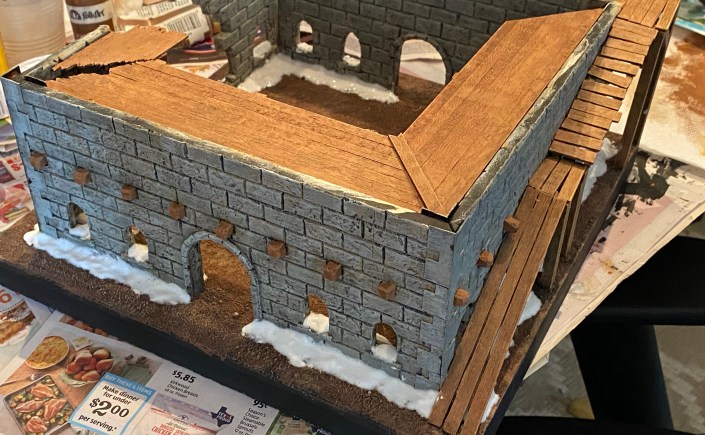
If you’ve looked at my previous posts on Frostgrave, you’ll see that I have two warbands painted and some terrain under construction. Recently, I completed most of the construction work on the first level of the large square central tower I’m building for the Silent Tower scenario (and whatever else it happens to be useful for–I’m not sure whether the new edition of the core book coming out this year will mean a change in scenarios). It struck me that, given the design of the building and the idea that (at the time at least) I had no intention for making the levels separable from one another, I’d ought to paint and finish the base and lower level before adding more to it that would make it even more difficult to paint the lower areas. If I’d been smarter, I’d have done all of the brickwork painting on the inside of the building before attaching parts of the second-level walkway (as you’ll see, I caught myself before finishing that installation and diverted to the painting!). Live and learn, I suppose.

It’s been a long while since I’ve painted terrain, and I had–and have–a lot to learn and relearn. I took a lot of cues from the Black Magic Craft videos for the stonework (though my technique isn’t near as good as his so far), and I even followed his instructions to make my own terrain washes using Liquitex acrylic inks.

I’m giving myself a B+ for the results. It’s not as good as I’d like, but it’s still a terrain piece I’ll be happy to put on my table and play on. I may consider some additional accents, like vines on the walls and perhaps the addition of some torches or lanterns, once I’ve finished the other levels. In future works, I think I’ll be using some lighter tones for the wood, but I used here what I had on hand and I think it turned out just fine for a sort of cedar-look.

I’ve opted for a muddy coloring for the base earth for the terrain, as I wanted some color contrast to the stony grey that will be ubiquitous in the buildings themselves. I’m happy with how this turned out and I’ll be adding some embellishments to other pieces–puddles where the ice and snow has melted and pooled, particularly mushy and gross mud patches, etc.

I admittedly had some issues with the snow–at least to my taste. I was using the Busch snow paste, and the top of the container held a pastier type of snow easier to create ridges and textures with. When working on this piece and delving deeper into the container, I found that the component parts had separated out into the pastier part and a heavy liquid. Like an idiot, my immediate response was to stir everything back together, which gave me a flowy-ier, smoother compound that makes for fluffy banks but wasn’t so much the look I wanted. And, I realize I didn’t think about the effects of the direction of the sun in determining where to put my snow, but meh.

On the other hand, it was driving me crazy trying to figure out how the Busch snow paste is made so that I could replicate my own in larger quantities and for cheaper. The paste had an immediately-identifiable smell to me–spackling paste–but I wasn’t sure about the other parts. After some thought, though, I think I’ve zeroed in on enough of the materials to create something very similar. If I get good results, I’ll post my recipe for your use.

In the meantime, enjoy some pictures of the work so far. Helpful criticism is welcome–I’m always happy to learn better ways to do things!

The Panentheism of the Holy Spirit

Let’s start with a definition. Panentheism is a constructed word for philosophical and theological discussion that means, “all in God.” This is intended to be distinct from theism, which see God as separate from everything else, and pantheism, in which asserts that “all is God.” More specifically, pantheism may communicate simply that the ultimate reality of the universe is (an impersonal) God or that everything we encounter (even ourselves) are simply illusory manifestations of that only thing that exists: God. Please allow for the usual linguistic slippage in the use of words to intend such complex ideas, an apology that perhaps all theological and philosophical construct-words require. Panentheism intends to hold some ontological separation between the existence of things that are God and things that are not God while clearly seeing them as in relationship.

There are a number of Christian theologies that involve some degree of panentheism: process theology, Eastern Orthodox theologies, Christian universalist theologies, etc. I point this out to say that, as with most theological issues within Christianity, there are diverse viewpoints and interpretations, the topic is (of course) complex, and a blog post of this length necessarily oversimplifies. The thoughts below do not take their place from any previously-established theology, systematic or not, but may coincide with some of those theologies (read: the thoughts that follow are my own, so: (1) don’t blame anyone else for them; and (2) that does not mean that somebody didn’t think of them well before I did).

Panentheism, in a general sense, is attractive in Christian thought for a number of reasons. First, it tends to accentuate a personal God who interacts–that is, who influences creation and who is influenced by creation–rather than the impersonal creative force of the purely theistic “clockmaker god” who created the principles on which existence runs but who now has little to do with the created. If you’re curious about the “is influenced by” language above, I recommend taking a look at my brief treatment of God’s passibility in my previous post: The Name of God as an Answer to Existential Questions. At the same time, panentheism avoids the implication (and, when intended, the outright assertion) that there is nothing outside of or distinct from God.

Orthodox Christian theology (across denominations and interpretations, for the most part) argues that creation is to some extent separate from but related to Creator, that free will exists (as a requirement for any moral judgment upon mankind), that God is omnipresent and that God is personally and deeply interested in Creation and its ultimate fate. We do not need to resort to process theology (if that is a theology you consider “extreme”) to see a place for panentheism in Christian thought.

Scripture
Nowhere in Scripture is a panentheistic idea stronger than in those passages that describe the Holy Spirit.

Paul is very clear that the Holy Spirit dwells within the believer (1 Corinthians 3:16, 16:19-20; 2 Corinthians 3:17; Romans 5:5, Ephesians 4:30), and this is taken as axiomatic by most Christians, I think. Indeed, this is the origin of the term “my body is a temple.”

Other Scriptures indicate that the Holy Spirit may act through a human being, but are also careful to remark that, when this occurs, the Holy Spirit and the human are separate, though the former may dwell within the latter. See 2 Peter 1:21; Mark 13:11; Acts 2:3-4.

The very point of the Pentecost story (and much of the Book of Acts, for that matter) is that the indwelling of the Holy Spirit within a person gives the person power they could not have apart from God gifting it to them. Although, in the great scheme of things, if God created all things, then that’s necessarily true of all power, but we can avoid such tautologies for the present time.

Tradition
At least within the United Methodist Church (and I suspect many other mainstream Protestant churches), our liturgy and understanding of God often attributes the title of “Sustainer” to God–support for this can undoubtedly be found in the Psalms. If we mean that, without God’s continued will for existence to exist, we would not, it’s only a short step from that idea to a panentheistic cosmology–it would be easy to argue that it that part of God that is within us, or that part of us that is within God, that sustains our continued ontology. This makes for an interesting interpretation of Jesus’ saying, “I am the way, the truth and the life,” though not one I have any intent of analyzing in this post!

A Panentheistic Holy Spirit and the Triune God
It is possible to point to panentheisms in other religions (some understandings of Hinduism, Kabbalistic Judaism, some Sufi and Ismaili forms of Islam). But panentheism of the Holy Spirit in Christianity has what I believe to be a theological advantage over all of those faiths (which statement is not intended to demean the value, meaning or beauty of those religions). That advantage is the doctrine of the Trinity (which proves theologically advantageous, if mysterious and mystical, in many other theological analyses as well). Why?

Because the Trinity does not allow the entirety of Christianity to be reduced to panentheism. As I’ve argued elsewhere, the nature of the Trinity, with its three distinct persons in inseparable eternal relationship, accentuates both the individual and the relationship itself. This underpins the idea that, if we should view the Holy Spirit as panentheistic in nature, we need to be careful not to see that as our whole relationship with God, or as a reality that diminishes the importance of our being unique and separate creations of God gifted with free will and self-determination by God’s forbearance to exercise God’s absolute power over us.

In essence, this is the best of all possibilities, isn’t it? Our individual objective existence and subjective experience have cosmic meaning and truth because we are independent of God. And yet, at the same time, God dwells within is and is always in relationship with us. If we want to view God through the lens of metaphorical parent, this balancing of allowing independence while providing support is what many of us would describe as the perfect parenting style. In our trainings as foster parents, we are told that this is the “authoritative” parenting style, as opposed to “authoritarian,” “permissive,”  or “neglecting” parenting styles (the four styles being arranged on an x-axis of supportive/unsupportive (sometimes representing as high or low “warmth”) and a y-axis of high or low expectations or control).

To put a simpler way, the Trinity reminds us that, although there is a panentheistic component to our relationship with God, we cannot define ourselves, God, or our relationship by reference only to panentheistic theology. To keep the length of this post down, I’ll keep this as a side note, but I think it bears stating: I don’t think that the Trinity should be used to oversimplify the ways in which we ought to think about our relationship with God. There is, potentially, a formulation under which one might argue that we have a theistic relationship with one person of the Trinity, a pantheistic relationship with the second person of the Trinity and a panentheistic relationship with the third, but such a structure is both too convenient a classification scheme and one that does not bear much scrutiny or the application of logic (to the extent that logic can be brought to bear to describe the mystery of the Trinity).

C.S. Lewis’ “Natural Law” as a Panentheistic Argument
I’ve referred to C.S. Lewis’s arguments about “natural law” on several occasions, his assertions that our conscience is often God speaking to us. It’s a short hop to call this the movement of the Holy Spirit within us, and then to link that with the panentheistic arguments above. Rather than reiterating his work here, I’m going to touch upon it lightly (done!) and move on.

Consequences of a Panentheistic View
What I’m really interested in discussing in this post (though I’ve taken my time in getting this point, I admit), are the theological consequences of a panentheistic view of the Holy Spirit.

God is Always with Us
I mean this in a very specific sense–that there is no time before God starts being with us always. Especially if we rely on C.S. Lewis’s “natural law” arguments, then God’s working of good within us is there from our very inception. Methodist theologian Albert Outler once lamented the difficulty–and therefore scarcity–of pneumatology in comparison with other theological inquiries (and particularly in comparison with inquiries into the other two persons of the Trinity), and perhaps this example reiterates his point, because I must admit plenty of mystery remains in harmonizing this view with the idea of Jesus “sending” the Paraclete to us on Pentecost.

On the other hand, I think we can safely say that the Holy Spirit is co-eternal with the Father and the Son in the Trinity and that the above “problem” with harmonization has–to the extent it can be–largely been resolved by arguments over the nature of the Trinity itself. For my part, I’d rather focus on two points here (by reference to previous posts):

(1) The idea that God works within us from our very creation causes some concern for the doctrine of original sin, at least perhaps in its traditional formulation. I find that Biblical support for ideas of original sin only really allow for an understanding of that concept in an existential sense–as beings possessed of a free (and often overly-self-interested will) and limited understanding, we are bound to sin–both willfully and inadvertently–until we are fully sanctified. I’ve written about this idea in regards to the narrative of the Fall in my post, “An Alternative Reading of the Fall,” and about the (partially) existential nature of sin in general in the post “Is Sin Phenomenal or Existential?”

(2) This idea also bears upon doctrines of “total depravity.” To be honest, I’d rewritten this particular portion of the post several times in hopes of avoiding having to weigh in on the soteriological aspects of that term in Calvinist or Arminian/Methodist theologies and to focus on the more common sense of the term. But, given some of the conclusions I draw below, I decided that such avoidance was ultimately unworkable, so here we go:

Briefly, the difference between the two: Calvinism posits that, because of the Fall, man can do no good works because everything man does is entirely selfish. As a result, only by God’s predestination (“election”) can man choose to accept God’s salvation and be justified and sanctified thereby–after which point man can actually do good. On the Arminian side, the argument goes that, like Calvinism, man is in a state of total enslavement to sin after the Fall. However, because of God’s prevenient grace, God has freed mankind’s will from sin enough to be able to choose to accept God’s gifts of salvation, justification and sanctification of his own volition.

To be blunt, I find the Calvinist formulation to utter hogwash–this is the equivalent of God playing a game of semantics with God’s self and moving pieces around on a game table. It deprives the relationship between human and God of real meaning, our existence of the kind of meaning that requires our free will to be, and, ultimately–the analogy I want to use here is vulgar and I get blamed for blasphemy often enough as it is, so use your imagination.

The Arminian view is more convincing to me (imagine that, since I’m a Methodist), but ultimately I still think it views the theological issues in play from the wrong angles, unless we are to say that “prevenient grace” is intended to describe an existential feature of the human condition ordained by God rather than a divine remedial action.

The idea of a panentheistic Holy Spirit could certainly be used to bolster the idea of prevenient grace by providing a mechanism through which prevenient grace is enacted by God. However, that view would be exactly what I mean by a “divine remedial action.” I think it better to view the indwelling of the Holy Spirit from a person’s very creation as indicative of the depth of the relationship between created and creator rather than as a methodology for helping us to “be good.”

I’ve discussed at some length ideas of goodness and fallenness contrasted in my post, “The World and the World,” a rough draft of a chapter for the first theology book I intend to finish, refine and publish in the not-too-distant future. For extra credit (or more information about some of my thoughts regarding soteriological theology, see “Salvation and Sanctification.”

For now, let’s turn to the idea that, if the Holy Spirit is dwelling within us from the very get-go, as C.S. Lewis’s “natural law” theory seems to imply, then:

No Cosmological Duality
This is a phrase I’ve been hearing a bit lately in the new (new to me) thing I’ve been attending at St. Paul’s Methodist Church in Houston, a thing called “Ordinary Life.” I’m calling it a thing because I know that I’d probably upset people if I called it a “Sunday School Class,” an epithet that it explicitly rejects in order to be a less-constrained, more welcoming approach to spiritual issues. If I understand it correctly (and maybe someone from that group will stumble across this and correct me if I don’t!) the term “cosmological duality” is intended to mean that traditional formulation of Christianity where:

God is Far Removed from Mankind
|
|
|
|                               Jesus had to die to make God like us again
|                                                        T
|                                                        |
|                                                        |
V                                                        |
Because humans screwed up and

(I hope you enjoy my makeshift graphic.) Cosmological duality is the idea that somehow God is unable or unwilling to be within us in our sinfulness and fallenness without Jesus “paying the price” for us. Elsewhere, I usually hear this referred to as “penal substitutionary atonement.” Generally, I think it could be more generally applied to views of Christianity that focus on God’s holiness and glory (and in effort to accentuate that holiness and glory posits humanity’s sinfulness and worthlessness), on God’s “entitlements” and not on God’s desire for relationship with us. To me, the beauty of Jesus, the beauty of the Christian faith as a whole, is the good news that, although God is entitled to all glory and holiness, God’s not so much interested in that as in love and relationship. That is a hopeful message; much more hopeful than “since you can’t help but break the rules, if you love Jesus hard enough, God will be forced to forgive you and will let you into heaven…perhaps begrudgingly.”

And this is where a panentheistic view of the indwelling of the Holy Spirit really brings things into focus. If we accept that view, and C.S. Lewis’s argument that conscience is one piece of evidence of that view and the existence of the Holy Spirit within us from our very conception (I mean this metaphysically more than physiologically), then we are presented with an image of God always reaching out to us no matter the state we are in, no matter whether we are consciously pursuing an understanding of Jesus and the God revealed in him, no matter whether we are Christian, or religious at all. That’s a God of Love.

Now, if this is true, then there are:

No Magic Words
The evangelical gold-standard of having someone “accept Jesus into his heart” by uttering some prescribed “magic words” really has no place in our theology. There is no switch-flicking moment that instantly transitions us from one existential condition (sinful, fallen, hopeless, unredeemed) to another (justified, sanctified, redeemed). (I want to make clear that I don’t intend to say that being “born again” isn’t a thing–Jesus himself talks about it. I just mean to say that it’s not a thing as fundamentalist evangelicals conceive of it).

It’s more complicated than that. And, if there’s anything I’ve learned in my time studying philosophy, religions and Christian theology, the answer to spiritual matters usually is, “it’s more complicated than that.” We have to start looking at the meaning of our faith, the character and intent of our God, the nature and design of Christ’s salvific work on the Cross, in a more complex, nuanced way. What we get is a set of assertions, arguments and “understandings” that are more ambiguous, less comprehensible, but by far more beautiful than any simplistic understand of God we had before.

For me, as I think my theological posts on this blog make clear, the lens that allows such careful and expansive investigation into all things spiritual or theological is the existential approach, founded on more brilliant minds who’ve come before me: Barth and Tillich are the readiest examples I’ve drawn upon, and developing into the theology I’ve been describing on the blog and calling, “New Mysticism.”

Existential Sanctification
If we look at the indwelling of the Holy Spirit in this panentheistic way (which I think is what we intuitively and colloquially tend to do as Christians), then think about what this means for the process of sanctification. I’ve argued in the past that I believe there is very purposeful divine intent in the relative ease (from our perspective at least) of gaining salvation (being freely offered by God and only needing to be accepted by us) compared to the decided difficulty of seeking sanctification (that is, becoming “Christ-like” and “holy.”)

But consider this–under this panentheistic view of the Holy Spirit, God has always been with you and whispering to you about the righteous path. Sanctification, in actuality, then, is starting to listen to those continual revelations direct from God to you, starting to try to put them into practice.

This brings us around to Luke 17:21, in which Jesus says, “Neither shall they say, Lo here! or lo there! for, behold, the kingdom of God is within you.” I’m really looking forward to spending some time with that passage in the context of existential Christianity and the idea of sanctification, which I’ll do soon.

A Third View of Worldbuilding

The past month has been rather silent on the blog, and for that I apologize. I’ve got a few half-written posts that I’m letting percolate a while and I’ve spent a good deal of that time continuing to expand and refine my fictional setting, Avar Narn.

In undertaking that task, I’ve been thinking a bit about the process and craft of worldbuilding, and I thought I’d share some of my thoughts with you.

I’ve called this post “A Third View of Worldbuilding” to contrast against the two most-commonly-described approaches to building fictional settings: the “top-down approach” and the “bottom-up approach.” As the title suggests, I’m going to offer a third way in this post, one I’ll call the “archaeological” approach. But first, let’s get some definitions of the established approaches.

A Note on Historical Analogues
I think it worthwhile to have a quick sidebar discussion about reliance on examples from the real world in building fictional worlds. There seems to me to be a sense that drawing upon real-world analogues for building nations, cultures, religions, and other aspects of the setting is lazy or uncreative. I’d argue that the use of such analogy is both unavoidable and valuable to worldbuilding when done purposefully and carefully.

Reference to our world is inescapable because humans lack the capacity to create something new ex nihilo. All human creativity is a matter of taking the blocks of what we know and arranging them into new patterns that no one’s thought about before. Lean into it and cut yourself some slack.

I’ve got a quotation at the beginning of my Avar Narn worldbuilding notebook from writer of fiction and roleplaying game content Ari Marmell, and I think it makes the point as concisely as possible. He says, “Originality is great–as a tool for writing good stories and compelling characters, or as a byproduct thereof. It should never be your goal; your goals should be, well, writing a good story and creating compelling characters.”

Some examples that I think prove his point:

The Witcher setting draws very heavily from medieval history and fairy tales to provide the core of its narratives. We don’t read those novels because we’re looking for a completely innovative setting; we read them because Geralt and his companions are interesting characters and the stories they find themselves within are fascinating and entertaining. Those stories benefit from their groundedness in the pseudohistoricity of the setting.

Abercrombie’s First Law setting likewise draws upon historical analogues (though not necessarily to the same extent as The Witcher) to build the setting (and quickly clue the reader into it). Angland has its roots in England (obviously) and in Norse/Germanic cultures. The Gurkish Empire finds its footing in the historical Muslim (and particularly Ottoman, I think) states–though this footing either purposefully draws upon some Western romantic (I hesitate to use that phrase because the Western romanticism of the Near East is rarely positive) or it curves in that direction because of the narrative and setting itself. I don’t want to imply any judgment there, because I don’t think there’s an agenda behind Abercrombie’s choices except to write compelling fiction. Styria has, of course, the feel of Renaissance Italy.

Tolkien drew heavily upon Anglo-Saxon culture for the Rohirrim (it was his academic specialty, after all).

Brandon Sanderson’s feruchemy, allomancy and hemalurgy are so fascinating precisely because they contrast so starkly with Western historical magical ideas (and thus what we typically expect in Western fantasy fiction), while Jim Butcher uses those same ideas (the historical Western ideas about magic) as a starting point to establish depth and interest in his urban fantasy, The Dresden Files.

In roleplaying games and in speculative short fiction, the use of close adherence to historical analogues can quickly establish setting, useful for getting an unfamiliar audience invested quickly. John Wick’s roleplaying games 7th Sea and Legend of the Five Rings are prime examples.

All of this is to say that you should beg, borrow and steal from real-world examples to build your fictional worlds. Just do so thoughtfully and intentionally and you’ll be held in good stead, no matter how much you eventually veer from the “source material.”

The Top-Down Approach
The Top-Down Approach suggests that you start with the general, the big ideas of the setting, and work your way down to the details based upon those big ideas. This approach works well for fiction writers, where the setting ought to be considered in relation to the kinds of stories you want to tell, to the themes and motifs of the works you’re considering, and to the sort of atmosphere you want to establish for your audience.

No approach to worldbuilding is without its disadvantages, however. The Top-Down Approach runs the risk of creating generic settings that feel like the two-dimensional facades of buildings on the main street of some theme park–it’s just so easy to rely entirely on historical analogues to provide all of the details. Without reliance on reference to the real world, it can be hard to know where to begin with the Top-Down Approach and easy to end up with contradictory details as you develop different aspects of the setting and bring them together.

The Bottom-Up Approach
In this approach, you start with a limited part of the setting, developing in detail, before using that beachhead as a jumping-off point for expansion into larger aspects of the world. The Bottom-Up method is great for getting stuck right into a story or game–you start with only what you need to get going and add on only when the scope of your narrative needs to expand. There’s a reason that Dungeons and Dragons encourages GMs to create a small adventure setting first (a town or village “hub” with adventure sites in the surrounds) to begin a game. Sometimes you really only need the 2-d facade because all of the story will take place on the main street.

This is easier with writing rather than gaming, where a reader can’t spontaneously decide to peek behind the curtain. But it’s not a bad thing either, because the ability to improvise new setting details (or to offer your players the opportunity to fill in details) can add new and unexpected dimensions to the setting, which is both meaningful and entertaining.

The biggest danger of Bottom-Up creation, I think, is that you end up with a “kitchen-sink” setting, where everything needs to be pigeonholed into the setting somewhere (I’d argue that this is the case with D&D’s Forgotten Realms setting) so that the world feels more like a theme park than a living, functioning, believable world. As a corollary to that, if you have multiple Bottom-Up aspects developed concurrently before moving to higher-level issues, you end up with a mish-mash of ideas instead of a cohesive setting with central themes and ideas. I don’t mean to say that that’s wrong–our own world has no clear cut definitions of what it means, so there’s realism to be found there as well. But in terms of narrative, having cues about what you’re about (or what your setting’s about, anyway) can be helpful.

A Third Way
Now for my own point: (not the) third way for worldbuilding. We’re going to use archaeology as our analogue here (hence my calling this the “archaeological approach,” of course). When archaeologists are excavating a site, they first set up a marked grid so that the location of each object found can be carefully recorded as they go. A single archaeologist can only work in one cell of the grid at a time, but a useful interpretation of the site only develops as multiple cells are excavated. The interpretation the archaeologist had after excavating area A1 may change dramatically after excavating cell D4, so she may need to go look at A1 again to rework her thoughts. Eventually, a cohesive interpretation of the whole will develop, but only as different cells are examined over time.

The same occurs between different archaeological sites. What is discovered in one place might drastically change the interpretation of an earlier-excavated site. And, good archaeologists leave parts of the site unexcavated and preserved for future scholars, who will arrive to continue the work armed with more sophisticated tools and, hopefully, knowledge about the site and culture being investigated that the earlier archaeologists didn’t have.

Okay, this is essentially nothing new–my point is that the art of worldbuilding shouldn’t be simply top-down or bottom-up; it’s a back and forth, a jumping around–the assembly of a puzzle rather than the construction of a building. “Top-down” and “bottom-up” are merely constructs for discussing the art of worldbuilding anyway; I seriously doubt that most worldbuilders engage solely in one method, or even in a dogmatically rigid sequence of building a setting. I certainly don’t. You have to use what works best for you: your personality, work habits and creative style. I’ll follow this with some concrete tips that have worked for me.

Tips for the “Archaeological Approach”

1. Always be ready to change what you’ve established in light of new “discoveries.”
This is one of the most effective tools for originality in a setting and one of the most rewarding aspects of worldbuilding (at least when done for its own sake). This is very much like discovering new things about your characters or plot when writing a novel. In worldbuilding, as you add details to the history, geography and cultures of your world, you’ll start to have little epiphanies about the consequences of those choices or contradictions between details that develop because of them. If you’re consistently ready to take those developments and go back through what you’ve established, metaphorically ironing out the kinks, the setting will begin to develop in some unexpected ways that add depth, detail, and verisimilitude. I believe I’ve said before in a different post that my favorite thing about Max Brooks’ book World War Z is how, if you can just suspend belief for the zombies, the stories and political events that the novel describes make logical sense based on real-world political realities and history. The more places someone investigating your settings says, “Aha! X happened because of Y and Z,” the more immersive and believable your setting becomes, no matter how fantastic.

2. Put pins in things.
To try to maintain flow in the process of worldbuilding, try to avoid letting yourself get hung up on details that you’re not ready to fill in yet. Some examples, if you’re working through your setting’s history and a new nation crops up, don’t feel like you have to go define that nation’s culture and separate history right away. Put a pin in those subtopics and continue working on the task at hand.

For me, this helps in two ways: First, it helps me to stay efficient, focusing my efforts where I’m ready to make good use of my time instead of following rabbit trails that I’m not mentally prepared for. Second, when I do run into writer’s block in my current task, it gives me ready alternatives to shift to so that I can continue making useful worldbuilding efforts instead of having to put the whole thing down for a while to let it sit.

This works both for details and–especially–for names. If I don’t have ready names in hand when I come to a new character or place in Avar Narn, I tend to change my font to bold (so that I remember I need to come back to the detail) and put a shorthand description of the thing in brackets so that I can keep going with the narrative.

3. Keep lists.
Sometimes, I feel like I’m too tired or distracted to have the mental wherewithal to conduct some serious worldbuilding, but I want to do something useful to keep progress going. I’ll play around with an online name generator, taking the output and modifying it into names I like or that I think would have a place in one of Avar Narn’s languages. I’ll make lists of interesting cultural oddities, quirks or nuances that I might be able to “plug into” a culture as I’m developing it, speeding along the development of granularity of detail. Hell, I’ll make lists of topics I need to develop, so that when I’m feeling creative (or sitting myself down to be creative–damn how I feel about it!), I have options in front of me so that I can select the one that most appeals at the time and get straight to it.

4. Be Able to See the Forest.
Organizing your work is essential in worldbuilding. If you don’t, you’ll lose details altogether or have to rework some of the work you’ve already done to account for them. More important than that, though, is the ability to take a quick high-level approach to see how things are fitting together. How developed is your setting at this moment? Are you working on helpful details or just adding more to the setting that may never come into play? If you’re worldbuilding for worldbuilding’s sake–and I think it is a worthwhile exercise even if you never plan to do anything with your setting–this doesn’t matter so much. But if you’re developing a setting for a roleplaying game or for fiction and you’ve got some extrinsic or intrinsic deadline for kicking off the game or writing, you want to be able to make sure you’re not spending in the weeds–naming that delicious pie shop at the end of the world your characters will never visit.

Overall, I mean to say that you should be able to move into a temporary top-down approach when that suits you.

5. Be able to see the trees.
Modern historians no longer view history as a collection of the exploits and ideologies of the elite–they rightfully recognize that most events have multiple confluences of causes that come together to trigger them in a particular place and time. Looking at the finer details allows you to make larger-scale choices that seem to flow naturally and consequentially from those smaller choices.

In other words, be able to move into a bottom-up approach when useful.

6. Be a sponge.
Samuel Johnson said, “Never trust a man who writes more than he reads.” Fair point.

Soak up all the information you can: about how the world works, about how people work, examples of real-world history and culture, etc., etc., ad nauseam. If you accept as true that human creativity is a matter of rearranging the blocks we already have into new structures, put as many different blocks in your toy box as you can. But, don’t let sponging up knowledge be all that you do. This is an excuse I often use myself; I’ll tell myself I’m sponging up information right now, and when I have enough, I’ll get back to the worldbuilding. There’s never enough, so use what you have even as you’re getting more.

Conclusion
I won’t say that there are “a lot” of worldbuilding books out there, but there are a few. I personally find them useful for providing with checklists of things to think about as I’m building my world, but I’ve never found any of them to be a panacea or ready guide to doing the damn thing.

In my mind, worldbuilding is and should be an organic process, difficult to predict in its details or course, much less in its results. It’s a journey you have to walk, not an engineering plan to rigidly follow. Your experience may differ vastly, of course.

As a final thought, lest you think that I am blind to the downsides of the approach I’ve argued for in comparison to top-down and bottom-up methods: this organic, back-and-forth approach of worldbuilding is time-consuming and risks becoming the object in and of itself. If you’re worldbuilding for the sake of it, that’s not a problem. But if you have purpose(s) in mind for your setting once it’s “ready,” remember that at some point you’ve got to start actually running that RPG or writing that novel.