What Writers (and Roleplayers) Need to Know about Swordplay, Part I: Introduction and Sources

I’m far from the first person to pick up this subject, but I continue to hear so many mistakes made about medieval and Renaissance weapons, armor and combat that I feel that the subject merits continued treatment.

To begin, let me set out my bona fides: My undergraduate degree is a B.A. in History, focusing on Medieval and Renaissance History, my senior thesis was written on Henry VIII’s use of Arthurian Legend as propaganda and included research at the British Library and National Archives. My master’s degree is in English, focusing again on medieval and Renaissance literature; my master’s thesis was about the use of particular weapons and fighting styles in Shakespeare’s works, 16th century English fighting manuals and adventure pamphlets as a method of establishing identity, particularly national identity.

I was a sport fencer in high school (which hardly counts for anything in this field, unfortunately, except in the rudiments of all hand-to-hand combat: distance, timing and footwork) and spent my college years as a member (and later study-group leader) of the Association for Renaissance Martial Arts (ARMA), having broken a rib and an eardrum in separate sparring engagements during that time (no, I did not get stabbed in the ear). Though I did not continue my affiliation with them after I left my original study group, I have continued to practice and develop my skills as a swordsman, off and on. I have experience sparring at full contact with padded weapons carefully designed to emulate the weight and balance of actual swords, with wooden “wasters” and with blunted steel. I’ve studied and worked through Ringeck, Talhoffer, Fiori dei Liberi, Silver, Swetnam and others, including some sword-and-buckler work in the I.33 and some rapier work with Agrippa, Di Grassi and Saviolo. My primary experience (in practice) is in the two-handed longsword, single-handed swords of the “cut-and-thrust” variety (mostly with dagger or a free secondary hand), the rapier (again with dagger or free hand), and grappling/dagger work. I have used a shield sometimes, mostly a buckler, and all of my experience is in the realm of “blossfechten,” that is, fighting without (plate) armor. I’ve seen a number of demonstrations of fighting in plate (harnessfechten) and understand the theory, but have no direct experience there.

The subject of “medieval and Renaissance martial arts,” “historical European martial arts,” (HEMA) or “Western martial arts”  (WMA) has become an increasing interest in Western culture over the past thirty years, though I’d still venture to say that the subject, as both research field and martial art form, remains in the early stages of reconstruction.

If you want to see what swordplay looks like, I recommend you go to YouTube and look for clips under the search terms in the preceding paragraph, with particular attention to some of the European competition clips. Each year, it seems, there are more competitions, the “sport” becomes more like other sports (with organizations, sponsors, etc.), and the competitors seem to have greater skill. This will give you some perspective on the topics we’ll cover in this series.

How did we get to a point where, after such a far remove from the times when these weapons were actually employed, we can begin to understand and reconstruct their usage?

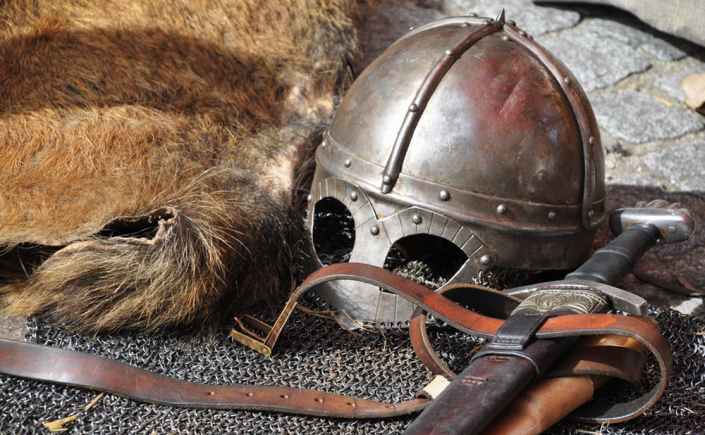
There are museum pieces and archeological records of course, which give us much of our information on actual weights and designs of swords, armor and other weapons. The Royal Armouries in Leeds, England has, as far as I’m aware, one of the very best collections of early modern armaments anywhere in the world. Bear in mind though, that we find far fewer pristine examples of items than we do pitted and degraded examples, this being more the case the farther in time we look back.

For the technical aspects of medieval arms and armor, I would refer the student to begin with the works of Ewart Oakeshott, with the caveat that his interpretations are not the final say in the matter, that even he was unsure about some of his classifications, and that there has been much debate and revision of his ideas since.

We also have art and literature but, as we’ll see, the interpretation of these alone can sometimes lead to misunderstandings (that continue to defy correction)!

For the actual reconstruction of the martial “arts” of the medieval and early modern periods, we have written instructions, what are generally referred to as the “fechtbuchs.” The earliest of which I’m aware is the Royal Armouries’ I.33 sword and buckler manuscript, probably written sometime around the turn of the 13th century to the 14th.

We continue to see handcrafted manuals, but the invention of Gutenberg’s printing press in 1439 led to the “mass-” production of printed manuals as well. These texts were put down by masters of arms, those teachers of the craft who had earned sufficient fame and demonstrated sufficient skill, both as instruction manual and as advertisement, probably. A list of Western martial arts manuals may be found (on Wikipedia) here.

In the modern age, groups like ARMA and many others–local schools like any Eastern martial arts dojo are popping up in U.S. cities all the time–take these manuals, translate them into English (or, more likely, purchase translated copies), and then work through the examples and instructions within to figure out what is intended and what actually works. Many of the fechtbuchs are illustrated, though there’s often some debate over whether the pictures accurately reflect what is referenced in the text. If modern artists’ renderings of concept firearms are any indication, some artists understood what they were depicting well enough to be accurate, but many, perhaps most, did not.

The amount of scholarly attention to this field grows a little year-by-year, but it is still (as far as I’m aware) the focus of only a small handful of professors and professional scholars. The Martial Arts of Renaissance Europe remains one of the best scholarly surveys of historical fighting manuals available; it is approaching its twentieth anniversary.

If you get on Amazon, you can now find instructional manuals like those for any martial art, the authors having purportedly gone through earlier texts to recreate the skills and portray them in modern language and pictures.

As a person writing or roleplaying in a setting with swords and armor, should you feel compelled to join some reenactment group or martial arts collective participating in the HEMA/WMA world? It certainly wouldn’t hurt to have the experience. In this series, though, I’m going to try to cover the essentials of what you need to know so that you’re at least not making any glaring errors.

To continue to the next Part in this Series, click here.

Some Thoughts on Writing: Plotting and Pantsing

There is no One True Way to write; anyone who tells you there is is a fool and/or trying to sell you something.

That said, I’d like to share some of my thoughts on writing fiction, particularly on plotting and “pantsing,” in this post. Maybe it will be useful for someone. Maybe someone will disagree with me in the comments and that will be useful for someone.

To me, writing fiction is really two things inextricably bound together. The first is storytelling, by which I mean the structural aspects of the craft: story structure and flow (and therefore “plot”), pacing, character creation and motivation and all of the building blocks of the a story. The second is style, the actual selection of words, grammar, syntax, etc. The storytelling never becomes a story without the application of words; but the words themselves never amount to anything without a structure and purpose to them.

Both of these things are always difficult and often frustrating. I’ll liken this to exams in law school: those people who weren’t nervous about the test didn’t understand how much there was to know in that field and just how complex its operations were. You could only be blasé about it through ignorance. Perhaps there is someone in this wide world who is naturally, innately and intuitively creative and powerfully-minded enough that this doesn’t apply to them, but I doubt it.

In my writing of late, both those projects that have ultimately “failed,” or at least not come to immediate fruition, and those that I have “finished” in a relatively complete form or on which I continue working, I’ve noticed that most of my instances of “writer’s block” occur because of the intersection of the two elements of writing fiction. I hang up when I’m in the middle of a sentence and the plot has brought me to the necessity of naming a new character. I struggle when I rewrite the same damn sentence over and over because I’m trying to make it sound right and figure out where the story is going next. In short, writer’s block ambushes me when I’m pantsing, trying to split attention between both necessary aspects of the craft.

So, I have moved to a more “structured” approach to writing, one that finds good analogy perhaps in other, more tangible art forms. In painting, you don’t put paint to canvas until you’ve done sketches to create the basics of the image or prepared the canvas. Working on story structure is like that, with the actual writing of it the painting, of course.

My approach has thus become one of meticulous plotting before beginning the actual writing. I start with the broad strokes, major plot points and characters, then parsing out into scenes, then plotting out each scene. While sometimes tedious and certainly time-consuming, it allows me to make my adjustments to structure and plot lines, to make sure callbacks, foreshadowing, etc. are all properly placed and linked, and to develop or edit side plots before doing so will cause me to do a lot of re-writing. Once all of this is done, the focus can shift almost entirely to the craft and style of the writing, since everything else will already be signposted.

This is not to say that pantsing has no value, either in general or to me. Pantsing can be a great way to get the creative juices going, and it’s how I ended up with the basis of the novel I’m currently working on–pantsing a short story became 20,000 words to provide the core plot of a larger, more complex story.

But much of the skill of storytelling lies in making sure that there is a place for everything, everything is in its place, and all the pieces fit together seamlessly. Story structure and plotting are the writer’s carpentry; it makes sense here to measure twice and cut once just as it does with lumber–so far as that analogy can be pushed, at least.

I’ve been thinking about this quite a bit both while working on my in-progress novel and while reading Joe Abercrombie’s stuff (I’ve just started Best Served Cold right after concluding the First Law trilogy). It’s been apparent to me that, while much of the punch comes from Abercrombie’s style of writing, the combination of that with masterful structure and plotting is what makes his novels so enjoyable.

An admission: I’m writing this in procrastination of working on the novel itself. It’s perhaps best I turn to that now.

Faith, Fiction, Fatherhood…and Frostgrave?

As I mentioned in an earlier post, I’ve recently decided to take a break from video-gaming and devote more time to my “analog” hobbies. It’s now been roughly six weeks since I’ve played a video game and, honestly, I don’t think I miss it as much as I expected to.

The novel I’m working on is progressing slowly but steadily, and I seem to be on schedule to have a finished draft by the end of the year.

But what else has filled my time? I’ve been finishing up Joe Abercrombie’s First Law series, so expect an overall review on that in the near future. As I mentioned in a recent post on gaming as an adult, I’ve been building a hyperlinked database (in OneNote) of characters, locations, events and other goodies to drop players into for future Shadowrun campaigns conducted in the style of a “narrative hexcrawl” (if you’ll bear with me on the liberal use of the term).

With the remainder of my time not spent on the above, or working, or caring for children, I’ve been returning to a long-running, off-and-on-again love affair: miniature gaming. It started around when I was twelve; my dad brought me back some Warhammer Fantasy miniatures from a business trip to London. I was hooked. I remember fondly spending a lot of time in a partially-finished room of the house he used for his model railroading set-ups, listening to the radio and painting miniatures. That was were I discovered my favorite band (Live) and probably much of the rest of the 90’s music I still enjoy so much (it was the 90’s, after all).

I never actually played Warhammer Fantasy. But I spent hours in middle school and high school playing (and arguing over) Warhammer 40k, Necromunda, Mordheim and Warhammer Quest with my best friends. I worked on a lot of miniatures in college, but never seemed to get in an actual game. Off and on, I’d paint and sell minis, get “out” of the hobby and then return again–there are many people on Ebay and Bartertown that got some great deals out of my indecisiveness. After finishing (law) school, I played Warmachine for a while, then Infinity, then Malifaux. I enjoyed all of them (probably Infinity most of all), but the focus on synergies over tactics in both Warmachine and Malifaux left me unsatisfied at the end of the day.

After a few years away from minis games (and a false start with the new Necromunda), I decided to get into Frostgrave. I’ve found that I prefer skirmish level games, love campaigns where characters can gain XP and improve (how I miss Mordheim!), and kitbashing plastic kits is perhaps my favorite part of the hobby side of miniatures games. I also wanted a game where I could, without spending a small fortune, have enough minis to invite my friends to play without having to first convince them to buy into a game. This all pointed to Frostgrave.

I don’t do anything half-assed, and my approach to miniature games is no exception. I cannot bring myself to play games with unpainted figures and really prefer to have some nice terrain to fight over, too. Fortunately, I’ve collected a modest set of skills to accommodate both preferences over the years.

I began (after collecting all of the PDFs available for Frostgrave) by buying up a collection of plastic minis to build from. I picked up the Frostgrave Soldiers, Soldiers II (the women soldiers), Barbarians, Cultists and two boxes of the newer plastic Wizards. On top of that I added Fireforge Foot Sergeants and Foot Knights as well as a box of Oathmark humans. I had a set of Perry War of the Roses Miniatures from the small set of things I hadn’t gotten rid of the last time I got “out” of minis gaming, and I look forward to acquiring more Perry medievals for three reasons: (1) they’re beautiful minis; (2) they’re pretty good for historical accuracy; (3) while many others have used them for Game of Thrones minis (search Google for “To Westeros with Captain Blood” for the best example, in my opinion), they strike me as perfect for a Witcher minis game (y’know, once I’ve built and painted all the Frostgrave minis, and bestiary monsters, and terrain to complete a good collection).

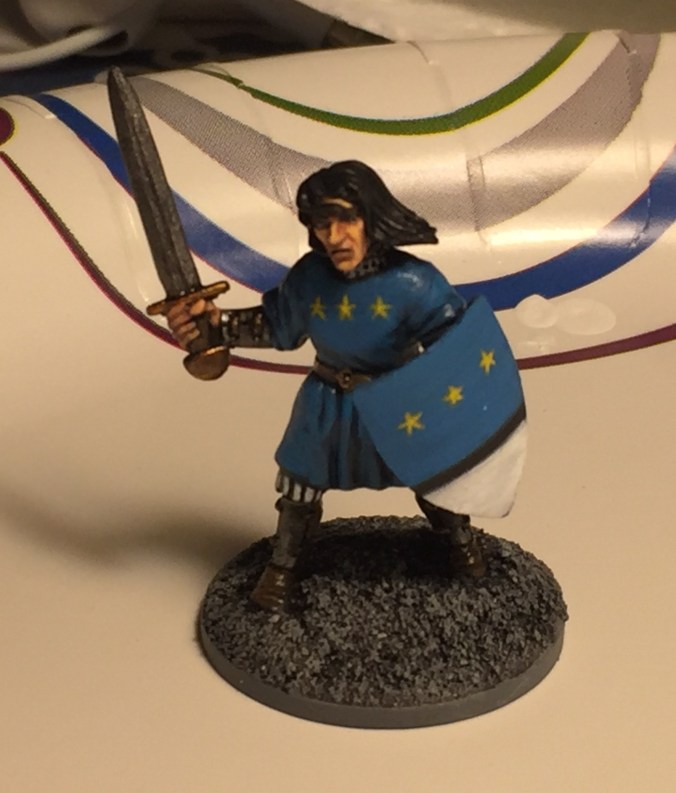
I started by kitbashing and painting a few random soldiers: a knight here, a few thugs there, a marksman. This is the knight, the first of the minis I’ve painted in a long while:

img_2225.jpg

After a few of these, a thought occurred to me: what if I do a warband that seems to go together rather than a bunch of ragtag outcasts, a group of models with some unity in their clothing and colors. After all, I’ve got thirty Oathmark bodies and plenty of stuff to mix them with.

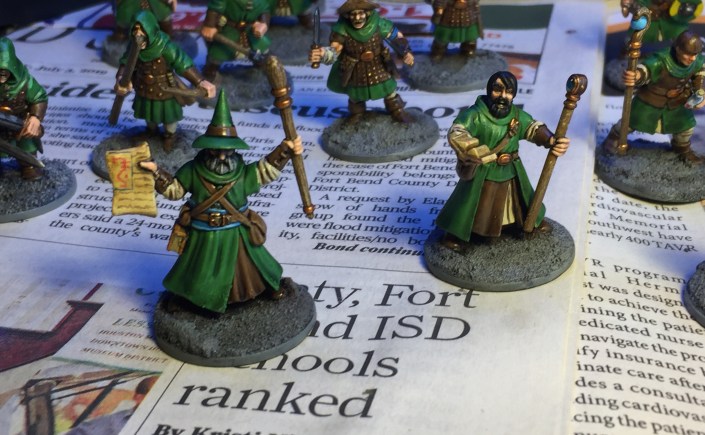
I’d decided my first warband would be a Sigilist, so I built my wizard and his apprentice (the header photo) and sixteen of their closest companions: thugs, an apothecary, archers, a marksman, a thief, a treasure hunter, a tunnel fighter, etc. I finished painting them today.

The bases still need some detailing (my model snow and foliage tufts are on the way), but they’re otherwise finished. Not the best painting I’ve ever done, but not bad for shaking the dust off after so long.

Of course, after I finished painting these guys was when I looked at how I might assemble them into a starting warband and realized I’m probably at least one thug short for what I should have (and there are a few other soldier “classes” I don’t have represented yet), so I started building some more to accompany them even before my brushes were dry.

I had planned from the beginning, however, for a captain. I wanted my captain to have mail armor, though, and the Oathmark humans, well, don’t. Frostgrave makes a distinction between no armor, leather armor and chainmail armor (the latest game by McCullough, Rangers of Shadow Deep, uses “light armor” and “heavy” armor, which, for a game that encourages you to use whatever minis you want, should probably have been the distinction in Frostgrave as well). Technically speaking, what the Oathmark soldiers are wearing is what D&D (and therefore many fantasy games) calls “studded leather.” This categorization is based upon a misunderstanding of armor depicted in art, where the “studs” that make the leather “studded” are actually rivets holding together small metal plates between a front and back (both probably of cloth, not leather) forming what is called a “brigandine.” This type of armor is probably closer to chainmail in its effectiveness. But, I figure most of those poor souls I can convince to play a minis game with me don’t also want to hear my pedantry about medieval arms and armor–the above is just the tip of the iceberg.

All of that is to say that I decided to go with the conceit that the armor on the Oathmark minis is “leather” armor. Actually, there’s a lot of dispute about just how much leather was used in armors, historically, but…see what I mean about the pedantry?

The point is that I needed a model with mail but wanted one that would still fit with the clothing of the rest of the soldiers. I sucked it up and decided to venture into a new skill, one I’ve actually wanted to pick up as a hobbyist for a long time–sculpting in “green stuff” (kneadatite) for the conversion of minis. So, I started with an Oathmark body and set to work.

Once I’d done the mail for the mini, I couldn’t help but also try a fur cloak. They’ve come out well, but I have a few minor details to sculpt before the mini gets some primer and a proper coat of paint.

As I said, I don’t really tolerate a minis game without some passable terrain as well. The below is my first humble piece, not quite finished (the ladder needs painting and it also needs snowy details). I’m mostly happy with it, but I’ve since learned some techniques to put some more color into the stonework, which is what this piece is currently lacking.

IMG_2221

And that’s it for now, but the work continues. My Proxxon foam cutter just arrived today and I’ve drawn up some templates for the main building in the Silent Tower scenario, so I’m itching to put it to work.

So here we are, with a new (sub-section) of the blog, wherein I’ll post some more my work toward getting an entire table worth of terrain and a slew of minis to go with it, hopefully followed by some tales of battles fought by–as my wife calls them–“tiny minions of dice death.”

Pre-Review: Shadowrun 6th Edition (Beginner’s Box)

In this short review, I’m going to focus mainly on changes in the Sixth Edition of Shadowrun (as they are explained in the Beginner’s Box) to earlier additions. I’ll do a full review when I get my grubby hands on the main rulebook in early-to-mid-August with the rest of the plebs.

The info on the tin says that the Sixth Edition is a “streamlined” version of Shadowrun, and the Quick-Start rules in the Beginner’s Box bear this out. Those familiar with Shadowrun will see much carried over from previous editions: rolls are generally Attribute + Skill to form a dice pool of d6s, 5s and 6s are “hits” which are compared to the Threshold in a simple test or the hits generated by the opposing person/object in an opposed test. Rolling more 1s than half the dice pool remains a “glitch,” and something bad happens.

The first change you’ll encounter in the new rules (in their simplified form in the Quick-Start) is how Edge is used. Each character still has an Edge attribute and starts each scene with a number of Edge points equal to the attribute. In contrast to earlier editions, Edge flows much more freely now and is expected to be spent more like the Plot Points of Fate. Mechanical effects can be chosen by spending between 1 and 5 Edge points, and the expenditure of 5 Edge points, with GM permission, can even be used to “Create a Special Effect,” much giving the player agency to add a new fact, event, or trait to the scene at hand–essentially an interposition into the narrative itself (again, much like Fate).

This new Edge system, at least based upon the Quick-Start, seems designed to take the place of large lists of modifiers to rolls seen in earlier editions. Edge is awarded when one character is on the better end of a large discrepancy between Attack and Defense Ratings, when the situation gives the character an advantage over others (low-light vision in a darkened room, for instance), or when the GM awards Edge for good roleplaying decisions (based on the wording it’s unclear whether they mean this as a “reward” for playing the character well or for creativity in approaching problems or both). The Quick-Start does not include any lists of modifiers to combat rolls (recoil, lighting, distance, etc.), giving the impression that Edge is to be awarded in lieu of having to track lots of numbers. If this bears out in the full ruleset, I think that this is an excellent idea, basically (in my mind, at least) taking a cue from more narratively-focused systems to streamline the mechanics.

Another big change I appreciate (if I’m reading the rules correctly) is to how initiative enhancement works. In previous editions, those characters with Adept Powers, Wired Reflexes or the like took additional turns in a Combat Round, meaning that they essentially were multiple times faster in all aspects than unaugmented characters. This created an impression that characters intended to have a lead roll in combat situations had to have initiative enhancement. The Quick-Start rules give everyone a single turn in a Combat Round. A character gets one Major Action, one Minor Action, and an additional Minor Action for each Initiative Die the character has. So, most characters will have one Major Action and two Minor Actions per turn, with (if the numbers for initiative enhancement translate) at most five Minor Actions. Four Minor Actions may be exchanged for an additional Major Action. This means that the most augmented characters will (at extensive cost in nuyen and Essence, presumably) be able to make two attacks in a turn at a maximum. This is a much better balance (in my opinion), make characters without augmentation much more viable in combat, and is probably how I’d run things even if the Core Book changes this.

Attacks remain opposed rolls similar to previous editions. The “Soak” roll following a defender losing the opposed roll remains as well, and I wish we’d seen some additional streamlining here by using a flat deduction from damage.

Although the Quick-Start rules contain no modifiers for recoil (or recoil compensation)–and I don’t expect the Core Book to either if I’m understanding the design philosophy correctly, it does retain Fire Modes–Single Shots, Semi-Auto (two rounds fired) and Bursts. A Single Shot does not modify the base rules, while Semi-Auto trades dice from the Attack Rating (for determining Edge, not from the Attack Roll) for additional damage and Burst Fire allows you to do the same or to split your pool between two targets (as if you’d fired at both in Semi-Auto). This maintains tactical options without resort to the dizzying amount of potential modifiers we Shadowrunners are used to.

Matrix and Rigging rules are, necessarily, simplified in the Quick-Start, but the Matrix rules look like they have become much more task-focused rather than the complexity of placing marks and then resorting to all other manner of shenanigans to achieve effects. GOD is still in control (of the Matrix). The result is a simplified system allowing a more seemless move back-and-forth between meatspace team members and deckers/hackers/technomancers. Shadowrun has needed this approach for a very long time, though it remains possible that the Core Book complexifies things and mucks it all up.

Riggers get two pages of rules, mostly some quick notes about which Attributes to use when “jumped-in” and some brief vehicle rules. The attention to “Meters per Combat Round” for vehicle distance seems a relic of former rulesets entirely unnecessary to this approach, but your mileage may vary.

Only sorcery is treated in the Magic rules here; the rules seem to have been streamlined here as well. The greater part of spell mechanics are now determined by the category of spell (retaining the standard categories of Combat, Detection, Illusion, Health and Manipulation), with individual spells now differing in smaller details (area of effect, target type, etc.). Drain remains a separate roll from casting (which again, I would have preferred to see streamlined out).

So far, so good–while I have some nitpicks and places I’ll likely houserule to further streamline (and it’s likely that I’ll want to use this ruleset), I think the design philosophy has by and large gone in the right direction.

What remains to be seen, of course, is the complexity of character creation, particularly in how augmentations (cybernetic, bioware or adept powers) and resources such as nuyen and contacts are worked out. Based on the weapons and decks described by the Quick-Start, the customization options for gear have been simplified in favor of ease of use, and the Edge system also seems to indicate that the details of what certain augmentations do will be left to the provision of Edge rather than factoring in tons of modifiers. I’d very much like to see character creation that no longer takes hours to do correctly. While I must admit that I find character creation in earlier Shadowrun editions an amusing exercise for its own sake, for actually running games a much-abbreviated design process is a must.

My understanding is that we’re about two weeks out from the release of the Core Rulebook, so expect a full review shortly after that!

A Short(ish) Note on Rolling Dice (in RPGs)

This morning, I’m re-reading through the Sixth World Beginner’s Box for Shadowrun 6th Edition to write a short review as a prelude to a full review when the core book releases. As I’m reading through, comparing to other roleplaying games, and thinking about the mechanics and systems that make our games run, a thought occurs to me.

We need a paradigm shift on dice rolling. For some of you, particularly those who play more narratively-styled games, this is likely already part of your repertoire, and a number of games that have been out for quite some time make a point of this explicitly, or at least imply it heavily. Others may say, “yeah, that’s not necessarily in the rules, but it’s the heart of ‘Old School’ gaming.” But I think that the approach I’m about to describe (wait for it!) should apply to all roleplaying games, because it’s fundamental and universal to the way stories are told.

Dice should only be rolled with the result increases drama and drives the story forward. Seems simple, right? But if it’s so simple, why do games keep using a different formulation, one that goes something like this: “Easy, mundane or routine tasks do not require a roll. Complex or more difficult actions do.”

If you want to lean heavy on the simulationist side of the GNS theory (and if that’s what’s fun for you, I’m not going to say you’re doing it wrong!), then this formulation does make some sense.

But from the standpoint of telling a story–even if aspects of that story are governed by intricate and complex systems to govern outcomes–the difficulty of a task is not the standard by which we should determine whether to pick up the dice. Novels and short stories often compress into tiny fractions of the narrative those tasks which, while difficult, are necessary to the story but not terribly interesting to focus on. Perhaps the epitome of this approach is the oft-maligned (and oftener-used) “montage” of film fame. The training or preparation depicted in the montage is crucial to understanding where the narrative goes next (or explaining why it goes where it goes), but it’s not where we want to spend our time. Rocky immediately comes to mind, right? All that training that the eponymous character does provides context and justification for everything that comes after, but if the film had two hours of watching Stallone work out as “character development,” many of us would never make it to the story’s climax.

Dice rolling should be treated similarly, and the best example I can give in practice is the Gumshoe system and its treatment of investigation. In an investigation adventure arc, the discovery of the clues to move the plot forward is essential and integral to the success of the story (unless the investigation is a side-story which will turn up again whether or not the characters are successful). Therefore, the characters must succeed at discovering the crucial facts, though it’s just fine if they don’t discover all of the available clues.

If you predicate the discovery of clues on successful dice rolls placing difficulty as the first concern, you get a realistic approach to be sure–but plenty of mysteries are never solved, and that’s just not interesting in a roleplaying game when the mystery serves as the main plot! So, as Gumshoe suggests, don’t roll the dice–just give the players the core clues in ways that match the particular characters’ skills and backgrounds. Sure, you can let them roll (or, as in Gumshoe, let them spend character resources) to gather additional helpful but non-essential clues, but we don’t want to hide the narrative ball (as it were) or put our foot on it to stop it altogether.

This goes well beyond investigation, though, and applies to all types of actions and scenes. Do the characters need to scale that castle wall–no matter how difficult–for the next central plot point to occur? Then success cannot be predicated on a roll of the dice, and the GM shouldn’t put himself in the situation where s/he must fudge the roll or the story hits an impasse.

There are plenty of narrative ways to keep these challenges interesting to the players (and GM), and we can return to the montage for one example. In our scaling the castle wall, maybe the characters need some manner of assistance to do it, so it’s not about a roll of the dice but the proper preparation. This may be as simple as having the players come up with a feasible strategy and concomitant preparation and having that influence the description of the ascent. The obstacle could simply require the expenditure of some character resource (to represent the difficulty) without being predicated on a dice roll. Or, you could make them do the legwork of the preparation as dedicated scenes in the adventure (if interesting), and have these subtasks involve dice-rolling, so long as the last feasible strategy available to the characters automatically succeeds (otherwise you’ve just move the same problem to a different location in the narrative).

Whether in the GM’s section of an RPG book, or in the growing number of books about the craft of GMing, it’s an axiom that a good GM will give each character (and therefore player) a chance to “shine” and take center-stage in the narrative for a bit of awesomeness. If there’s a challenging task in the characters’ way that must be successfully resolved, consider dictating that one of your player characters is able to accomplish it readily because of particular skills, backgrounds, or other character traits that make the character especially suited to success.

You could also use the “failure at a cost” principle on rolls that must succeed to drive the story forward. Rolling the dice isn’t about the success of the roll, but about the severity of the cost of that success. See the Powered by the Apocalypse games for an example of this principle writ mechanically. Like Gumshoe, though, the principle can be applied to any roleplaying game whether or not codified in the mechanics.

My key concern in this rant (which is already longer than I’d originally intended) is to decide when to roll the dice based on when doing so pushes the players toward the edge of their seats, not the objective/realistic difficulty of a task at hand. Choosing when to roll the dice is like zooming in the camera–you’re telling the players, “here’s where the story gets interesting.” Always make good on that promise!

There’s a corollary to that–always have a back-up plan when you roll the dice. If you’ve asked your players to roll, there ought to be an interesting result no matter how the dice fall. If there’s not, consider avoiding the roll altogether and simply dictating the interesting result.

At this point, if you’re working out in your head some criticism about player agency, let me address you specifically (I’m tempted to put a random name here in hopes of blowing the mind of some fortuitous reader, but I’ll not). Player agency is not an absolute in a roleplaying game (just as it’s not in real life); it ebbs and flows and is often a “negotiation” between player and GM. Sometimes the characters have more ability (and therefore agency) to freely respond to a situation than others. And the dice are not the only mechanism of player agency–far from it. On top of those points, most players intuitively understand the idea that their character’s agency changes from scene to scene and will accept that without complaint. Problems arise when (the lack of) player agency gets pushed beyond the breaking point and players feel “railroaded” or as (unwilling) participants in a story told solely by the GM. There is a great distance between dictating the occasional outcome without resort to the dice and reaching this point. If you’re basing dice rolls on drama anyway, you’re going to blow past the dictated results to focus on the times when the players have the greatest amount of agency in the story (and thus drama is at its peak). That’s the whole point.

I’m going back to my reread of the Beginner’s Box to hopefully get my pre-review up this morning as well. Rant over.

(Roleplaying) Gaming as an Adult

With kids in the house again, I’m reminded of how precious little time I often have for some of my favorite pursuits–reading, writing and games of all types. The change in lifestyle has brought about for me a new opportunity (or perhaps mandate is a better word) to consider my priorities (for both life and leisure) and develop some strategies to meet those priorities.

My Xbox One X developed an issue about six weeks ago–the HDMI out port has blown, meaning I can run the system if I stream it through my computer (which is a poor substitute) or otherwise not at all. It’s currently sitting in parts on my study table, waiting for me to receive the new HDMI port, finish desoldering the old port, and hopefully complete the repair without having damaged anything else on the motherboard. I’ve learned a lot about soldering in this effort, which is cool (I like learning and improving skills, not matter how tangential to everyday life), but I’m not yet sure of the cost. Given my past history with DIY electronics repairs, I may well have completely botched the whole thing.

Regardless, the break from my Xbox (between its state of disrepair and the kiddos taking up most of my time) has been an unexpected but welcome change. Even if I fix the Xbox (and I hope I do!), I’m looking forward to devoting more of my free time to analog gaming for a while–roleplaying games and (one of my first loves) miniatures games.

Writing is still the priority, and though the children have drastically slowed the rate of progress on my pending novel, I am still finding small bits of time where (for lack of distractions and sufficient energy and focus) I’m able to push things along ever so incrementally. My goal is still to have the first draft of the novel finished by the end of the year; the goal remains a seemingly reasonable one.

That brings me to my leisure activities. While I love writing and feel compelled to do it, it’s not always a leisurely thing. Sometimes I hit that magic “flow” state and the rhythm of it becomes intoxicating, sometimes I write that magically-worded sentence that causes me to glow with pride, sometimes I discover something new about my narrative that gives me an indescribable joy of creating something with a hint of life in it. Most of the time though, writing is work, and hard work at that. In some ways, then, it’s like running for me. While I sometimes enjoy running, I usually don’t. I do enjoy having run. I like writing a lot more, but it is often a difficult thing.

So, my writing remains a priority along with work, family and other obligations. But I need to look elsewhere for those times to recharge my creative batteries and replenish my energy while bleeding off some stress.

But, as all adults, and especially those with young children, time for other things is rare indeed. Gone are the days when I could call up a few friends on short notice for an all-weekend or all-night roleplaying session. Gone are the days when I got home from school at 3:00, finished homework in an hour, and had all the rest of the day to play videogames and paint miniatures.

Multiply that problem by however many other adults you have in your gaming group, and getting everyone together for a game at one time seems Herculean.

There’s no panacea to this ailment of course; it’s just a fact of life. But I have thought of some things (none of which are shocking or new, but I’ll tell you how I’m using them) to make my leisure goals a little more attainable. These ideas are specifically focused on “pen and paper” roleplaying games.

(1) Online Gaming

I don’t mean for video games, as I’m focusing on “analog” games here. About a year ago, I ran an online game for some Methodist pastor friends of mine (which arose out of the Israel trip, believe it or not). It lasted for a few months and played relatively smoothly. There are a lot of virtual tabletop programs out there, and we used (for a time) Roll20. It’s an excellent program, with many great features, but I’m of a mind just to use Skype or a different video-conference platform to run games.

A few reasons for this: First, as I’ll state below, I think running games of a more narrative style makes a lot more sense for the time-strapped gamer. Second, it became an extra time-burden for me to try to learn the systems that make Roll20 run smoothly in addition to all the other gaming-planning I had to do for the game. The KISS principle seems to work for my adult-oriented gaming schedule. No, that phrase isn’t the right one. You know what I mean.

I’m looking simply to recreate the feel of sitting at the table together as simply and authentically as possible. I think a lot of “set pieces” and battlemaps and miniatures focus a roleplaying game on the wrong things (as I prefer to play, not objectively–there’s no “one true way” to play an RPG, and that’s one of the wonderful things about them), so I don’t really need most of the features that Roll20 has to offer. If I can email or fileshare handouts easily enough, and if I really need to visually display something I can manipulate in realtime, I can set up an extra device to put a camera specifically on that.\

The online venue doesn’t fully substitute for all sitting down at the same table, but it does make things much easier in terms of scheduling everyone or being able to game with friends across large geographic distances.

(2) Pick a Ruleset

We all know that there’s a learning curve with any new roleplaying game, and even a “relearning” curve when returning to games that you haven’t played in a while. The fewer rulesets you can manage in your gaming group, the more you cut down on this learning curve and keep it easy to jump into a game with little preparation.

There are some rulesets that lend themselves to (relatively easy) adaptation across settings and genres–those of you who read regularly (or as regularly as I write!) know that I’m a big proponent of Fate and Cortex Plus/Prime.

But the Fifth Edition D&D rules are being constantly tweaked to be used in different genres and settings, so if that’s your bag (or GURPS or anything else for that matter), no reason not to use one of those.

The point is to find efficiency in consistency. The fewer rulesets to jump between, the faster character generation is and the faster gameplay goes.  That said, specific rulesets built for certain games are often better at evoking the mood for that setting (The One Ring comes to mind), so there’s a balancing act to consider here.

(3) Run Narrative-Focused Games

Quite simply, narrative-focused games run more intuitively (in my opinion) and keep the action focused on the story over the mechanics. I have a strong personal bias in this direction, admittedly, and if I want to focus on detailed tactical combat, I’ll play a video game or a miniatures game.

Games like Fate, Cortex Plus/Prime, the Powered by the Apocalypse games and the Forged in the Dark games have enough “crunch” to structure gameplay and create consequences for failure and success based on more than mere GM fiat, and I think they’re easier to run spontaneously (certainly at least the Apocalypse games were designed with that in mind).

What I don’t want to do is spend lots of time balancing “encounters,” looking up charts and carefully choosing enemies from lists with large stat blocks. That can be a fun exercise, but it’s not were I want to spend my personal gaming budget.

(4) Personal Setting Books, OneNote and “Emergent Gameplay”

This one is part well-trod ground and part personal eccentricity. For me, though I don’t think this is a necessary consequence, this goes hand-in-hand with running more narratively-focused games.

I’m not by most definitions an “old school” gamer. I cut my teeth on West End Star Wars, Shadowrun Second Edition and Vampire: The Masquerade (and its sister games). But I’ve always like the idea of the sandbox game and the hexcrawl.

My tack here is to adapt the mechanically-focused idea of the “old school” hexcrawl to a narrative focus. By that, I mean the creation of a narrative sandbox rather than a “physical” one. Instead of filling in hexes on a map and developing random generators for what players might find in that hex, I’m working on building the practical setting to run a game in–collections of NPCs and their relationships, important location descriptions, events and conflicts underway.

Right now I’m working on building a setting for Houston in the Shadowrun universe. I can do this a little bit at a time–do a quick write-up for an NPC who could be a contact here, fill out organizational charts of the important criminal organizations and local megacorp executives, etc. Since I can do one thing at a time, or even jot some notes down to return to and flesh out later, I can fit this kind of work easily into small opportunities to write. The more I develop, the more links between characters, events and locations that naturally develop, bringing the world alive.

This allows for emergent gameplay. You can drop the characters into the setting and you have all of the elements you need to organically respond to the actions they take and the direction they lead the narrative.

This makes the work persistent, as I can do this for each of the settings I know I’m likely to want to run in the future. I can start a Shadowrun game with what I’ve got in my “setting database,” add to it both as a result of play and in my free moments away from the table, and whether that game fizzles and dies, I’ve got the background material ready to go to run a fresh game immediately or later without going back to square one with a campaign idea. Efficiency is key here.

A setting can sit for a very long time and, when the urge to run that setting returns, it’s ready for you at a moment’s notice. You can even have your gaming group build characters in advance for various settings and you can play “pick up” games with very little prep-time. This takes a lot of the GM stress out of gaming and helps me be excited to run games and to enjoy them to the fullest when I do.

As an added bonus, this kind of writing seems lower risk to me than writing for Avar Narn, so when I’m feeling “stuck” in my “more serious” writing or just needing to get my creative juices flowing, I’ve got ready prompts to turn to where the work I do will be useful elsewhere.

You can also use these setting portfolios like gaming scrapbooks–see a character idea or an interesting location that would work for one of your settings (whether in an official book for the game or as a riff off of something you experience in the quotidian)–and you can create an entry for it, import text or inspirational pictures, etc.

This system can easily translate to a setting bible for your own fictional universes as well.

I prefer OneNote for this kind of work. It’s inexpensive, it’s relatively intuitive, and it has a lot of hypertextuality which allows me to link my work easily and access it effectively at the gaming table. I can save my OneNote notebooks to the cloud and have them both securely backed-up and easily accessible over multiple devices.

Conclusion

So there you have it, a few of my thoughts on managing to keep playing RPGs as a busy adult.

As I mentioned, I’m also trying to get back into miniatures games (and Frostgrave in particular; I’ll have to post on this separately). Strategies for this are more difficult–I try to do some modeling of both terrain and miniatures when the kiddos are sleeping and I’m not yet to the point of being ready to play games!

Learning from Game of Thrones

[SPOILER ALERT: This post presupposes familiarity the sweep of the Game of Thrones TV series, with a focus on the final season. If you’re sensitive to having narrative spoiled for you and haven’t watched everything yet, don’t read.]

It would be hardly original of me to spend a post simply lamenting this last season of Game of Thrones, despite my desire to do so. Instead, I’m going to spend some time pointing out what I think are some lessons to be learnt by aspiring writers (in any medium) from the recent failures of the show.

To preface that though, I need to exhibit some due humility. The greatest lesson to be taken from the recent episodes is that good writing is difficult, no matter who you are. It is, as with so many things, far easier to criticize than to create. D.B. Weiss and David Benioff, and the other writers who contributed throughout the show’s run, have managed to create for widespread public consumption. At this point, I have not. I feel it’s only appropriate to bear that in mind and take what I have to say with a pinch of salt as we continue (though ultimately, I hope that the weight of my arguments, rather than the status of the people involved, carries the day in this discussion).

Show Don’t Tell

It’s one of the commonly-touted pieces of advice given to writers. Don’t use boring exposition when you can just as easily let the audience get the necessary information from context or from being immersed in the setting and story. Don’t explain the inner thoughts of the characters when we can understand them just as well by how the characters act and speak.

This is especially true of visual media–which is why Industrial Lights & Magic and Weta Workshop have been able to do such wonderful things for defining setting in films and TV, why concept art is such an important aspect of designing for those media (and even for the written word)!

So, for me, Game of Thrones’ after-the-show talks with the showrunners pointed out a key problem. When you have to explain what you were trying to get at in an episode after the episode, you haven’t written the episode well enough to stand on its own. When you smugly assume that everyone got exactly what you’re talking about while watching, you’re adding insult to injury.

This is largely a result of rushing the storytelling. Without time enough to lay all of the necessary groundwork to explain events and occurrences within the show, you’re going to have to either let the audience create their own explanations or hand the explanations to them elsewhere. The lesson here: make sure you’re taking the right amount of time to show what you need to show so that you don’t have to tell later.

To be clear, this is a general rule, and general rules can always be broken in good writing–if done well and only when appropriate. It is possible to have key events happen “off stage” and describe them later or to play with the relation of key information in other ways, but these decisions must be made carefully and deliberately. My recommendation is to start with a “more is more” approach when writing and then employ a “less is more” approach when editing. It’s easier (I think) to lay it all out and refine by cutting out the dross than to realize your narrative isn’t complete and then struggle to fill in gaps–I’ve been there!

Here are some specific examples from Season 8 of this being an issue: the tactics employed at the Battle of Winterfell, Daenerys’ suddden change in the attack on King’s Landing. This lesson could just as easily be called “Timing is everything,” or “Don’t Rush” (the latter of which is probably the cause of most of Season 8’s mistakes).

Reversals of Expectations: There’s a right way and a wrong way.

The showrunners made a great deal out of “defying audience expectations” in Season 8. Defying audience expectations is a key technique in good narrative, but there’s more nuance to it than that. The technique, properly employed, has two parts: (1) give the audience a twist that they don’t see coming AND (2) set up the narrative so that, in retrospect, that twist feels somehow inevitable.

This is not a game of “gotcha!” Good writers do not play with twists and surprises simply because its something to do. Good writers use twists to increase tension, remind us that, like life itself, the unexpected (but often foreseeable) occurs in narrative, to create drama.

A good surprise must satisfy multiple demands in addition to the two basics mentioned above. The twist must follow the internal consistency of the setting–it should defy expectations of plot, but not of the personality and character of the actors or the rules (spoken or unspoken) of the setting itself. It must have sufficient groundwork laid in the story; without this the “twist” feels random and unmoored from the themes and scope of the rest of the narrative.

In “gritty” fiction, there will be times when bad fortune or ill luck interjects itself into the story, times when both readers and characters are left wondering “is there a meaning to all of this, or is everything that happens just random?” But those types of events only work when explained by coincidence and happenstance–they must truly be strokes of bad luck. When we’re talking about the choices made by characters, there must be believable motivation and a way for the character to justify the action–even if we don’t agree with the logic or morality of that justification.

The example that undoubtedly comes to mind here, as above, is Daenerys’ sudden decision to kill everyone in King’s Landing. There is some building-up of her story arc in the early narrative (following Martin) that Dany might not be the great savior everyone hopes that she will be. She is a harsh mistress to the Masters of the cities of Slaver’s Bay, willing to commit atrocities in the name of “justice.” But this moral ambiguity (strongly based in the character of historical figures in similar situations) is not the same as the desire for justice slipping into a desire for power and control to implement that justice. That story arc certainly works (it is the rationale behind Morgoth and especially Sauron in Tolkien’s world), but we need a solid background for such a morally-repugnant act as mass murder of innocents. We are given the groundwork for her eventual “fall” into a person willing to use harsh means to achieve her idealistic ends, but not for her to do what she did. This lack of laying the proper foundation for her sudden change leaves it feeling like, as some commenters put it, “a betrayal of her character.” This leads us to the next point.

Internal Consistency versus Authorial Fiat

For me, the greatest issue I took with Season 8, the thing that left such a bad taste in my mouth, was my belief that the showrunners decided what would happen and then shoehorned in all of the details to get them to those decisions. Euron’s sudden (and nonsensical) appearance before an undefended Targaryen fleet and ability to quickly slay a dragon compared with his powerlessness before one remaining dragon at King’s Landing is only one exemplar here. Having Arya kill the Night King (which had been “decided early on”) is another. And just about all of Episode 6.

One of the great joys of writing (in my mind, though I hear this with some frequency from other writers) is when a story takes on a life of its own. What you thought would happen in your story gets suddenly left behind because of the momentum the story has accrued, the logic of the setting, the narrative and the characters within it. We find ourselves mid-sentence, suddenly inspired (in as true a sense as that word can be used) with the thought, “That’s not what happens, this character would do X instead! Which means Y needs to change!” All of sudden, you’re going somewhere better than you were originally headed, somewhere truly rewarding to write and to for your audience to read or see.

This is the result of a dialectic that forms between the moving parts of the story. The narrative, the dramatic tensiveness of the story, the themes and motifs, the characters involved and the conditions established by the setting; the gestalt of these elements becomes something that lives and breathes, something greater than the mere sum of its parts.

Pigeonholing the plot forces it to become stilted, forced and (worst of all) didactic. Dead and mechanical. This is, in part, the difficulty with story “formulae.” There are narrative structures that provide a general framework for certain types of genres or stories, but following the formula with nothing else results in something unsatisfactory.

Here, though, my suspicion is that the problem was more a matter of fan-service and a slavish devotion to defying expectations than rote adherence to fantasy-story formulae.

One of the things that made the Song of Ice and Fire books, and the Game of Thrones TV show so popular, so gripping for the audience, was that it pulled more from medieval chronicle than fantasy yarn for its structure. The story is about the world and the group of characters as a whole in a way that is bigger than any of the constituent characters, that survives the misfortunate end of any one (or more) of them. This left no character safe, allowed for real surprises that contradicted expectations of narrative structure rather than expectations based on the internal logic of the harsh, unforgiving setting and culture(s) in which the story takes place. The internal logic, then, drives the defiance of expectations instead of resisting forced twists of expectations inserted into the plot by the author’s whim.

In fantasy in particular, internal consistency is the golden rule. In settings where magic is real, where dragons may soar in the skies and burn down the enemies of a proud queen, we are required to suspend disbelief. Of course. But we can manage that suspension of disbelief only when there is a reward for doing so and the obstacles that might prevent us are removed from our path. Magic is a wonder to behold in the truest sense, but it fizzles and dies when it appears that the magic in a setting does not follow certain rules or structure (even if we don’t fully understand those rules or that structure). If the magic is simply a convenient plot device that conforms like water to whatever shape the author needs or desires, then it fails to carry wonder or drama. Drama constitutes the ultimate reward for the suspension of disbelief–allow yourself to play in world with different rules from our own and the stories you find there will satisfy, amaze, entertain and tell us truths about our own world, even if it is very different. But without internal consistency, there can be little meaning. Without meaning, narrative is nonsense.

Season 8 lacked this internal consistency on many levels. From the small, like the much-discussed “teleportation” around Westeros, to the glaring, like battles being predetermined by plot rather than by the forces and characters that participated in them.

But the greatest issue I took with Season 8 in its (lack of) internal consistency was the ending. To me, the sudden appearance of the nobility of Westeros to decide, “Yay! Constitutional monarchy from now on!” seemed far too after-school special for me. For a story where peoples’ personalities, desires and miredness in a culture of vengeance and violence long proved the driving factor, you need far more of an internal story arc for a sudden commitment to peaceful resolution of issues to be believable. They would have to reject their entire culture to do so, rather than rationalizing how the culture is correct all along (what much more frequently happens in real life). I can see such a decision for Tyrion and for Jon. But for Sansa and Arya, I do not. And why Yara Greyjoy and the new Prince of Dorne wouldn’t likewise declare independence, I cannot say.

In short, I just don’t think that the narrative satisfactorily supports the actions taken by the ad-hoc council of Westerosi nobles in the final episode.

When a Narrative Fails Your Narrative

Why did putting Bran on the throne fall flat in the final episode? Tyrion gave an impassioned speech about how stories are what bind people together and create meaning (something with which I wholeheartedly agree as aspiring fantasy author and aspiring existential Christian theologian) and then made an argument about the power of Brandon’s story.

Wait, what? You lost me there. What was the power of Brandon’s story? Yes, it started strong, and he did do some amazing things–crossing north of the Wall, becoming the Three-Eyed Raven (whatever the hell that means), surviving his long fall from the tower at Winterfell. But, given his role in Season 8, I’m not sure that any of that mattered. He played relatively no role at the Battle of Winterfell (at least that we mortals could see), the narrative of his role as Three-Eyed Raven was left impotent and undeveloped at the end of the series, and of those with decision-making authority in Westeros, few had any direct experience with a Three-Eyed Raven, the White Walkers or the Battle of Winterfell. To them, the whole thing is just a made-up story by the North.

For narrative to be effective, we must be able to use it to find or create meaning. Bran’s story is too jumbled a mess without a climax or denouement for us to be able to piece much meaning out of it. In fact, we’re left wondering if it meant anything at all.

Since the idea to put him on the throne relies on the meaning of his story, the act of crowning him itself becomes meaningless; we can find no internally-consisted basis for supporting making him king (other than that he can’t father children) and no meta-narrative logic for the event either. This is exacerbated by the fact that Bran earlier tells us that he doesn’t consider himself to be Bran anymore. Without continuity of character, narrative loses meaning.

Thus, the finale fails because it relies on a sub-narrative that has failed. It is a common trope for fantasy fiction to use other stories (often legends) from the setting’s past to convey meanings and themes for the main narrative (Tolkien does this, Martin himself does, Rothfuss does as a major plot device in The Kingkiller Chronicles); writers looking to follow suit need to make sure that any “story-within-a-story” they use itself satisfies the necessities of good storytelling, or one is only heaping narrative failure upon narrative failure. The effect, I think, is exponential, not linear.

What the Audience Wants and What the Audience Needs

Several of my friends who are avid fans of the show and the books, before the final episode, expressed their feelings about the uncertain ending in terms of “what they could live with.” This was often contrasted with both their hopes for what would happen and their expectations of what would happen.

There’s been much talk (even by myself) about the showrunners performing “fan-service” in this season, whether through the “plot armor” of certain characters or the tidy wrapping up of certain narratives.

The claim that the showrunners made plot choices in order to please the audience has set me thinking about these types of choices on several fronts. On the one hand, GoT rose to prominence in part directly because of G.R.R. Martin’s seeming refusal to do any “fan-service.” That communicates to me that there is a gulf between what readers want from a story and what they need to feel satisfied by the story.

We can all recognize that there are stories that don’t end happily, either in general or for our most-beloved characters, that nevertheless remain truly satisfying and meaningful narratives for us, ones that we return to time and again.

So, should giving the audience what they want (or, to be more accurate, what we think they want) be a consideration for the writer? There is no simple answer to this question. The idealistic writer (like myself, I suppose) might argue that crafting a good story–which is not the same as a story that gives the audience exactly what it wants–is more important than satisfying tastes. On the other hand, the publishing industry has much to say about finding the right “market” for a book, and knowing what kind of stories will or won’t sell. For the person who needs or wants to make a living as an author, playing to those needs may be a necessity. Even if income isn’t a concern, there’s still something to be said for what the audience organically finds meaningful as opposed to what the author seeks to impose as the meaning and value of the story.

I just want to point out this tension as something that the final season of Game of Thrones might help us think about, not something for which I have any answers, easy or otherwise. When the final books in the series are released (if that ever happens), maybe there will be some fertile ground for exploration of these ideas. Of course, the intent of the various creative minds on all sides of this collection of narratives may remain forever too opaque for us to glean any true understanding of the delicate relationship between author, craft and audience.

Conclusion

I, as many of you I suspect, was left profoundly unsatisfied with the ending of a story I’ve spent years being attached to by the final season of Game of Thrones, and my frustration is further stoked by the knowledge that the showrunners could have had more episodes to finish things the right way instead of rushing to a capricious and arbitrary ending.

That said, the failures of the season (not to mention the great successes of previous seasons) provide many lessons for we would-be authors.

What do you think?
 

Nootropics for Writers

Disclaimer: I am not a doctor; this post is not intended to be medical or nutritional advice. It is only a description of some of my own experiences. “Dietary supplements” like the ones discussed herein are insufficiently regulated by the Food and Drug Administration or other agencies and there are no serious standards for the protection of consumers or for claims made by manufacturers. I highly recommend that you consult with medical professionals before making a decision to use any supplement, chemical or “herbal treatment.” Proceed at your own risk.

I don’t, as a rule, take drugs that are not prescribed for me or available over-the-counter for the short-term remedy of mild conditions. As I’ve expressed elsewhere on this blog, I suffer from clinical depression due to a chemical imbalance in my brain. It is well controlled under my current pharmaceutical regimen, and I have no desire to threaten that careful balance. I have never used an illegal substance and have no desire to start. I don’t smoke.

That said, if you tell me there’s a way to make myself a more productive writer, you can bet I’m going to investigate. While I’m passionate about writing, my brain tends to work in short bursts rather than long slogs and I personally find that much-vaunted “flow state” elusive more often than not.

As a writer of speculative fiction (mostly fantasy but with an interest in science fiction as well), I happened to come across the idea of “nootropics” while doing research into ideas and theories about human enhancement.

As best I can tell, there is a subculture evolving, partially an overlap with the more general “maker” and “biohacker” subcultures, devoted to the use of nootropics. You will find myriad sites and forums where advocates compare their personal “stacks.”

It starts with something we are all experientially aware of: some substances seem to have positive cognitive effects when administered in proper (and safe) doses. Caffeine is the most common and widely used of these substances, it seems, and it is in fact a part of most nootropic “stacks.”

The lists of nootropics is relatively long, ranging from things like gingko biloba to hardcore prescription-strength drugs like modafinil–a military-grade amphetamine alternative. Some of the substances touted for nootropic qualities act individually, while others supposedly provide greater effects when combined with other nootropics.

Most of those experimenting with nootropics (and I think it’s still safe to say that all nootropic usage is experimental at present given the lack of strong scientific support for usage or for most of the substances put forward) develop a “stack.” The “stack” consists of a collection of nootropics to be taken together, in hopes of maximizing effect.

For those who would rather not compile information and develop a stack for themselves, there are several commercially-available stacks such as Qualia.

Because I am not recommending that anyone use these substances, I’m not going to detail the particular ones I used to develop a stack for myself to see if there was anything to this whole idea.

But I will report my experiences. Over a handful of trials of the same stack (spread out over time–none of the substances in my stack, with the exception perhaps of caffeine are supposed to be addictive, but I’m trying to stay on the side of caution), I have experienced greater focus and even what I’d call “flow state.”

I would describe the most immediate effect I experienced as increased focus combined with maintained situational awareness. This is an odd sensation, but not unpleasant. While writing after using nootropics, I did experience increased word counts (as a measure of productivity) and longer periods over which I could sit and focus on writing, which is different from my typical experiences. So, yes, I did experience what I would call noticeable improvement in cognitive function, particularly for the purpose of writing productivity.

HOWEVER, I have a number of reservations as well. First, I cannot be sure that what I experienced is anything more than a placebo effect. My evaluation is, after all, entirely subjective. Further, I cannot be sure that nootropics were the direct cause of the increased productivity–I’ve been simultaneously and very consciously working on developing my writing focus and discipline. In an age of constant-partial attention, I’m not unconvinced that my difficulties writing for long periods of time or focusing for extended writing sessions are a matter of bad habits rather than chemical brain-states. Along with this, I have to question whether there are better–non chemically-dependent–measures for the achievement of the same effect. Is it possible that meditation, mindfulness exercises, actual exercise and other means could be used to do the same thing? I don’t know for sure, but I have a suspicion that the answer is “yes.” After all, the brain is a highly sophisticated organ, one which we do not understand nearly as well as we’d like to think in this information age. I think it’s probable, likely even, that there are natural ways of tapping into the body’s and brain’s natural ability to increase focus and creativity that do not rely upon the introduction of foreign substances to them.

So, if the question begged by this post is “do nootropics help writers to write?” then the definitive answer I can give is “maybe.” While I did experience some effects in productivity (going from writing about 1500 words in a sitting to writing 2500), I can’t be sure of causation in any logical or scientific way. And I can report that there are times when I naturally match the productivity I experienced without the need for a collection of horsepill-sized supplements. Further, there is no good information on the long-term effects of nootropics, and that alone should be concerning.

Given my lack of medical background, I’m not qualified to make a recommendation about the use of nootropics. Even though I personally experienced perceived cognitive enhancement through their use, I’d highly recommend that other strategies–development of habits, regular exercise, a routine where writing occurs at the time you naturally feel most creative and focused, careful curation of the writing space to be inspiring and free from distraction, etc.–be implemented before even considering nootropics as an aid to the writer’s craft.

When it comes down to it, we all want something for nothing. We writers all want some panacea, some magic trick that makes us brilliant authors without having to face difficulties. Combine that with the myth of the suffering artist, that we must either be crazy or despairing to be creative, and its easy to see why nootropics might be an enticing idea for the aspiring writer.

But the struggle with the craft, the wrestling with turning images, thoughts, ideas and emotions into words of power on a page, therein lies the true magic of the craft. For that, there are no shortcuts, no miracle drugs, no ways but the hard way. And at the end of the day, isn’t that one of the reasons we feel so driven to do it?

Cortex Prime Shadowrun, Part VII: Initiation, Metamagic, Magical Traditions, Mentor Spirits

While I’m on a roll, so to speak, another piece of the Shadowrun “puzzle” for my Cortex Prime hack. This time: initiation and metamagic, magical traditions and mentor spirits.

A General Note
In many ways, this rules hack makes the Cortex system more complex than it is intended to be, but I believe that this is required to capture as much of the nuance of the Shadowrun setting as possible. Additionally, it may be that I am pushing core Cortex ideas (SFX and Assets in particular) to or past their limits–this will be evaluated (and rules ultimately rejected or revised) when I get to playtest the completed material. In the meantime, most of the complication is in character design rather than in gameplay, and it’s my expectation and intent that this ruleset remain magnitudes less complex than the actual Shadowrun rules.

When all of the posts in this series are completed (meaning that I’ve completed the ruleset as a whole), I’ll post a PDF containing all of the rules to the blog so that readers can use, playtest and comment on the hack to help me improve it.

Initiation
Initiation is the process of being awakened to the higher mysteries of magic–to the extent that they do not remain forever mysterious. It is a strange hybrid of study and the revelation of truths which may only be experienced, never told. With initiation into the greater magical cosmos comes increased power in everyday spell-slinging.

The simple way to handle Initiation is to use it as a Signature Asset as described below:

Signature Asset: Initiation: By paying an Edge Point (see the Limit below), the character may add the Initiation die to a dice pool to resolve a magical task, even if a different Signature Asset is already in the pool (this is what differentiates Initiation from other Signature Assets and balances against the Ordeal requirement below).

Limit: Edge Point: Adding the Initiation die to a roll requires the expenditure of an Edge Point.

Limit: SFX: Initiation may only be used in ways permitted by metamagical SFX purchased by the character.

Limit: Ordeal: The initiate must complete an Ordeal (see below) for each step of the Intiation die to acquire that step. (One Ordeal per new step, not one Ordeal per step of new die).

Depending upon the type of game you’re running, you may or may not want to allow the purchase of the Initiation Signature Asset at Character Creation.

Metamagic
Metamagic represents the “superpowers” of magical ability. It is best represented as SFX for the Initiation Asset. I recommend allowing one SFX to be chosen for each die step of the Initiation die and allowing additional SFX to be purchased as normal. Here are the metamagical examples I’ve come up with:

Centering: Add your Initiation Die to a dice pool for a magical task that includes the Drain limit and step up the Effect Die assigned to Drain by one step.

Fixation: Add your Initiation Die to the dice pool to create an alchemical asset. The asset lasts for the entire session rather than the next scene.

Masking: Add your Initiation Die to the dice pool opposing an assensing test on you. You may force the opponent to reroll a single die in his pool.

Quickening: When you cast a spell to create an asset, you may pay an Edge Point for that asset to remain for the remainder of the Session without having to dedicate any resources to maintaining the asset.

Anchoring: You may cast a spell and anchor it to an astral construct overlaying a place or object. Make note of the dice pool’s result and the effect die, and define a triggering event for the spell. The spell remains dormant until triggered or until the end of the session.

Apotropaic Magic: When you assign your Magic die to defend a character from Magic, you may also add your Initiation Die. If the defense test result exceeds the caster’s test result by at least five points, the caster suffers the effect of the spell at the Effect Die chosen from his dice pool.

Geomancy: You may manipulate background mana and nearby mana lines to create Assets or Complications (adding your Initiation Die to the test) that apply to all magic tasks made during that scene and which can only be dispelled by another initiate with the Geomancy metamagic.

Necromancy: You may use ritual magic (adding your Initiation Die to the dice pool) to gain information from dead bodies, blood, and the residual mana in dead things.

Psychometry: You may assense objects (adding your Initiation Die to the dice pool) to gain information about the history of the object and/or its past owners.

Divination: You may use ritual magic (adding your Initiation Die to the dice pool) to gain glimpses of the future. You may ask the GM to answer one question for each step of the Effect Die from a successful task. Answers should be reasonably vague and subject to interpretation.

Channeling: Add your Initiation Die to the pool and gain a reroll on one die for rolls to invoke spirits (see Shadowrun rules; this requires an invoking magical tradition).

Exorcism: Add you Initiation Die to the pool and gain a reroll on one die for roles to banish spirits.

Cleansing: Add your Initiation Die to tasks to cleanse the astral pollution of a place, and step up your Effect Die by one step.

Sensing: Add your Initiation Die to astral perception tasks and step up your Effect Die by one step.

Notes on Metamagic
Those familiar with the Shadowrun setting will note that I haven’t included all of the metamagics described in the Shadowrun books. This is either because I feel that a particular metamagic doesn’t work well under Cortex rules or that one metamagic SFX described above covers multiple metamagics in the core Shadowrun rules (for example, Masking covers both Flexible Signature and Masking).

Ordeals
A character must complete an ordeal each time he or she raises her Initiation Die. Ordeals may be selected from the following, which I have placed into groups based on their general type.

Task Ordeals
Task Ordeals require the magician to complete a…task. The task may be roleplayed through, but it may be negotiated and described by the Gamemaster and the Player without playing through all aspects of the task. Regardless of which method is selected, the GM and Player should agree to change one of the Character’s Aspects based on how the experience affected the Character. Task Ordeals include metamagical quests, asceticism (which includes living as a Hermit as the ordeal) and the accomplishment of special deeds.

Limit Ordeals
As the name implies, these Ordeals involve taking on an additional Limit to the Initiation Asset. This includes both geas and oath Ordeals. Define the geas or oath and create a Shutdown Limit for the Initiation Die that occurs when the geas or oath is violated and that persists until the character can complete a recovery action involving atonement for the infraction.

Creation Ordeals
A creation Ordeal involves the completion of scholarly or artistic work. There must be a handmade original (or originals), each of which constitutes a material link to the creator (treat as an Asset for a possessor to take magical action against the creator or a permission for remote magic). This also creates a Limit on the Initiation Die: if the originals are all destroyed, step down the Initiation Die until new originals may be created.

Sacrifice Ordeals
Sacrifice Ordeals involve intentional maiming in pursuit of magical power. The character must take on a new d4 (or step up) Complication representing lasting physical injury that cannot be healed.

Familiar Ordeals
TBD.

Magical Traditions
A magic-using character will be required to take an Aspect declaring the type of magic-user that the character is and the tradition that the character follows (hermeticism, shamanism, Christian theurgy, Buddhist magic, chaos magic, Kabbalism, etc.). Quite simply, this definition should be used to determine what kind of spirits the character can summon (by reference to the Shadowrun material, and assuming that the character’s magic-using type may summon spirits), but it can also be used to add some mechanical nuance. For each tradition, choose two Approaches. For one, step up the Aspect die when the character uses that Approach. For the other, step down the Aspect die when the character uses the Approach.For instance, a hermetic character might apply their Aspect as an Advantage to rolls using the Deliberate Approach, but as a Consequence to rolls using the Dynamic Approach, whereas shamans might do the opposite. You can use the Shadowrun material to come up with patterns of use for the other traditions.

Mentor Spirits
Mentor spirits should be considered Signature Assets with the following nuances:
Core SFX: Spend an Edge Point to add the Mentor Spirit die to a magical task.
Defined SFX: Create an SFX for the Asset based on the bonuses provided by the spirit under the normal Shadowrun rules. See the Cortex “Core SFX” for this.
Behavior SFX: Gain an Edge Point by behaving in a (reckless or non-beneficial) way in line with the personality of the Mentor Spirit.
Core Limit: Shutdown the Mentor Spirit Asset to gain an Edge Point. The character must spend time communing with the Mentor Spirit to reactivate the Asset.


Cortex Plus/Prime Small Unit Combat, Part II: Streamlined Engagement Rules for Firefights

These rules are intended to streamline combat engagements that occur outside of CQB ranges (see the separate CQB rules for quickly handling those types of fights). While designed with modern combat in mind, the rules should prove easily useful with near-future and sci-fi based combat as well, though I have my doubts about using them for historical or fantasy combat without some extensive modification.

The rules seek to streamline combat in several ways. First, they group units of “normal” enemy combatants (those we might call “mooks” and which the Cortex Prime book calls “mobs”) into groups while keeping more important enemies separate. Second, they abstract combat to avoid becoming mired in the details of how many feet a combatant can move in a single turn or worrying about specific facing.

Note that these rules have been created under some genre expectations. Particularly, that the characters are especially potent combatants, able to cut through normal soldiers like a hot knife through butter and tough to kill. The tone of the rules creates a high-action sort of vibe rather than a terribly realistic one, though the “grit” factor may be modified by the number and types of opposition encountered at once, as well as the advantages and tactics used by enemy combatants. If deadlier and more realistic mid-range engagements are desired, I recommend using normal 1 to 1 combat rules. The CQB rules given separately should work well with either this approach or the standard one.

Where these rules seem incomplete, refer to the CQB rules to fill in the gaps. If you still have questions or want to share the results of playtesting, let me know so I can address any issues and make these rules better for you!

Differences From CQB Rules
If you’ve read my CQB combat rules, which are designed to be used in conjunction with these rules, you’ll notice some differences. In many ways, these rules “zoom out” from the CQB rules, adding (a little bit of) complexity and nuance. Where the CQB rules group both the Player Characters and their NPC opponents, these rules only group opponents and allow the characters to act individually.

A Note About Cortex Prime
The Cortex Prime rules include instructions for creating and using “mobs” and “ganging up”. The squad-based rules in both this and the previous CQB rules are essentially an expansion of this idea with slightly more granularity.

Initiative
To keep things simple, initiative will pass back and forth between the players and the GM with one activation per character or unit until one side has run out of activations, at which point any remaining activations may be used if available to any other participating group. On the players’ turn, they may choose which character activates, but no character can activate more than once in a turn. Likewise, the GM may activate the characters and units under his control in any order, but none may activate more than once in a turn.

Which side has the initiative should be decided by the situation—typically the attacking force will act first. When there is a meeting engagement (neither side was expecting the other), an attempted ambush, or other unusual situation, each side should nominate a character (or unit) to roll for their side—the roll will be Approach+Analysis+Tactics Specialization (if any)+Assets, Circumstances, Etc.(if using the set-up described in the CQB Rules; otherwise modify as necessary), with the winner choosing which side goes first.

Zones
Zones and Distance: The combat space should be separated out into zones. Zones will be used to calculate range penalties, so use this idea as a general guideline for how zones are placed. Generally speaking, firing at combatants in one’s own Zone takes place at CQB range, those enemies in adjacent zones are at mid-range, and those more than one zone away are at Long Range. Of course, narrative trumps hard-and-fast rules, so adjust as necessary.

Distance Penalties: When firing at targets at mid-range, add a d8 to the target’s dice pool. Add a d10 for targets at long range.

Cover and Concealment: The use of cover and/or concealment is important under these rules. As such, each zone should be given a “Cover Rating.” The Cover Rating represents the highest effect die that can be used (or rather, the cap if a higher die is assigned to the effect die on a roll) when creating an advantage (usually called “In Cover.”). The zone’s Cover Rating is an abstraction of the distance between pieces of cover, the size of cover, the general density of cover, and whether the zone’s cover is actually cover (something that will stop bullets) or is generally concealment (something that makes it harder to aim at a target but that does not stop projectiles fired at the target).

Cover Penalties: It is assumed that all combatants are using cover. However, the best use of cover requires skill and understanding. Add the lesser of a character’s Direct Action rating (or a unit’s lowest quality rating) or the assigned Cover Rating to pools to resist attacks.

Flanking: “Flanking” any enemy is maneuvering so as to be able to attack the enemy from the side. In small-unit firefights such as those depicted by these rules, “flanking” means achieving a position of attack from which the target does not gain the benefit of cover. An actor (individual or unit), may take an action to flank an enemy; treat this as an attack on the Cover Advantage that persists until either the target or the attacker moves.

Movement Between Zones: Handle movement by determining how many actions it would take to move from one zone to another. No need for specific measurements.

Basic Enemy Combatants
Quality Rating: The Quality Rating, expressed as a die, represents the general effectiveness of a troop type, a combination of skill and training, morale, equipment and command structure.

Grouping Combatants: Basic combatants should be put in groups of one to five; the grouped combatants act as a single entity using the Quality Rating of each combatant in the group to constitute the dice pool used for any action (in line with the “mobs” rule in Cortex Prime).

Specialists: Specialists are, as the name suggests, specially trained soldiers with specific capabilities. In game terms, Specialists count as SFX for a group of combatants, giving the group options for the expenditure of Edge Points to undertake special tasks or modify normal tasks undertaken by the group. The expenditure of an Edge Point is required to use Specialist. A group of combatants may have a number of Specialists equal to the number of troops it contains. Examples of Specialists:

Flamethrower: The acting unit must be in the same Zone as the target. The GM spends an Edge Point when the unit attacks to declare that the Flamethrower specialist is deploying the flamethrower. If the attack causes damage, the target takes an On Fire condition equal to the effect die of the attack. At the end of each turn in which the affected character has not extinguished the condition, the character takes damage according to the effect die of the condition. An affected character may attempt to put the fire out in the same manner as overcoming any other situational condition placed upon him.

Grenadier: When the unit attacks, the GM spends one or more Edge Points to declare that the Grenadier is using his or her equipment. For each Edge Point spent, the GM may do one of the following: (1) add another die equal to the Quality Rating of the Grenadier to the attack pool or (2) add another target (in the same zone as any other target) to the attack. Separate Effect Dice must be assigned to each target.

Medic: At any time, the GM may spend an Edge Point to declare that the Medic is activating to resuscitate a fallen combatant. The difficulty of the test to resuscitate a combatant is equal to 3d8; if the Medic succeeds with an Effect Die equal to or exceeding the Quality Die of the fallen combatant, that combatant is returned to his or her unit. Note that this action does not use the unit’s turn.

Drone Operator: Drones come in many forms, from remotely-operated turrets to flying surveillance or explosive-delivery devices. When the GM spends an Edge Point to activate the Drone Operator’s Specialty, she may choose one of the following:

Turret: add a new, standalone combatant with a pool of 3d6 to the fight. The turret may only take the attack or suppressing fire actions, acts separately from the unit that created it, and resists attacks at its dice pool.

Surveillance Drone: While this drone is operational, remove the Drone Operator’s die from the unit dice pool. The drone resists damage with a pool of 3d6. It may move one zone per turn and no target in that zone benefits from advantages representing concealment or cover while the drone is present in the drone.

Because the Drone Operator has limited resources in the field, the cost of deploying a drone (in Edge Points) doubles with each successive drone (1, 2, 4, etc.).

Marksman: When a unit containing a Marksman attacks and the GM uses an Edge Point, the target does not get to add his Armor Asset (if any) to the pool opposing the attack.

Machine Gunner: The GM may spend one or more Edge Points to place a Suppressed condition (disadvantage) equal to the Specialist’s Quality Die on one target for each Edge Point spent. Remove the Specialist’s Quality Die from the unit’s dice pool for as long as the condition remains in effect.

Note about Specialists: If you want to add some complexity and variation to your basic troops, you might consider giving them a separate Specialist die for various Specialists, using that die instead of the Specialist’s Quality Die in pools using the Specialist.

Attack and Defense:

The attack dice pool is formed as with any conflict under Cortex Prime rules—attacking characters will add an Approach, the Direct Action Role, and any Specializations, Assets, or Advantages to the pool, while the defenders will add their approach, Direct Action Role, Cover, Range and any Specializations, Assets, or Advantages. Units will use the dice pool formed from their combined Quality Dice.

When attacking a unit, the attacker may assign more than one Effect Die to take out multiple members of the unit in one attack, but only one Effect Die that would cause injury but not take a member of the unit out of action may be assigned.

Ex. The player-character member of a special operations team has gotten the drop on a fireteam of enemy grunts. The player character wins the conflict test and has d8 and 2d6 left over which might be assigned as Effect Dice. The grunts are well-trained, with a Quality Die of d8. The attacked may put one enemy combatant out of action with the D8 and may assign the d6 as an injury to a member of the unit (which counts as a Consequence/Disadvantage; see the CQB Rules). The attacked cannot also assign the second d6 because there is already an injury assigned to the unit.