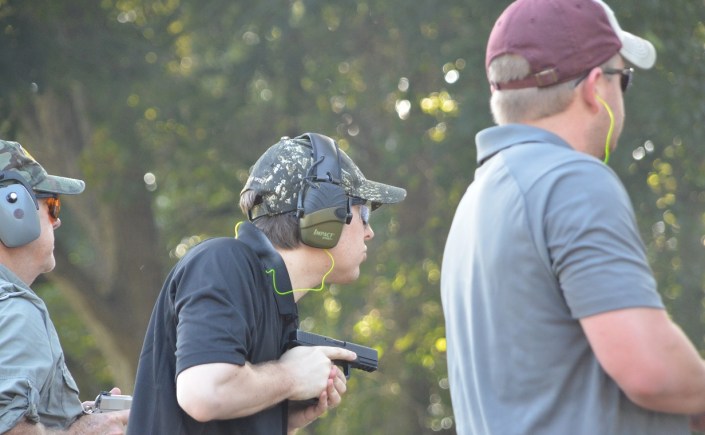
The End of Violence, Part I: Introduction

This Saturday, I’m going to a combined defensive pistol and defensive carbine class. It’s not my first tactical shooting class, and I’ve in the past been an NRA Pistol Instructor and a Texas Concealed Handgun Instructor. Regardless, the occasion seems a good one on which to share some of my thoughts about violence given my Christian faith.

This is not an easy subject and, while I’ve spent a fair amount of time studying various martial arts—krav maga, karate, sport fencing, historical European martial arts (swordplay, knife/dagger fighting and wrestling, mostly) and shooting—I can’t say that I’ve ever been in a real fight. As such, I simply don’t have access to the experience of either the event itself or the psychological aftermath. I invite those with such experience to comment on this series; I’m going to attempt to restrict myself to the abstract and philosophical side of things.

As a person of staunchly moderate political leanings and progressive theological positions, I’ve had the rare opportunity to be considered both conservative and liberal. Coming from one of the most diverse counties in the U.S. and being a theatre person with friends holding a diversity of sexual orientations and gender identities, moving to College Station put me solidly in the liberal minority, at least among the studentry (I nevertheless had no problem finding likeminded people—Texas A&M is a big school, after all). Then, going to Austin for graduate school, I suddenly found myself to be considered a conservative by my peers.

When many of my fellow students of medieval and renaissance literature discovered that I had a license to carry a concealed handgun, they suddenly had this idea that I had fashioned myself a vigilante; that I wanted to live in the Old West and have a shootout at high-noon; that I had naively decided that combat would be fun (or evilly decided that hurting other people could be enjoyable). When I explained myself, however, I often found them surprised.

I told them that I preferred to carry—legally, and not all of the time (campus carry was illegal back then, of course)— a firearm that I had trained seriously with because that way I knew that I would walk away from a violent confrontation (or, I at least had a good chance of doing so) and that I could try every non-violent dispute resolution technique I could think of rather than responding out of fear. Indeed, as a Resident Advisor at Texas A&M I had been trained in conflict de-escalation, and Texas requires similar training as part of the concealed handgun license coursework. I am convinced that there is no more valuable skill that a person may learn—whosoever they may be—than how to communicate peaceably, respectfully, empathetically and constructively with others, even if that results only in an agreement to disagree. In the broader scheme, more training in the world in how to relate and talk to people with competing interests would save more lives than all the firearms training in the world.

That was certainly my experience the only time I ever came even remotely close to drawing my weapon when carrying it. This was, conveniently, in Austin. K and I were living in an apartment on the southwest side in a suburban area well away from campus. Nevertheless, at about 2:30 in the morning one night, some undergrads in the next building over were blaring music, drinking heavily, and throwing beer bottles into the parking lot from their third floor balcony.

Admittedly, I am a very grumpy person when disturbed from my slumber. I got up, put some clothes on, and holstered my pistol in concealed holster just in case. The first move was mine, and I immediately made a mistake: upon getting close to their building I yelled up at them to turn the music down, using no expletives but not in the friendliest of voices. Immediately, three men, all very inebriated, ran down the stairs to confront me. I stood my ground but tried to backtrack, apologizing for yelling and explaining that I wanted to come ask them to turn the music down and stop throwing beer bottles rather than just calling the police.

They responded with threats. I kept my hands up and palms toward them in a non-threatening manner (also because it happened to be a good defensive position, just in case), but I also made clear that I was not intimidated. I repeated my request matter-of-factly, despite their threats at my mention of the police (they were happy to remind me that they outnumbered me, despite the fact that they were all practically falling over on their own and any collaboration between them was certainly out of the question). In the end, it became clear, perhaps as it should have been from the beginning, that I could not reason with them. I cautiously removed myself from the situation, returned to my apartment and called the police. The next day, I reported the confrontation (although not my possession of a firearm, which was immaterial as it was never produced) to the apartment management. The offending tenants were evicted for threatening fellow residents—a clear violation of the Texas Apartment Association form lease.

I’d like to think that, despite my rough start, the confrontation went about as well as I could have hoped for—I walked away unscathed and without the regret and what-ifs what would have attached if I had injured someone else—justifiably or not.

But the point of this post is not to talk about me (although I hope the long introduction has provided some background to my own biases and experience). Let’s talk about weapons, violence and Christianity. We’ll start in the next post.

Toward a Positive Morality

When K gives Bess a bath, they blare music and sing along. A great time is had by all, I’m sure. Bess is a quick study of melody if not of words and her little voice combines with K’s in a pleasing microcosm of happy home life.

Cute as it is, I don’t really care for the music they listen to. Most of it is old Sunday School songs that K and I heard as kids (and K actually remembered). After bath time, recently, K asked me why I had that look on my face. She knows I’m not a big fan of Christian “genre” music and knew what was going on before she asked, I think.

“I don’t like the music,” I say.

“What’s the matter with it?” she asks.

“I don’t think it’s good theology.”

“What’s the problem.”

“It’s too simplistic.”

“They’re kid’s songs!” she exclaims.

The one that really got me was the “Ten Commandments Song,” and not just because it is still infuriatingly running through my head—“Number One, we’ve just begun; God should be first in your life…” If you keep singing this to yourself, you’re probably a child of the eighties.

I’m not a big fan of the Ten Commandments. Gasp if you must, but I’m just not. I don’t think that they really have much of a place in Christian morality. Gasp again, this time so others turn to look at you.

That’s because the Ten Commandments, like most of the Old Testament law, enforce a negative morality—“thou shalt not.” There are several problems with this.

First, negative morality gives us ample ammunition to infringe upon the warning that we “judge not, lest [we] be judged.” Matthew 7:1. It’s just so tempting to say, “But he did!” when comparing someone’s actions to one of the Big Ten.

Second, negative morality does not allow us to fulfill our calling to follow after Jesus. Consider the Rich Young Ruler episode (Mark 10:17-27; Matthew 19:16-22; Luke 18:18-23). The Rich Young Ruler has followed the commandments all of his life, and Jesus quite readily tells him that there’s still more he lacks.

Negative morality is legalistic. Trust me; I’m a lawyer. It allows one to say, “I have avoided doing those things; I have fulfilled my obligation.” Jesus continually confronts the Pharisees about this problem, largely because the Pharisees hoped to reclaim righteousness through jurisprudence and adherence to the letter of the law. Compare with Jesus’ commands, which seem to be largely positively framed: “forgive those who trespass against you” (Matthew 6:9-13); “give to him that asks of you” (Matthew 5:38-42); “love your enemies” (Matthew 5:44-46); “Be perfect, as your Father in heaven is perfect” (Matthew 5:46-48).

This is a point made by E. Stanley Jones in The Christ of the Mount, which I’ve referred to before. Jones argues that, unlike negative morality that allows us to say, “I’ve done (or haven’t done) that, box checked,” the positive morality of Jesus always calls us to do more. “Love your neighbor as yourself” has no resting place—you must always ask what more one can do to love your neighbor. Negative morality tells us not to get worse; positive morality calls us to be better. It brings the spirit of the law to the apex and allows the letter of the law to subside in importance.

There is a good place for negative definitions of behavior—the legal system. Negative commandments allow us to offer societal protection against evils while preserving the greatest amount of freedom in the individual—“if it doesn’t say I can’t do that, then I can.” Excellent for the needs of society to order itself, but not great for those on a journey of sanctification.

Third, negative morality is not terribly responsive to our moral needs. “Thou shalt not kill,” doesn’t help us with questions like, “Is it permissible to kill one person to protect ten from him?” The commandment against bearing false witness is even flatly contradicted in the Old Testament, or at least an exception is made. Rahab, a prostitute (or perhaps innkeeper depending upon how misogynistic you like your translation) hides the Israelite spies in Jericho, lying to the authorities about the presence of the Hebrews in her home. For this lying, she is rewarded and blessed.

We live in a fallen world, so we need moral guidance that allows us to understand and work morally within that world. Black and white commandments of “thou shalt not” do not make room for the myriad potential factors and circumstances that influence any particular moral choice. Our intuition tells us that there’s a difference between killing someone for profit and a soldier killing to protect the lives of his brothers-in-arms.[1]

The positive commandments of Jesus—to “love your neighbor as yourself” is at once imminently simple and infinitely complex and responsive to circumstance. We must ask ourselves, “What does it mean to most love my neighbor in this circumstance? What does it mean to love two neighbors who are in conflict with one another?” Etc.

Fourth—and this is what got me thinking about this in the first place—positive morality is a, well, more positive formulation of behavior for instructing young ones. Isn’t it far better to say, “It hurt little Jimmy when you did that; what would be a way to love him better next time?” than to say, “That’s bad; we don’t hit,” which carries with it the connotation of “you’re bad and defined by that one action.” Am I overthinking this? Perhaps? Is it hippy-dippy (to use the term for the first time in my life)? Definitely. But would it have a positive impact on children’s behavioral development? What little knowledge I have on the subject seems to indicate yes.

I’m fairly well convinced that it’s worth it to start thinking about how we can be better rather than focusing on how we’ve messed up—to avoid hurting others by focusing on our relationships with them rather than sterile commands. What do you think?

—————————————————————————-

[1] A few caveats here. First, one must admit that, being subject to a fallen world, our intuitions may not always be trustworthy. Nevertheless, I believe in C.S. Lewis’s arguments about “natural law” and the existence of conscience as a signpost to God. Additionally, when we talk about comparative morality—“X is okay in this kind of situation but not this”—we open ourselves up to far more ambiguity than we can handle in this post. Still, that gives a good reason for the theological point that we treat all sin as equal—we’re incapable of knowing with certainty how to rank one sin against another, so let’s not fool ourselves into thinking we can.

What Tom Clancy’s The Division Teaches Us About Humanity

I’m a big fan of Tom Clancy games in general, but The Division really hit a chord with me. I don’t usually devote much time to MMO games, but I’ve remained steadily involved with the game since its release back in March. This is partially because I have good friends to play it with; friends make everything better.

But this is not a review. Instead, I want to talk about some of my observations in the game.

If you’re not familiar, the game has a place called the “Dark Zone”, a smallpox-contaminated part of Manhattan quarantined from the rest of New York City. The Dark Zone is the game’s PvP (Player versus Player) area. Some of the toughest computer-controlled bad guys are in the Dark Zone, as are some of the best rewards. To eliminate these bad guys and reap the rewards, one typically needs to form a group with other players. Once you’ve grabbed the loot, you have to go to a special area and call in a helicopter to extract the items before you “own” them. They are contaminated, after all.

Before you’ve extracted items, any other player can kill you and steal those items. Lone wanderer players make easy targets to teams of other players and—especially when you get the drop on them—are often easier to kill than the non-player character bad guys.

This is supposed to be part of the draw of the game—the cat and mouse of stalking and evading other players, the team-on-team direct combat against player opponents and, most of all, the tension the system creates. There are few people you can actually trust, and I’ve had more than a few encounters where, randomly encountering another player, we both have to scope each other out, not wanting to fight, but unsure of the other’s intentions. That nervousness is in some way satisfying because it is so immersive; it brings you into post-disaster New York in a personal and experiential way. I like that.

On the other hand, particularly because I’m introverted and often avoid linking up with random players (only joining teams of people I actually know in real life), I often find myself navigating the Dark Zone by myself. Consequently, I often find myself getting killed and my stuff ganked because I’m outnumbered, outgunned, or simply stabbed in the back by an opportunist while I’m trying to defeat the Zone’s tough computer-controlled hostiles.

My time playing has taught me that there are three groups of people when it comes to the Dark Zone. The first is where I find myself, reluctant to “go rogue” to kill and steal from other players even when I’m in a group and confident I can get away with it. I’ve encountered only a few other players with this view. The second group is probably largest. They understand that this is a game—there are winners and losers, and those who play have agreed to the rules that govern the game. This group probably enjoys the game the most because they fully play out the game’s possibilities—sometimes going rogue and killing other players in ambushes or pitched battles. But they don’t strike me as the type who would probably act that way were the game real life. They know the difference in the stakes and consequences of a game versus the real thing.

The last group is the one that I find so simultaneously fascinating and infuriating. These are the bullies, those whose primary joy in the game is picking on players less powerful than themselves. These are the ones who, having killed you in an unfair fight (usually extremely so—four to one odds and they strike when you’re otherwise occupied) come up and stand next to your body to laugh and mock you until you’re able to respawn. These are players with malice aforethought.

At the end of the day, it’s still a game, and it wouldn’t be fair for me to make a presumption about a stranger’s moral capacity in the real world based on behavior in a digitally-manufactured world. On the other hand, I’m a believer that the anonymity of the internet (including multiplayer games) allows people a release from the social conventions that normally restrain their baser selves.

When playing the game (admittedly, perhaps more to relieve my own frustration than any objective reality) I am constantly reminded that maybe there really is a fine line between social order and the chaos of those with more power and less restraint.