“Fluff,” Lore and Mechanics

“What, drawn, and talk of peace! I hate the word as I hate hell, all Montagues, and thee, [fluff]!”

I absolutely hate the word “fluff” as it is applied to gaming worlds. If I understand correctly, the term was first used by wargamers to discuss the information given about the world in which their chosen wargame takes place (for me, it was first used in “Warhammer 40k fluff.” The word is, of course, derisive, with the connotation that “fluff” is not necessary, but only a nice addition to have. I understand why some wargamers might have coined and still use the term if they only carry about the actual game they’re playing itself (they want to know which options make for the best Tyranid warriors but don’t give a fig about Tyranid biology, for instance), and the word makes this plainly evident.

Even in the wargaming realm, though, I think the word does a disservice. Maybe I’m just not as competitive a wargamer as others (or maybe I think I’m not until I sit down to a game and take it overly seriously!), but the narrative of an unfolding combat is just as or more interesting than all of the rules themselves. Games overly based on the army you bring and the synergies between unit selections quickly bore me over games where on-the-field decision making and use of resources takes center stage. I want to know a reason the forces are fighting for me to be interested in outcomes more than winning and losing. I think that’s a more fun approach, too, as you can celebrate the sudden reversals in fortune for your opponent with them instead of lamenting as “unfair” every time the dice turn against you.

As a curious aside, I find in interesting that some fictitious settings get “lore” or a “legendarium” while others have only “fluff.” I’m not quite sure where the distinction lies, but I’d love to locate the line. It’s not simply that games have fluff and speculative fiction has “lore”–the Elder Scrolls and Dragon Age worlds are often spoken of in terms of “lore” and not “fluff.” Maybe some of this is just a matter of how seriously a particular person takes a particular settings; almost certainly some of it is a matter of semiotic fluidity and carelessness with words.

But I do think it matters. Over the past fifty years, roleplaying games (and games based on fantasy and speculative fiction in general) have increased both in popular appeal and in the seriousness with which the writing of gamebooks and the playing of the game are taken as artistic and literary pursuits. Academia is studying and writing about roleplaying games more and more, and I think that’s an amazing thing; there may be more to learn about how humans examine and work through their own existence in the roleplaying game than in the solitary virtuoso’s classic novel.

When it comes to roleplaying games, I absolutely detest the word, “fluff.” I like a good set of mechanics for a game and I have a great interest in analyzing, modifying and creating RPG mechanics, as some of the posts on this blog demonstrate. I don’t want to fall into the trap of proclaiming the “one true way of roleplaying,” so take my opinions for just that: opinions. But I believe that the setting in which a roleplaying game takes place is not only just as (or more important than) the hard-coded rules, but that the setting and lore surrounding the game are part of the rules.

Those of you who read my RPG-related posts with some frequency know that I gravitate toward narratively-focused games, and especially Fate. But my posts on character-building for Shadowrun are probably the most-read posts on the entire site, so I’m not averse to rules-heavy games either. Still, the games I favor tend to explicitly incorporate setting as mechanics. Fate uses Aspects as a mechanism for those things that are narratively important to affect the dice resolutions, Cortex Plus and Prime do the same thing in a slightly different way. These rules are both focused on providing flexible mechanical systems to handle those points of narrative where randomness and insecurity of outcome is beneficial to the game, while keeping the narrative at the forefront. There are not rules for every case, nor do these rules get too bogged down in exceptions, combos, etc., leaving both Fate and Cortex as RPG toolkits for those gamemasters who like to tinker with and personalize their rules without having to start from scratch.

Forged in the Dark and Powered by the Apocalypse take a different, maybe even more direct, approach to setting as mechanics. They call this narrative or fictional “positioning,” and they don’t need hardcoded rules to do it. The premise is simple–when deciding how successful and effective an action is, we look at the context of the action to make the determination rather than resorting to a “margin of success” or other explicit rules. In a gunfight with a knife and you’ve out-rolled the opponent? Maybe you’re able to get a good slash on the opponent and disarm him. Had you been using a gun of your own, maybe the result would have been a John Wick-style headshot, since you’d have had a much better fictional possession relative to your opponent.

Both systems can use the “hardness” of a GM response, cost of success or degree of success or how many pieces of a clock are filled in for a more specific tracking system.

But neither of these system is necessary to use the “setting and situation as rules” approach. In fact, I think it’s fair to argue that all games to this to a greater or lesser extent. Even Dungeons and Dragons, where you might have a discrete dice roll for damage or to determine whether a condition is suffered, many tests (especially skill tests) are wide open to interpretation of result by the GM. Genre, setting and situation can be drawn upon to determine results in such cases.

A few notes on this:
(1) I think that this is part of what OSR gamers are looking for–greater acknowledgment of setting and situation for resolution rather than specific rules for every action authorizing what can and cannot be done. There’s an opportunity cost for writing rules for specific actions, one most evident in feats and abilities for characters, I think. If there’s a “Great Leap” ability that allows for a jump attack, there’s, at the very least, an implication that characters without this ability can never make (Brad Pitt as Achilles in Troy-style) badass jumping attacks.
(2) Also with reference to D&D, the opposite situation–when mechanics are treated as the physics of the setting, even when that doesn’t make rational sense–occurs. I think that this is part of what drives me away from the D&D system as a whole (among other things). I think of Jake Norwood, writing in the preface of his awesome game The Riddle of Steel, when he states that part of the impetus for creating his game was a D&D experience where his character stood on the edge of a cliff, a horde of orcs rushing towards him, and he realized he’d take less damage jumping off the cliff than fighting the orcs. It’s okay to say, “if your character does this, he will die”–even if the rules say otherwise. Unless you’re trying to play a goofy slapstick game (power to you if that’s how you roll), everyone at the table should understand that logic trumps rules when they’re in conflict. A good example, I think, was how the Serenity RPG handled being thrown into space without protection. The rules state (in paraphrase): “The character dies. If you really need to, roll all the dice on the table and apply that much damage.” Note that I’m not saying that it’s inappropriate for a game to have a mechanism for resolving falling damage, only that that mechanism should give way to the fiat of death (perhaps modified by whatever “barely escape from death” points the system has) when it is logically appropriate.
(3) No rules system can cover all situations, nor can it possibly account for all of the minute variables that might factor into a resolution roll, so by necessity we resort to using setting and situation (as our form of internal consistency and logic) to structure resolution rolls in the first place. Is this a one-die penalty for difficulty or two?

And, of course, the lore of a setting tells us what types of things are likely to happen in that setting, what things are extremely unlikely, and how actions or events are likely to play out. You can, and sometimes should, homebrew and modify rules to reflect those realities, but the truth is that you don’t necessarily need to if the setting itself provides the North Star in guiding the structure and interpretation of rolls.

For all of these reasons, I’d argue that setting is a much a part of mechanics (or at least should be considered such) as everything that falls within the “rules” section of the books. When that’s the case, there’s no such thing as “fluff,” there’s only information about the setting that helps us understand how to position the mechanics we use when playing in that setting.
Faith, Fiction & Frostgrave: Laying a Foundation

The last few weeks have been a little crazy (hence a lack of posts), but I’ve managed to sneak in a little time on some projects–the one below and some other things that will make their way to the blog shortly.

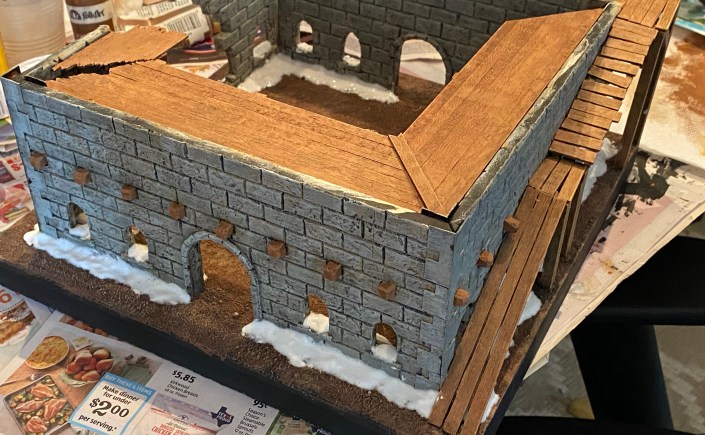
If you’ve looked at my previous posts on Frostgrave, you’ll see that I have two warbands painted and some terrain under construction. Recently, I completed most of the construction work on the first level of the large square central tower I’m building for the Silent Tower scenario (and whatever else it happens to be useful for–I’m not sure whether the new edition of the core book coming out this year will mean a change in scenarios). It struck me that, given the design of the building and the idea that (at the time at least) I had no intention for making the levels separable from one another, I’d ought to paint and finish the base and lower level before adding more to it that would make it even more difficult to paint the lower areas. If I’d been smarter, I’d have done all of the brickwork painting on the inside of the building before attaching parts of the second-level walkway (as you’ll see, I caught myself before finishing that installation and diverted to the painting!). Live and learn, I suppose.

It’s been a long while since I’ve painted terrain, and I had–and have–a lot to learn and relearn. I took a lot of cues from the Black Magic Craft videos for the stonework (though my technique isn’t near as good as his so far), and I even followed his instructions to make my own terrain washes using Liquitex acrylic inks.

I’m giving myself a B+ for the results. It’s not as good as I’d like, but it’s still a terrain piece I’ll be happy to put on my table and play on. I may consider some additional accents, like vines on the walls and perhaps the addition of some torches or lanterns, once I’ve finished the other levels. In future works, I think I’ll be using some lighter tones for the wood, but I used here what I had on hand and I think it turned out just fine for a sort of cedar-look.

I’ve opted for a muddy coloring for the base earth for the terrain, as I wanted some color contrast to the stony grey that will be ubiquitous in the buildings themselves. I’m happy with how this turned out and I’ll be adding some embellishments to other pieces–puddles where the ice and snow has melted and pooled, particularly mushy and gross mud patches, etc.

I admittedly had some issues with the snow–at least to my taste. I was using the Busch snow paste, and the top of the container held a pastier type of snow easier to create ridges and textures with. When working on this piece and delving deeper into the container, I found that the component parts had separated out into the pastier part and a heavy liquid. Like an idiot, my immediate response was to stir everything back together, which gave me a flowy-ier, smoother compound that makes for fluffy banks but wasn’t so much the look I wanted. And, I realize I didn’t think about the effects of the direction of the sun in determining where to put my snow, but meh.

On the other hand, it was driving me crazy trying to figure out how the Busch snow paste is made so that I could replicate my own in larger quantities and for cheaper. The paste had an immediately-identifiable smell to me–spackling paste–but I wasn’t sure about the other parts. After some thought, though, I think I’ve zeroed in on enough of the materials to create something very similar. If I get good results, I’ll post my recipe for your use.

In the meantime, enjoy some pictures of the work so far. Helpful criticism is welcome–I’m always happy to learn better ways to do things!

FFF & Frostgrave Continues

When not trying to get some writing in–on my slowly-developing novel or on the blog–or preparing my impending Shadowrun campaign, I’ve been steadily working away at more stuff for Frostgrave.

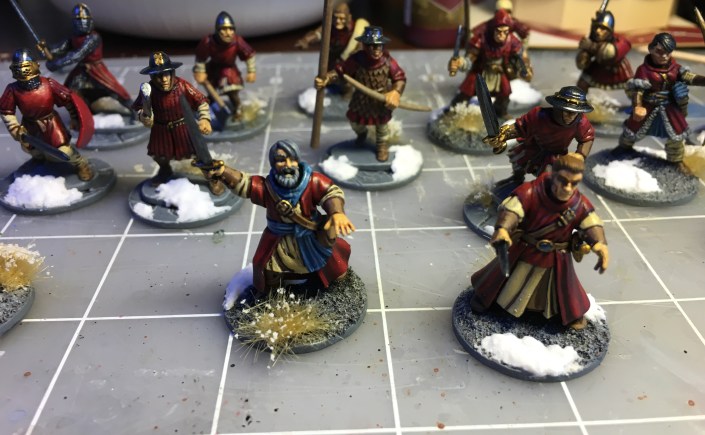
Without further ado, here’s my second warband all painted up, an elementalist and his retinue:

As you can see, this one is largely Fireforge historical miniatures, with some kitbashing from the Oathmark humans and some Frostgrave plastics. Some of the miniatures have Renedra textured bases, which I’m pretty happy with, but some were assembled and based before I had the bases (or started this warband) and so there’s a little bit of a hodgepodge. As you see, I’ve added some foliage tufts and snow paste to these bases (as well as the first warband) for extra effect.

(It’s really bugging me that I can’t figure out exactly what my snow paste is made of. It’s definitely a spackle base, with some sort of glitter and maybe a gloss medium added. If I can parse it out, I can make my own much more cheaply, which would be nice!)

This warband does not have as wide an array of specialist soldiers than the first one–I figured the elementalist would want to focus on combative soldiers bringing the pain over utilitarian ones.

I’ve gone back and forth in my head about how strongly to color-code my warbands (I’ve inadvertantly got Christmas colors going now, it seems). I often like the rag-tag look for its thematic nature (reinforcing the expendability of soldiers), but there’s a great convenience (both in the efficiency of painting and in recognizing minis on the table) to matched soldiers.

After the first color-coded warband I’d finished, I actually had started to do some rag-tag soldiers. But, after painting about ten or so, I realized that they rather handily fit into some color-coded groups: browns for my barbarians, purples and blacks for my cultists, etc. So, I think I’m sticking to color-coding for now.

One of the reasons I picked Frostgrave to get back into minis gaming (other than the setting and style of the game, which are both right up my alley) is the relative ease of having enough miniatures myself to invite friends to partake in the fun of the game without having to talk them into purchasing and painting a bunch of minis for themselves. Having over the last decade talked friends into Warmahordes, Infinity and Malifaux, I decided I’d better front the cost of the game myself and not have to persuade anyone to spend anything if I want to best maintain my relationships. Of course, I’m not stopping anyone who wants to join in with their own warband!

My Proxxon hot wire cutter came in a few weeks ago as well. I almost immediately jury-rigged some jigs (one for cutting circles and one for “ripping” styrofoam to adjust its thickness) based off of the very nice ones done by GeBoom at Shifting Lands. I’ll definitely want to invest in their jigs eventually (and there’s a lot of other cool stuff, like their window templates, I’ll want to add to my order), but I was excited to just get things going. Maybe too excited with the number of styrofoam rings that ended up on my study table. I’m still making a lot of mistakes and learning a lot with each task or operation, but so far I do have one pretty decent (and multi-leveled!) round tower for the Silent Tower scenario (as well as just generally useful terrain).

I’ve got a larger square tower in the works and a number of cut foamcore and insulation foam pieces that need texturing before I glue them to bases for more general ruined terrain.

I can’t say enough good things about the Proxxon. It’s just an amazing tool. I think I’d love it even more with the Shifting Lands add-ons, but I’m able to do a lot of stuff with the base unit and the two jigs I put together with a nail, leftover 1/8″ hardboard and some wood glue.

I’d focused on terrain for a short while before I went back to painting minis, which is where I’m feeling the current pull. It’s all got to get done eventually; I’ll post more pics as things develop.

Faith, Fiction, Fatherhood…and Frostgrave?

As I mentioned in an earlier post, I’ve recently decided to take a break from video-gaming and devote more time to my “analog” hobbies. It’s now been roughly six weeks since I’ve played a video game and, honestly, I don’t think I miss it as much as I expected to.

The novel I’m working on is progressing slowly but steadily, and I seem to be on schedule to have a finished draft by the end of the year.

But what else has filled my time? I’ve been finishing up Joe Abercrombie’s First Law series, so expect an overall review on that in the near future. As I mentioned in a recent post on gaming as an adult, I’ve been building a hyperlinked database (in OneNote) of characters, locations, events and other goodies to drop players into for future Shadowrun campaigns conducted in the style of a “narrative hexcrawl” (if you’ll bear with me on the liberal use of the term).

With the remainder of my time not spent on the above, or working, or caring for children, I’ve been returning to a long-running, off-and-on-again love affair: miniature gaming. It started around when I was twelve; my dad brought me back some Warhammer Fantasy miniatures from a business trip to London. I was hooked. I remember fondly spending a lot of time in a partially-finished room of the house he used for his model railroading set-ups, listening to the radio and painting miniatures. That was were I discovered my favorite band (Live) and probably much of the rest of the 90’s music I still enjoy so much (it was the 90’s, after all).

I never actually played Warhammer Fantasy. But I spent hours in middle school and high school playing (and arguing over) Warhammer 40k, Necromunda, Mordheim and Warhammer Quest with my best friends. I worked on a lot of miniatures in college, but never seemed to get in an actual game. Off and on, I’d paint and sell minis, get “out” of the hobby and then return again–there are many people on Ebay and Bartertown that got some great deals out of my indecisiveness. After finishing (law) school, I played Warmachine for a while, then Infinity, then Malifaux. I enjoyed all of them (probably Infinity most of all), but the focus on synergies over tactics in both Warmachine and Malifaux left me unsatisfied at the end of the day.

After a few years away from minis games (and a false start with the new Necromunda), I decided to get into Frostgrave. I’ve found that I prefer skirmish level games, love campaigns where characters can gain XP and improve (how I miss Mordheim!), and kitbashing plastic kits is perhaps my favorite part of the hobby side of miniatures games. I also wanted a game where I could, without spending a small fortune, have enough minis to invite my friends to play without having to first convince them to buy into a game. This all pointed to Frostgrave.

I don’t do anything half-assed, and my approach to miniature games is no exception. I cannot bring myself to play games with unpainted figures and really prefer to have some nice terrain to fight over, too. Fortunately, I’ve collected a modest set of skills to accommodate both preferences over the years.

I began (after collecting all of the PDFs available for Frostgrave) by buying up a collection of plastic minis to build from. I picked up the Frostgrave Soldiers, Soldiers II (the women soldiers), Barbarians, Cultists and two boxes of the newer plastic Wizards. On top of that I added Fireforge Foot Sergeants and Foot Knights as well as a box of Oathmark humans. I had a set of Perry War of the Roses Miniatures from the small set of things I hadn’t gotten rid of the last time I got “out” of minis gaming, and I look forward to acquiring more Perry medievals for three reasons: (1) they’re beautiful minis; (2) they’re pretty good for historical accuracy; (3) while many others have used them for Game of Thrones minis (search Google for “To Westeros with Captain Blood” for the best example, in my opinion), they strike me as perfect for a Witcher minis game (y’know, once I’ve built and painted all the Frostgrave minis, and bestiary monsters, and terrain to complete a good collection).

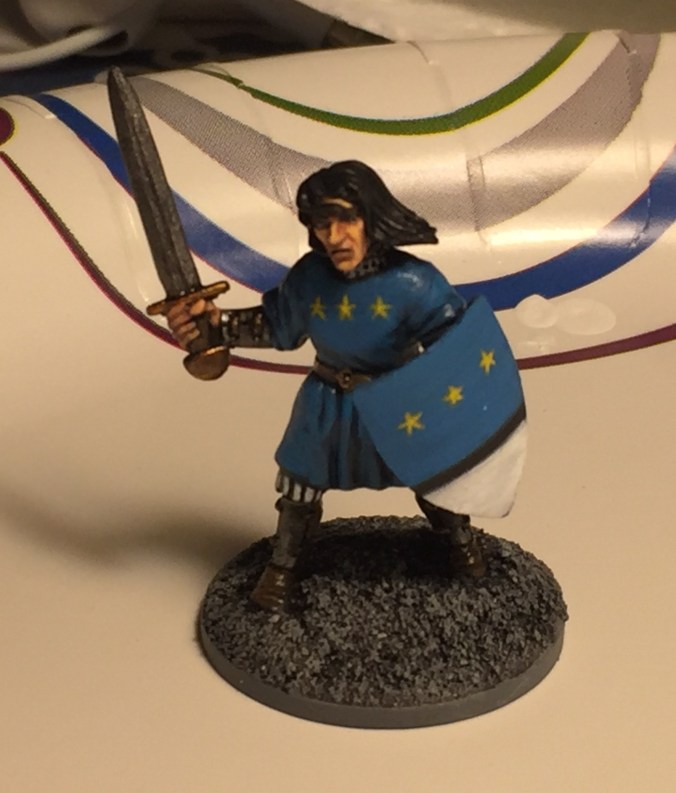
I started by kitbashing and painting a few random soldiers: a knight here, a few thugs there, a marksman. This is the knight, the first of the minis I’ve painted in a long while:

img_2225.jpg

After a few of these, a thought occurred to me: what if I do a warband that seems to go together rather than a bunch of ragtag outcasts, a group of models with some unity in their clothing and colors. After all, I’ve got thirty Oathmark bodies and plenty of stuff to mix them with.

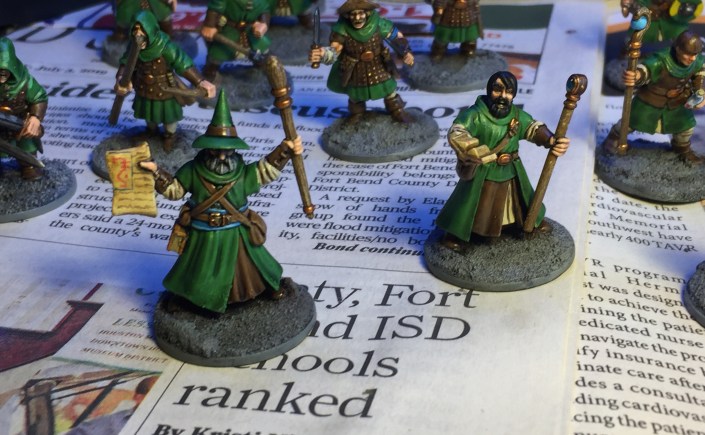
I’d decided my first warband would be a Sigilist, so I built my wizard and his apprentice (the header photo) and sixteen of their closest companions: thugs, an apothecary, archers, a marksman, a thief, a treasure hunter, a tunnel fighter, etc. I finished painting them today.

The bases still need some detailing (my model snow and foliage tufts are on the way), but they’re otherwise finished. Not the best painting I’ve ever done, but not bad for shaking the dust off after so long.

Of course, after I finished painting these guys was when I looked at how I might assemble them into a starting warband and realized I’m probably at least one thug short for what I should have (and there are a few other soldier “classes” I don’t have represented yet), so I started building some more to accompany them even before my brushes were dry.

I had planned from the beginning, however, for a captain. I wanted my captain to have mail armor, though, and the Oathmark humans, well, don’t. Frostgrave makes a distinction between no armor, leather armor and chainmail armor (the latest game by McCullough, Rangers of Shadow Deep, uses “light armor” and “heavy” armor, which, for a game that encourages you to use whatever minis you want, should probably have been the distinction in Frostgrave as well). Technically speaking, what the Oathmark soldiers are wearing is what D&D (and therefore many fantasy games) calls “studded leather.” This categorization is based upon a misunderstanding of armor depicted in art, where the “studs” that make the leather “studded” are actually rivets holding together small metal plates between a front and back (both probably of cloth, not leather) forming what is called a “brigandine.” This type of armor is probably closer to chainmail in its effectiveness. But, I figure most of those poor souls I can convince to play a minis game with me don’t also want to hear my pedantry about medieval arms and armor–the above is just the tip of the iceberg.

All of that is to say that I decided to go with the conceit that the armor on the Oathmark minis is “leather” armor. Actually, there’s a lot of dispute about just how much leather was used in armors, historically, but…see what I mean about the pedantry?

The point is that I needed a model with mail but wanted one that would still fit with the clothing of the rest of the soldiers. I sucked it up and decided to venture into a new skill, one I’ve actually wanted to pick up as a hobbyist for a long time–sculpting in “green stuff” (kneadatite) for the conversion of minis. So, I started with an Oathmark body and set to work.

Once I’d done the mail for the mini, I couldn’t help but also try a fur cloak. They’ve come out well, but I have a few minor details to sculpt before the mini gets some primer and a proper coat of paint.

As I said, I don’t really tolerate a minis game without some passable terrain as well. The below is my first humble piece, not quite finished (the ladder needs painting and it also needs snowy details). I’m mostly happy with it, but I’ve since learned some techniques to put some more color into the stonework, which is what this piece is currently lacking.

IMG_2221

And that’s it for now, but the work continues. My Proxxon foam cutter just arrived today and I’ve drawn up some templates for the main building in the Silent Tower scenario, so I’m itching to put it to work.

So here we are, with a new (sub-section) of the blog, wherein I’ll post some more my work toward getting an entire table worth of terrain and a slew of minis to go with it, hopefully followed by some tales of battles fought by–as my wife calls them–“tiny minions of dice death.”