Nano-Update: Final!

It is finished.

Last week, both of the kids had the flu, so between trying to get work done and staying home with them, it became difficult to put all of the time into writing that I had hoped to. Neither K and I seemed to have caught it (thank God!), but I think we’re both still feeling a bit exhausted in scrambling to make sure they were comfortable while meeting work deadlines and trying to plan for the holidays.

Nevertheless, while I didn’t write as much as I’d wanted to, I did get enough in to hit my 50,000 words for NaNoWriMo. Yay! I win! Although, I have to admit that I don’t actually feel much at all about hitting that deadline. The things I feel good about–a constant schedule of writing, feeling productive and creative while writing, reaping the benefits of the massive amount I’ve time I put into plotting the novel–really don’t have much to do with the event itself. And, given that the novel is looking more and more like it’s going to be right at 150,000 words when complete, 50,000 doesn’t feel like quite the big milestone it might be. I realize that this kind of treatment of NaNoWriMo might make me an asshole (I feel like it does given that completing NaNoWriMo is a significant achievement on the way to finishing a novel for aspiring writers such as myself). But, as they say with unassailable logic, “It is what it is.”

As I’ve mentioned in previous posts, I’m trying to finish (the first draft of) the whole thing by the end of the year; while I’ve previously been optimistic about this, the events of this past week especially have made me wonder whether I’ll be able to keep that up in light of all of life’s competing demands (though I do now believe that, if I didn’t have to work a “day” job, I could be a prolific writer). In order not to stress myself out overmuch, while I will continue to try to get the draft done by the end of the year, I’m going to focus more on making time to constantly work on it until it gets finished than worry too much about the deadline. We’ll see how it goes.

I’ve got a few side projects that will make their way to the blog in the near future. One, a set of optional rules for cybernetics and human augmentation in the Fate RPG system, should be out in a week or so.

Another (which I’m quite proud of) is an Excel spreadsheet to make adjusting Fate’s “dials” easy for planning new settings and campaigns in the system. There is a single-page Fate worksheet for this, but the dials it includes are relatively basic and do not account for many innovative rules mods that have been added by the many books that have been published since Fate Core first released. This spreadsheet will incorporate (by reference only–I’m avoiding any copyright issues by providing explanations of the rules referenced) sources from the Fate Toolkits to the Fate Plus and Fate Codex periodicals to rules from various published settings (like Transhumanity’s FateTachyon SquadronInterface Zero 2.0, etc.)

“Dials” will include variables such as number of character aspects, general category each aspect should fit, special aspects rules, whether you’re using Approaches or Skills (or both!), what your skill list will be (from options I’ve developed for my own games), what starting Refresh will be, how magic, gear, weapons, armor and human augmentation will be treated (if they need to have special rules at all), how many and what type of stress tracks you’ll use (and how they’ll be calculated), whether you’ll be using rules for Resources and Contacts, how consequences will be factored, how recovery will work, how character advancement will work and much more. It makes me excited to plan out different potential settings and games, and I hope to share that excitement with you. It is certainly possible to do all of this planning without the kind of tool I’m working on, but the spreadsheet (I think) allows you to look at the “big picture” and think about various rules mods you’re going to use will all fit together. I know one of my issues with the customization of the Fate system is that I get tempted to do too much when simpler methods can often accomplish the same results (or similar enough) while better keeping to the elegance and efficiency of the system altogether.

Spreadsheets with automatic referencing and drop-down menus is about the closest I get to computer programming, but I do enjoy it when I need something a bit more rote and that doesn’t take too much brain power to work on. This has been a little respite for those times when I’m too tired to write creatively but not ready to sit still and passively watch TV or something (at least not without multitasking, a bad habit of mine).

All of this is to say that I’ll be returned to doing some more regular posting on the blog in addition to trying to keep up with the novel’s progress. More to come soon!

Nano-Update 3

I’m in the home stretch. As of this post, I’m at 40,588 words written, and that’s still after having some of my worst days writing this NaNoWriMo (one dismal 600-word day and an 1100 word day this week).

At my current average pace and goal, I’ll finish by the 20th or 21st. With NaNoWriMo at least. More and more now, though, I’m thinking about the goal of having the whole thing finished, in first draft, before the end of the year. If I can keep up this pace, I can do it. As I’ve mentioned, it’s looking like the novel will be somewhere between 125,000 and 150,000 words when finished, so that gives me somewhere between 35 and 47 days to the end of the novel. As of today, there are 44 more days in the year.

I worry about keeping up that pace, though. I’m worried that I’ll do the same thing I do when I’m running–I’ll push too hard to fast and then tire myself out early and be unable to run the entire distance I’d planned for. I’m not a distance runner by any means (and I like having run much more than I like running), and I’d like to think that I’m a much better writer than runner (certainly I write much more consistently than I run), so maybe this isn’t the best analogy. But, having not attempted to write at this pace for that long before, its the uncertainty that threatens. Isn’t that always the way of things?

On the other hand, though, there’s a part of me that thinks that maybe this pace is relatively easily sustainable. The goal I’ve been setting for myself is to write 2,700 words per day, and I’m hitting that more days than I’m not. It’s been taking me about two hours to hit that word count when I’m focused, and I’m finding it a bit easier to focus each time I sit down to write.

What’s more, I’m finding that, at the conclusion of a session, I still want to write. I often want to work on some side project rather than continuing the novel, some of which will make their way to the blog in the near future, I’m sure, but I don’t feel that my creative juices are exhausted at the end of a session. I’d almost equate that feeling to the runner’s high–it’s a damn good feeling.

Of course, trying to maintain this pace likely means fewer posts on the blog until I finish that first draft, so I’ll beg your forgiveness in advance.

On the other hand, I’ve repeatedly requested readers for the novel-in-progress, so if you’re just dying to read something of mine in the meantime, you have that option!

If you’re a fellow NaNoWriMoer, I wish you the best of luck. Put up a comment and let me know how you’re doing and how you feel about it!

Nano-Update 2

It’s 10:45 am on Sunday morning. I’m at home while K and little Marshal are at church; Hawkwood has been sick the past few days and is, thankfully, resting comfortably at present.

Writing has been good. I’m now at 27,293 words and beginning to focus more on my goal of finishing the first draft by the end of the year than the fifty-thousand-word goal of NaNoWriMo, which now seems like it will not be any issue. This is nine-and-a-half chapters into a text that is plotted to forty-something chapters, so I’m also feeling pretty good about the likely end length.

Also, I have a (very early) working title: Things Unseen.

What’s more, I’m finding the writing easier. I’m averaging about 2,700 words in two hours of writing each day, and that feels very sustainable. The first time I did NaNoWriMo, I finished, and early, but I seem to remember having a tougher time dragging out the words and spilling them onto the page, spending more time in the writing altogether, and more of that time frustrated.

I’m still having the ups and downs of going from “I’m a brilliant writer!” to “This is crap, why am I spending my time on this!” but I’m more comfortable with the struggle than I have been. I’m learning to forgive myself (and my writing) a little bit more. The biggest part of that is rejecting the myth that brilliant writers get it right the first time, can write something down once and be done.

Some of the things I write do feel really good in the first draft (hence the highs), but I’m reminding myself that writing a novel is a long journey and there’ll be a lot to clean up, rewrite, rework and improve on subsequent passes through the manuscript. In some ways, it’s like a sculpture. At first, I’m getting the general shape of things, the suggestion of the lines and contours of what I’m chiseling away at. But there will be additional sessions necessary to bring all the details into focus and then to smooth the lines so that everything flows together as it should. I’m becoming comfortable with that idea. This is also helping to put me in the mindset that writing a novel is a marathon and not a sprint. Pacing myself is important, which is why I haven’t been pushing to write more faster given that I’m at a pace that is good, comfortable and sustainable.

Another influential factor is accepting the fact that I have to write. It’s just part of who I am. Yes, I very much want to write things that are good, that people want to read, that give me a way to send my voice, ideas and stories to thousands of people are more. I want to write things that would allow me to be a writer, full-time. But those desires are not the point. I write now because I must; because I’m not me–and I’m not happy–when I don’t. Even if it doesn’t turn out as well as I hope, it’s still mine, part of me in an essential way.

So far, so good, but we’re only ten days in. We’ll see if I still feel the same about the pace and sustainability next week.

Who else out there is participating in NaNoWriMo? I’m sure some of the people who read my blog are. Let me know how you’re doing! And, if you’re brave enough to read along with my first draft and want to give me some feedback, please reach out! You can email me at FaithFictionFatherhood@gmail.com.

Nano-Update 1

Three days in to NaNoWriMo 2019 and I have 10,443 words in the bag, which is almost my first four chapters done.  It’s been about 2 hours a day to hit that pace, which I’m extremely happy with. If I could find time to keep that pace and write three or more hours a day, I’d be very satisfied. Alas, so far I have not been able to achieve that.

I’m trying not to self-edit too much in this first-draft run through so that I can focus on getting the complete story to paper (or screen, as the case may be). I can clean it up after the first draft is done, and since that will be unavoidable, no sense trying to forestall it by editing as I go. Still, sometimes I can’t help myself.

If I can sustain this writing pace, then I can reasonably expect to finish the novel by the end of the year. It’s plotted at about fifty chapters, so I’m expecting somewhere between 125,000 and 150,000 words when finished. Any more than that, and I’ll have to seriously take the scissors to parts of it. Yes, A Game of Thrones is 298,000 words, but I’m not going to pretend I’m Martin on the first go-round. Not from a writing standpoint and not from a marketing standpoint.

Nevertheless, I’m finding relatively few moments when I’m stymied about what to write next, which is new for me. Hopefully it keeps up!

If you’d like to read the first chapter, click here. If you’d like to be a reader and journey along with me as I write, please be in touch!

NaNoWrimo 2019 – First Chapter

As a little taste of my NaNoWriMo 2019 project (still untitled), I’m posting the short introductory chapter (in first draft and unedited) here. Hope you enjoy!


One evening in the month of Tengas, by the Ealthen Calendar, when the nights remain hot even under the moons, I found myself on the road from my home in Ilessa to the castle-town of Vaina at the southwestern end of the Nysas Hills. Some acquaintances I’d made in the Old City had asked me to visit their brother Aryden, lord of their house, at their familial holding. Brother and sister—after several glasses of wine—whispered to me that their home had become haunted, that their brother’s wife in particular suffered greatly at the hands of some undiscovered spirit.

Knowing my profession—if it can truly be called that—they’d asked if I might see what I could do to remedy the situation. I proved reluctant until they assured me that my efforts would be well rewarded; I had heard that the amn Vaina family enjoys great wealth. Were it not for my habit, I could live simply and not hurdle headlong into the sort of otherworldly dangers to which my erstwhile friends had directed me. What habit is that, you ask? Books, of course. Even those from the printers are expensive enough, but the ones that hold the greatest interest for me cannot be found in print; they must be discovered and transcribed by hand.

And so, I held a minor incantation alive in my mind, softly illuminating the well-trod dirt path with preternatural light, nudging my borrowed horse along carefully, lest an injurious misstep cost me more than the value of the job before I’d even arrived. Windborne, my mount had been named. Once, perhaps, she had been fast enough to earn such a name. Now, though, only her ambling gait recommended her to me.
In the nearing distance, the firelights of the small castle-town of Vaina shone like a beacon, the fortress itself glowing on the hill above the nighttime fires of the town below. Food, though now only as hot as the air around me, waited for me there, and wine for the frustrations of the road.On these things I thought as Windborne plodded along only slightly faster than I could’ve walked, and I returned my eyes to the ground to watch her hooves.

In my reverie I’d not noticed the two men stepping onto the path before me until one of them cleared his throat, startling Windborne ever so slightly, I imagined that, dulled with age as her senses were, there was little she perceived clearly enough to find truly terrifying.

Men who greet a traveler in such a way have only one thing in mind, and I should’ve known to pay better attention on the road.

“Don’t you know it’s dangerous to travel the road alone?” asked the first man?

“Especially at night,” the second added.

Desperation marked every aspect of the mens’ appearance, from the travel-stained and road-worn clothes to the small patches of rust marring their drawn steel, poorly-crafted falchions better suited to chopping wood. But I’d seen men killed by far less, and the two carried themselves with confidence enough that I believe that they’d put their blades to nefarious use before.

A scraggly beard partially covered the pock-marked face of the first man, middle-aged and possessed of the sort of sinewy muscles that speak to service as a soldier or farmer, hard work with meager returns. Hard living had likewise ruddied the flower of the youth of the first man’s teenaged companion; dark circles around the boy’s eyes and cracks at the corner of his mouth told the all-too-common-tale of hornroot use.

“Highway robbery’s a pretty dangerous pursuit as well, I hear,” I told them, casually, hoping nonchalance covered over the disquiet in my mind. “You never know who you’re going to chance across. A wandering knight of legend, some noble’s assassin, bounty hunters, a thaumaturge.”

With the last words, recognition dawned upon the faces of the two bandits as they realized that they could not identify a natural source of the light that currently illuminated us. “Fucking witch,” the first one said.

“I think they call the menfolk ‘warlocks,’” the younger man corrected, earning a sidelong glance from his elder.

“Not in the Sisters,” I said.

“We ain’t in the Sisters, is we? We’re in the heartlands here, where the true and honest folk live. Those who fear the One as they should. Those who wouldn’t dream of doing the Evil One’s bidding with sorceries and mutterings and the like.” This from the older fellow.

“Two birds, one stone, innit?” The companion added. “Do a service for the One by killing us a warlock, and I bet he’s got some good shit to sell, too. And a horse.”

“Two birds with one stone? A trivial matter. Perhaps you’d like to see how two stones are killed with one bird?”

Almost simultaneously, they cocked their heads at me, like puppies trying to sort out something new. Given that precious-short pause, I split my mind between the effort of maintaining the thaumaturgic ball of light and weighing my options. With a quick sorcery, I could turn the illumination into a brief flare, blinding, or at least distracting, the men and galloping past them in their confusion, but the ensuing dark would leave me barreling blindly into the darkness at as least as much risk as standing still. I could draw the sword that hung languidly at my side: a thin, quick blade in the Altaenin style equally suited to cut and thrust, equally at home in the duel or on the battlefield. I have some skill in its use, to be sure, but two against one are never fair odds regardless of skill. Even if I managed to fell one of them quickly, his friend would likely injure me as I did so. Once cut, I’d have little chance of straight-on success with the survivor. I needed something better than violence.

So I released the incantation of light, letting its structure fall to nothingness in my mind, the ghostly illumination returning to darkness as I did. For a brief moment, we squinted at each other, waiting for our eyes to adjust; clouds had obscured the moons above and little light reached the darkened Avar through them. In that time, the darkness proved a friend.

I squeezed my legs delicately to urge Windborne to step slowly backward, creating some distance against my would-be robbers in case my ruse failed. And then I began to chant loudly, my voice booming with feigned wrath as I shaped nonsense words bereft of the Power or any chance to effect change in the world outside of me. It was an idle threat, to be sure, but with the fatigue of the road upon me, not to mention my inability to see the foes in front of me, I dared not call upon some working lest it fail miserably and make a difficult situation worse. Even if successful, my inability to control the Flux bleeding off of the working might accomplish something I hadn’t imagined—and wouldn’t welcome.

I settled on the blind bluff, chanting louder and quickening my rhythm, allowing my own nervousness to interject a reckless passion into the manufactured syllables. A lack of confidence in my trick drove my hand to the hilt of the blade; useless as it might actually have been, it at least provided a false sense of comfort. When my eyes had finally adjusted to the dark of the night, I could not make out the robbers on the road.

The movement of two dark shapes, pushing through the tall grass on the left side of the road, caught my attention. Smiling to myself, I ceased my babbling, remaining still to listen as the men’s grunts and their rustling in the underbrush faded into imperception.

Thinking it best not to reignite my thaumaturgic lamp, I dismounted, leading Windborne the rest of the way by her bridle, testing each step along the way with my own feet, adjusting for the rises and falls of the trail, circumnavigating the rocks embedded in the path. This made for slow going, but Windborne didn’t seem to mind. I could feel the pulses of air from her nostrils on my hand, beating out our marching time like some invisible drum. The sensation might have annoyed me under other circumstances, but the draining of adrenaline from me left me giddy, the night smelling sweeter than before and my feet feeling light along the path.

Midnight must have come and gone by the time I reached the outermost buildings of Vaina, the limits of the newer portion of the town that had sprung up on the wrong side of the fortress’s wall. Judging by the age of some of the buildings, this “newer” part of the town might itself be several centuries old.

NaNoWriMo Eve

I’ve mentioned before that I have a (probably unrealistic) goal of finishing a first draft of a novel I’m working on by the end of the year. If you’ve been following the blog for a while, this is not the same novel I was working on the last time I did National Novel Writing Month (hence NaNoWriMo)–I will return and finish that novel, but not yet.

The novel I’m currently working on is, of course, set in my Avar Narn fantasy setting; it is a noir-ish story following a thaumaturge’s investigation of a haunting in the castle of the town of Vaina inland from the Seven Sisters (seven major cities on an island in the central sea famous for their independence, importance to trade, intrigue and “loose morals”). Our protagonist, Iaren, hails from one of the Sisters, Ilessa, and finds himself in a very different world in the noble estates that fill the interior of the island. He’s in a race against time before the haunting drives the Lady amn Vaina to death or insanity in a town where everyone has a secret to keep. It’s a little bit Dresden Files mixed with the grit of Joe Abercrombie or Glen Cook, some of the intrigue of Scott Lynch and a developed magic system much more “traditional” than Sanderson’s feruchemy and allomancy, but just as detailed.

I’m excited to write it and have high hopes that it will turn out to reveal that I’m a pretty skilled writer of fantasy fiction after all. Of course, it will surely need a good bit of work after the first draft, but I’m optimistic and that’s better than the alternative!

Practically speaking, here’s where I’m at: I’ve got a pretty detailed plot outline for the entirety of the novel, though there are still some details I haven’t fully resolved. I’m having to replot the last several chapters to adequately close what could be plot gaps and have the major issues tied up at the end (though I’m a believer that not everything should be satisfactorily concluded by the end of a novel–it never is in life). I’m currently importing my outline notes from Word into a fresh Scrivener project (after doing my initial work in a different Scrivener project and then using Word for the separate detailed outline; that’s not the most efficient way to do things, I know, but it kept me more in the flow).

So, my prep is not as complete as I’d like it to be (I let myself get distracted by other projects this month), but it’s good enough to instill confidence. We’ll see how it goes.

If there’s not much posted on the blog over the next month, it’s because I’ve got nose to grindstone on the novel; my apologies in advance. I further apologize that this means you’ll have to wait for the rest of my series on running piracy games in Fate Core (if that’s something you’re eagerly anticipating).

If, dear readers, you might be interested in reading along as I write and providing some continuing feedback, I could certainly use a few people to look over my shoulder and see things I might not. Send me a message and we’ll sort out logistics–it would mean a lot to me, and be exceptionally motivating, if some of you journey with me.

What Writers (and Roleplayers) Need to Know about Swordplay, Part VI: Reading Recommendations and Conclusions

Reading Recommendations:
The Martial Arts of Renaissance Europe, Sydney Anglo
Records of the Medieval Sword, Ewart Oakeshott
The Art of Sword Combat: A 1568 German Treatise on Swordsmanship, Translation                      of Jaochim Meyer by Jeffrey Forgeng
The Medieval Art of Swordsmanship: Royal Armouries MS I.33, another Jeffrey                              Forgeng translation
Sigmund Ringeck’s Knightly Art of the Longword, David Lindholm and Peter Svard
Master of Defense: The Works of George Silver, by Paul Wagner
How to Behave Badly in Elizabethan England: A Guide for Knaves, Fools, Harlots,                   Cuckolds, Drunkards, Liars, Thieves and Braggarts, by Ruth Goodman (the chapter               on violence has some great social context about swashbuckling, the rest of the                     book is also great fun)

Film: Believe it or not, Star Wars, Episode III, has some of the best swordplay in film (the move where Anakin cuts off Dooku’s hands looks like it could have come straight out of a fight manual), though it should be noted that the Germanic longsword style is probably not the best way to employ a weapon that only needs to touch its target to cause serious wounds–a more subtle system would probably be warranted.

The film, The Duellists, with Harvey Keitel and David Carradine, has some pretty good moments as well. Although well outside our period, the TV show Black Flag has some decent swordplay in it, and a generally excellent depiction of the tactics and combat techniques of early 18th-century pirates. Unfortunately, I can think of more cringeworthy examples of swordplay in film than good ones.

RPGs: If you want an RPG that realistically treats medieval/Renaissance combat in all its glory and detail, then you need to look at The Riddle of Steel by Jake Norwood and Driftwood Studios (now out-of-print and the publishing company defunct, I believe). Norwood in addition so other applicable background experience, was (may still be) a (very talented) member of The Association for Renaissance Martial Arts. I got to spar with him once, more than a decade-and-a-half ago at this point, and found him to be both a fierce fencer and a gracious person.

The Riddle of Steel has a very cool system for combat that focuses on character skill but also accounts for various advantages and disadvantages in weapon selection. It’s been more influential on my own thoughts on game design for other reasons (its Spiritual Attributes are a really cool idea), but as a younger gamer, I loved the combat system, running games set in Avar Narn and the Warhammer Fantasy setting (the latter of which was a particularly good marriage of rules and setting). Now, I prefer more streamlined rules, with my knowledge of fighting techniques influencing narration more than mechanics.

There are two sucessor systems to TROS that I’m aware of: Blade of the Iron Throne, which ports the rules into a more sword & sorcery system, and Song of Swords, which I believe just published after the wait following its successful kickstarter. I haven’t checked it out yet.

Another gamer and member of the historical martial arts community built a large rules mod for the 3.5 Edition of D&D called Codex Martialis, that brings a lot of the ideas from TROS into approximated usage with the d20 system. I haven’t gone back to look at how much work it would take to port this over to the Fifth Edition (likely a rewrite of the Fighter class at a minimum), but it might be worth investigating if you or your players don’t want to leave D&D but want to find some ways to put the ideas in this series into mechanics. I personally think that d100 systems like Mythras probably provide the best middleground, but I’m personally not a huge fan of d100 systems either (picky me!). though Mythras may be my favorite of them.

Some Thoughts About Swordplay in RPGs
Following on my recommendation of The Riddle of Steel and its successors, I want to share some personal thoughts on using knowledge about swordplay in RPGs. Given my preference for simple and quick-moving RPG systems (at present I’m even thinking of laying the complexity of my in-progress Avar Narn RPG system aside for a customization of Fate to the setting), I actually don’t think that much needs to be done mechanically in an RPG to capture realistic swordplay.

That is not to say that nothing should be done. The bare minimum, as GM or player, is to get a grasp of swordplay (and hand-to-hand combat in general) so that you can describe your combats well–make them exciting and interesting with realistic detail and flow that helps to hold the attention of the players.

If you want to do more than that, then you’re talking about making some assumptions about theme and setting. A realistic treatment of swordplay means genuinely dangerous combats that don’t typically last very long. Not every fight will end in death and large-scale dismemberment, though. Here’s a thought to drive that home: it takes about 8 pounds of force to pull an ear off. How many people really want to keep fighting when someone just ripped their ear off? Probably not the majority.

Permanent/lingering wounds and a real possibility of character death will achieve this, but give rise to additional necessary considerations. You need to do one (or more) of three things: (1) give players access to improved healing (and perhaps resurrection) through the setting, (2) ensure that there are mechanical “meta” mechanics for preventing character death (hero points, Edge, whatever you’d like to call it and/or (3) get their buy-in about character death and setting lethality before play begins.

There are, I believe, some important mechanical considerations to a game with realistic combat. I really believe that a bell curve system of task resolution is best, because predictability of outcome will be a huge benefit to players and characters when they must choose whether or not to fight. A bell curve maintains the possibility that an inexperienced person will get lucky and kill a skilled combatant, but it also means that a skilled combatant fighting an untrained person will usually result in a beatdown. This, I think is realistic. I believe that a dice pool system is potentially serviceable, as you get diminishing returns as difficulty decreases (the more important part of the bell curve), but the mechanic with a Gaussian distribution will be better in the end.

If you want to take things further, damage inflicted in combat derives more from the skill of the attacker than the weapon used–in the right hands and the right situation, a dagger may be deadlier than a sword or polearm. Weapons, then, should likely give some advantage on attack tests when they would reasonably offer the combatant advantage over his foe rather than setting the range of damage he does.

Shields should be treated as weapons, not armor, because that’s what they are. Yes, they are weapons better suited to deflecting enemy blows, but they may still be used to push, bash and strike with both the shield face and the edges of the shield. A buckler, in essence, is an armored fist.

Combined with all of the above, fighting ability should probably be skill-based and not level-based. That’s debatable, of course, since levels arguably represent the experience and veterancy of a character, but surviving fights long enough is not the sole determiner of whether a character will “git gud.”

As you can see, all of this militates against D&D for the system to use if you want to run games with realistic combats–or much realism at all, I’d argue. A game where a character can survive a direct hit from a fireball or lightning strike just doesn’t lend itself to verisimilitude. I’d reiterate that that does not make D&D bad/wrong; it’s just a very different approach to RPGs than a gritty and realistic system and the availability of a variety of approaches to our games is a wonderful thing.

I will warn, from my own experience, however, that attempting to modify the D&D system into something that effectively captures some verisimilitude in its combat requires such sweeping changes to both mechanics and assumptions of the system as to be an exercise in futility. That way lies madness.

I’d also say that gritty and deadly doesn’t necessarily mean the “low fantasy” genre, though I see in both literature and games a strong correlation between the two. I would not describe my own setting, Avar Narn, as low magic, but I would certainly argue that it’s gritty.

Conclusion
My argument here is not for the primacy of historically-based realism in fiction and fantasy roleplaying–these media are far too broad to allow such an oversimplification and there are many competing goals in our fictional pursuits over verisimilitude. I do intend to argue, though, that an understanding of the historical basis is a benefit to anyone who devotes the time to it, because that understanding gives you power to manipulate the feel, genre and themes of your setting intentionally rather than wondering in blind.

The less realistic the combat, the more legendary (in the literary sense) and mythopoeic a story or game will feel, and that’s an opportunity to exploit just as the opposite is.

I hope that this series has given you something to mull over, some new opportunities to explore and consider as you create settings and mechanics for your own fiction or games. The rest, as they say, is up to you.

What Writers (and Roleplayers) Need to Know about Swordplay: Part VI: Social Context

For the previous post in this series, click here.

In the first scene of Romeo and Juliet, two armed servingmen of the house of Capulet are boasting to one another, demonstrating bravado in their defiance of the Montagues (and their preponderance of sexual innuendo). According to the stage notes they are armed, as we would expect, with sword and buckler.

Sampson attempts to provoke two Montague men by biting his thumb at them. As an aside, it’s worth noting that this was not an offensive gesture in England at the time–but it was in Italy. Since our story is set in “fair Verona,” that makes sense, but it also allowed Shakespeare to avoid fears of censorship by using a gesture that wouldn’t have been offensive to the audience–or those with authority to censor.

An exchange of words is coupled with blows, as Sampson and Gregory (the Capulet men) begin to fight with Abraham and Balthasar. All are armed with sword and buckler. This combination of weapons allowed for a lot of noise and commotion without as much risk.

Remember that I said that the foyning (thrusting) fence had been outlawed in England in 1534? Dueling, disturbing the peace, assault and murder were all already illegal, so the passage of such a law indicates a social anxiety about the increased deadliness of the thrust. With sword and buckler fighting, particularly if there is no thrusting or grappling and a medium distance is engaged, there can be a lot of swinging of weapons against which there is ready defense (both sword and buckler). Indeed, the court records of Tudor England indicate that these “swashbucklers” were known to brawl without significant injury on either side on many occasions. This matches with the servingman’s dispute–he must put on a good show for the honor of his master, but he doesn’t actually want to get killed, so he fights only as aggressively as he must to avoid derision and acquit himself well, expecting his opponents to do the same.

If murder and death had been the actual intent here, the parties would not (as they often did and do in our dramatic example) face each other openly and begin with words and taunts–they would have engaged in ambuscade and trickery.

Let’s return to Shakespeare. Benvolio, a Montague noble, and Tybalt, a Capulet noble, enter just as the fight begins. Benvolio attempts to stop the fray. But Tybalt is a duelist of the newer style (to England at least)–he enters with a rapier. We know this in part because of Mercutio’s later description of him, which matches with Spanish styles of rapier fence (or at least stereotypes about them).

The English master George Silver had great derision in his fight manual for the rapier as un-English–and indeed, it was the popularity of Italian fencing masters in London teaching rapier over other forms of fighting in Elizabeth England (and therefore depriving Silver of business) that underlay much of his scorn. The sword and buckler, on the other hand, was considered the proper (and traditional) servingman’s armaments in England. But Tybalt is no servingman, he is one of the nobles represented by Gregory and Sampson.

So, Tybalt’s entry into the fight is disruptive on three levels–it interjects foreignness into what (despite the Italian setting of the play) is good ‘ole Englishness; represents a condescension of the noble into the sort of brawl whcih should, in line with social expectations, be left to the servingman; and brings a very palpable and socially-recognized increase in the lethality of the fight through the introduction of the rapier. Indeed, his first words to Benvolio are, “What, art thou drawn among these hearless hinds? [and here Tybalt is calling out the lack of true deadly intent in the servingmen fighting with sword and buckler]. Turn thee, Benvolio, look upon thy death.” These stacked transgressions would have singled Tybalt out for a villain in the first moments of his entrance, with no exposition needed. That is brilliant writing.

That kind of context is lost to the modern audience–we lose some great narrative techniques with it. It takes careful worldbuilding and weaving these expectations into a novel (or game) to bring the audience to a position where they’d recognize such a message given with so much “show don’t tell,” but it is possible to reclaim these opportunities. In some sense, the barbarian with the “twenty-pound sword” is a very clumsy way of trying to use something similar (choice of weapons to convey character), but this is too blunt, too dumb, to be a mark of skill in the craft or familiarity with the conceits of historical parallels.

I love Tybalt’s example because it hits so many social contexts about the use of weapons all at once. The classist angle is the easiest of them, as this persists through most or all historical periods when hand-to-hand fighting is the primary method of violence. Early on, the sword itself is the emblem of the higher-class warrior. By the Elizabethan period, the type of sword used serves a similar function. Likewise, the grosse messer I mentioned in the previous post was a lower-class weapon than certain alternatives. But as important in Tybalt’s example is that there is a social stratification about when and how it is appropriate (or conversely, inappropriate) for people of certain social status to fight.

Vincentio Saviolo, one of those Italian rapier masters who had come to London in 1590, included instructions in the rules of dueling in his fighting manual. This code included the point that men of high status ought not duel with men of lower status, because their lower status itself meant that they could not participate in the game of honor that lay behind the code duello. The closest thing I can think of in this context in the RPG world is the D&D conceit that cleric’s cannot use bladed weapons because they cannot “spill blood,” a popular but unverified historical belief based–as far as I can tell–on the fact that Bishop Odo bears a mace rather than a sword in the Bayeux Tapestry. Anyone who’s seen blunt trauma knows that this is a distinction without a difference on its own (blunt trauma’s plenty bloody), not to mention that it’s a pretty poor argument from history even if we’re going to give a lot of play to the potential hypocrisy of medieval clergy. We can do better as gamers and writers.

The nationalist context of the use of weapons in Romeo & Juliet, George Silver’s Paradoxes of Defense, and an adventure pamphlet purporting to tell the story of an English adventurer who participated in the post-Armada attack on Cadiz, was the focus on my master’s thesis.

Silver states in his fight manual that he can handily defeat two men armed with rapiers with the good old English quarterstaff, but declines to boast that he can defeat three. The adventurer in the Cadiz pamphlet bests three rapier-armed Spaniards with his quarterstaff in a duel arranged after his capture by the Spanish simply to set up the writer’s argument of English national superiority, it seems.

In the historical Renaissance, there’s a tension in the context of weapon use. For warfare, there will likely be a homogenization where the context of warfare is the same or similar (i.e. all of Europe moved to pike formations, cannons and increasingly lighter cavalry over the period) but choices in minor variations of arms and armor (or those weapons used outside the context of warfare) that are tied to national identity. The Italians and Spanish with their rapiers and the English with their swords and bucklers and quarterstaves are one example.

The point is, use this to develop setting and character. From a mechanical sense, perhaps, fighting is fighting is fighting. But not from a philosophical or social sense–there are rules that shape the who, what, when, where and how of fighting created by people and cultures. And, as we see with the swashbuckler servingmen, not every fight is intended to maim and kill.

I’m gonna have to dig on D&D again (sorry if you’re an enthusiast–from a gaming and narrative perspective, it’s not a bad game, even if I personally have a lot of gripes with it). Let’s look at D&D’s rapier: d6 damage instead of d8 of the “traditional” one-handed sword (still incorrectly called a “longsword”) and the ability to use Dexterity instead of Strength on attack rolls. Wrong on so many levels! All weapons should probably be using Dexterity to hit–or better yet, a system relying more on skill than attributes and levels, and the historical rapier was largely considered to be deadlier than the cut-and-thrust single-hand-sword (all other things being equal–experience shows that this match up is much more about the skill of the participants than anything else, and social perceptions certainly don’t always match with reality). So, we see the rapier in D&D as the weapon of Rogues and other “secondary” fighters rather than a measure of social status and a weapon particularly suited for self-defense, dueling and street-brawling over warfare.

Now, if you’re a GM or player of D&D, it would take a massive set of homebrew rules to replace the D&D conceits with more realistic rules (a trap I regularly fall into, never successfully, before again admitting to myself that the D&D system just isn’t a ruleset I can redeem for the types of games I like to run). But that doesn’t mean you can’t make some easy modifications to how you treat weapons in your setting (in the social context and aside from their mechanics) in a D&D campaign.

If you’re a writer, take these ideas and run–and be thankful you don’t have to tie them to mechanics!

In the last post in this series, I’ll provide some final thoughts and some reading recommendations.

What Writers (and Roleplayers) Need to Know about Swordplay, Part V: Learning the Art

For the previous post in this series, click here.

The sword masters of the early-modern period agree that one must learn the sword by doing and, indeed, this is a precept of many modern WMA groups–reading the fight manuals and seeing their illustrations is one thing, but one cannot truly understand the art and craft of the sword (or any other aspect of medieval/Renaissance hand-to-hand combat) without actually experiencing it, working through the techniques described.

With that in mind, it’s safe to assume that most training in swordplay occurred by direct instruction. The farther we go back in history, the harder it is to determine exactly what that looked like, but we can make some safe assumptions. During most of the medieval period, training in arms was a part of a young nobleman’s education, and it was expected that those who had charge over him, whether he was raised by his own family or placed in the household of another noble house, would provide for such. This likely started as an informal affair and became more formalized during a young man’s time as a squire while that system was in use.

While a few of the fighting manuals show grappling techniques, many do not, and those that do tend to show more advanced techniques of traps, breaks, locks and such. I can’t remember a manual that demonstrates how to throw a punch or how to kick someone. As is the usual assumption when the specifics of a skill are not described when the skill is mentioned in an instructional manual, the common belief is that those people writing the fight manuals took for granted that a person looking to undertake instruction armed combat understood the fundamentals of unarmed combat. We might say something along the lines of, “those young men who didn’t learn how to defend themselves with fists and feet during their childhood lack the constitution and mental preparation necessary to learn the sword.”

From the grappling techniques recorded in fighting manuals, the medievals and their Renaissance successors had a relatively comprehensive grasp of unarmed fighting, retaining some techniques that descended from Roman practice and perhaps even from Greek Pankration as well as formulating techniques specific to the weapons of their own day. As I said before, to a certain extent (and most so with unarmed fighting), the capabilities of the human body and body mechanics being what they are, and people being of generally the same amount of intelligence and insight across geographies and times, unarmed fighting is unarmed fighting, regardless of what little stylistic spins you put on it.

As we also discussed earlier, in the medieval period, both because of the cost of equipment and the nobility’s concerns about peasant revolt, formal training in the sword and those weapons preferred by the nobility were probably restricted to the nobility. But the later the period, the more widespread the availability of swords.

By the 16th century, at least, swords were available and affordable enough that those of the burgeoning middle class could afford them. As mentioned in Part II, owning a sword, and carrying it if you could get away with it, were social signifiers as much as practical, defensive goals.

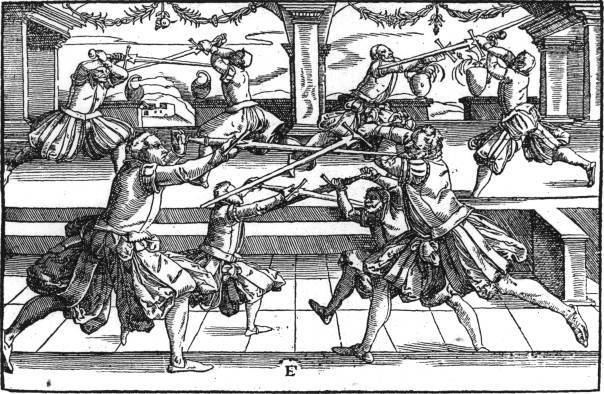
We have papers and statues affecting the London guild of masters of arms from the 1530’s, and a number of woodcuts from the same century depicting the fechtchules, where those who could pay the dues and commit to the rules of membership could study the arts of war under an acknowledged master. These woodcuts display training in the longsword and quarterstaff, in the grosse messer (the “big knife” single-handed sword; the kriegsmesser or “war knife” is the two-handed variant, of German usage), and to a lesser extent, in other weapons.

Generally, students accepted to a fight school where called “scholars.” After studying for a time and proving adeptness in  the foundational skills, they could progress to “free scholars” and then to “provosts.”

Doing so required “playing the prize,” a public demonstration of skill through sparring matches with other members of the school as well as (potentially) the school’s master and even potentially visiting masters (though this was usually reserved for someone seeking the title of master himself–according to Parisian law of the period, he would need at least three other masters to certify his skill with multiple weapons).

A raised platform for visibility was an expectation for the event, and the person playing his prize might be expected to provide beer or other drink for his schoolmates (for the afterparty, I guess), so we are again returned to the linkage of social status (or at least wealth) with attendance at these schools.

Bear in mind that, in England at least, “foyning” (thrusting) was made illegal (I’ll pick this up in the next post) in 1534. Sparring was conducted with bated (i.e. blunted) steel; some amount of injury was expected. The crowds, though, were also used to executions as a form of public entertainment (ultraviolent films had not yet been produced, after all), and it seems that there was a ready audience who wanted to see the blood flow. Remember that armed fights are usually over very quickly, and if the exhibition, as it was intended to be, consisted of controlled action emphasizing finding the opening with discipline and technique enough to pull the strike when it was clear that it would have connected, then there was room to add more blood to the show.

I don’t have the documentary evidence to back this up, but I’ve heard more than one historian say that (an as a folk etymology it makes sense) the organizers of such exhibitions arranged for pugilism to warm up the audience–unarmed fighting lasting longer and being a bit bloodier when conducted with bare or lightly-padded fists and actual intent. Over time, the pugilism aspect became more and more of the focus, hence our modern reference to boxing as “prizefighting.” Remember, the scholars, free scholars and provosts were “playing the prize.”

The 16th century also saw the burgeoning field of science applied to the sword, particularly math and geometry. Indeed, Mercutio describes Tybalt (in Romeo and Juliet) as “More than prince of cats, I can tell you. O, he is the courageous captain of compliments. He fights as you sing prick-song, keeps time, distance and proportion; rests me his minim rest, one, two, and the third in your bosom: the very butcher of a silk button, a duelist, a duelist; a gentleman of the very first house, of the first and second cause. Ah, the immortal passado! The punto reverso! The hai!” (Act 2, Scene 4). It was in particular the Spanish who made comparisons (in the rapier fight) with dancing–the importance of precision of time and distance, with careful footwork. For more information on this aspect of the science of arms, see Sydney Anglo’s book, The Martial Arts of Renaissance Europe, which includes both frontispieces showing the fencing master/author as mathematician and scientist (bearing compass and other tools of the trade) and images parodying the overuse of mathematical principles as the major focus of fencing instruction (there is one in particular of a dwarf farting, with the wind from his buttocks parsed out into geometrical diagram).

I want to emphasize, again, that despite the prevalence of the written fight manuals in this period, the bulk of real instruction took place through personal relationships, whether or not commercialized. The richest employed private instructors, while the middle class sought the public instruction available through the guilds and schools run by masters of defense. Without a practice partner and the opportunity to work through precise (and sometimes complex and counter-intuitive) maneuvers, it is difficult to do more than properly practice stances, movement between them, basic cutting technique and blocking technique when working solo.

Let’s conclude this part by bringing it to the writer’s craft and the gamer’s table. If you have a martially-skilled character, how did he learn, and how did that affect him. Was his teacher patient or demanding? Was his instruction in solitary practice between single student and instructor, or as part of a group whether in military drill (which, as we have mentioned, would have focused more on formation and movement than the techniques of individual combat) or fight school. In a group, what were the rivalries, tough lessons and embarrassments, not to mention successes, that shape how the character thinks about fighting now?

For the D&D (and other fantasy game) players, what about a fighter whose purpose in adventuring is not the righting of wrongs or the accumulation of wealth, but the gathering of practical fighting experience in multiple weapons to undergird his dream of establishing a fight school? Unfortunately, D&D’s approach to weapons is almost entirely gamist, without much in the way to distinguish when a dagger is a better weapon than a halberd, or that its the skill of the arm much more often than the weapon itself that causes the grievous injury, but I digress.

On that note, think about what the experienced swordsman actually thinks about fighting. The assumption in D&D and its many sister games is that the fighter is expected to jump into the fight, to push the party into combat encounters. But the person who knows how fragile life is in hand-to-hand combat, that even the lucky unskilled peasant can kill a well-trained knight, probably doesn’t rush to fight when there are alternatives. And almost certainly avoids doing so fairly when he has the option of seeking advantage. Yes, there will be some for whom ideology overtakes all practical concerns, but that should be far from the norm (and when it is, it’s all the more believable when it does occur).

For the next post in the series, click here.


What Writers (and Roleplayers) Need to Know about Swordplay, Part III: (The Basics of) How Swordplay Works

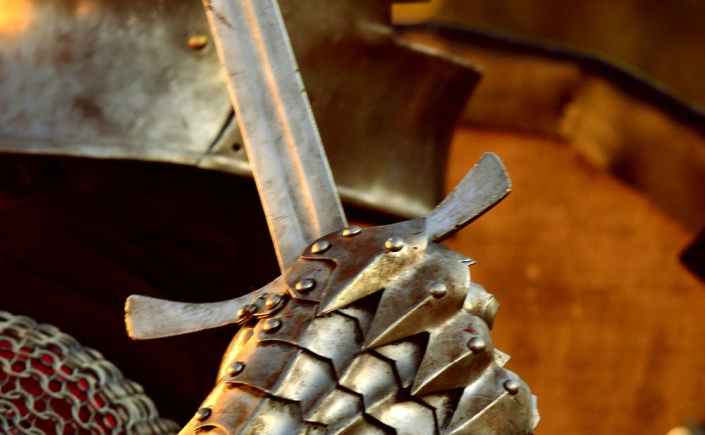
Nota Bene: The techniques and conditions described in this part are primarily concerned with unarmored fighting (or at least fighting in anything less than plate armor). This, despite the picture above.

Also, an apology: I’m verbose on good days, but this post is a bit of an infodump. Sorry.

Forget Chivalry
If you believe that medieval and Renaissance swordplay was all about a sense of honor and fair play, check yourself. I spent some time studying krav maga, and the approach of the fechtbuchs to swordplay is similar–the only thing that matters is winning (surviving), so it doesn’t matter how underhanded, unfair or dastardly a technique is if it means you walk away and the other guy doesn’t.

Scholars of the medieval period perennially return to the debate over whether the ideals of chivalry actually ever existed outside of the period’s literature. My personal belief is probably, “yes, it did,” albeit in localized appearances–people who choose to put such ideas before the exigencies and pragmatisms of the day, rare as they must have been (and continue to be).

I have two examples for you from the fighting manuals to allay your sense of chivalry having a place here:

(1) How to Kill a Fallen Enemy: If you’ve watched Kingdom of Heaven or the Lord of the Rings/Hobbit movies, you’ve seen the move where, after knocking an opponent down, our hero takes his sword, one hand on the grip and one on the quillions (crossbar) and drives the blade downward into his foe’s stomach. It looks badass, I guess, but that’s a good way to risk your opponent stabbing you back before he dies.

The “proper” way to easily dispatch an opponent who you have knocked to the ground is to wait. Once they roll onto all fours to pick themselves up, you chop of their head and thank them for presenting such a clean angle on their neck. Not that they’ll hear it. Far less risk that way.

(2) How to Rob a Peasant: If I remember correctly, this technique–with pictures–is in the Codex Wallerstein. It goes like this: you grab you victim by the neck in your off hand while drawing your dagger. You pinch some of the skin of the victim’s neck between your fingers and slice this with the dagger–not hard, just a nick. You just want the man’s money, not his life, after all. In thinking that you’ve just slit his throat, his hands will go to his neck, conveniently leaving the purses and poaches on his belt free from obstructions. Your dagger’s already out, so it’s hardly anything at all to quickly cut what you want free and walk away before the poor man has realized what’s happened.

All of this is to say that biting, eye gouging, groin strikes, sand throwing and all manner of other nasty trick is fair game in a real fight. At the same time, though, we have the very good fortune of not having to live or die by our swordplay, so maybe think of exercising some restraint when sparring so that your opponent is still your friend after it’s over.

Three Results
There are three primary results in a swordfight, with only one of them positive: (1) you walk away and your opponent dies or is significantly wounded, (2) your opponent kills or significantly kills you and walks away, and (3) you manage to kill or seriously wound each other.

When you think about it that way, the odds are stacked against you from the outset.

Everyone Dies
Even the best fighter makes mistakes, and even an untrained person gets lucky every once in a while. There is no swordfight without risk. Maybe this is obvious to you, but there’s a common assumption, particularly in some roleplaying game mechanics, that a disparity of skill can make a fighter invulnerable in some circumstances. Untrue. Unrealistic, if you care about verisimilitude.

It should be rare that your characters are so self-assured as to not realize that any fight potentially means their death. There are some characters (just as there are some people) too foolish to have this realization, but its best (in my opinion) that it’s clear that that kind of attitude is portrayed as foolishness.

If any of you decides to take up sparring and the practice of western martial arts as a result of reading this series, take this warning: sparring with swords, whether wooden stand-ins or blunt steel, requires trust and control. I have seen more very talented swordsmen and -women injured by someone who did not know what they were doing trying to spar at full speed without the ability to pull a blow they knew was going to correct, or who was too eager and couldn’t wait for their partner to be ready before executing a technique. I got my nose broken that way while sparring once (I left that one out before, didn’t I? It’s crooked to this day.) I’m lucky it wasn’t my eyes–and stupid for not wearing a helmet at that time. In my defense, I was in college, stupid, and there was a machismo endemic to WMA that led us to eschew protective gear for “authenticity” sometimes. Like I said, stupid. If you take up sparring, make sure you wear–at a minimum, a fencing helmet and protective gloves, preferably more than that. Even in practicing techniques at speed and “with intent” protective gear should always be worn.

Parts of a Sword
To understand descriptions of techniques, you need to understand the parts of a sword.

1280px-Sword_parts-en.svg

Traced by User:Stannered; original by Nathan Robinson of myArmoury.com. This SVG image was created by Medium69. Cette image SVG a été créée par Medium69. Please credit this : William Crochot – Derivative of File:Sword Parts.jpg

Our primary focus in the above will be with the blade, and particularly the weak and strong parts of the blade. If, considering that I mentioned earlier that the force of a swing is greatest toward the weapon’s tip, you’re wondering why the base of the blade is called the strong part and the tip the weak, it’s because we’re thinking from a different perspective now. It is easier to push your opponent’s blade (or to resist your blade being pushed) toward the hilt (where the opponent is less able to make use of the lever that your sword is); the opposite is true toward the weapon’s point. We’ll discuss this more in the section on winding and binding, below.

There is a further distinction not depicted in the above, the true (sometimes “long”) and false (alternatively, “short”) edges of the blade. Simply put, if you’re holding the sword out in front of you, the true edge is the one that faces your enemy, while the false edge faces you. Some techniques indicate that the strike should be made with the true edge (which is what someone unfamiliar with the use of a sword would assume is true of all strikes), but others use the false edge. This requires some contortion of the arms but allows for very rapid attacks alternating between the two edges of the blade. This is the time, I feel, to point out that the use of the phrase, “a double-edged sword,” to point out something with both advantages and disadvantages is rather stupid in context. Two edges means I can cut you twice as often. I should also note that a two-handed weapon is necessary to get the most out of the false edge of a blade, because it is the movement of the “off” hand around the sword’s pommel that gives the greatest force to false edge movements–with only one hand on the grip, a false edge attack is as likely to see you lose the weapon as it is to be effective. Someone with greater strength and/or experience than I may have a different opinion, but I saw little use for the false edge when sparring with a one-handed sword.

Timing and Distance
The most fundamental aspects of any hand-to-hand combat, armed or not, are timing and distance. If you cannot accurately judge the distance between yourself and your opponent and combine this with a realistic intuition about your reach, you run a high risk of either overextending yourself or allowing the opponent to slip closer than you are prepared to attack. The important of footwork, in all forms of fighting but especially in swordplay, is largely related to the control of distance and, if possible, to causing your opponent to misjudge intentions and distance by the use of movement.

Likewise, timing is at least as important in swordplay as it is in telling a joke; moreso if you like living, I guess. Some techniques (especially “master strokes”) only work with excruciatingly precise timing. Even without resorting to those high arts of swordplay, there’s always an advantage in attacking when your opponent isn’t expecting it, or being ready to respond in sufficient time to your opponent’s attacking.

If you’ve heard it said in regards to hand-to-hand fighting that “distance is time,” you ought to believe it. The two are inseparable.

Many techniques, at least within the German school of longsword fencing with which I am most familiar, are very specific as to their timing. They fall into three categories: (1) before your opponent takes an action, (2) after your opponent has just completed an action, and (3) while your opponent is acting (that seems to cover all the possibilities, doesn’t it). Whether or not based on conscious analysis or the result of intuitive understanding after many sparring matches or duels, the timing of particular techniques, I believe, has much to do with body-mechanics: timing is based on the amount of time (on average) it would take an opponent to take or complete an action compared to the amount of time needed for the actor to complete his own technique.

Movement
As an arbiter of timing and distance, movement is the foundation of all swordplay (you didn’t think it was your arms, did you?). Here, there are several counter-intuitive aspects of the art. First, because of human physiology and body-mechanics, at least in using a two-handed sword, your reach on an attack extends farther on the later part of the swing than on the earlier part. This means that dodging a blade may be more effective when you dodge in the direction of the attack is coming from (horizontally, not directly into the swing, of course) than away.

Bear in mind also that dodging can be a high-risk, high-reward exercise. The closer you are to the swing of the opponent’s blade without being hit by it, the more you have controlled the distance of the fight. Stepping close to an opponent after he has swung the weapon while pulling your weapon close to you is a very effective way to keep your opponent from being able to protect himself against your next attack (often a thrust).

Ideally, most movement in a swordfight should be at an angle to your opponent, not directly toward or away from him (or her–there were some famous swordswomen and certainly are some very talented women with a blade in modern practice). There are two advantages here: first, it forces your opponent to turn to maintain facing with you. Second, it gives you more control (and increased deceptive ability) in determining distance.

If you’ve watched Olympic fencing, you’ll notice that the fencers are usually on a linear strip. In epee fencing, this strip has a special layer on it, because the epee has a small button on the end that completes a circuit when depressed, allowing for precise scoring of points. The covering of the fencing area prevents false positives with the tip of the epee hits the floor.

As I mentioned above, this is inaccurate as to historical swordplay.

The manuals describe moving in two ways: stepping, which is movement in which your lead leg remains your lead leg (one leg moves and the other follows, essentially) and passing, where either your back leg moves forward to become your lead leg or your lead leg passes backwards, again making the back leg become the lead leg.

Holding the Sword
The first thing you must know about how to grip a two-handed sword is that it is not a baseball bat. You do not lock your hands on it like a vise. As you transition between stances, defenses and strikes, your hands will rotate around the grip as necessary to preserve edge alignment and to ensure maximum force and retention as the weapon swings and rotates. With the two-handed sword, you may even find that your non-dominant hand sometimes pushes the weapon’s pommel like a lever or a gearshift!

There are many stances common between fechtbuchs. In German: Ochs (the ox), Pflug (the Plow), Zornhut (the wrath guard), Vom Tag (from the roof), Auber (the Fool), Wechsel (the “changer”) and those whose German names I can’t remember or never knew: tail and the hanging guard. Those stances where the sword is held away from the center line of the body have variants for the right side and the left side (and indeed, “it works on both sides” is a common note to techniques in the fighting manuals).

There are other more specialized stances less-often used: the Iron Door (open and closed, of course), Unicorn, Long Point, for instance.

The foundation of a swordsperson’s training is in learning these stances and how to gracefully transition between them. You see a little of this in the brief fight between Jaime Lannister and Ned Stark in the Game of Thrones TV show (with Jaime transitioning between ox on the left side and the right side as he “tests” Ned’s stances and footwork).

Pictures are worth a thousand words, so look them up, but I’ll give some descriptions of major stances here (assuming that nothing has changed in interpretation and scholarship since I last seriously studied).

The Plow: when I started my practice of WMA, Plow was treated as holding the sword slightly out in front of you down your centerline, point oriented at about your opponent’s neck. Think the classic “we’re about to fight with lightsabers” pose in the original Star Wars trilogy. This is now referred to sometimes as the “long Plow.” Later, scholars and practitioners decided that it made more sense that your hands were actually pulled back and low to the side of the body, with the blade still pointed at your opponent’s neck, but the tip of the blade not far from about where your face is because pulling your hands back. On your non-dominant side, you actually rotate your grip so that the true edge is facing up, making for easier rising strikes. Your opposite leg (from the side the sword is on) is forward in this stance.

Ox: In the Ox stance, your hands are oriented up near the side of your face, with the blade running parallel to the ground, again aimed about at your opponent’s neck. This is an aggressive stance, quick for the thrust and also for strikes. It transitions easily and quickly to and from the hanging guard stance, and one may change sides in the Ox stance either by thrusting and recovering or using a zwerchau strike (see below). Like Plow, the leg opposite the side your sword is on leads.

Hanging Guard: A defensive stance that nevertheless rapidly transitions into strikes; your hands are held high, above your head and on one side or the other, so that the blade is angled about forty-five degrees from your hands to the ground and about forty-five degrees relative to your opponent’s centerline as it crosses in front of your body. Either leg can lead on either side if I remember correctly.

The Roof: The sword is held over your head, the point at about 45 degrees behind you from the vertical. This is a strong aggressive stance for overhand strikes or quick transition to rising strikes (by moving into the Tail stance). Either foot may lead.

Wrath Guard: Like the Roof, but the sword is held just over your shoulder at the same angle rather than over your head, opposite leg leading. like Plow, when on the non-dominant side, the wrists are rotated so that the false edge points to the foe, making for a fast and powerful rising strike from your non-dominant side.

Tail: In this stance, the sword is held with your hands almost resting on your hip, blade pointed behind and away from you. This stance is primarily used on the dominant side, with a variant stance called Wechsel often substituted on the non-dominant side. Why would you hold your blade behind you? For one, it conceals the length of your blade from easy assessment and so makes a decent starting stance. Additionally, it transitions quickly into Ox and a thrust, allowing you to compensate for the starting point of the blade with an attack that has longer reach than a swing.

The Fool: You’ve been wondering about this one the whole time, haven’t you? There’s some debate about why it’s called the Fool–the swordsman using the stance may look foolish, but the true fool is the one who strikes against this stance, I think. This sword is held in front of the body, like the “long” Plow, but with the tip of the blade pointed toward the ground rather than toward the enemy’s neck. This appears to be a stance of vulnerability to those who don’t know better, even taunting the foe to attack. But the Fool transitions into a nasty rising thrust, or quickly to Tail, Ox or the Hanging Guard and, as it draws the opponent forward, helps with tricks involving management of distance.

Three Wonders
The German masters described the “three wonders” of sword attacks–the cut, the thrust, and “everything else.” That third category typically refers to the “draw cut,” when damage is done not by hacking or swinging at the enemy but by drawing the edge of the blade against them, slicing as it goes by lateral movement.

Swings: The two-handed sword is most commonly swung in one of eight directions–overhanded or “falling” from the right or left, aimed at shoulders or neck, “rising” from below on right or left to the legs or torso, straight up (not terribly common except to create distance) or straight down (at the head), or horizontally. Horizontal attacks are usually made (at least in the German system) at the head or upper body using the horizontal zwerchau, which, when employed from The Roof, the Wrath Guard or the Hanging Guard looks like a helicopter blade sort of motion, especially when several are executed in rapid succession. You can see lots of these used in the lightsaber fight between Obi-Wan Kenobi and Anakin Skywalker in Episode 3 of the Star Wars films.

Thrusting: This doesn’t need much explanation, right? It’s the simplest of all instructions with the sword: “stick ’em with the pointy end.” It does bear mention, though, that the lunge, in which the lead leg is rapidly moved forward in a long extension dragging the following leg, does not appear to have been used until systems of rapier fighting. My own interpretation is that the ability to cut as an alternative to repeated thrusting made the over-extension less useful as it later became.

Draw Cutting: In my experience, draw cutting is opportunistic more than anticipated. It’s a technique best used when footwork brings you in close proximity to one another, to counter an attempt to grapple or when leaving a grapple that was not determinative of the fight.

Other Strikes: Yes, the pommel is a not-infrequent weapon, and the quillions, the flat of the blade, fists, headbutts and feet also represent valid attacks as opportunity presents. Even with the two-handed weapon, having a dagger at hand to be drawn in the midst of a grapple can be a “lifesaver”–or at least an analogue thereto in sparring.

The masters agree that aggression is to be desired over defensiveness–when the opponent is struggling to not get hit, he’s less likely to be striking back (but there are plenty of techniques, like the master strokes, that are both attack and defense, or where one quickly follows the other).

The key to successful attacks, when not simply a matter of sneaky tricks with timing and distance (which are common, mind you), is a flurry of blows rapidly alternating between strike zones. We have diagrams (the later the Renaissance, the more mathematical fencing theory attempted to become) and images of students in fechtschules (to be discussed later) practicing against targets split into quarters to be quickly attacked with strikes alternating both target quarter and whether the true or false edge is used.

Defend Thyself!
The first thing that you need to know about defending against a sword strike with your own sword in the western/European system of fighting is that you block an incoming strike with the flat of your blade. For God’s sake, do not block with the edge!

There are myriad reasons for this; videlicet: (1) Banging edge against edge ruins the blades of both weapons. This is a valued possession, one you rely on with your life–you don’t want to ruin it without necessity. (2) Physics: If you block with the flat side of your blade, there is more area with which the opponent’s edge makes contact, decreasing the pressure exerted by the strike. (3) If you were to block with the edge of your sword–assuming that the swords don’t fuse together as they both deform so that, like idiots, one of you has to put his foot on the other and push so that you can separate them again–the edge of your sword is pointed at the enemy’s blade and must be withdrawn before you can use it. On the other hand, if you block properly with the flat of the blade, the edge is still free and, conveniently, probably pointed at your opponent. With a simple rotation, you may be able to counterattack.

It is also possible to catch the blade of a strike with your quillions. This type of block usually involves violently pushing your hilt toward the incoming strike, catching the opponent’s blade high so that you can then use a falling strike with the false edge. It is also used as an entry to grappling and/or a disarm attempt.

Static blocks are not the only way, not necessarily even the best way, to stop an enemy attack with your blade. Sometimes, it is more effective to swing your weapon into your opponents, knocking it out of its path. Combined with movement, this can delay your opponent’s follow-up enough to create an opening for a counterattack or to create time and distance. I often found that, when using a one-handed sword against an opponent with a two-handed sword (assuming I did not have a shield or parrying dagger), this was necessary to deflect attacks; static blocks would result in the longsword blowing through my defense despite my interposed weapon. When used preemptively against an opponent’s blade, this is called a “beat” (in modern parlance). It is possible, but I’m not entirely sure, that the verb “to ward” is intended in the parlance of the time to indicate a moving block rather than a static one.

It is, of course, also possible to stop an attack with another attack. This is particularly true of counterattacks to the wrist and forearm, where the connecting attack cuts (literally) against the force of your opponent’s strike as well as potentially reducing its range and changing its direction. The “stop-thrust” still used in sport fencing (although in modern epee practice, this is likelier targeted for the top of the opponent’s sword hand or arm into the pocket of the elbow) and constitutes an example of this as an alternative to cutting.

With the right distance and timing, it is also possible to catch your opponent’s wrist, arm, or even the grip of his sword if there’s space enough and to stop the attack with your hand. If this is done with one hand while simultaneously readying the sword for an attack (usually a thrust), it can be a fight-ending maneuver. Again, high risk, high reward. One of my favorite variants (because of its impressiveness if it could be pulled off) of this is, upon the opponent’s initiation of an overhand strike, to grip your own longsword in the half-sword grip and use it almost like a stick to catch the opponent under his wrists before his swing gains much momentum. If you’re fast and aggressive enough (and tall enough!), you can even push the sort back over the opponent’s head and behind his back, at which point you’ve probably disarmed him (or he’s let go his sword preemptively and you find yourself grappling). Conversely, the awkwardest of positions is when you and your opponent have each grabbed each other’s sword or dominant hand and you’re thus connected and both probably moving your arms ridiculously in the manner of rowers to try and shake each other off for a moment before one or both of you realizes you should be trying something different.

Master Strokes
Master strokes are strikes that simultaneously defend the user of the technique while counterattacking, usually based upon the principle of physics that two objects cannot occupy the same physical space simultaneously. The master stroke works against a very particular strike and must be executed with precision and perfect timing–usually just after the opponent has begun the strike to which the master stroke is a defense.

Winding and Binding
The practice of “winding and binding” is the collection of techniques and moves once the blades have made contact and stay in contact–either because one fighter is intentionally attempting to enter this kind of contest, or because the two fighters have both executed maneuvers that put them in this situation for more than a split-second.

Unlike the movies, (think the Princess Bride) this is not the point at which the fighters push meaninglessly against one another like rugby players and trade witty banter. Winding and binding is far too fast, complex, and delicate for that. At any given point once the blades have come into contact, you have what are essentially two options: withdraw your blade from contact to ready another blow or push against your opponent’s blade to gain advantage. It’s the latter that is truly winding and binding. But this is a game of geometries and vector physics, not of brute strength. While winding, you are not pushing your blade directly into your enemy’s; that would be too simple. You are instead trying to angle your blade, maintaining contact between the strong part of your blade and the weak part of your opponent’s to have dominance in the pushing (it’s rarely about physical strength) while maneuvering the point of your sword for a thrust or the edge for a draw cut. If you push too far too fast, your opponent will simply withdraw from contact and strike at you–perhaps before you can recover to defend. Likewise, if you choose to withdraw with your enemy’s blade in too advantageous a position, he’ll simply stab or cut you while you’re drawing your own blade back to strike. It’s a three-dimensional tug-of-war with many possible outcomes. It’s fascinating to watch, frustrating and exhilarating to participate in, and quite difficult to get good at.

A note: provided that your opponent hasn’t done it first, it may be appropriate here to turn the edge of your blade into your opponent’s sword (provided that this doesn’t put you edge against edge). Again, it’s a matter of reducing surface area over which force is applied to increase pressure in pushing against the opponent.

How Important is Strength?
Outside of grappling, not very (in my experience). Physical conditioning, stamina, agility and dexterity are all more important in the fight, and it takes a very large disparity in strength between combatants before an appreciable difference is noted. A more skilled combatant through understanding of body mechanics and good technique can negate any advantage enjoyed by a stronger but less skilled opponent.

Height is a greater advantage than strength in my experience, for several reasons. Under most circumstances, the taller fighter has superior reach, putting his opponent at disadvantage. That’s multiplied by the fact that the taller fighter probably uses a longer sword as well–it was generally agreed by fencing masters that a longsword of proper size for its wielder ought to have its pommel reach comfortably into your armpit with point on the ground. This increased reach combined with an advantage in the taller person regarding leverage makes height a significant factor.

Back when I was heavily involved in ARMA, there were two people in a nearby study-group, a skilled man and an equally skilled and tough-as-nails woman, who had very unfortunate relative heights–on multiple occasions, she had her thumb broken by him while sparring, likely a function of the angle of the strike on her hand influenced by the height difference. This occurred once during a public demonstration, so she simply switched to a single-handed sword in her off-hand rather than a longsword and continued sparring. Told you she was tough-as-nails.

Put Altogether, What is it Like?
My experience as a practitioner of western martial arts, and not a historical reenactor, is limited to one-on-one duels and small skirmishes (no battle lines, no shield walls, etc.).

In these instances, swordplay is marvelously fast and typically graceful, with pitiable exceptions when someone takes a bad step and bites it before making contact, fumbles their weapon, etc. Usually there is a flow to combat that begins with footwork, maneuvering, changing stances and the like to size up and/or psych-out an opponent while gauging distance followed by a flurry of blows, blocks and counterstrikes exchanged over two or three seconds, sometimes longer. If the engagement hasn’t gone to winding and binding or grappling by the end of it, and neither party has been injured, the fighters will disengage and start the process over again. But, like any fight, this dilates and contracts, with sometimes long spaces between attacks and sometimes just time enough for a breath before the combatants reengage. Usually, though, someone has been struck a significant blow in a matter of seconds. These drawn-out swordfights in films are beautiful to watch, and certainly dramatic, but don’t represent what experiences has told me is the average length of a fight with swords–short.

Hit Locations and Injuries
The commonest locations struck by blows (based on my experience sparring) are the head, hands and forearms. If you’re designing a roleplaying game that uses hit locations, consider that the standard distribution used by most games doesn’t reflect reality. On the other hand, getting one-shotted in the head all of the time (or even a third of the time) won’t make for happy players, so some liberties probably ought to be taken.

If you want to understand (as best as we can morally, ethically and legally) the potential severity of sword wounds, look into the archaeology of the Battle of Visby in 1361 (excavations were done in 1928). There were multiple instances where a single blow managed to cut through both of a combatant’s legs. There are also multiple instances where a body was discovered to have a significant, but not necessarily mortal wound (to a limb) as well as a fatal head wound. It is likely that the attacker first injured the other combatant with and initial strike and, when the defender was stunned and in shock and pain from the that strike, the attacker took the opportunity to strike a fatal blow.

Again, there’s no easy translation of this information to a roleplaying game, where being hit once meaning almost certain death is not going to be particularly fun. In “traditional” fiction, this information can add verisimilitude.

Asymmetric Warfare (or at least uneven odds)
Fighting one person is difficult enough; holding off several attackers at once–all of you armed with swords–is especially daunting.

The good news is that only about three attackers can simultaneously attack a single defender without risking a high probability of accidentally striking one another, presuming that they’re using cutting weapons that must be swung; you can fit a lot more people in if all they’re doing is stabbing.

The bad news is that that’s still two other people ready to hack at you while you’re focused on their friend. Since most of us do not have superhuman speed, we have to rely on footwork and maneuver to try to counteract the advantage held by multiple attackers. Specifically, the single combatant should be constantly moving so that she keeps one of her three counterparts between herself and the other two, a sort of “human shield.” With continued maneuver, a skilled combatant can, for a time at least, limit the fight to one attacker at a time. Nevertheless, this is not foolproof, you still have to defend yourself from that one attacker right in front of you, and it’s quite tiring.

Conclusion
There really is no substitute for seeing swordplay by skilled practitioners if you want to understand the speed and elegance of historical fencing. Nor is there for studying the fight manuals and working through the techniques–even if very slowly and with a simple dowel rod from Home Depot.

Nevertheless, I hope that I’ve conveyed the deep complexity of the art of the sword in this Part of the series; it really is so much more than swinging a chunk of metal. It should be in your games and your stories as well. Even if you’re playing a ruleset that, by and large, doesn’t account for all of these factors (and, from a design perspective, most games probably shouldn’t), an understanding of the mechanics of fencing will allow you to narrate much more exciting combats. If you’re a writer of conventional fiction, hopefully this illustrates to you the wide range of ways in which you can show, not tell, the martial skill (or lack thereof!) of your characters.

In the next Part, we’ll talk about armor. I think I’ll squeeze in a post on some of the social and cultural aspects of learning swordplay in the early modern period, and we’ll finish up with the promised reading list and recommendations.