Rules for Piracy in Fate

Over the past few weeks, I’ve been running an RPG campaign of fantasy piracy in a nascent setting I’m calling “The Innumerable Isles.” I ended up doing a lot of work (drawing upon my The Fate of Piracy series from the not-too-distant past), to come up with some rules for pirate games in Fate.

You’ll find attached below a PDF with the rules as I currently have them. Within those pages, I’ve included a system for using Professions as Skills, rules for Ships as characters (as well as assembling and customizing a ship), general guidelines for character creation, rules for handling piratical particulars (a ship-to-ship combat system and some easy ways to run the ruses used by pirates to tempt unwary prey), and even some fantastical elements (including a magic system).

The ruleset should be easy to employ for either historical games or in fantasy games set in an age of sail analogue.

I’ll follow on soon with some background on the Innumerable Isles setting (although I am turning my main focus to writing down more of my Avar Narn material in preparation for my Patreon launch with the start of the new year) and with some additional tools for the rules included here (including some random encounter charts!)

Review: Watch Dogs: Legion – Good Timing?

I picked up Watch Dogs: Legion on something of a whim, if I’m to be honest. I played the first one but passed on the second. What piqued my interest and put me over the edge was the fact that there is no “chosen one” central character and that you recruit your resistance against the forces that have overtaken near-future London from the general populace.

I probably spent as much time recruiting characters to DedSec as I did actually playing through the story. Certainly, I devoted much more time to recruitment than I did to side missions–about halfway through the game I decided I just wasn’t interested enough to spend that much time playing.

The situation in London is bleak at the beginning of the game; a terrorist group calling itself Zero-Day (or maybe lead by someone calling themself Zero-Day, this wasn’t quite clear to me) uses a spate of synchronized bombings across London to allow the city to largely turn over authority to a private military company, ironically named Albion. At least it’s leader isn’t named “Arthur.”

This puts London in a condition that represents some of my worst fears for the direction the U.S. is headed. I should mention that my father lived outside of London for about two years while I was in high school, so I spent a good deal of time in the city and, being too young to drive in the States, I learned to navigate the Tube long before I learned how to navigate Houston’s congested highways. So, in my mind, there’s a personal link between London and my own experience that perhaps made its familiar places (I always knew I’d gotten myself lost in the West End when I found myself walking between the adult-themed shops of Soho) feel like a strong link to my present concerns.

If you’d like it laid out for you, here are some of the aspects of the collapse of London’s (the country as a whole is rarely mentioned) democracy in the game: Albion patrols the streets in armored personnel carriers, armed with the kit expected of a warfighter, not a peace officer (blurred as that line is in the U.S. right now). Normal people are stopped and harassed as the already-prevalent camera system and the personal data captured by our smart devices turn London into a surveillance state. The vestiges of British democracy–the Home Office, the Parliament, etc., still exist, but only to provide cover for the authoritarian leanings of those really pulling the strings (the game explains that Parliament has been suspended and that the Queen–no indication of which Queen that is, mind you–has not been seen for some time since the bombings). Albion is disappearing its detractors left and right, the news stories that come up in your feed are often manipulated propaganda rather than reporting with integrity, and the current administration has formed unofficial alliances with the city’s largest criminal organization to facilitate its ends.

This is the situation in which your resistance hacker collective is formed. In today’s day and age–not just in the U.S. but in Europe and Britain as well, where the specter of conservatism dangerously flirting with fascism and/or populism raises its frightening head as well–there is a definite catharsis to be had for players needing to sublimate the angst they feel at the current political climate into imaginary action. I count myself among those players.

That’s why the recruitment missions feel so powerful–the need to bring in allies of similar mindset, who confirm and justify your beliefs that there’s something wrong with the current situation that calls for action, even of the direct and aggressive variety–is something many of us feel right now, whether or not that’s a reasonable mindset.

There are plenty of reviews talking about how cool it is to search out the various abilities (or weapons) different characters have as you build your team; I’ll acknowledge that aspect of the system but not dwell on it.

I will mention that the game has an option for permadeath for your operatives, and I can’t imagine playing the game without this option. The consequences, the drama of recruitment and selection of a particular character, make the whole system of having no single protagonist worth it; if you can’t lose the characters you recruit, that system loses much of its narrative weight. I lost about a half-dozen characters in my playthrough, most of them being “specialist” operatives with better skills and equipment than the average recruit: I lost an anarchist (one of the best character “classes” if you’re focusing on less-lethal tactics), a spy (my particular favorite character), a professional hitman (I thought that an amateur hitman was just a murderer, but, lo and behold, I did later recruit an “amateur hitman”), a deputy director of the Met, and a few others. Their losses–especially in otherwise successful story missions–were keenly felt, and that was the point, wasn’t it?

Otherwise, the gameplay was nothing unexpected for a GTA/Assassin’s Creed/Watch Dogs/Etc.-style of game. Less free-running and more hacking, but otherwise in line with expectations. Admittedly, I played the game on “normal” difficulty which, despite my losses, seemed easier than I should have selected for optimal enjoyment. If you liked the previous Watch Dog games, you’ll like the way this one plays.

Ultimately, the game’s narrative was less satisfying than I’d initially expected. I called the nature of Zero-Day a mile away, and the plot points of the missions hit a little too hard on the tropes and cliches of the genre: the THEMIS idea essentially rehashed Philip K. Dick’s The Minority Report, the Skye Larson plot played out the typical mad scientist trope (while sidestepping all of the actually-interesting philosophical and practical issues of mind-uploading by making her a monster), and Mary Kelley played an unnuanced criminal mastermind the likes of which have starred in many a poor detective story. The most emotional point of the story’s ending is immediately undone after the credits roll. Part of me liked that, but it was a cheap happiness to be sure.

Fortunately, the nature of the game itself, rather than the plot, brought some nuance with it. As with Watch Dogs 2 (so I’m told), the game pushes you toward a less-lethal approach to combat. You can only unlock less-lethal weapons for your characters (some recruits come with lethal weapons, but that’s the only way to get them) and even the “takedown” animations that show a neck being broken or the hitman garroting a victim to death are revealed to be less lethal attacks in the game’s treatment of them.

As a brief digression, I found the distribution of lethal weapons on recruitable characters–especially in London–to be ridiculous. It’s at least plausible that the Spy has a silenced pistol, or that the Professional Hitman comes with a pistol and assault rifle, but that’s not the half of it.

One of the first people I passed in the game was a “Tourist” with an M249 light machine gun. I chalked it up to satire of Americans, but then I also added to my potential recruits list a Chef with the same weapon. And then a University Researcher with a silenced pistol. As it turned out the number of people casually packing in dystopian London–heavy weapons no less–mystified.

But that aside, the game’s push toward less-lethal weapons made me continually ask myself about the morality of using lethal weapons in the fight. And this is particularly where I’d wished I’d set the difficulty to a higher level. As it stood, there where many missions where I could send in a Professional Hitman and run-and-gun my way through Albion personnel, stopping shooting to hack only when necessary. I wished that the difficulty had been higher so that the hero fantasy of blasting one’s way through faceless neo-fascist bad guys without a care in the world might have been less accessible, along with all of its accompanying problems. But, ignoring the moral question within the game, I continued to ponder the point at which armed resistance becomes an acceptable approach–it is never a “good” approach. As I’ve written elsewhere, I don’t think violence can ever truly overcome evil–only delay it–and that thought reverberated for me as I confronted my programmed “enemies.”

It was certainly the fact that the setting of the game resonated with current fears and concerns about the future of the U.S. that led me to all of these thoughts, and it was morality and politics that traveled through my brain while playing the game far more than any consideration of privacy or technology issues. Even now, as I write this review, I’m continually refreshing the AP’s report on 2020 election results, full of some hope for the presidential results but mostly dread at the stark divide in my nation, the number of people who seem to value their own economic prosperity (manufactured as that may be) over ideas of democracy, justice, equality, or any of the other things I see as the ideals that justify the messiness and difficulty of our political system.

I’d better quit while I’m ahead. Or at least before I’m too far behind. I’ll conclude with this: I enjoyed playing through Watch Dogs: Legion, but it was far from an amazing experience. More important, I came away from this game wondering (in all sense of the word) how the cyberpunk stories and games of my youth seemed to be more prophetic year after year. As much as I enjoy playing games like Shadowrun, or Deus Ex, or Watch Dogs, that’s not a direction I would consciously chose. Which, in turn, made me a little embarrassed to play this game after all, feeling like I was turning my angst to video games rather than getting “out there” and doing something that might help incite meaningful change in the world. Do I feel like that’s even possible, or have I turned to a game like this because I’m beginning to feel powerless? Or is the coincidence of this game’s release with the 2020 election simply a serendipitous synchronicity of memes and fears as to put me in existential angst?

I don’t think any of that was what Watch Dogs’ creators intended it to be. But for me, that was my Watch Dogs: Legion: a self-inflicted reverie about my place in and responsibilities to the world. As I look back at this article, weird as it turned out to be, I think it reflects the course of my experience with the game–a journey from light-hearted escapism into contemplating much tougher questions and concepts. Was that worth my sixty bucks? Maybe.

Poems

I don’t often write poetry, but when I do…I have no idea if it’s any good.

Nevertheless, I’ve felt myself compelled more and more to write poems lately (having not written anything of the sort in long years), and I’ve come up with a few that I think might be decent (at least worth revising and/or expanding some time in the future). Here are a few for your reading pleasure (I hope!):

Turn Back Again
Where does ignorance become willfulness?
Where does fear become evil?
Is it the striking snake or the stampeding cow?
Is it the deceitful mirage or the devastating storm?
Or are these phenomena ours alone,
We who build marvels to behold,
We who write so as to move the heart,
We who sing praises as we cover ourselves in ash and dirt?
Where is the place of responsibility?
Where the locus of guilt?
Why do we only know that place once we’ve passed it?
And why do we never turn back again?

A Balm in Gilead
There is a balm in Gilead,
But it is not what you think.
For all healing requires pain,
So that we know when we are finished.
All else is only covering a wound,
Letting it fester and rot until we become numb,
Until the stench becomes too much and the flesh sloughs away,
Leaving us to exclaim, “From whence this new wound?”

Patreon Planning

I’ve thought about it since my first post on this subject, and I’m deciding to take the leap and create a Patreon to see how it goes in expanding my production and helping me to push forward toward my goals as a writer.

First and foremost, the Patreon will not replace this blog. You should still expect to see weekly (most of the time, anyway) posts on the blog on all of the usual subjects. Instead, the Patreon will supplement the blog by providing focused materials for a portion of the blog’s readers–I do not expect that everyone who reads my writings here will be interested in what the Patreon has to offer.

The Patreon will consist of setting material, RPG rules, and fiction for my fantasy world, Avar Narn. Each week, I’ll provide patrons with a minimum of 2,500 words of background material on the world. RPG rules and fiction will be included as it is written.

Look for another post soon that gives you a “pitch” for the Avar Narn setting, so that you can see what you’d be getting into if you’re not already familiar from following the blog. You can read some of the stories and work on the “My Writing” page to get a feel for things as well.

I will be setting up three Patreon tiers with the following material:

“Tourist” Tier: For $3 per month, Patrons will receive access to a monthly newsletter and the weekly blog posts with setting material.

“Explorer” Tier: For $5 per month, Patrons will receive the benefits of the “Tourist” Tier, plus access to RPG mechanics posts, access to a Discord server to participate in a community exploring the setting together in which I will directly and regularly participate, and the ability to vote on specific topics for me to address in subsequent months.

“Venture Captain” Tier: At $8 per month, this tier includes everything in the previous tiers plus access to work-in-progress fiction set in Avar Narn (including in the immediate future the revisions and rewrites of the novel Things Unseen) and “behind-the-scenes” posts on my methods and strategies for developing the information seen in weekly posts.

Money from the Patreon will most likely be used to purchase tools, books, and services (such as the creation of artwork) to further expand the material available for Avar Narn, with the plan of eventually publishing setting books and roleplaying rules to accompany the novels and short stories I hope to publish. If the Patreon income becomes significant enough (which I do not expect), then I may use some of it to pay bills and devote more time to writing (meaning more material both in general and for Patreon).

I expect to launch the Patreon with the new year. I’d really love to hear from you if you are interested, have comments or criticisms of the above-described plan. Feel free to leave comments or send me a message or email. In all honesty, I’m a little nervous about starting this venture and would love to know that there’s actually a desire for it.

I will be posting material for other settings on this blog, but these materials will not be nearly as regular nor as detailed as those for Avar Narn on the Patreon. Depending upon how the Patreon goes, I will consider adding some of those other settings to the Patreon (with an increase in detail and frequency of writing of material for them) if doing so looks feasible to add value without detracting from my work on Avar Narn or burning me out.

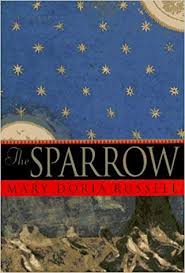
Review: The Sparrow

I know; I’m a little late to the game if I’m reviewing a book that’s twenty-five years old. But I’m excited about it enough that I really don’t care about that.

So, we’re gonna talk about Mary Doria Russell’s The Sparrow, an exposition of theodicy wrapped in a sci-fi tale that’s secretly a bildungsroman of sorts. If you’re not a theology nerd, “theodicy” is the word for the study of the problems of evil and suffering. In Christianity, in particular, this problem might be more specifically phrased as “If God is all-powerful and entirely good and loving, why does God allow evil and suffering in the world? Why do these things happen to seemingly good people?”

Job is my favorite book of the Old Testament, in part because it addresses this very question and gives us the best answer I think can be had for it. When God appears to Job at the end of the poem, God’s answer to Job’s questioning is to tell Job that he cannot understand the answer. It’s too complex, it’s too nuanced, for the human brain to comprehend in all its depths. The ultimate answer God gives that humans can understand is “Trust me.” Faith, faith that God is sovereign over all things, that God is love and intends ultimate good for God’s creation, hope that everything will one day be clear and suffering and evil will be conquered fully after having served their purposes–as inscrutable to us as those purposes may be–is the answer. It is, admittedly, an answer that I find at once entirely frustrating and comforting. It’s not my job to solve the problem of evil and suffering; it’s my job to respond to evil in suffering in the way that God has instructed me.

Part of the brilliance and beauty of Russell’s book–and only part, mind you–is that she takes the same approach. There is no attempt to answer the question of suffering, only an attempt to hold it in her hands and turn it at all angles for the reader to view, to experience in part, all of its manifest complexity and difficulty. There are no apologies here, no arguments, only an investigation of the issue that is by turns beautiful and terrifying, humbling and infuriating.

I don’t want to give too much of the plot away, but I’ve got to at least tell you what the book is about, right? All of that investigation into theodicy is not exposition or diatribe, it is examined through the experiences and humanity of the characters.

The Sparrow tells of the aftermath of a first-contact mission put together in secret by the Society of Jesus to the planet of Rakhat, discovered by the Arecibo facility in Puerto Rico in 2019, when the astronomy equipment there picks up radio signals that turn out to be the singing of the indigenous peoples of Rakhat.

Only priest and linguist Emilio Sandoz survives the mission; the handful of clergy and layperson companions that accompany him to Rakhat do not. The time dilation of space travel, the reports of the second, secular mission to Rakhat, and reports from the first missionaries themselves seem to tell the tale of a horrific fall from grace and into depravity on the part of Sandoz. The story jumps back and forth between the Jesuit interviews with the recovered Sandoz (in an attempt to discover the truth of the reports and, hopefully, salvage something of the Jesuit reputation after the reports of the missionary journey have decimated it), the first discovery of Rakhat and the synchronicity that brought Sandoz and his companions into the mission in the first place, and the events that actually unfolded on Rakhat. These separate narratives meet, as it were, at the climax of Sandoz’s telling of his story.

That main thread, and its analysis of theodicy, contrasted with the modern missionaries’ own thoughts about their relationship to the 16th century missions of the Jesuits to the “New World”, form the core of the text, but Russell’s writing of the missionary characters, their backgrounds, their feelings, their developing relationships to one another, their thoughts about their places in Creation as they confront their missionary (or priestly) status, provides just as much literary joy and human insight as the “mystery” that frames all of these subplots.

This is, after all, a sci-fi story (one for which Russell won the Arthur C. Clarke award in 1996, the year the book was published), and great detail is paid to the physiology and culture of the peoples of Rakhat, to the methods of space travel (the missionaries convert a mined-out asteroid into their spaceship) and the believable physics of story. At the same time, those elements never get in the way of the narrative; no time is lost on long exposition about the nature of technologies or theories of culture and alien psychology. These run seamlessly throughout the text, woven in with the unfolding plot instead of interrupting it.

The writing itself is beautiful, jealousy-inducing for an aspiring writer such as myself. The blend of familiar, practical tone with clever description and amusing turn-of-phrase reveals the intelligence and imagination of the mind behind this tale in an ever-delightful manner. The pacing and plotting of the story are an example of mastercraft in that aspect of the art, something especially apparent to me as I struggle with revising the plotting and pacing of my own fledgling work.

I must also express a debt of gratitude to my wife for bringing me to read this book. It’s one she first read–and told me about–almost a decade ago. It sounded interesting, but I must not have been paying close enough attention to her explanations, because this a book that fits with my own interests so uncannily perfectly. Only when she announced that she was going to read it again, now that her experiences in ministry and seminary had sharpened her abilities to appreciate the tale, did I agree to read it alongside her. As I must often admit, she was right all along. I should’ve read it the first time she told me to. So should you.

Infinite Recursions

I think it was Stephen King who wrote or said that, if one wants to be successful as a writer, one needs to writing like a (second) job. I’m not one for taking people’s advice on reputation alone, especially on something so deeply personal and resistant to generalization as writing. Nevertheless, I think (maybe “worry” is a better word) that he’s right.

In light of that, I’m considering starting a Patreon. Through that medium, I’d add some focused posts on my personal worldbuilding endeavors, including fiction and roleplaying rules for those settings. Avar Narn would, of course, be a particular focus, but I also have a handful of additional settings I want to develop—especially for roleplaying (mine and others’). Posts would be at least weekly, with deep dives into aspects of setting, maps, and much more for the enjoyment and use of patrons. I don’t know if I really have a critical mass for something like that to work, but I think it would be useful to me in several ways. First, the deadlines and accountability this could bring me would, I think, help my productivity.

I’m also reminded of a story about a Russian agent working for CIA case officers at the height of the Cold War. He’d regularly ask his handlers for money in exchange for his services, increasing the amount that he wanted every time he asked. Eventually, the Soviets found him out and did what they always did to suspected spies. The CIA officers rushed to his apartment to strip out anything that could link him to others before the KGB could recover it. As they did so, they found all of the money they’d paid him. He had never been the mercenary they’d expected; the money was his way of ensuring that the information he passed to American spies was worthwhile and valuable.

I’d like to think that that’s how Patreon would work for me—as a tangible indication that people are actually interested in my creative work. It would be nice to have some associated income—either to allow me to devote more time to writing and other creative endeavors or to invest in the settings themselves—for artwork and other needs that could allow me to produce professional-grade works—but I don’t expect the income derived therefrom to be a life-changer.

One of my reservations about taking the leap, other than the possibility that a lack of response becomes a de-motivator, is some release of creative control over my productions. Which leads me to the title of this post.

As I was thinking about the prospect of a Patreon, of what it would practically look like, I realized the fallacy of thinking about absolute creative control. Once a piece of art or writing is shared with others, it irrecoverably shatters into a number of pieces equal to the number of participants in the setting.

There is no single Middle Earth, no one Marvel Universe, no absolute Star Wars (just ask Disney). And this goes well beyond fanboy-ism and head cannon—the “feel” of a setting is going to be unique in some inexplicable way to each experiencer, even before we talk about fan fiction or roleplaying games set in that world.

And that’s not a bad thing—it’s a really fascinating one to think that every fictional world becomes infinite worlds, recursions of varying degrees all riffing in some core ideas.

Like all things, that makes the creative act both deeply personal and necessarily communal if it is to be enjoyed. That dialectic speaks to my soul, if I’m going to be honest, and all my worries about whether other peoples’ ideas creep into my own creations seems stupid, honestly, in the light of our corporate relationship between a setting with all of its idiosyncrasies created by our own idiosyncrasies, and the relationship that creates between each of us.

Frankly, it makes me want to create more, write more, give others more setting to make their own in their various ways and enjoy.

I think I’ll give Patreon a shot. We’ll see what happens.

Tom Clancy’s Division Tabletop (Fate) RPG

I’d been recently gearing up to run a tabletop game (using the Fate RPG) set in the world Tom Clancy’s Division. First, my potential players asked for more granularity than Fate usually offers, so I created the attached rules for weapons, equipment and encumbrance.

About the time of getting through the first draft of the rules for character creation (and the accompanying program), discussion among us turned to the fact that this setting might just hit a little too close to home right now to fully be the kind of distracting amusement we could all use. At the same time, two of the other people in the group both offered to GM–if we played D&D.

So, this project has been put on the shelf, maybe indefinitely (I have to admit that, if I had my ‘druthers, I’d have stuck closer to the Core rules of Fate without all of the added complexity). Nevertheless, this was a very interesting exercise for me in game design, particularly in pushing the boundaries of the Fate system’s intent without (hopefully) breaking it.

Anyway, the rules I’m including here are for character creation, as I hadn’t gotten to the rest of the rules (settlements, group combat, etc.) that I’d intended to write. They could be easily adapted to any higher-granularity modern military-style game; feel free to take what you want and leave the rest.

I’ve included a character-generation spreadsheet that will help calculate all of the weapon design and encumbrance matters for you, as well as some premade weapons and archetypal character builds to provide some examples for the system as a whole.

I’d love to hear your thoughts, as I can apply comments and criticisms to my future design efforts, whether for Fate or for something else.

Division Fate Character Creation Unfinished
Fate Division Archetypes
Fate Division Character Spreasheet In-Progress v2
Fate Division Weapon Premades


How I Learned to Stop Worrying and Love the D&D

I generally don’t like D&D as a gaming system. So how did I get here? Well, given the general downtime for everyone, I started working on a roleplaying game to be played virtually with some friends. Since the Shadowrun game tapered off, I haven’t had a game running and there’s a part of me that’s just not happy whenever that’s the case.

I suggested to my friends a game using the Fate system based on the Tom Clancy’s Division games. I spent a lot of time working on some custom rules for the setting (which I’ll post in their unfinished state in a separate post) before two things happened: (1) several of us came to the conclusion that that setting probably doesn’t provide enough respite from every day life in the COVID-19 world, and (2) two other members in the group both offered to GM/DM if we played Dungeons & Dragons. I do a lot more running of games than playing in them, so, despite my reservations, I quickly agreed and we set about negotiating a rotating GMing situation, with our first game set for this Friday.

Here are some of the (admittedly subjective) reasons I’m not a big fan of D&D:

  1. I would prefer a more “realistic” rules approach to combat, particularly than large hit point pools, armor as making one more difficult to hit and no penalties for taking damage until you’re out-of-action.
  2. I don’t like classes and levels, generally. I tend to think that these constructs detract from roleplaying and character development in their rigidity. For instance, only Rogues get sneak attack bonus damage–other characters are mechanically incapable of taking full advantage of an ambush, no matter whether they’re a soldier whose survived a thousand ambushes himself or a gutter punk getting lucky with a sudden knife attack.
  3. As a corollary, D&D is a game (like Shadowrun) with a ruleset that draws me into ours of obsessive character-building to try to find the exact build that will do all the things I want it to, even while knowing that the character generation’s economy of resources won’t allow for it and I can’t (and shouldn’t) try to play characters that are good at everything.
  4. I see D&D as a system that pushes a game toward combat and the gamist side over the roleplaying side based on its design. As you know, my preference leans heavily narrativist. Basing XP on kills makes me uncomfortable on many levels–from the ethical and theological to game design itself. G.K Chesterton once wrote (and I agree): “Fairy tales do not tell children the dragons exist. Children already know that dragons exist. Fairy tales tell children the dragons can be killed.” But that’s a big leap from killing 100 orcs because, well, they’re orcs and “orcs bad!”
  5. Encounter building and levels work together in a way that, if playing strictly by the rules, makes some fights unwinnable. I fully believe that some fights should be unwinnable if the players aren’t resourceful, clever and maybe a bit lucky, but D&D as written militates in favor of a straight-up fight of hit-point attrition and forces the good GM to make-up whole cloth how alternative approaches work. Yes, we can talk about “rules versus rulings,” but I’d argue that, when we have to have that conversation at all, something it lacking in what the rules are communicating. That’s not to say that rules should address every eventuality and should be rigidly followed–far from it. The problem here is that the D&D books might say that they encourage this kind of player creativity that requires responsive and flexible GM/DM adjudication, but the rules give the impression of the opposite, and few tools are provided to assist in making such ad-hoc judgments. Put another way, I don’t like that Level 1 characters (or 5 or 8 for that matter) don’t have a chance against a dragon simply because they haven’t ground out enough levels yet. In addition to the ways the rules are written complained of above, a skills-based system over a level-based one can go a long way in this regard.
  6. The assumption that combat is the way you overcome monsters bugs me. Why not more interesting possibilities? Ghosts that you don’t hit with magic swords but that must be banished or appeased in some other way that relies on wits and skills more than fighting?
  7. D&D Physics. This is perhaps my biggest gripe, and it’s admittedly about certain players rather than the rules themselves. Some players assume that the rulebooks represent the physics of the worlds D&D games take place in–if something is technically allowable by the rules as written, no matter how ridiculous, then it’s a loophole in the spacetime continuum that should be exploitable by a player. One example: the player who thinks that, as long as he succeeds at a Deception/Persuasion check, he can convince anyone of anything, no matter how blatantly untrue or unlikely. Another, from 3.5e: a ladder costs less than two ten-foot poles, but is comprised of two ten-foot poles plus some other stuff. You do the math. If I remember correctly, in the forward to The Riddle of Steel roleplaying game (an amazing game on many levels, if not the easiest to run), Jake Norwood described a game of D&D where he realized he would take fewer hit points of damage jumping off the cliff he stood atop than fighting his way through the oncoming orc horde as an inspiration for creating a game with much more realistic combat (he’s also a talented western martial artist, so he was just the type of person to write that game).

Okay, that’s a fair amount of griping, and none of it’s new to anyone. While there are alternatives to D&D (some very good ones), D&D retains the large majority of market share in fantasy roleplaying, despite decades of competition. Why? For one, it’s the only name that most would-be roleplayers know. Additionally, it’s got a special nostalgia factor for a lot of gamers my age or older and a solid place within popular culture that grows every year (2 episodes of CommunityStranger Things, the Greetings, Adventurers! and The Adventure Zone podcasts, etc., etc.). But most of all, I must admit, it’s just a fun game. I’ve played several campaigns of D&D in the past, none of them especially-long running but usually going for a few months or so, and not one of the things I’ve mentioned above really factors into my overall-fond memories of those games.

I’ve decided to enter this upcoming D&D campaign with an eye toward throwing aside some of my complaints and design differences and enjoying the game for what it is–a time-tested engine for running enjoyable high-fantasy games. The other players in my group are all fans of D&D and familiar with it (to varying degrees, but certainly moreso on average than any other system I’d choose to run) and, if all goes well, I may well commit to (personally) running more D&D for them in the future.

Okay, so how am I stopping worrying and learning to love the D&D? Some counterarguments to my complaints above I’m trying to keep in my mind as I undertake this adventure:

  1. Hit points aren’t meant to be a reflection of damage (though they often are treated that way). They’re more like Stress in Fate RPG: a narrative indicator of the leeway a character has before receiving a serious injury. A character who loses hitpoints has lost some of that vigor and focus that keeps her from being injured and comes closer to the possibility, but shouldn’t be thought of as having taken a blow (instead having barely turned it aside, etc.). There are a few points that, as a GM, I’d have go along with this: (a) narrate hit point damage as a near miss and degradation of performance but not a blow actually received; (b) use lingering injuries when hitting zero HP to drive home the fact that that’s when injuries occur; (c) use alternative mechanisms over HP to adjudicate unavoidable damage where appropriate (falling, etc.). Under this approach, it makes good sense that armor serves as a buffer to having to use up HP rather than as a dampener on HP lost, so I get a double rationalization with this mindset!
  2. Classes really are a good conceit for certain types of roleplaying games. In D&D, classes give everyone’s character a chance to shine, clear delineations of where characters fit within the team of players, and accentuate’s cooperative, synergistic play as a group.
  3. Levels can make sense, too, within the conceit of the game mechanics. If we’re literally talking about the accumulation of experience that makes adventurers better at what they do, levels are an appropriate shorthand for that, even if not the choice I’d personally make in game design.
  4. A good GM can use the rules in creative ways (or modify/ignore them) to overcome issues about the game being too combat-focused or too restrictive in the allowance of creative problem-solving, and the occasional unbalanced encounter can be a good reminder to players that discretion is sometimes the better part of valor.
  5. I tend to take a very particular approach in what I want from roleplaying games–I expect deep immersion and something approaching high art. I rarely get it, so these expectations are just setting myself up for disappointment. If I’m willing to focus on entertaining stories, interesting characters, exciting encounters and generally having fun, I’d likely enjoy running games even more than I currently do. In other words, maybe I should just get over myself. D&D is an excellent system having fun and telling entertaining stories if I forego my pretensions. I retain the belief that RPGs can lead to deep, immersive stories with significant impact on the players’ thoughts and lives–but they don’t have to be, and if my gaming friends frankly aren’t that interested in that kind of roleplaying, maybe I should lighten up and just have more fun with them! After all, I am a writer, so I do have some outlet for the deep and artistic (if that’s actually more than just pretension and something that actually pervades my writing…).

So there it is. D&D may not be my first choice of RPGs, but there are certainly things about it I like, and could potentially grow to love. Now, if I could just figure out how to build the character I want to play…

Faith, Fiction & Frostgrave: Laying a Foundation

The last few weeks have been a little crazy (hence a lack of posts), but I’ve managed to sneak in a little time on some projects–the one below and some other things that will make their way to the blog shortly.

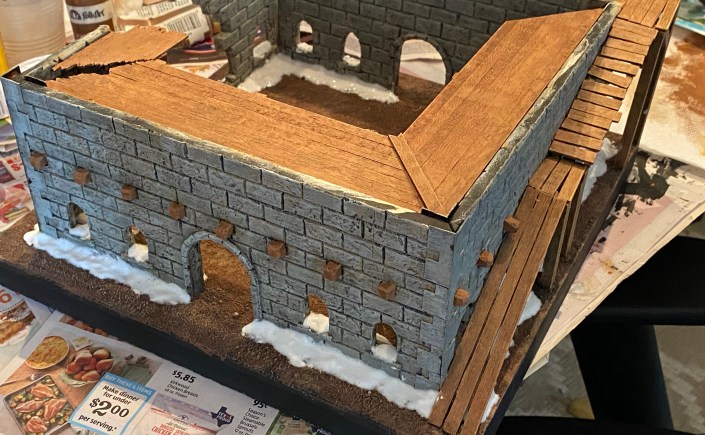
If you’ve looked at my previous posts on Frostgrave, you’ll see that I have two warbands painted and some terrain under construction. Recently, I completed most of the construction work on the first level of the large square central tower I’m building for the Silent Tower scenario (and whatever else it happens to be useful for–I’m not sure whether the new edition of the core book coming out this year will mean a change in scenarios). It struck me that, given the design of the building and the idea that (at the time at least) I had no intention for making the levels separable from one another, I’d ought to paint and finish the base and lower level before adding more to it that would make it even more difficult to paint the lower areas. If I’d been smarter, I’d have done all of the brickwork painting on the inside of the building before attaching parts of the second-level walkway (as you’ll see, I caught myself before finishing that installation and diverted to the painting!). Live and learn, I suppose.

It’s been a long while since I’ve painted terrain, and I had–and have–a lot to learn and relearn. I took a lot of cues from the Black Magic Craft videos for the stonework (though my technique isn’t near as good as his so far), and I even followed his instructions to make my own terrain washes using Liquitex acrylic inks.

I’m giving myself a B+ for the results. It’s not as good as I’d like, but it’s still a terrain piece I’ll be happy to put on my table and play on. I may consider some additional accents, like vines on the walls and perhaps the addition of some torches or lanterns, once I’ve finished the other levels. In future works, I think I’ll be using some lighter tones for the wood, but I used here what I had on hand and I think it turned out just fine for a sort of cedar-look.

I’ve opted for a muddy coloring for the base earth for the terrain, as I wanted some color contrast to the stony grey that will be ubiquitous in the buildings themselves. I’m happy with how this turned out and I’ll be adding some embellishments to other pieces–puddles where the ice and snow has melted and pooled, particularly mushy and gross mud patches, etc.

I admittedly had some issues with the snow–at least to my taste. I was using the Busch snow paste, and the top of the container held a pastier type of snow easier to create ridges and textures with. When working on this piece and delving deeper into the container, I found that the component parts had separated out into the pastier part and a heavy liquid. Like an idiot, my immediate response was to stir everything back together, which gave me a flowy-ier, smoother compound that makes for fluffy banks but wasn’t so much the look I wanted. And, I realize I didn’t think about the effects of the direction of the sun in determining where to put my snow, but meh.

On the other hand, it was driving me crazy trying to figure out how the Busch snow paste is made so that I could replicate my own in larger quantities and for cheaper. The paste had an immediately-identifiable smell to me–spackling paste–but I wasn’t sure about the other parts. After some thought, though, I think I’ve zeroed in on enough of the materials to create something very similar. If I get good results, I’ll post my recipe for your use.

In the meantime, enjoy some pictures of the work so far. Helpful criticism is welcome–I’m always happy to learn better ways to do things!

A Third View of Worldbuilding

The past month has been rather silent on the blog, and for that I apologize. I’ve got a few half-written posts that I’m letting percolate a while and I’ve spent a good deal of that time continuing to expand and refine my fictional setting, Avar Narn.

In undertaking that task, I’ve been thinking a bit about the process and craft of worldbuilding, and I thought I’d share some of my thoughts with you.

I’ve called this post “A Third View of Worldbuilding” to contrast against the two most-commonly-described approaches to building fictional settings: the “top-down approach” and the “bottom-up approach.” As the title suggests, I’m going to offer a third way in this post, one I’ll call the “archaeological” approach. But first, let’s get some definitions of the established approaches.

A Note on Historical Analogues
I think it worthwhile to have a quick sidebar discussion about reliance on examples from the real world in building fictional worlds. There seems to me to be a sense that drawing upon real-world analogues for building nations, cultures, religions, and other aspects of the setting is lazy or uncreative. I’d argue that the use of such analogy is both unavoidable and valuable to worldbuilding when done purposefully and carefully.

Reference to our world is inescapable because humans lack the capacity to create something new ex nihilo. All human creativity is a matter of taking the blocks of what we know and arranging them into new patterns that no one’s thought about before. Lean into it and cut yourself some slack.

I’ve got a quotation at the beginning of my Avar Narn worldbuilding notebook from writer of fiction and roleplaying game content Ari Marmell, and I think it makes the point as concisely as possible. He says, “Originality is great–as a tool for writing good stories and compelling characters, or as a byproduct thereof. It should never be your goal; your goals should be, well, writing a good story and creating compelling characters.”

Some examples that I think prove his point:

The Witcher setting draws very heavily from medieval history and fairy tales to provide the core of its narratives. We don’t read those novels because we’re looking for a completely innovative setting; we read them because Geralt and his companions are interesting characters and the stories they find themselves within are fascinating and entertaining. Those stories benefit from their groundedness in the pseudohistoricity of the setting.

Abercrombie’s First Law setting likewise draws upon historical analogues (though not necessarily to the same extent as The Witcher) to build the setting (and quickly clue the reader into it). Angland has its roots in England (obviously) and in Norse/Germanic cultures. The Gurkish Empire finds its footing in the historical Muslim (and particularly Ottoman, I think) states–though this footing either purposefully draws upon some Western romantic (I hesitate to use that phrase because the Western romanticism of the Near East is rarely positive) or it curves in that direction because of the narrative and setting itself. I don’t want to imply any judgment there, because I don’t think there’s an agenda behind Abercrombie’s choices except to write compelling fiction. Styria has, of course, the feel of Renaissance Italy.

Tolkien drew heavily upon Anglo-Saxon culture for the Rohirrim (it was his academic specialty, after all).

Brandon Sanderson’s feruchemy, allomancy and hemalurgy are so fascinating precisely because they contrast so starkly with Western historical magical ideas (and thus what we typically expect in Western fantasy fiction), while Jim Butcher uses those same ideas (the historical Western ideas about magic) as a starting point to establish depth and interest in his urban fantasy, The Dresden Files.

In roleplaying games and in speculative short fiction, the use of close adherence to historical analogues can quickly establish setting, useful for getting an unfamiliar audience invested quickly. John Wick’s roleplaying games 7th Sea and Legend of the Five Rings are prime examples.

All of this is to say that you should beg, borrow and steal from real-world examples to build your fictional worlds. Just do so thoughtfully and intentionally and you’ll be held in good stead, no matter how much you eventually veer from the “source material.”

The Top-Down Approach
The Top-Down Approach suggests that you start with the general, the big ideas of the setting, and work your way down to the details based upon those big ideas. This approach works well for fiction writers, where the setting ought to be considered in relation to the kinds of stories you want to tell, to the themes and motifs of the works you’re considering, and to the sort of atmosphere you want to establish for your audience.

No approach to worldbuilding is without its disadvantages, however. The Top-Down Approach runs the risk of creating generic settings that feel like the two-dimensional facades of buildings on the main street of some theme park–it’s just so easy to rely entirely on historical analogues to provide all of the details. Without reliance on reference to the real world, it can be hard to know where to begin with the Top-Down Approach and easy to end up with contradictory details as you develop different aspects of the setting and bring them together.

The Bottom-Up Approach
In this approach, you start with a limited part of the setting, developing in detail, before using that beachhead as a jumping-off point for expansion into larger aspects of the world. The Bottom-Up method is great for getting stuck right into a story or game–you start with only what you need to get going and add on only when the scope of your narrative needs to expand. There’s a reason that Dungeons and Dragons encourages GMs to create a small adventure setting first (a town or village “hub” with adventure sites in the surrounds) to begin a game. Sometimes you really only need the 2-d facade because all of the story will take place on the main street.

This is easier with writing rather than gaming, where a reader can’t spontaneously decide to peek behind the curtain. But it’s not a bad thing either, because the ability to improvise new setting details (or to offer your players the opportunity to fill in details) can add new and unexpected dimensions to the setting, which is both meaningful and entertaining.

The biggest danger of Bottom-Up creation, I think, is that you end up with a “kitchen-sink” setting, where everything needs to be pigeonholed into the setting somewhere (I’d argue that this is the case with D&D’s Forgotten Realms setting) so that the world feels more like a theme park than a living, functioning, believable world. As a corollary to that, if you have multiple Bottom-Up aspects developed concurrently before moving to higher-level issues, you end up with a mish-mash of ideas instead of a cohesive setting with central themes and ideas. I don’t mean to say that that’s wrong–our own world has no clear cut definitions of what it means, so there’s realism to be found there as well. But in terms of narrative, having cues about what you’re about (or what your setting’s about, anyway) can be helpful.

A Third Way
Now for my own point: (not the) third way for worldbuilding. We’re going to use archaeology as our analogue here (hence my calling this the “archaeological approach,” of course). When archaeologists are excavating a site, they first set up a marked grid so that the location of each object found can be carefully recorded as they go. A single archaeologist can only work in one cell of the grid at a time, but a useful interpretation of the site only develops as multiple cells are excavated. The interpretation the archaeologist had after excavating area A1 may change dramatically after excavating cell D4, so she may need to go look at A1 again to rework her thoughts. Eventually, a cohesive interpretation of the whole will develop, but only as different cells are examined over time.

The same occurs between different archaeological sites. What is discovered in one place might drastically change the interpretation of an earlier-excavated site. And, good archaeologists leave parts of the site unexcavated and preserved for future scholars, who will arrive to continue the work armed with more sophisticated tools and, hopefully, knowledge about the site and culture being investigated that the earlier archaeologists didn’t have.

Okay, this is essentially nothing new–my point is that the art of worldbuilding shouldn’t be simply top-down or bottom-up; it’s a back and forth, a jumping around–the assembly of a puzzle rather than the construction of a building. “Top-down” and “bottom-up” are merely constructs for discussing the art of worldbuilding anyway; I seriously doubt that most worldbuilders engage solely in one method, or even in a dogmatically rigid sequence of building a setting. I certainly don’t. You have to use what works best for you: your personality, work habits and creative style. I’ll follow this with some concrete tips that have worked for me.

Tips for the “Archaeological Approach”

1. Always be ready to change what you’ve established in light of new “discoveries.”
This is one of the most effective tools for originality in a setting and one of the most rewarding aspects of worldbuilding (at least when done for its own sake). This is very much like discovering new things about your characters or plot when writing a novel. In worldbuilding, as you add details to the history, geography and cultures of your world, you’ll start to have little epiphanies about the consequences of those choices or contradictions between details that develop because of them. If you’re consistently ready to take those developments and go back through what you’ve established, metaphorically ironing out the kinks, the setting will begin to develop in some unexpected ways that add depth, detail, and verisimilitude. I believe I’ve said before in a different post that my favorite thing about Max Brooks’ book World War Z is how, if you can just suspend belief for the zombies, the stories and political events that the novel describes make logical sense based on real-world political realities and history. The more places someone investigating your settings says, “Aha! X happened because of Y and Z,” the more immersive and believable your setting becomes, no matter how fantastic.

2. Put pins in things.
To try to maintain flow in the process of worldbuilding, try to avoid letting yourself get hung up on details that you’re not ready to fill in yet. Some examples, if you’re working through your setting’s history and a new nation crops up, don’t feel like you have to go define that nation’s culture and separate history right away. Put a pin in those subtopics and continue working on the task at hand.

For me, this helps in two ways: First, it helps me to stay efficient, focusing my efforts where I’m ready to make good use of my time instead of following rabbit trails that I’m not mentally prepared for. Second, when I do run into writer’s block in my current task, it gives me ready alternatives to shift to so that I can continue making useful worldbuilding efforts instead of having to put the whole thing down for a while to let it sit.

This works both for details and–especially–for names. If I don’t have ready names in hand when I come to a new character or place in Avar Narn, I tend to change my font to bold (so that I remember I need to come back to the detail) and put a shorthand description of the thing in brackets so that I can keep going with the narrative.

3. Keep lists.
Sometimes, I feel like I’m too tired or distracted to have the mental wherewithal to conduct some serious worldbuilding, but I want to do something useful to keep progress going. I’ll play around with an online name generator, taking the output and modifying it into names I like or that I think would have a place in one of Avar Narn’s languages. I’ll make lists of interesting cultural oddities, quirks or nuances that I might be able to “plug into” a culture as I’m developing it, speeding along the development of granularity of detail. Hell, I’ll make lists of topics I need to develop, so that when I’m feeling creative (or sitting myself down to be creative–damn how I feel about it!), I have options in front of me so that I can select the one that most appeals at the time and get straight to it.

4. Be Able to See the Forest.
Organizing your work is essential in worldbuilding. If you don’t, you’ll lose details altogether or have to rework some of the work you’ve already done to account for them. More important than that, though, is the ability to take a quick high-level approach to see how things are fitting together. How developed is your setting at this moment? Are you working on helpful details or just adding more to the setting that may never come into play? If you’re worldbuilding for worldbuilding’s sake–and I think it is a worthwhile exercise even if you never plan to do anything with your setting–this doesn’t matter so much. But if you’re developing a setting for a roleplaying game or for fiction and you’ve got some extrinsic or intrinsic deadline for kicking off the game or writing, you want to be able to make sure you’re not spending in the weeds–naming that delicious pie shop at the end of the world your characters will never visit.

Overall, I mean to say that you should be able to move into a temporary top-down approach when that suits you.

5. Be able to see the trees.
Modern historians no longer view history as a collection of the exploits and ideologies of the elite–they rightfully recognize that most events have multiple confluences of causes that come together to trigger them in a particular place and time. Looking at the finer details allows you to make larger-scale choices that seem to flow naturally and consequentially from those smaller choices.

In other words, be able to move into a bottom-up approach when useful.

6. Be a sponge.
Samuel Johnson said, “Never trust a man who writes more than he reads.” Fair point.

Soak up all the information you can: about how the world works, about how people work, examples of real-world history and culture, etc., etc., ad nauseam. If you accept as true that human creativity is a matter of rearranging the blocks we already have into new structures, put as many different blocks in your toy box as you can. But, don’t let sponging up knowledge be all that you do. This is an excuse I often use myself; I’ll tell myself I’m sponging up information right now, and when I have enough, I’ll get back to the worldbuilding. There’s never enough, so use what you have even as you’re getting more.

Conclusion
I won’t say that there are “a lot” of worldbuilding books out there, but there are a few. I personally find them useful for providing with checklists of things to think about as I’m building my world, but I’ve never found any of them to be a panacea or ready guide to doing the damn thing.

In my mind, worldbuilding is and should be an organic process, difficult to predict in its details or course, much less in its results. It’s a journey you have to walk, not an engineering plan to rigidly follow. Your experience may differ vastly, of course.

As a final thought, lest you think that I am blind to the downsides of the approach I’ve argued for in comparison to top-down and bottom-up methods: this organic, back-and-forth approach of worldbuilding is time-consuming and risks becoming the object in and of itself. If you’re worldbuilding for the sake of it, that’s not a problem. But if you have purpose(s) in mind for your setting once it’s “ready,” remember that at some point you’ve got to start actually running that RPG or writing that novel.